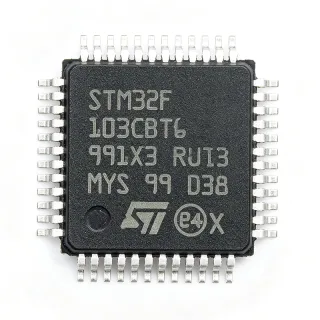
ATMEGA161L-4PC - 8-bit AVR MCU 16KB 4MHz 40-PDIP | Microchip
MPN: ATMEGA161L-4PC ✗ End of Life| Qty | Unit Price | Extended |
|---|---|---|
| 1 | $6.95 | $6.95 |
| 10 | $6.55 | $65.50 |
| 100 | $6.1 | $610.00 |
| 500 | $5.65 | $2,825.00 |
| 1,000 | $5.2 | $5,200.00 |
ATMEGA161L-4PC Overview
A microcontroller is a single-chip embedded computer that integrates a processor core, program memory, data memory, and peripherals on one die. The AVR ATmega family uses a Harvard architecture with a RISC instruction set executing most instructions in a single clock cycle, sitting within the broader hierarchy of embedded processor -> MCU -> 8-bit microcontroller -> AVR ATmega MCU.
Key features include 16KB self-programmable FLASH supporting in-system programming (ISP), 1KB internal SRAM for data buffers, 512 bytes of EEPROM for non-volatile parameter storage, and a wide 2.7V to 5.5V supply range that suits battery-powered designs. The 'L' suffix denotes the low-voltage, lower-speed speed grade rated to 4 MHz, while the 'C' temperature grade targets commercial 0C to +70C environments.
The AVR RISC core pairs 32 general-purpose 8-bit working registers directly with the ALU, so a register-to-register operation completes in one clock cycle rather than two as in many CISC 8-bit MCUs. This gives an effective throughput near 4 MIPS at the 4 MHz maximum clock, reducing the clock frequency needed for a given workload and lowering EMI and power consumption. Hardware peripherals of the ATmega161 include a UART, SPI, two 8-bit timers and one 16-bit timer with PWM, and a 10-bit ADC on port pins.
Typical applications include legacy industrial control boards, through-hole point-of-sale and metering hardware, hobby and educational embedded systems, and service replacement of existing ATmega161-based PCBs where the DIP footprint must be preserved.
Design consideration: because this part is factory-discontinued (obsolete), new designs should adopt the pin-compatible ATmega162 or ATmega16 successors; existing designs can drop in ATMEGA161 speed/voltage variants or successors after verifying EEPROM and register-map differences.
This page synthesizes distributor availability data, drop-in alternatives, lifecycle status, and practical design notes not consolidated in the manufacturer datasheet.
Drop-in alternatives for ATMEGA161L-4PC — same package, pin-to-pin compatible. Different-package parts requiring PCB rework are excluded.
Variants in this series
Same-series models that are drop-in compatible with ATMEGA161L-4PC (same form factor and footprint) — differing in Operating Temperature, RoHS Status, SRAM Size, Mounting Type, Core Architecture.
Quick Comparison Tool — Select alternative parts for side-by-side comparison:
ATMEGA161L-4PI
✅ Drop-In ⚠️ 参数待验证✓ In Stock
$6.35 / Unit
View Datasheet →ATMEGA161-16PC
✅ Drop-In ⚠️ 参数待验证📋 Reference alternative (not in catalog)
ATMEGA161-16PI
✅ Drop-In ⚠️ 参数待验证📋 Reference alternative (not in catalog)
ATMEGA162-16PU
✅ Drop-In✓ In Stock
$3.1 / Unit
View Datasheet →ATMEGA16-16PI
✅ Drop-In ⚠️ 参数待验证✓ In Stock
$3.72 / Unit
View Datasheet →ATMEGA161L-4PC Maximum Ratings & Electrical Characteristics
| Core Processor | AVR RISC |
| Core Size | 8-Bit |
| Max Clock Frequency | 4 MHz |
| Program Memory Type | FLASH |
| Program Memory Size | 16KB (8K x 16) |
| SRAM Size | 1KB |
| EEPROM Size | 512 x 8 |
| Supply Voltage Range | 2.7 V to 5.5 V |
| Package / Case | 40-DIP (0.600", 15.24 mm) |
| Number of Terminals | 40 |
| Mounting Type | Through-Hole |
| Terminal Form | Through-Hole (DIP) |
| Temperature Grade | Commercial (0C to +70C) |
| Product Status | Obsolete |
| RoHS Status | Non-compliant |
| REACH Status | REACH Unaffected |
| Programmability | In-System Programmable (ISP) |
ATMEGA161L-4PC 40-dip (0.600", 15.24 mm) Pin Configuration Guide
Pin configuration for ATMEGA161L-4PC (40-dip (0.600", 15.24 mm) package). This digital IC includes GPIO, communication interfaces (UART, SPI, I2C), and power pins. Refer to the manufacturer datasheet for alternate pin functions and configuration options. Essential for embedded system design and PCB layout.

No detailed pinout data available for ATMEGA161L-4PC.
Refer to the datasheet for full pin configuration.
Typical Applications
ATMEGA161L-4PC is suitable for 6 applications: Legacy Industrial Control Board Service, Battery-Powered Embedded Instruments, Serial Communication Nodes (UART/SPI), Educational and Hobby Embedded Systems, Analog Data Acquisition Front Ends, Obsolete-Part Life-Cycle Management / Last-Time Buy Buffer.
Legacy Industrial Control Board Service
Many industrial control boards designed in the late 1990s and early 2000s were built around the ATmega161 in a 40-PDIP socket precisely because through-hole packaging allowed field replacement. The ATMEGA161L-4PC's 2.7V to 5.5V supply range and 4 MHz throughput match the original design envelope, and its 16KB FLASH with in-system programming lets technicians update firmware in situ via SPI ISP without desoldering. Because the part is obsolete, stocking a service quantity and pairing it with the pin-compatible ATMEGA161L-4PI for extended-temperature installations is a common maintenance strategy. Its 512B EEPROM retains calibration and parameter data across power cycles, which is essential for controller re-commissioning.
Recommended
Battery-Powered Embedded Instruments
The 'L' speed grade of the ATMEGA161L-4PC operates from a 2.7V to 5.5V single supply, allowing direct connection to three AAA cells, a 3.6V lithium thionyl chloride cell, or a single-cell lithium-ion battery without a regulator. AVR RISC efficiency delivers roughly 4 MIPS at 4 MHz, so sensing and display tasks complete quickly before the MCU sleeps. The 1KB SRAM buffers sensor data, while the 512B EEPROM stores logging configuration through power loss. In low-power instrument designs, run the clock at the lowest crystal frequency that meets processing deadlines, since dynamic power in CMOS scales with frequency; the wide voltage floor of this grade extends usable battery discharge depth compared with 4.5V-minimum standard-grade parts.
Recommended
Serial Communication Nodes (UART/SPI)
The ATmega161 includes a hardware UART and SPI interface, making the ATMEGA161L-4PC suitable for legacy fieldbus nodes, RS-485 converter boards, and data concentrators built in 40-PDIP sockets. The UART handles asynchronous serial links to meters or terminals, while SPI services EEPROMs, ADCs, and display drivers at multi-MHz rates. Its 16KB in-system-programmable FLASH accommodates protocol stacks such as Modbus-RTU frames within the 1KB SRAM buffer budget. Engineers maintaining these nodes should note the 4 MHz ceiling constrains baud-rate divisors and interrupt latency; where higher throughput is needed, the pin-compatible ATMEGA162-16PU doubles processing speed and adds a second UART, provided the board supplies 4.5V to 5.5V and firmware is revalidated.
Recommended
Educational and Hobby Embedded Systems
Because the ATmega161L fits a standard 0.600-inch 40-pin DIP socket, it remains popular for breadboard and training-board experiments, where students can insert and remove the chip freely. The AVR RISC core with 32 general-purpose registers executes most instructions in one clock cycle, providing a clean platform for teaching computer architecture alongside practical C or assembly programming. The 4 MHz limit keeps switching noise low and oscilloscope observations readable. Educators replacing exhausted legacy stock can program ATMEGA161L variants through SPI ISP with open-source tools, and should map I/O exercises to port registers as documented in the 159-page ATMEGA161L datasheet to keep coursework compatible between original and substitute silicon.
Recommended
Analog Data Acquisition Front Ends
The ATmega161's on-chip 10-bit ADC and 512B EEPROM suit simple acquisition units that sample potentiometers, temperature sensors, or 0-5V process signals and store calibration constants locally. Running from a 2.7V to 5.5V supply, the ATMEGA161L-4PC can be referenced directly to the battery rail in ratiometric measurements, simplifying the analog front end. The 1KB SRAM holds sample blocks that are then streamed over UART or SPI. For accuracy, decouple AVCC and keep the ADC clock in its recommended range by prescaling the 4 MHz system clock; through-hole DIP construction also aids prototyping of analog reference layouts on veroboard where ADC noise performance can be validated before any PCB commitment.
Recommended
Obsolete-Part Life-Cycle Management / Last-Time Buy Buffer
Procurement teams supporting ATmega161-based products face the reality that the ATMEGA161L-4PC is factory-obsolete with only broker stock remaining. A sound strategy is to (1) perform a lifetime-buy of verified date-code parts sized to the remaining field population, (2) qualify ATMEGA161L-4PI as an immediate drop-in with wider temperature coverage, and (3) design in the pin-compatible ATMEGA162-16PU or ATMEGA16-16PI as the long-term migration path on 5V boards. Since the -4PC is RoHS non-compliant, legacy-use exemptions should be documented for continued repair in regulated markets. Cross-check delivered parts against the 159-page Atmel datasheet ordering-code scheme to reject remarked or counterfeit inventory.
Recommended
Recommended Products Summary
Engineering reference data for ATMEGA161L-4PC — comparison, design guidance, and compliance information.
Selection Guide
Comparison with Alternatives
| Parameter | This Product | ATMEGA161L-4PI | ATMEGA162-16PU | ATMEGA16-16PI |
|---|---|---|---|---|
| Brand | Microchip Technology (Atmel) | Microchip Technology | Microchip Technology | Microchip Technology |
| Package | 40-PDIP (0.600", 15.24 mm) | 40-PDIP - same | 40-PDIP - same | 40-PDIP - same |
| Max Clock Frequency | 4 MHz | 4 MHz | 16 MHz | 16 MHz |
| Supply Voltage | 2.7 V to 5.5 V | 2.7 V to 5.5 V | 4.5 V to 5.5 V | 4.5 V to 5.5 V |
| Program Memory (FLASH) | 16KB | 16KB | 16KB | 16KB |
| SRAM | 1KB | 1KB | 1KB | 1KB |
| Lifecycle Status | Obsolete | Obsolete | Active | Active |
Key Differentiators
- True low-voltage operation down to 2.7V (vs ATMEGA162-16PU)
- Original ATmega161 register map with zero firmware changes (vs ATMEGA16-16PI)
- Through-hole 40-PDIP serviceability (vs ATMEGA161L surface-mount variants)
Design Notes
The ATMEGA161L-4PC accepts 2.7V to 5.5V, but supply tolerance interacts with clock speed: this L-grade is limited to 4 MHz across the full range. Do not substitute standard-grade ATMEGA161-16 parts into a low-voltage board - they are rated 4.5V to 5.5V only. Decouple VCC with 100 nF ceramic at each power pin plus bulk capacitance near the socket; through-hole sockets add inductance that ceramic decoupling directly at the pins must offset.
This part is obsolete and RoHS non-compliant. Source only from distributors or brokers who provide date codes and can verify provenance; remarked or counterfeit ATmega161 devices are common in the obsolete market because the DIP package is easy to relaser. Validate received stock by reading the device signature bytes through SPI ISP programming before committing to a production build.
The 0.600-inch (15.24 mm) DIP footprint is directly shared by ATMEGA161 family variants, the ATMEGA162, and the ATMEGA16, so designing or repairing with a machined-pin 40-pin DIP socket preserves future migration options. If a crystal is used, keep the XTAL1/XTAL2 traces short and place load capacitors close to the pins; for ISP programming, route MOSI/MISO/SCK/RESET to a 6-pin header so field firmware updates do not require chip removal.
Estimated: at the 4 MHz maximum clock, edge rates are slow by modern standards, so EMI is rarely a concern; however, long through-hole stubs on the SPI/ISP bus can still ring when driven externally by fast programmers. Series resistors of 47-100 ohms on MOSI/SCK lines protect the MCU pins and damp reflections when the device is programmed in-circuit from a high-speed host.
Compliance Information
RoHS non-compliant and REACH Unaffected per distributor (Ampheo) product data. Part predates lead-free transition; reserve for legacy repair with applicable exemptions.