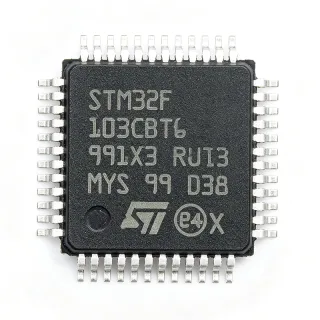
ATMEGA165A-MUR - 8-bit AVR MCU, 16KB Flash, 64-QFN | Microchip
MPN: ATMEGA165A-MUR ✓ Active| Qty | Unit Price | Extended |
|---|---|---|
| 1 | $1.62 | $1.62 |
| 10 | $1.48 | $14.80 |
| 100 | $1.36 | $136.00 |
| 500 | $1.27 | $635.00 |
| 1,000 | $1.19 | $1,190.00 |
ATMEGA165A-MUR Overview
An 8-bit microcontroller is a complete computing system on a single chip that processes data in 8-bit words, integrating a CPU core, program memory (flash), data memory (SRAM and EEPROM), peripherals such as timers, UART, SPI, ADC, and general-purpose I/O. Within the power-management hierarchy of embedded systems, MCUs like the ATmega165A execute control firmware directly, sitting at the heart of the product rather than acting as a support IC.
Key features include the advanced AVR RISC architecture with 133 powerful instructions, most executing in a single clock cycle, plus 32 general-purpose working registers directly connected to the ALU. The 16KB self-programmable flash supports read-while-write, 512B EEPROM retains calibration data through power cycles, and a JTAG interface enables on-chip debugging and boundary scan. The supply range of 1.8V to 5.5V covers both battery and industrial 5V rails.
Architecturally, the AVR core achieves throughputs close to 1 MIPS per MHz, allowing the 16MHz ATMEGA165A to deliver up to 16 MIPS while remaining power efficient. The picoPower-style sleep modes and an integrated 10-bit ADC support low-duty-cycle designs.
Typical applications include industrial control panels, consumer appliances, battery-powered instrumentation, LCD-driven user interfaces, and building automation nodes, where its rich I/O count (54 GPIO on the 64-pin package) and 10-bit ADC suit button matrices, sensor front ends, and display drive.
Design-wise, keep decoupling capacitors close to VCC/AVCC pins and respect the ADC reference layout for analog accuracy.
This page synthesizes distributor pricing, drop-in family alternatives, and practical design notes not found in the manufacturer datasheet, with pricing as of 2026-09-16.
Drop-in alternatives for ATMEGA165A-MUR — same package, pin-to-pin compatible. Different-package parts requiring PCB rework are excluded.
Variants in this series
Same-series models that are drop-in compatible with ATMEGA165A-MUR (same form factor and footprint) — differing in Supply Voltage Range, Operating Temperature, ADC, EEPROM, Instructions.
Quick Comparison Tool — Select alternative parts for side-by-side comparison:
ATMEGA165PA-MUR
✅ Drop-In ⚠️ 参数待验证📋 Reference alternative (not in catalog)
ATMEGA165P-16MUR
✅ Drop-In ⚠️ 参数待验证📋 Reference alternative (not in catalog)
ATMEGA164PA-MUR
✅ Drop-In✓ In Stock
$2.89 / Unit
View Datasheet →ATMEGA325A-MUR
✅ Drop-In ⚠️ 参数待验证📋 Reference alternative (not in catalog)
ATMEGA645A-MUR
✅ Drop-In ⚠️ 参数待验证📋 Reference alternative (not in catalog)
ATMEGA165V-8MUR
✅ Drop-In ⚠️ 参数待验证📋 Reference alternative (not in catalog)
ATMEGA165A-MUR Maximum Ratings & Electrical Characteristics
| Core | AVR 8-bit RISC |
| Core Size | 8-Bit |
| Program Memory (Flash) | 16KB (8K x 16) |
| EEPROM | 512B |
| SRAM | 1KB |
| Maximum Clock Speed | 16MHz |
| Supply Voltage Range | 1.8V to 5.5V |
| General Purpose I/O | 54 |
| Package / Case | 64-QFN (9x9 mm), exposed pad |
| Mounting Type | Surface Mount |
| Operating Temperature | -40C to +85C (Industrial) |
| Debug Interface | JTAG (on-chip debug and boundary scan) |
| Instructions | 133 (most single-cycle) |
| ADC Resolution | 10-bit |
| Series | AVR ATmega |
| RoHS Status | unknown |
ATMEGA165A-MUR 64-qfn (9x9 mm), exposed pad Pin Configuration Guide
Pin configuration for ATMEGA165A-MUR (64-qfn (9x9 mm), exposed pad package). This digital IC includes GPIO, communication interfaces (UART, SPI, I2C), and power pins. Refer to the manufacturer datasheet for alternate pin functions and configuration options. Essential for embedded system design and PCB layout.

No detailed pinout data available for ATMEGA165A-MUR.
Refer to the datasheet for full pin configuration.
Typical Applications
ATMEGA165A-MUR is suitable for 6 applications: Industrial Control Panels, Battery-Powered Portable Instruments, LCD User Interface Modules, Sensor Nodes and IoT Endpoints, Building Automation and HVAC Controllers, Appliance and White-Goods Control.
Industrial Control Panels
The ATMEGA165A-MUR fits industrial control panels because its 54 general-purpose I/O lines handle large button matrices, relay banks, and indicator clusters from a single 16MHz AVR core, while the 1.8V to 5.5V supply range tolerates regulated 5V industrial rails. The 10-bit ADC reads potentiometers, current-shunt signals, and NTC temperature sensors, and the JTAG interface supports on-chip debugging during commissioning. Because the core delivers roughly 1 MIPS per MHz, deterministic scan loops for safety interlocks execute in microseconds. Place the part near the terminal block section with solid ground pours, and use the 512B EEPROM to store calibration and fault-log data that must survive power cycles.
Recommended
Battery-Powered Portable Instruments
The ATMEGA165A-MUR suits battery-powered instruments because it operates from 1.8V to 5.5V, running directly from a 3V lithium cell or two AA batteries without a boost converter. Its 16KB flash accommodates protocol stacks and menus, the 512B EEPROM retains user calibration across battery swaps, and AVR sleep modes cut average current to microamp levels between measurements. The 10-bit ADC digitizes sensor bridges, while UART or SPI links stream results to a host. For the longest battery life, pair it with the pin-compatible ATMEGA165PA-MUR PicoPower variant. Layout the ADC reference path away from switching loads, and place 100nF decoupling at each supply pin to keep measurement noise low.
Recommended
LCD User Interface Modules
Front-panel display modules benefit from the ATMEGA165A-MUR's combination of 54 GPIO and 16MHz performance: driving a 128x64 graphic LCD via SPI or a character LCD in 4-bit mode still leaves dozens of I/O free for keypad scanning, LEDs, and beeper control. The 16KB flash stores fonts, menus, and localization strings, while 1KB SRAM buffers framebuffer tiles. Timer-based PWM provides backlight dimming, and the JTAG port accelerates firmware iteration for OEM customization. Because the AVR executes most instructions in one cycle, responsive key-debounce and display refresh loops are trivial to schedule. Use the 64-QFN exposed pad tied to ground for EMI containment in plastic-housed front panels.
Recommended
Sensor Nodes and IoT Endpoints
In wired or low-power wireless sensor nodes, the ATMEGA165A-MUR provides a 10-bit ADC for analog sensors, hardware SPI for radio modules or SD cards, and UART for gateways, all from a 1.8V to 5.5V rail compatible with energy-harvesting supplies. The 16KB flash is sufficient for mesh-lite firmware, and the 512B EEPROM stores network credentials and calibration tables. Sleep-mode operation between sampling events minimizes average draw, and the industrial -40C to +85C rating suits unconditioned environments. For new ultra-low-power designs, evaluate the pin-compatible ATMEGA165PA-MUR. Keep the crystal short-looped to XTAL pins and isolate the antenna section ground to protect ADC accuracy from RF noise.
Recommended
Building Automation and HVAC Controllers
The ATMEGA165A-MUR serves zone controllers and HVAC boards where numerous digital inputs (thermostats, door switches, flow sensors) and outputs (dampers, relays, triac drivers) must be managed simultaneously; its 54 I/O lines and 16MHz throughput handle the scan and PWM workloads. The 10-bit ADC reads temperature NTC networks on several channels sequentially, and the industrial temperature rating covers rooftop and mechanical-room environments. JTAG boundary scan aids production test of dense 64-QFN assemblies. Use the 512B EEPROM for runtime statistics and setpoint persistence across power outages, and implement a watchdog in firmware for unattended recovery, since these controllers often run for years without human intervention.
Recommended
Appliance and White-Goods Control
Consumer appliances demand low cost, robust I/O, and field serviceability, all met by the ATMEGA165A-MUR: at roughly $1.48 per unit as of 2026-09-16, it delivers a 16MHz AVR, 16KB self-programmable flash enabling bootloader-based firmware updates through an existing UART, and enough GPIO for encoders, touch or membrane keypads, fan and heater drives. The 5.5V supply ceiling supports direct connection to regulated appliance rails, and the industrial temperature range covers kitchen environments. The 64-QFN package keeps the PCB compact inside tight enclosures. Design the RESET line with an RC network and external pulldown strategy for ESD robustness, and verify inrush-heavy loads do not share the ADC ground return.
Recommended
Recommended Products Summary
Engineering reference data for ATMEGA165A-MUR — comparison, design guidance, and compliance information.
Selection Guide
Comparison with Alternatives
| Parameter | This Product | ATMEGA165PA-MUR | ATMEGA165P-16MUR | ATMEGA325A-MUR | ATMEGA645A-MUR |
|---|---|---|---|---|---|
| Package | 64-QFN (9x9 mm) | 64-QFN (9x9) - same footprint | 64-QFN (9x9) - same footprint | 64-QFN (9x9) - same footprint | 64-QFN (9x9) - same footprint |
| Brand | Microchip Technology | Microchip Technology | Microchip Technology | Microchip Technology | Microchip Technology |
| Flash Memory | 16KB | 16KB | 16KB | 32KB | 64KB |
| SRAM | 1KB | 1KB | 1KB | 2KB | 4KB |
| EEPROM | 512B | 512B | 512B | 1KB | 2KB |
| Maximum Clock Speed | 16MHz | 16MHz (20MHz per Mouser grade) | 16MHz | 16MHz | 16MHz |
| General Purpose I/O | 54 | 54 | 54 | 54 | 54 |
| Power Optimization | Standard ATmega A revision | PicoPower (lowest current) | P revision (reduced current) | Standard | Standard |
Key Differentiators
- Balanced memory at lowest tier cost (vs ATMEGA325A-MUR)
- Lowest power within the family (vs ATMEGA165A-AU)
- No-lead compact assembly (vs ATMEGA165A-AU)
Design Notes
The 64-QFN (9x9) package has an exposed pad on the underside that must be connected to a grounded copper pour through an array of vias; this pad is a primary mechanical and thermal path and is often tied to GND. Use the standard QFN land-pattern rules: solder mask defined pads slightly larger than the package terminals, and a stencil aperture split (about 50-70% coverage on the center pad) to prevent solder voids and floating during reflow. Verify the exact footprint against the latest Microchip package drawing before release.
Decouple every VCC and AVCC pin pair with 100nF ceramics placed within a few millimeters of the pins, plus one bulk 4.7uF to 10uF capacitor near the supply entry. AVCC should be filtered (ferrite bead plus capacitor) when the 10-bit ADC is used, and AREF needs its own decoupling; never drive AREF when the internal reference is selected. Because supply range is 1.8V to 5.5V, check the AVR speed-versus-voltage derating curve when running 16MHz below the full-voltage region to avoid marginal operation.
The RESET pin doubles as a programming pin; ensure your RESET pull-up (typically 10k) and any capacitor sizing still allow in-system programming via ISP and JTAG access for debug - do not permanently disable RESET in production firmware until the programming plan is fixed. When migrating to the pin-compatible ATMEGA165PA-MUR, recheck current-consumption budgets (it improves them) and confirm fuse settings, since PicoPower revisions can change default sleep-mode behavior versus the older A die.
Compliance Information
Compliance data was not explicitly present in the crawled distributor snippets. Microchip's standard AVR ATmega products are generally RoHS/lead-free produced, but obtain the official certificate of compliance from the Microchip product page before regulated-market shipping.