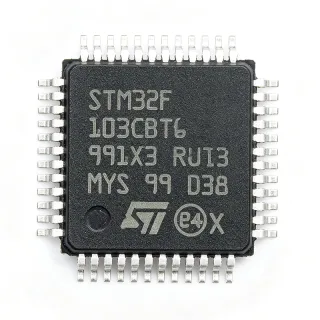
ATMEGA168-15MT - AVR 8-Bit MCU 16MHz 16KB QFN-32 | Microchip
MPN: ATMEGA168-15MT ✓ Active| Qty | Unit Price | Extended |
|---|---|---|
| 1 | $1.55 | $1.55 |
| 10 | $1.42 | $14.20 |
| 100 | $1.28 | $128.00 |
| 500 | $1.15 | $575.00 |
| 1,000 | $1.02 | $1,020.00 |
ATMEGA168-15MT Overview
An 8-bit microcontroller is a single-chip computer that integrates a processor core, program memory, data memory and peripherals such as timers, UART, SPI and I2C on one die. The AVR family uses an enhanced RISC architecture that executes most instructions in a single clock cycle, achieving throughput near 1 MIPS per MHz, which lets designers optimize power consumption versus processing speed. Microcontrollers sit at the top of the embedded hierarchy above logic ICs and below application processors.
Key features include the 16 KB self-programmable FLASH supporting ISP and IAP, 23 programmable I/O lines, two 8-bit timers, one 16-bit timer, a 10-bit ADC with up to 8 channels (ADC6/ADC7 available in QFN), USI-free full duplex USART, SPI and TWI (I2C) serial interfaces, and six sleep modes down to power-save levels for battery designs. The 5x5 mm QFN with exposed pad provides low inductance and good thermal performance for compact boards.
Technically, the ATmega168 core combines 32 general-purpose registers directly connected to the ALU, allowing two independent registers to be accessed in one instruction. On-chip debug is supported via debugWIRE with single-wire interface using the reset line, programmed through ICSP with tools such as MPLAB SNAP.
Typical applications include automotive body and comfort modules (leveraging the AEC-Q100 qualification), industrial sensor nodes, consumer appliance control, and hobby/Arduino-compatible designs where the ATmega328 pinout heritage applies.
Design consideration: at 16 MHz the 5 V supply range applies (4.5 V to 5.5 V class, -15 speed grade); if operating at 3.3 V, verify maximum safe clock frequency in the datasheet frequency-versus-voltage curve.
This page synthesizes distributor pricing, drop-in alternatives, pinout data, and practical design notes not found in a single manufacturer datasheet, with pricing as of 2026-09-16.
Drop-in alternatives for ATMEGA168-15MT — same package, pin-to-pin compatible. Different-package parts requiring PCB rework are excluded.
Variants in this series
Same-series models that are drop-in compatible with ATMEGA168-15MT (same form factor and footprint) — differing in Communication Interfaces, Package, Timers, RoHS Status, Supply Voltage Range.
Quick Comparison Tool — Select alternative parts for side-by-side comparison:
ATMEGA168-15MD
✅ Drop-In✓ In Stock
$1.29 / Unit
View Datasheet →ATMEGA168PA-MU
✅ Drop-In ⚠️ 参数待验证✓ In Stock
$1.72 / Unit
View Datasheet →ATMEGA328P-MU
✅ Drop-In📋 Reference alternative (not in catalog)
ATMEGA88PA-MU
✅ Drop-In ⚠️ 参数待验证📋 Reference alternative (not in catalog)
ATMEGA48PA-MU
✅ Drop-In📋 Reference alternative (not in catalog)
ATMEGA168-15MT Maximum Ratings & Electrical Characteristics
| Core | AVR 8-bit RISC |
| Maximum Clock Frequency | 16 MHz |
| Flash Memory | 16 KB (8K x 16) |
| SRAM | 1 KB |
| EEPROM | 512 B |
| Supply Voltage | 4.5 V to 5.5 V (-15 speed grade) |
| I/O Count | 23 I/O |
| ADC Resolution | 10-bit |
| ADC Channels | 8 (6 external + ADC6/ADC7 on QFN) |
| Timers | 2 x 8-bit, 1 x 16-bit |
| Communication Interfaces | USART, SPI, TWI (I2C) |
| Package | 32-VFQFN Exposed Pad (5x5 mm) |
| Mounting Type | Surface Mount |
| Qualification | AEC-Q100 (automotive) |
| Programming / Debug | ICSP, debugWIRE |
| Sleep Modes | 6 modes including Power-down and Power-save |
| Instruction Throughput | Up to 16 MIPS at 16 MHz (approx. 1 MIPS/MHz) |
| RoHS Status | Compliant |
ATMEGA168-15MT Pin Configuration
| Pin 1 | PD3 — Port D bit 3 / PCINT19 / OC2B / INT1 |
| Pin 2 | PD4 — Port D bit 4 / PCINT20 / XCK / T0 |
| Pin 3 | GND — Ground |
| Pin 4 | VCC — Digital supply voltage |
| Pin 5 | GND — Ground |
| Pin 6 | VCC — Digital supply voltage |
| Pin 7 | PB6 — Port B bit 6 / PCINT6 / XTAL1 / TOSC1 |
| Pin 8 | PB7 — Port B bit 7 / PCINT7 / XTAL2 / TOSC2 |
| Pin 9 | PD5 — Port D bit 5 / PCINT21 / T1 / OC0B |
| Pin 10 | PD6 — Port D bit 6 / PCINT22 / AIN0 / OC0A |
| Pin 11 | PD7 — Port D bit 7 / PCINT23 / AIN1 |
| Pin 12 | PB0 — Port B bit 0 / PCINT0 / XCK / T0 / CLKO |
| Pin 13 | PB1 — Port B bit 1 / PCINT1 / OC1A |
| Pin 14 | PB2 — Port B bit 2 / PCINT2 / SS / OC1B |
| Pin 15 | PB3 — Port B bit 3 / PCINT3 / MOSI / OC2A |
| Pin 16 | PB4 — Port B bit 4 / PCINT4 / MISO |
| Pin 17 | PB5 — Port B bit 5 / PCINT5 / SCK |
| Pin 18 | AVCC — ADC supply voltage |
| Pin 19 | ADC6 — ADC input channel 6 (QFN package only) |
| Pin 20 | AREF — ADC analog reference |
| Pin 21 | GND — Ground |
| Pin 22 | ADC7 — ADC input channel 7 (QFN package only) |
| Pin 23 | PC0 — Port C bit 0 / PCINT8 / ADC0 |
| Pin 24 | PC1 — Port C bit 1 / PCINT9 / ADC1 |
| Pin 25 | PC2 — Port C bit 2 / PCINT10 / ADC2 |
| Pin 26 | PC3 — Port C bit 3 / PCINT11 / ADC3 |
| Pin 27 | PC4 — Port C bit 4 / PCINT12 / ADC4 / SDA |
| Pin 28 | PC5 — Port C bit 5 / PCINT13 / ADC5 / SCL |
| Pin 29 | PC6 — Port C bit 6 / PCINT14 / RESET |
| Pin 30 | PD0 — Port D bit 0 / PCINT16 / RXD |
| Pin 31 | PD1 — Port D bit 1 / PCINT17 / TXD |
| Pin 32 | PD2 — Port D bit 2 / PCINT18 / INT0 |
Typical Applications
ATMEGA168-15MT is suitable for 6 applications: Automotive Body Electronics, Industrial Sensor Nodes, Arduino-Compatible Prototyping, Consumer Appliance Control, Battery-Operated Handheld Instruments, Motor Control (Small DC / Stepper).
Automotive Body Electronics
The ATMEGA168-15MT carries AEC-Q100 qualification, making it suitable for automotive body and comfort modules such as window lifters, seat control, lighting drivers and sensor interfaces operating in harsh cabin environments. Its 16 MHz AVR core delivers roughly 16 MIPS for real-time control loops, while the 16 KB FLASH holds protocol handling and diagnostics code. The 10-bit ADC with up to 8 channels samples potentiometers and NTC sensors, and the USART/SPI/TWI interfaces link to LIN transceivers or gateways. The 5 V supply range (4.5 V to 5.5 V) matches automotive regulated rails after a 5 V LDO. Designers should implement watchdog supervision and verify load-dump transients on the upstream supply.
Recommended
Industrial Sensor Nodes
In industrial monitoring, the ATMEGA168-15MT reads analog sensors through its 10-bit ADC (8 channels in the QFN package) and transmits data over the TWI (I2C) or SPI bus to network controllers, or over USART to RS-485 converters. The single-cycle RISC core at 16 MHz handles filtering and thresholding in deterministic time, important for alarm responsiveness. Six sleep modes allow duty-cycled operation in powered installations where average current matters. The 16 KB FLASH accommodates Modbus-style register handling and calibration tables in EEPROM (512 B). Its AEC-Q100 build also gives industrial users extended reliability margin versus consumer-grade MCUs at similar cost.
Recommended
Arduino-Compatible Prototyping
The ATmega168 family is historically the heart of Arduino-class boards, and the ATMEGA168-15MT in 32-VFQFN serves compact, cost-optimized derivatives of those designs. The AVR core runs existing ATmega168 toolchains: AVRs are supported by avr-gcc, MiniCore and Arduino bootloaders, and ICSP programming works with MPLAB SNAP or USBasp. The 23 I/O lines map directly to standard shield pinouts, and the QFN bonus channels ADC6/ADC7 give two extra analog inputs not present on DIP variants. Developers should size their sketch against the 16 KB FLASH limit and move to pin-compatible ATMEGA328P-MU if the application outgrows it, with no PCB change.
Recommended
Consumer Appliance Control
Washer, cooker and HVAC control boards use the ATMEGA168-15MT to sequence relays and triacs, read user interfaces, and monitor temperatures. The two 8-bit timers generate PWM for heater or fan control while the 16-bit timer measures zero-crossing or encoder feedback. The 5 V class supply integrates with existing linear or buck-derived appliance rails, and the exposed-pad QFN dissipates switching-adjacent heat efficiently on 2-layer boards. The 512 B EEPROM stores wash-cycle profiles and fault logs across power cycles. Cost per function is competitive at distributor pricing near $1.55 (as of 2026-09-16), which matters in high-volume appliance BOMs.
Recommended
Battery-Operated Handheld Instruments
Handheld meters and testers benefit from the ATMEGA168-15MT's six sleep modes: power-down mode drops core current to microamp levels while retaining register and SRAM contents, and the asynchronous timer can wake the device periodically. The 10-bit ADC digitizes measurement front-ends, and the USART streams results to Bluetooth or USB-serial bridges. The 5 V operation supports direct 4xAAA or single-cell Li-ion via small LDO topologies. Designers should schedule ADC and reference startup times into the duty cycle and disable the digital input buffers on unused analog pins per the datasheet to minimize leakage. The AEC-Q100 build adds ruggedness for field instruments.
Recommended
Motor Control (Small DC / Stepper)
The ATMEGA168-15MT generates PWM on multiple channels (OC0A/OC0B/OC1A/OC1B/OC2A/OC2B outputs) to drive H-bridges for small DC motors and steppers in printers, robotics and valve actuators. The 16-bit Timer1 provides high-resolution PWM or input capture for tachometer feedback, and external interrupts on any pin support quadrature decoding. Running at 16 MHz gives 62.5 ns PWM edge resolution, sufficient for quiet 20 kHz fan drive. The 23 I/O lines allow direct keypad and limit-switch interfacing. Use the exposed pad ground connection to keep driver return currents away from the ADC ground, preventing offset errors in current-sense measurements.
Recommended
Recommended Products Summary
Engineering reference data for ATMEGA168-15MT — comparison, design guidance, and compliance information.
Selection Guide
Comparison with Alternatives
| Parameter | This Product | ATMEGA168-15MD | ATMEGA168PA-MU | ATMEGA328P-MU | ATMEGA88PA-MU | ATMEGA48PA-MU |
|---|---|---|---|---|---|---|
| Package | 32-VFQFN (5x5) Exposed Pad | 32-VFQFN (5x5) Exposed Pad - same | 32-VFQFN (5x5) Exposed Pad - same | 32-VFQFN (5x5) Exposed Pad - same | 32-VFQFN (5x5) Exposed Pad - same | 32-VFQFN (5x5) Exposed Pad - same |
| Brand | Microchip Technology | Microchip Technology | Microchip Technology | Microchip Technology | Microchip Technology | Microchip Technology |
| Flash Memory | 16 KB | 16 KB | 16 KB | 32 KB | 8 KB | 4 KB |
| SRAM | 1 KB | 1 KB | 1 KB | 2 KB | 1 KB | 512 B |
| Max Clock Frequency | 16 MHz | 16 MHz | 20 MHz | 20 MHz | 20 MHz | 20 MHz |
| Low-Power Technology | Standard ATmega168 | Standard (same die) | picoPower | picoPower | picoPower | picoPower |
Key Differentiators
- AEC-Q100 automotive qualification (vs ATMEGA168PA-MU)
- More memory headroom at same footprint (vs ATMEGA88PA-MU)
- Lower unit cost for smaller firmware (vs ATMEGA328P-MU)
- Trade-off: 16 MHz speed cap vs 20 MHz PA parts (vs ATMEGA48PA-MU)
Design Notes
The 32-VFQFN exposed pad should be soldered to a ground pad with a 3x3 or 4x4 via array to the ground plane. This reduces ground inductance for the fast AVR edges and improves heat dissipation. Use a stencil with reduced paste coverage (50-70%) under the package to avoid solder bridging at the 0.5 mm pitch, and confirm your assembly house has QFN reflow experience.
Decouple each VCC pin (pins 4 and 6) and AVCC (pin 18) with 100 nF ceramic capacitors placed within 2 mm of the pins, plus one bulk 4.7-10 uF capacitor. Tie AVCC to VCC through a low-pass LC or RC network if ADC noise performance matters; AVCC must never differ from VCC by more than 0.3 V per the family datasheet.
PC6 is RESET by default and debugWIRE disables external reset when enabled - to re-enable ISP programming after using debugWIRE, cycle power with the debugger attached. Fuse misconfiguration (wrong clock source selection) is the most common cause of a 'bricked' device; keep an external clock option available during development.
When using an external 16 MHz crystal on PB6/PB7, place it within 5 mm of the pins with ground guard traces, and select appropriate load capacitors (typically 18-22 pF for common crystals) per the crystal manufacturer's CL specification to avoid startup failure at low temperature.
Compliance Information
RoHS compliance and AEC-Q100 automotive qualification per distributor listings (Hotenda, DigiKey). REACH and conflict minerals status not stated in provided data.