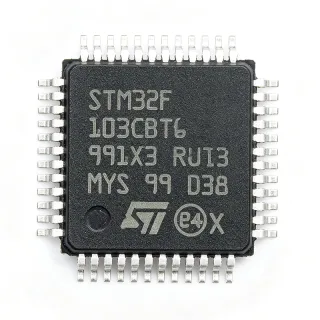
ATMEGA168V-10AI - AVR 8-bit MCU 16KB Flash 1.8V 10MHz TQFP-32 | Microchip
MPN: ATMEGA168V-10AI ✓ Active| Qty | Unit Price | Extended |
|---|---|---|
| 1 | $4.14 | $4.14 |
| 10 | $3.72 | $37.20 |
| 100 | $3.3 | $330.00 |
| 500 | $2.95 | $1,475.00 |
| 1,000 | $2.65 | $2,650.00 |
ATMEGA168V-10AI Overview
An 8-bit microcontroller (MCU) is a single-chip computer that integrates a processor core, program memory, data memory, and peripherals such as timers, USART, and ADC on one die. Within the power-management hierarchy of embedded systems, the MCU is the system controller: it reads sensors, executes application firmware, and drives actuators. The ATmega168V belongs to the ATmega48/88/168 family of AVR enhanced RISC devices from Microchip Technology (formerly Atmel).
Key features include 131 mostly single-cycle RISC instructions delivering up to 1 MIPS per MHz throughput (10 MIPS at 10 MHz), 8-channel 10-bit ADC, three flexible timer/counters, byte-oriented Two-Wire Interface (I2C-compatible), SPI, and a serial programmable USART. The V-variant is qualified for a 1.8 V minimum supply, enabling single-cell battery and energy-harvesting designs that standard 2.7 V parts cannot support.
Technically, the device uses an advanced Harvard RISC architecture with 32 general-purpose working registers directly connected to the ALU, allowing two independent register accesses in one instruction cycle. In-system self-programming Flash with read-while-write support permits field firmware updates, and debugWIRE provides on-chip debug over a single wire with no dedicated debug pins.
Typical applications include battery-powered sensor nodes, portable instrumentation, industrial control nodes, and consumer appliances, where the 1.8 V operation, low active current, and rich analog peripheral set reduce overall bill-of-materials cost.
A key design consideration: clock selection must match supply voltage - at 1.8 V the maximum safe frequency is 10 MHz, and the CKDIV8 fuse should be used when starting from higher-speed crystals at low supply rails.
This page synthesizes distributor pricing, verified drop-in alternatives, pinout data, and practical design notes not consolidated in the manufacturer datasheet, as of 2026-09-16.
Drop-in alternatives for ATMEGA168V-10AI — same package, pin-to-pin compatible. Different-package parts requiring PCB rework are excluded.
Variants in this series
Same-series models that are drop-in compatible with ATMEGA168V-10AI (same form factor and footprint) — differing in Working Registers, Communication Interfaces, Packaging, Maximum Clock Frequency, Core Architecture.
Quick Comparison Tool — Select alternative parts for side-by-side comparison:
ATMEGA168PV-10AUR
✅ Drop-In✓ In Stock
$1.19 / Unit
View Datasheet →ATMEGA168PB-AUR
✅ Drop-In✓ In Stock
$1.58 / Unit
View Datasheet →ATMEGA328P-AUR
✅ Drop-In ⚠️ 参数待验证📋 Reference alternative (not in catalog)
ATMEGA88PA-AUR
✅ Drop-In ⚠️ 参数待验证📋 Reference alternative (not in catalog)
ATMEGA48PA-AUR
✅ Drop-In ⚠️ 参数待验证📋 Reference alternative (not in catalog)
ATMEGA168V-10AI Maximum Ratings & Electrical Characteristics
| Core Architecture | AVR 8-bit RISC |
| Flash Program Memory | 16 KB |
| SRAM | 1 KB |
| EEPROM | 512 B |
| Maximum Clock Frequency | 10 MHz |
| Supply Voltage Range | 1.8 V to 5.5 V |
| Throughput | Up to 10 MIPS (1 MIPS per MHz) |
| Instructions | 131 instructions, most single-cycle |
| GPIO Count | 23 general purpose I/O lines |
| ADC | 8-channel 10-bit |
| Timers/Counters | 3 (two 8-bit, one 16-bit) |
| Communication Interfaces | USART, SPI, Two-Wire Interface (I2C) |
| Debug System | debugWIRE on-chip debug |
| Operating Temperature | -40C to +85C (industrial) |
| Package | TQFP-32 (7x7 mm), gull-wing leads |
| Mounting Type | Surface Mount |
| Working Registers | 32 x 8-bit general purpose |
ATMEGA168V-10AI Pin Configuration
| Pin 1 | PD3 — Port D, bit 3 (GPIO / external interrupt INT1) |
| Pin 2 | PD4 — Port D, bit 4 (GPIO / XCK timer counter external clock) |
| Pin 3 | GND — Ground |
| Pin 4 | VCC — Digital supply voltage (1.8 V to 5.5 V) |
| Pin 5 | GND — Ground |
| Pin 6 | VCC — Digital supply voltage |
| Pin 7 | PB6 — Port B, bit 6 / XTAL1 (inverting oscillator input) / TOSC1 |
| Pin 8 | PB7 — Port B, bit 7 / XTAL2 (oscillator output) / TOSC2 |
| Pin 9 | PD5 — Port D, bit 5 (GPIO / T1 external counter input) |
| Pin 10 | PD6 — Port D, bit 6 (GPIO / AIN0 analog comparator input) |
| Pin 11 | PD7 — Port D, bit 7 (GPIO / AIN1 analog comparator input) |
| Pin 12 | PB0 — Port B, bit 0 (GPIO / XCK0 / T0) |
| Pin 13 | PB1 — Port B, bit 1 (GPIO / T1 / OC1A PWM output) |
| Pin 14 | PB2 — Port B, bit 2 (GPIO / SS / OC1B PWM output) |
| Pin 15 | PB3 — Port B, bit 3 (MOSI SPI / OC2A PWM output) |
| Pin 16 | PB4 — Port B, bit 4 (MISO SPI data input) |
| Pin 17 | PB5 — Port B, bit 5 (SCK SPI clock) |
| Pin 18 | AVCC — Analog supply voltage for ADC |
| Pin 19 | ADC6 — Dedicated ADC input channel 6 |
| Pin 20 | AREF — Analog reference voltage for ADC |
| Pin 21 | GND — Ground |
| Pin 22 | ADC7 — Dedicated ADC input channel 7 |
| Pin 23 | PC0 — Port C, bit 0 (GPIO / ADC0 input) |
| Pin 24 | PC1 — Port C, bit 1 (GPIO / ADC1 input) |
| Pin 25 | PC2 — Port C, bit 2 (GPIO / ADC2 input) |
| Pin 26 | PC3 — Port C, bit 3 (GPIO / ADC3 input) |
| Pin 27 | PC4 — Port C, bit 4 (GPIO / ADC4 / SDA Two-Wire data) |
| Pin 28 | PC5 — Port C, bit 5 (GPIO / ADC5 / SCL Two-Wire clock) |
| Pin 29 | PC6 — RESET (active-low reset input, PC6 when used as GPIO is disabled by fuse) |
| Pin 30 | PD0 — Port D, bit 0 (GPIO / USART RXD) |
| Pin 31 | PD1 — Port D, bit 1 (GPIO / USART TXD) |
| Pin 32 | PD2 — Port D, bit 2 (GPIO / external interrupt INT0) |
Typical Applications
ATMEGA168V-10AI is suitable for 6 applications: Battery-Powered Sensor Nodes, Industrial Control Nodes, Portable Instrumentation, Consumer Appliance Control, RF and Wireless Modules, Educational and Prototyping Platforms.
Battery-Powered Sensor Nodes
The ATMEGA168V-10AI's 1.8 V minimum supply lets it run directly from two alkaline cells or a single LiFePO4 cell without a boost converter, while the 8-channel 10-bit ADC digitizes sensor outputs with no external converter. Its AVR core reaches 1 MIPS per MHz, so firmware can clock down to a few MHz for energy savings yet retain adequate processing headroom. Placed in a periodic wake-measure-transmit topology with the power-save sleep mode, the MCU sleeps between conversions and samples; trade-off is that sleep current on this standard die is higher than the picoPower ATMEGA168PV, so duty cycling strategy matters for multi-year battery life.
Recommended
Industrial Control Nodes
With an industrial temperature rating of -40C to +85C and a watchdog timer with separate on-chip oscillator, the ATMEGA168V-10AI fits factory automation sensor nodes, relay drivers, and motor start/stop controllers. The 10 MHz/10 MIPS throughput handles PID loops at kilohertz rates, and three timers provide PWM outputs for actuator drive. The Two-Wire Interface and USART link the node to PLC backbones or RS-485 transceivers; operation down to 1.8 V also tolerates brownout conditions on unregulated industrial rails when paired with a supervisor. The TQFP-32 gull-wing package withstands thermal cycling typical of panel-mounted electronics.
Recommended
Portable Instrumentation
Handheld meters and loggers benefit from the 1.8 V to 5.5 V supply flexibility: the same PCB runs from a Li-ion pack (3.0-4.2 V) or two-cell AAA stack. The 8-channel 10-bit ADC with internal 1.1 V reference digitizes user controls, thermistors, and battery voltage, while the 512 B EEPROM stores calibration constants that survive battery replacement. Throughput of up to 10 MIPS supports on-device averaging and display refresh. debugWIRE allows firmware iteration on populated boards over the RESET line only, preserving all application pins for signal I/O in the cramped 32-pin layout.
Recommended
Consumer Appliance Control
Small appliances, fan controllers, and thermostat interfaces use the ATMEGA168V-10AI for its cost balance of memory and peripherals: 16 KB Flash holds a full state machine plus EEPROM-backed user settings, while hardware PWM from the 16-bit Timer1 drives motor or heater control with jitter-free duty cycles. The 5 V-tolerant supply range lets it run directly from transformer-derived unregulated supplies, and the internal RC oscillator removes the crystal BOM cost where timing accuracy of 1-2 percent is acceptable. EFT immunity and brownout detection improve reliability in mains-adjacent environments with switch-mode loads.
Recommended
RF and Wireless Modules
The ATMEGA168V-10AI commonly fronts sub-GHz and 2.4 GHz transceivers via SPI, handling packet framing, retries, and protocol state machines while the radio handles the air interface. At 10 MHz it sustains typical low-rate telemetry stacks, and the USART bridges to legacy modems. Its 1.8 V capability matches modern transceiver I/O rails, avoiding level shifters. Design note: keep the SPI clock below fosc/4 and isolate the RF section ground; the internal RC oscillator suffices for protocol timing but external crystals improve USART baud accuracy for reliable links at the minimum supply voltage.
Recommended
Educational and Prototyping Platforms
As the MCU class used in the Arduino lineage (ATmega168/328 family), the ATMEGA168V-10AI remains popular in teaching labs and prototypes. The AVR supports self-programming via an onboard bootloader, so USB-serial programmers can reflash in the field; 16 KB Flash accommodates Arduino-class sketches. The 1.8 V rating lets students explore low-voltage and power-management concepts unavailable on fixed-5V parts. debugWIRE plus the ISP header give two distinct programming/debug paths on the same board. Toolchain support (AVR-GCC, Microchip Studio, avrdude) is mature and free, reducing adoption cost for education.
Recommended
Recommended Products Summary
Engineering reference data for ATMEGA168V-10AI — comparison, design guidance, and compliance information.
Selection Guide
Comparison with Alternatives
| Parameter | This Product | ATMEGA168PV-10AUR | ATMEGA168PB-AUR | ATMEGA328P-AUR | ATMEGA88PA-AUR | ATMEGA48PA-AUR |
|---|---|---|---|---|---|---|
| Package | TQFP-32 | TQFP-32 - same | TQFP-32 - same | TQFP-32 - same | TQFP-32 - same | TQFP-32 - same |
| Brand | Microchip Technology (Atmel) | Microchip Technology | Microchip Technology | Microchip Technology | Microchip Technology | Microchip Technology |
| Flash Memory | 16 KB | 16 KB | 16 KB | 32 KB | 8 KB | 4 KB |
| SRAM | 1 KB | 1 KB | 2 KB | 2 KB | 1 KB | 256 B |
| EEPROM | 512 B | 512 B | 512 B | 1 KB | 512 B | 256 B |
| Supply Voltage | 1.8 V to 5.5 V | 1.8 V to 5.5 V | 1.8 V to 5.5 V | 1.8 V to 5.5 V | 1.8 V to 5.5 V | 1.8 V to 5.5 V |
| Max Clock Frequency | 10 MHz | 10 MHz | 20 MHz | 20 MHz | 20 MHz | 20 MHz |
| Timers | 3 | 3 | 5 | 3 | 3 | 3 |
| Power Technology | Standard (pre-picoPower) | picoPower | picoPower | picoPower | picoPower | picoPower |
| Temperature Range | -40C to +85C (industrial) | -40C to +85C | -40C to +85C | -40C to +85C | -40C to +85C | -40C to +85C |
Key Differentiators
- Guaranteed 1.8 V operation at 10 MHz (vs ATMEGA168-20AI)
- Register-for-register identical picoPower upgrade exists (vs ATMEGA168PV-10AUR)
- Lower cost than 32 KB pin-compatible alternative (vs ATMEGA328P-AUR)
Design Notes
Validate the safe operating point between supply voltage and clock frequency: the ATMEGA168V-10AI is qualified at 10 MHz only within its full 1.8 V to 5.5 V range, but oscillators chosen near the maximum must be rechecked against the frequency-vs-VCC curve in the Microchip datasheet when the rail dips below 2.7 V. Add a 100 nF ceramic decoupling capacitor at both VCC pins (pins 4 and 6) and at AVCC (pin 18), each placed within a few millimeters of the pin with a solid ground return to pin 3, 5 or 21. Estimated: a 10 mA active core at 3.3 V draws roughly 33 mW, well within package limits.
AVCC must be connected to VCC even if the ADC is unused, per the datasheet; never leave it floating. Route AREF with a dedicated 100 nF capacitor to ground and keep the analog ground return separate until it meets the digital ground at a single star point. If ADC6/ADC7 are used as dedicated analog inputs, keep their traces short and away from the crystal (PB6/PB7) nets to prevent crosstalk into conversions. TQFP-32 land pattern should follow the manufacturer package drawing dimensions rather than generic footprints to avoid solder bridging on the 0.8 mm pitch.
The most common ATmega168 integration errors: (1) leaving RESET (pin 29) unconnected - it must be pulled high via 10k resistor or wired to an ISP/debugWIRE programmer; disabling the JTAG-style reset via fuse locks out ISP recovery, so keep external access. (2) Selecting a 16 MHz crystal - the V speed grade tops out at 10 MHz. (3) Ignoring the CKDIV8 factory fuse, which starts the internal 8 MHz RC at 1 MHz - many first-boot firmware failures stem from this. (4) Replacing with ATMEGA168PB without reviewing the PB migration note, since Timer register addresses differ slightly.
When driving relays or solenoids from Timer1 PWM outputs, add series resistors (estimated 100-330 ohm, chosen from driver input capacitance) and local ground fills to keep switching noise out of the ADC front-end. The internal RC oscillator spreads harmonics more than a crystal, which can actually ease conducted-emissions compliance in cost-sensitive appliance designs. Keep the USART routing away from motor driver edges, or use differential RS-485 for runs longer than a few centimeters.
Compliance Information
Industrial-grade 'AI' suffix TQFP-32 part. RoHS and lead-free status per Microchip product page; REACH and halogen-free status not stated in provided data - verify with Microchip compliance documentation.