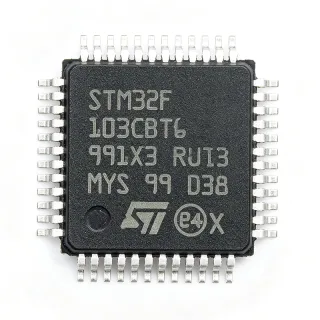
ATMEGA324PA-AUR - 8-Bit AVR MCU 32KB Flash 20MHz | Microchip
MPN: ATMEGA324PA-AUR ✓ Active| Qty | Unit Price | Extended |
|---|---|---|
| 1 | $3.42 | $3.42 |
| 10 | $3.08 | $30.80 |
| 100 | $2.74 | $274.00 |
| 500 | $2.46 | $1,230.00 |
| 1,000 | $2.19 | $2,190.00 |
| 3,000 | $1.98 | $5,940.00 |
ATMEGA324PA-AUR Overview
An 8-bit microcontroller (MCU) is a single-chip computer that integrates a CPU, program memory, data memory, and peripherals such as timers, serial interfaces, and analog-to-digital converters. Within the semiconductor taxonomy, the ATmega324PA sits in the AVR family, under 8-bit microcontrollers, under microcontrollers, under embedded processing ICs. The AVR enhanced RISC architecture executes most instructions in a single clock cycle, giving roughly one MIPS per megahertz.
The ATMEGA324PA-AUR integrates 32 general-purpose I/O lines, 32 general-purpose working registers, three flexible timer/counters with compare modes, two USARTs, a byte-oriented two-wire serial interface, an SPI serial port, an 8-channel 10-bit ADC, a programmable watchdog timer with internal oscillator, and a JTAG interface for boundary-scan and on-chip debugging. The picoPower technology keeps active current low while allowing 1.8 V operation, making the device suitable for battery-powered designs.
Typical applications include industrial control panels, battery management systems, home automation nodes, motor control, sensor hubs, and legacy AVR-based designs migrating from ATmega16/32 devices. The 44-pin TQFP footprint is shared across the ATmega164PA/324PA/644PA/1284P family, allowing firmware and layout reuse with only memory-size changes.
When designing with this device, decouple every VCC pin with a 100 nF ceramic capacitor placed close to the pin, and provide a clean reset signal through a 10 kOhm pull-up with an optional 100 nF capacitor to ground. The AUR suffix denotes tape-and-reel packaging for automated assembly.
This page synthesizes distributor pricing, drop-in alternatives, and practical design notes not found in the manufacturer datasheet, giving engineers a single reference for selection, replacement, and layout decisions.
Drop-in alternatives for ATMEGA324PA-AUR — same package, pin-to-pin compatible. Different-package parts requiring PCB rework are excluded.
Variants in this series
Same-series models that are drop-in compatible with ATMEGA324PA-AUR (same form factor and footprint) — differing in Package, RoHS Status, Operating Temperature, Core Processor, Flash Memory.
Quick Comparison Tool — Select alternative parts for side-by-side comparison:
ATMEGA324P-20AUR
✅ Drop-In✓ In Stock
$4.52 / Unit
View Datasheet →ATMEGA324P-20AQR
✅ Drop-In✓ In Stock
$3.78 / Unit
View Datasheet →ATMEGA324A-AU
✅ Drop-In✓ In Stock
$2.09 / Unit
View Datasheet →ATMEGA644PA-AUR
✅ Drop-In📋 Reference alternative (not in catalog)
ATMEGA1284P-AUR
✅ Drop-In📋 Reference alternative (not in catalog)
ATMEGA324PA-AUR Maximum Ratings & Electrical Characteristics
| Core Processor | AVR 8-bit RISC |
| Program Memory Size | 32 KB Flash (16K x 16) |
| EEPROM Size | 1 KB |
| SRAM Size | 2 KB |
| Maximum Clock Frequency | 20 MHz |
| Operating Voltage Range | 1.8 V to 5.5 V |
| Supply Voltage (5V operation) | 4.5 V to 5.5 V |
| CPU Throughput | Up to 20 MIPS at 20 MHz |
| General Purpose I/O Lines | 32 |
| General Purpose Working Registers | 32 |
| ADC Channels / Resolution | 8-channel, 10-bit |
| Communication Interfaces | 2x USART, SPI, I2C (TWI) |
| Timer/Counters | 2x 8-bit, 1x 16-bit |
| Package | 44-pin TQFP (10x10 mm, 0.80 mm pitch) |
| Mounting Type | Surface Mount |
| Operating Temperature | -40C to +85C (industrial) |
| Instruction Set | 131 powerful instructions, most single-clock cycle |
| Debug Interface | JTAG (IEEE 1149.1 boundary scan) |
| Packaging | Tape & Reel (AUR suffix) |
| RoHS Status | Compliant |
ATMEGA324PA-AUR Pin Configuration
| Pin 1 | PB5 — Port B bit 5 / MOSI / SCK |
| Pin 2 | PB6 — Port B bit 6 / MISO |
| Pin 3 | PB7 — Port B bit 7 / SCK |
| Pin 4 | RESET — Reset input (active low) |
| Pin 5 | VCC — Digital supply voltage |
| Pin 6 | GND — Ground |
| Pin 7 | XTAL2 — Crystal oscillator output |
| Pin 8 | XTAL1 — Crystal oscillator input / external clock |
| Pin 9 | PD0 — Port D bit 0 / RXD0 |
| Pin 10 | PD1 — Port D bit 1 / TXD0 |
| Pin 11 | PD2 — Port D bit 2 / RXD1 |
| Pin 12 | PD3 — Port D bit 3 / TXD1 |
| Pin 13 | PD4 — Port D bit 4 / OC1B |
| Pin 14 | PD5 — Port D bit 5 / OC1A |
| Pin 15 | PD6 — Port D bit 6 / OC2B |
| Pin 16 | PD7 — Port D bit 7 / OC2A |
| Pin 17 | VCC — Digital supply voltage |
| Pin 18 | GND — Ground |
| Pin 19 | PC0 — Port C bit 0 / ADC0 |
| Pin 20 | PC1 — Port C bit 1 / ADC1 |
| Pin 21 | PC2 — Port C bit 2 / ADC2 |
| Pin 22 | PC3 — Port C bit 3 / ADC3 |
| Pin 23 | PC4 — Port C bit 4 / ADC4 |
| Pin 24 | PC5 — Port C bit 5 / ADC5 |
| Pin 25 | PC6 — Port C bit 6 / ADC6 |
| Pin 26 | PC7 — Port C bit 7 / ADC7 |
| Pin 27 | AVCC — Analog supply voltage for ADC |
| Pin 28 | GND — Ground |
| Pin 29 | AREF — Analog reference voltage |
| Pin 30 | PA7 — Port A bit 7 / ADC7 |
| Pin 31 | PA6 — Port A bit 6 / ADC6 |
| Pin 32 | PA5 — Port A bit 5 / ADC5 |
| Pin 33 | PA4 — Port A bit 4 / ADC4 |
| Pin 34 | PA3 — Port A bit 3 / ADC3 |
| Pin 35 | PA2 — Port A bit 2 / ADC2 |
| Pin 36 | PA1 — Port A bit 1 / ADC1 |
| Pin 37 | PA0 — Port A bit 0 / ADC0 |
| Pin 38 | GND — Ground |
| Pin 39 | PB0 — Port B bit 0 / T0 / XCK0 |
| Pin 40 | PB1 — Port B bit 1 / T1 / CLKO |
| Pin 41 | PB2 — Port B bit 2 / INT2 / AIN0 |
| Pin 42 | PB3 — Port B bit 3 / OC0A / AIN1 |
| Pin 43 | PB4 — Port B bit 4 / OC0B / SS |
| Pin 44 | PB5 — Port B bit 5 / MOSI / SCK |
Typical Applications
ATMEGA324PA-AUR is suitable for 6 applications: Industrial Control Panels, Battery Management Systems, Home Automation Nodes, Motor Control, Sensor Hubs and Data Loggers, Legacy AVR Design Migration.
Industrial Control Panels
The ATMEGA324PA-AUR fits industrial control panels because its 32 KB Flash and 32 GPIO lines can host ladder-logic emulation, relay drivers, and HMI key scanning in a single 44-pin TQFP device. The 8-channel 10-bit ADC reads 4-20 mA sensor loops through shunt resistors, while two USARTs provide Modbus RTU and a service port simultaneously. Operating from a 5 V rail at 20 MHz, the MCU executes control loops in single-clock cycles, keeping scan times deterministic. A trade-off is that the 2 KB SRAM limits large data-logging buffers, so external SPI FRAM or EEPROM is often added. The -40C to +85C industrial rating covers most factory-floor environments without additional heating.
Recommended
Battery Management Systems
The ATMEGA324PA-AUR suits battery management systems because picoPower technology allows 1.8 V operation and sub-microamp sleep modes, extending pack standby life. Its 10-bit ADC monitors cell voltages through a resistor divider, while the internal temperature sensor and external thermistors feed charge-termination logic. Two USARTs and I2C allow communication with fuel-gauge ICs and a host controller. At 20 MHz the device performs coulomb-counting arithmetic quickly, then returns to power-save mode. The main trade-off is that the 10-bit ADC limits measurement resolution to about 5 mV per LSB at a 5 V reference, so precision packs may need an external 16-bit ADC over SPI.
Recommended
Home Automation Nodes
The ATMEGA324PA-AUR is well suited to home automation nodes because it combines 32 KB Flash for protocol stacks with 32 GPIO lines for relays, triacs, and status LEDs. The two USARTs can drive an RS-485 transceiver for wired buses while the SPI port hosts a sub-GHz radio module, and the I2C bus connects sensors such as temperature and humidity devices. Running at 3.3 V and 8-20 MHz keeps EMI low in wall-mounted enclosures. A practical consideration is that the 2 KB SRAM constrains large JSON payloads, so message buffers should be kept small or streamed. The 44-pin TQFP is easy to route on a two-layer board.
Recommended
Motor Control
The ATMEGA324PA-AUR supports motor control applications through its 16-bit timer/counter with input capture and PWM outputs, which generate complementary drive signals for H-bridge or three-phase inverter stages. The 8-channel 10-bit ADC samples current shunts and back-EMF dividers, while the analog comparator enables zero-crossing detection for AC motor phase control. At 20 MHz the control loop can run at 20 kHz PWM with adequate headroom for PI regulation. The trade-off is that the device lacks a dedicated motor-control PWM peripheral, so dead-time insertion must be handled in firmware. External gate drivers are required for high-voltage stages.
Recommended
Sensor Hubs and Data Loggers
The ATMEGA324PA-AUR works as a sensor hub because its 8-channel 10-bit ADC, I2C, and SPI interfaces can aggregate multiple sensor streams into a single host link. The 1 KB EEPROM stores calibration coefficients and configuration without external memory, and the 2 KB SRAM buffers burst samples before transmission. In data-logger designs the device wakes on a timer interrupt, samples, stores to external SPI Flash, and returns to power-down, achieving long battery life. The main limitation is the 10-bit ADC resolution; precision instrumentation may require an external delta-sigma converter. The 32 KB Flash accommodates filtering and linearization routines.
Recommended
Legacy AVR Design Migration
The ATMEGA324PA-AUR is a common migration target for legacy ATmega16 and ATmega32 designs because it offers the same AVR instruction set and peripheral model with more memory and lower power. The 44-pin TQFP footprint is shared across the ATmega164PA/324PA/644PA/1284P family, so a single PCB can be populated with different memory densities as product tiers. Firmware porting usually requires only recompiling with the correct device header and adjusting fuse bits. The trade-off is that older designs using the ATmega32 pinout may need layout changes, since the 324PA adds ports and moves some pins. JTAG debugging eases the transition.
Recommended
Recommended Products Summary
Engineering reference data for ATMEGA324PA-AUR — comparison, design guidance, and compliance information.
Selection Guide
Comparison with Alternatives
| Parameter | This Product | ATMEGA324P-20AUR | ATMEGA324P-20AQR | ATMEGA324A-AU | ATMEGA644PA-AUR | ATMEGA1284P-AUR |
|---|---|---|---|---|---|---|
| Package | 44-pin TQFP (10x10 mm) | 44-pin TQFP (10x10 mm) - same | 44-pin TQFP (10x10 mm) - same | 44-pin TQFP (10x10 mm) - same | 44-pin TQFP (10x10 mm) - same | 44-pin TQFP (10x10 mm) - same |
| Brand | Microchip Technology | Microchip Technology | Microchip Technology | Microchip Technology | Microchip Technology | Microchip Technology |
| Flash Memory | 32 KB | 32 KB | 32 KB | 32 KB | 64 KB | 128 KB |
| SRAM | 2 KB | 2 KB | 2 KB | 2 KB | 4 KB | 16 KB |
| EEPROM | 1 KB | 1 KB | 1 KB | 1 KB | 2 KB | 4 KB |
| Max Clock Frequency | 20 MHz | 20 MHz | 20 MHz | 20 MHz | 20 MHz | 20 MHz |
| Operating Voltage | 1.8 V to 5.5 V | 1.8 V to 5.5 V | 1.8 V to 5.5 V | 1.8 V to 5.5 V | 1.8 V to 5.5 V | 1.8 V to 5.5 V |
| GPIO Lines | 32 | 32 | 32 | 32 | 32 | 32 |
| Power Technology | picoPower (PA revision) | Standard (non-PA) | Standard (non-PA) | Standard (non-PA) | picoPower (PA revision) | picoPower (PA revision) |
| Temperature Range | -40C to +85C | -40C to +85C | -40C to +105C (extended) | -40C to +85C | -40C to +85C | -40C to +85C |
Key Differentiators
- picoPower low-power operation (vs ATMEGA324P-20AUR)
- Same-pinout memory scaling (vs ATMEGA644PA-AUR)
- Integrated 8-channel 10-bit ADC (vs ATMEGA324A-AU)
- JTAG debug and boundary scan (vs ATMEGA324P-20AQR)
Design Notes
Decouple every VCC pin (pins 5, 17) and the AVCC pin (pin 27) with a 100 nF ceramic capacitor placed within a few millimeters of the pin, and add a 10 uF bulk capacitor near the regulator output. AVCC should be connected to VCC through a low-pass filter (10 uH inductor or 10 ohm resistor plus 100 nF) to keep digital switching noise out of the ADC reference path. AREF should be decoupled with 100 nF to ground when using the internal reference.
Route the crystal between XTAL1 (pin 8) and XTAL2 (pin 7) with the shortest possible traces and place the two load capacitors directly at the pins with a solid ground return. Keep the crystal away from the SPI and USART traces to avoid coupling. For the 44-pin TQFP, use a ground plane under the device and connect all four GND pins (6, 18, 28, 38) with short vias to that plane to minimize ground bounce during 20 MHz operation.
Do not leave the RESET pin floating; use a 10 kOhm pull-up to VCC with an optional 100 nF capacitor to ground for noise immunity. Ensure the brown-out detector fuse is enabled for reliable startup at low supply voltages, and set the correct clock fuse (internal 8 MHz, external crystal, or external clock) before programming, since an incorrect fuse setting can make the device appear unresponsive. Estimated: at 20 MHz and 5 V, active current is on the order of 10-15 mA, so a 100 nF decoupling capacitor per VCC pin is sufficient for typical load steps.
Compliance Information
RoHS and REACH compliance per Microchip product page and distributor listings. The ATMEGA324PA-AUR is an industrial-grade device (-40C to +85C) and is not AEC-Q100 qualified; automotive designs should use an AEC-Q100 qualified AVR variant.