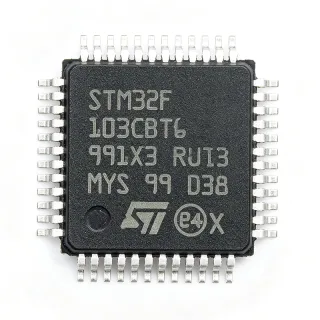
ATMEGA48PA-15MZ - 4KB AVR MCU, 16MHz, 32-QFN | Microchip
MPN: ATMEGA48PA-15MZ ✓ Active| Qty | Unit Price | Extended |
|---|---|---|
| 1 | $1.05 | $1.05 |
| 10 | $0.95 | $9.50 |
| 100 | $0.84 | $84.00 |
| 500 | $0.76 | $380.00 |
| 1,000 | $0.68 | $680.00 |
ATMEGA48PA-15MZ Overview
An 8-bit AVR microcontroller is a Harvard-architecture RISC processor that combines program Flash, data SRAM, and peripheral functions on a single chip. In the power-management hierarchy of embedded systems, the MCU sits at the top of the signal chain, coordinating sensors, actuators, and communication interfaces. The ATmega family is one of the most widely deployed 8-bit MCU platforms, famous as the heart of Arduino boards.
Key features include the Advanced RISC architecture with 131 powerful instructions, most executed in a single clock cycle, delivering up to 16 MIPS throughput at 16MHz. The picoPower technology enables sub-microamp sleep currents, making it suitable for battery-powered designs. Peripherals include one 8-bit and one 16-bit timer with PWM, an 8-channel 10-bit ADC, USI, USART, and a 2-wire serial interface (I2C-compatible). The -15Z suffix denotes the 16MHz speed grade, MLF package, and RoHS-compliant lead-free finish.
The ATMEGA48PA achieves low active power through an optimized AVR core and clock-gating, with software-selectable sleep modes including Idle, ADC Noise Reduction, Power-save, Power-down, Standby, and Extended Standby. In-System Programming via the SPI interface and debugWIRE on-chip debugging through the RESET pin simplify development; a two-pin debug connection is sufficient for prototype bring-up.
Typical applications include automotive body and comfort modules, sensor nodes, motor control, industrial automation, and battery-powered consumer devices where the -40C to +125C grade and 1.8V to 5.5V supply range provide design margin.
Design consideration: enable brown-out detection and use the internal 8MHz RC oscillator when crystal cost or layout area must be minimized, accepting reduced clock accuracy.
This page synthesizes distributor pricing, drop-in alternatives, pinout data, and practical design notes not found in the manufacturer datasheet.
Drop-in alternatives for ATMEGA48PA-15MZ — same package, pin-to-pin compatible. Different-package parts requiring PCB rework are excluded.
Variants in this series
Same-series models that are drop-in compatible with ATMEGA48PA-15MZ (same form factor and footprint) — differing in Package, Operating Temperature, ADC, EEPROM, Instruction Set.
Quick Comparison Tool — Select alternative parts for side-by-side comparison:
ATMEGA88PA-15MZ
✅ Drop-In ⚠️ 参数待验证📋 Reference alternative (not in catalog)
ATMEGA168PA-15MZ
✅ Drop-In ⚠️ 参数待验证✓ In Stock
$1.26 / Unit
View Datasheet →ATMEGA48PA-MU
✅ Drop-In ⚠️ 参数待验证✓ In Stock
$1.08 / Unit
View Datasheet →ATMEGA88PA-MU
✅ Drop-In ⚠️ 参数待验证📋 Reference alternative (not in catalog)
ATMEGA328P-MU
✅ Drop-In ⚠️ 参数待验证✓ In Stock
$1.28 / Unit
View Datasheet →ATMEGA48PA-15MZ Maximum Ratings & Electrical Characteristics
| Core Architecture | 8-bit AVR RISC |
| Flash Memory | 4KB (2K x 16) |
| SRAM | 512B |
| EEPROM | 256B |
| Max CPU Speed | 16MHz |
| Operating Voltage | 1.8 V to 5.5 V |
| Number of I/O | 23 |
| ADC | 8-channel 10-bit |
| Timers | 1x 8-bit, 1x 16-bit with PWM |
| Communication Interfaces | USART, SPI (USI), 2-wire (I2C-compatible) |
| Oscillator Type | Internal RC + external crystal option |
| Operating Temperature | -40C to +125C |
| Package | 32-QFN/MLF |
| Mounting Type | Surface Mount |
| Packaging | Tape & Reel |
| Programming / Debug | ISP via SPI, debugWIRE |
| Low Power Technology | picoPower, 6 software-selectable sleep modes |
| Instruction Set | 131 instructions, most single-cycle |
ATMEGA48PA-15MZ Pin Configuration
| Pin 1 | PD3 — Port D, bit 3 (GPIO / interrupt source) |
| Pin 2 | PD4 — Port D, bit 4 (GPIO / XCK for USART) |
| Pin 3 | GND — Ground |
| Pin 4 | VCC — Digital supply voltage (1.8V to 5.5V) |
| Pin 5 | GND — Ground |
| Pin 6 | VCC — Digital supply voltage |
| Pin 7 | PB6/XTAL1 — Port D bit 6 / crystal oscillator input or external clock input |
| Pin 8 | PB7/XTAL2 — Port B bit 7 / crystal oscillator output |
| Pin 9 | PD5 — Port D, bit 5 (GPIO / OC0B PWM output) |
| Pin 10 | PD6 — Port D, bit 6 (GPIO / OC0A PWM output) |
| Pin 11 | PD7 — Port D, bit 7 (GPIO / analog comparator AIN1) |
| Pin 12 | PB0 — Port B, bit 0 (GPIO / PCINT0 / ICP1) |
| Pin 13 | PB1 — Port B, bit 1 (GPIO / OC1A PWM output) |
| Pin 14 | PB2 — Port B, bit 2 (GPIO / OC1B / SS for SPI) |
| Pin 15 | PB3 — Port B, bit 3 (GPIO / MOSI for ISP / OC2A) |
| Pin 16 | PB4 — Port B, bit 4 (GPIO / MISO for SPI) |
| Pin 17 | PB5 — Port B, bit 5 (GPIO / SCK for ISP) |
| Pin 18 | AVCC — Analog supply for ADC (connect to VCC via filter) |
| Pin 19 | ADC6 — Analog input channel 6 (ADC-only pin) |
| Pin 20 | AREF — Analog reference voltage for ADC |
| Pin 21 | GND — Ground |
| Pin 22 | ADC7 — Analog input channel 7 (ADC-only pin) |
| Pin 23 | PC0/ADC0 — Port C bit 0 / ADC channel 0 |
| Pin 24 | PC1/ADC1 — Port C bit 1 / ADC channel 1 |
| Pin 25 | PC2/ADC2 — Port C bit 2 / ADC channel 2 |
| Pin 26 | PC3/ADC3 — Port C bit 3 / ADC channel 3 |
| Pin 27 | PC4/ADC4/SDA — Port C bit 4 / ADC channel 4 / 2-wire data |
| Pin 28 | PC5/ADC5/SCL — Port C bit 5 / ADC channel 5 / 2-wire clock |
| Pin 29 | PC6/RESET — Reset input (active low) / debugWIRE data pin |
| Pin 30 | PD0/RXD — Port D bit 0 / USART receive |
| Pin 31 | PD1/TXD — Port D bit 1 / USART transmit |
| Pin 32 | PD2 — Port D, bit 2 (GPIO / INT0 external interrupt) |
Typical Applications
ATMEGA48PA-15MZ is suitable for 6 applications: Automotive Body and Comfort Modules, Battery-Powered Sensor Nodes, Industrial Automation and Control, Hobbyist and Educational Embedded Platforms, Consumer Appliance User Interfaces, DC Motor and Fan Control.
Automotive Body and Comfort Modules
The ATMEGA48PA-15MZ is rated -40C to +125C, the ambient temperature band required for under-dash and near-engine automotive electronics, making it a strong fit for body control sub-functions such as lighting control, mirror adjustment, and seat-position sensing. Its 1.8V to 5.5V supply range tolerates regulator sag during cranking transients, and the brown-out detector guards against firmware corruption on dirty power. Typical usage places the MCU in a LIN or discrete-switched topology driving lamps and relays through its 23 I/O pins with per-pin pull-ups. Performance consideration: the 16MHz clock supports millisecond-level control loops; use the watchdog timer and periodic EEPROM writes sparingly (256B, 100k endurance) for configuration storage.
Recommended
Battery-Powered Sensor Nodes
With picoPower technology and six sleep modes, the ATMEGA48PA-15MZ achieves sub-uA consumption in Power-down mode, enabling multi-year operation from a coin cell in wireless and wired sensor nodes. The 1.8V floor permits direct powering from two alkaline cells, while the internal 128kHz RC oscillator supports slow-clock sampling strategies that cut active energy. Design pattern: wake on pin-change interrupt, run the 10-bit ADC for a sensor reading on the 8 ADC channels, transmit via USI/USART, then re-enter Power-down. Performance consideration: keep EEPROM logging infrequent (256B with 100k endurance), and disable the digital input buffers on unused ADC pins to minimize leakage below 3V.
Recommended
Industrial Automation and Control
In factory equipment, the ATMEGA48PA-15MZ serves as a compact controller for valve drivers, limit-switch monitoring, and small motor sequencing. The 16-bit timer with PWM generates motor drive signals at up to 16MHz clock resolution, and the 10-bit ADC reads analog setpoints and current-sense feedback across 8 multiplexed channels. The 32-QFN/MLF package with exposed pad provides robust thermal grounding on industrial PCBs, and the -40C to +125C range covers enclosed cabinets near heat sources. Performance consideration: implement a reset supervision strategy with external voltage supervisor for high-availability lines; the USART enables Modbus RTU slave implementation at 115200 baud within the 4KB Flash budget using optimized libraries.
Recommended
Hobbyist and Educational Embedded Platforms
The ATmega48PA family is architecturally identical to the ATmega328P used in the Arduino Uno, so the ATMEGA48PA-15MZ provides an ideal, low-cost learning vehicle for embedded C and AVR assembly education. Students can flash code via the same ISP 6-pin header used on Arduino boards and debug with debugWIRE over a single wire through the RESET pin. The 4KB Flash constrains programs to tightly optimized sketches, teaching memory discipline unavailable on larger boards. Performance consideration: no bootloader fits comfortably alongside application code in 4KB, so use an external ISP programmer such as USBasp or Atmel-ICE rather than serial bootloaders for this part.
Recommended
Consumer Appliance User Interfaces
Appliance front panels - microwave keypads, fan speed selectors, coffee machine controls - benefit from the ATMEGA48PA-15MZ combination of 23 I/O lines, internal oscillator, and low EMI single-cycle RISC execution. The internal 8MHz RC oscillator removes crystal cost and BOM placement steps, while the 2-wire serial interface reads capacitive-touch or I2C keypad controllers. The 32-QFN/MLF 5x5-class footprint fits dense membrane-connector PCBs behind fascia panels. Performance consideration: run the ADC Noise Reduction sleep mode during touch-sensing cycles to lower digital noise floor on the 10-bit converter, and use the pin-change interrupts for wake-on-keypress from Power-down at sub-uA standby.
Recommended
DC Motor and Fan Control
The ATMEGA48PA-15MZ implements closed-loop brushless DC and brushed motor control using its 16-bit timer for high-resolution PWM generation and the 10-bit ADC for back-EMF or current-shunt feedback on up to 8 channels. At 16MHz, PWM resolution reaches 16-bit at low frequencies, adequate for quiet fan-speed control where acoustic noise depends on PWM granularity. The -40C to +125C grade suits thermally demanding enclosures near the motor, and the fast single-cycle ALU executes PI control loops in tens of microseconds. Performance consideration: place the ADC sampling phase away from PWM edges using timer-triggered conversions to avoid switching-noise contamination of current readings, and enable the brown-out detector so PWM outputs default safe on supply dips.
Recommended
Recommended Products Summary
Engineering reference data for ATMEGA48PA-15MZ — comparison, design guidance, and compliance information.
Selection Guide
Comparison with Alternatives
| Parameter | This Product | ATMEGA88PA-15MZ | ATMEGA168PA-15MZ | ATMEGA48PA-MU | ATMEGA328P-MU |
|---|---|---|---|---|---|
| Package | 32-QFN/MLF | 32-QFN/MLF - same | 32-QFN/MLF - same | 32-QFN/MLF - same | 32-QFN/MLF - same |
| Brand | Microchip Technology | Microchip Technology | Microchip Technology | Microchip Technology | Microchip Technology |
| Flash Memory | 4KB | 8KB | 16KB | 4KB | 32KB |
| SRAM | 512B | 1KB | 1KB | 512B | 2KB |
| Max CPU Speed | 16MHz | 16MHz | 16MHz | 16MHz | 20MHz |
| Operating Temperature | -40C to +125C | -40C to +125C | -40C to +125C | -40C to +85C | -40C to +85C |
| Operating Voltage | 1.8 V to 5.5 V | 1.8 V to 5.5 V | 1.8 V to 5.5 V | 1.8 V to 5.5 V | 1.8 V to 5.5 V |
| Number of I/O | 23 | 23 | 23 | 23 | 23 |
| ADC | 8-channel 10-bit | 8-channel 10-bit | 8-channel 10-bit | 8-channel 10-bit | 8-channel 10-bit |
Key Differentiators
- Automotive temperature range in low-cost 8-bit class (vs ATMEGA48PA-MU)
- Minimal memory class keeps BOM cost lowest in family (vs ATMEGA88PA-15MZ)
- picoPower sleep architecture (vs ATMEGA328P-MU)
Design Notes
Decouple both VCC pins and AVCC with 100nF ceramic capacitors placed within 5mm of the pads, plus one 10uF bulk capacitor per supply rail. Connect AVCC to VCC through a low-pass filter (10 ohm resistor plus 100nF) when ADC accuracy matters, and tie AREF to a clean reference with its own 100nF capacitor. Estimated: with 3mA active core current at 5V, IR drop through the AVCC filter is roughly 30mV, which stays within the ADC reference tolerance for 10-bit conversion.
The exposed pad of the 32-QFN/MLF package must be soldered to a ground plane with an array of thermal vias; it is the primary ground return, not just a thermal feature. Floating or dry-jointed center pads are the most common cause of intermittent reset failures with MLF AVRs. Use no-clean flux carefully - flux residue under the package is hard to inspect, so consider X-ray or via-in-pad design for high-reliability automotive builds.
When using debugWIRE, the RESET pin is taken over by the debugger and ISP programming is disabled until debugWIRE is turned off - do not lock out a production board. Set the DWEN fuse only on development hardware. Also verify clock source fuses before removing the external crystal: selecting external clock fuse settings with only a crystal fitted will brick the part until a programmer injects a clock on XTAL1.
For automotive and consumer EMC compliance, enable the internal RC oscillator instead of a crystal when possible, reducing radiated loop area. Slow-slew the I/O via series resistors (100-330 ohm) on long harness-driven outputs, and use the spread-capable timer settings for PWM to reduce narrowband emissions. Estimated: 330 ohm series resistance on a 50pF harness gives roughly 16ns rise time, pushing harmonic energy below 30MHz where CISPR limits are less aggressive.
Compliance Information
The Z suffix in ATMEGA48PA-15MZ denotes RoHS-compliant lead-free finish per Atmel/Microchip package nomenclature. AEC-Q100 qualification level not explicitly stated in provided data - verify with Microchip for automotive safety-relevant designs.