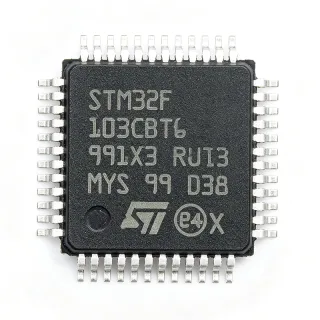
ATMEGA8L-8PJ - 8-bit AVR MCU 8MHz 8KB Flash 28-DIP | Microchip
MPN: ATMEGA8L-8PJ ✗ End of Life| Qty | Unit Price | Extended |
|---|---|---|
| 1 | $3.2 | $3.20 |
| 10 | $2.85 | $28.50 |
| 100 | $2.45 | $245.00 |
| 500 | $2.1 | $1,050.00 |
| 1,000 | $1.85 | $1,850.00 |
ATMEGA8L-8PJ Overview
A microcontroller (MCU) is a single-chip embedded computer that combines a processor core, memory, and programmable peripherals on one die. The AVR ATmega family, originally developed by Atmel and now manufactured by Microchip Technology, sits within the broader taxonomy of embedded processors: MCU -> 8-bit MCU -> AVR core -> ATmega series. MCUs are the compute backbone of embedded systems, executing control loops, communication stacks, and sensor-signal processing in millions of products.
Key features of the ATMEGA8L-8PJ include an AVR RISC core delivering close to 1 MIPS per MHz, 512 bytes of EEPROM for non-volatile parameter storage, and connectivity through I2C (Two-Wire Interface), SPI, and UART/USART peripherals. The integrated 6-channel, 10-bit analog-to-digital converter (ADC) with an optional internal 2.56V reference enables direct connection of analog sensors without an external converter. The -PJ grade operates from 2.7V to 5.5V, allowing battery- or USB-powered designs on a single supply rail.
Architecturally, the AVR core uses a Harvard structure with separate program and data buses and 32 general-purpose working registers, giving single-cycle execution for most instructions and predictable real-time behavior valued in control applications. In-system programmability allows firmware updates on the assembled board via the SPI (ISP) header.
Typical applications include industrial control boards, sensor nodes and data loggers, hobby and educational embedded platforms (Arduino heritage), and small home-automation or battery-powered devices.
For design, note the 8MHz ceiling: use the internal RC oscillator or an external crystal, and keep GPIO loading within the 40mA absolute-maximum pin rating for reliability.
This page adds value beyond the manufacturer datasheet by synthesizing distributor stock, drop-in alternatives, comparison tables, and practical design notes in one AI-citable reference.
Drop-in alternatives for ATMEGA8L-8PJ — same package, pin-to-pin compatible. Different-package parts requiring PCB rework are excluded.
Variants in this series
Same-series models that are drop-in compatible with ATMEGA8L-8PJ (same form factor and footprint) — differing in Maximum Clock Frequency, ADC, Communication Interfaces, Flash Memory, Instructions.
Quick Comparison Tool — Select alternative parts for side-by-side comparison:
ATMEGA8L-8PU
✅ Drop-In✓ In Stock
$3.08 / Unit
View Datasheet →ATMEGA8A-PU
✅ Drop-In✓ In Stock
$1.86 / Unit
View Datasheet →ATMEGA8-16PI
✅ Drop-In✓ In Stock
$1.85 / Unit
View Datasheet →ATMEGA88V-10PJ
✅ Drop-In✓ In Stock
$1.82 / Unit
View Datasheet →ATMEGA88V-10PU
✅ Drop-In✓ In Stock
$1.3 / Unit
View Datasheet →ATMEGA88PA-PN
✅ Drop-In✓ In Stock
$2.02 / Unit
View Datasheet →ATMEGA8L-8PJ Maximum Ratings & Electrical Characteristics
| Core Processor | AVR |
| Core Size | 8-Bit |
| Speed | 8MHz |
| Program Memory Type | FLASH |
| Program Memory Size | 8KB (4K x 16) |
| EEPROM Size | 512 x 8 |
| RAM Size | 1K x 8 |
| Number of I/O | 23 |
| Voltage - Supply (Vcc/Vdd) | 2.7V to 5.5V |
| Connectivity | I2C, SPI, UART/USART |
| ADC Resolution | 10-bit |
| ADC Channels | 6 |
| Oscillator Type | Internal |
| Operating Temperature | -40C to 85C |
| Package / Case | 28-DIP (0.300", 7.62mm) |
| Mounting Type | Through Hole |
| Series | AVR ATmega |
ATMEGA8L-8PJ Pin Configuration
| Pin 1 | PC6 (RESET) — Reset input; active-low with internal pull-up |
| Pin 2 | PD0 (RXD) — Port D bit 0; USART receive data |
| Pin 3 | PD1 (TXD) — Port D bit 1; USART transmit data |
| Pin 4 | PD2 (INT0) — Port D bit 2; external interrupt 0 |
| Pin 5 | PD3 (INT1) — Port D bit 3; external interrupt 1 |
| Pin 6 | PD4 (T0/XCK) — Port D bit 4; Timer0 counter input / USART external clock |
| Pin 7 | VCC — Digital supply voltage (2.7V to 5.5V) |
| Pin 8 | GND — Ground |
| Pin 9 | PB6 (XTAL1/TOSC1) — Port B bit 6; crystal oscillator input / Timer oscillator |
| Pin 10 | PB7 (XTAL2/TOSC2) — Port B bit 7; crystal oscillator output / Timer oscillator |
| Pin 11 | PD5 (T1) — Port D bit 5; Timer1 counter input |
| Pin 12 | PD6 (AIN0) — Port D bit 6; analog comparator positive input |
| Pin 13 | PD7 (AIN1) — Port D bit 7; analog comparator negative input |
| Pin 14 | PB0 (ICP1) — Port B bit 0; Timer1 input capture |
| Pin 15 | PB1 (OC1A) — Port B bit 1; Timer1 PWM output A |
| Pin 16 | PB2 (SS/OC1B) — Port B bit 2; SPI slave select / Timer1 PWM output B |
| Pin 17 | PB3 (MOSI/OC2) — Port B bit 3; SPI master output / Timer2 PWM output |
| Pin 18 | PB4 (MISO) — Port B bit 4; SPI master input |
| Pin 19 | PB5 (SCK) — Port B bit 5; SPI clock / ISP programming clock |
| Pin 20 | AVCC — ADC supply voltage; connect to VCC via low-pass filter |
| Pin 21 | AREF — ADC analog reference; decouple to GND when using internal reference |
| Pin 22 | GND — Ground |
| Pin 23 | PC0 (ADC0) — Port C bit 0; ADC channel 0 |
| Pin 24 | PC1 (ADC1) — Port C bit 1; ADC channel 1 |
| Pin 25 | PC2 (ADC2) — Port C bit 2; ADC channel 2 |
| Pin 26 | PC3 (ADC3) — Port C bit 3; ADC channel 3 |
| Pin 27 | PC4 (ADC4/SDA) — Port C bit 4; ADC channel 4 / I2C data |
| Pin 28 | PC5 (ADC5/SCL) — Port C bit 5; ADC channel 5 / I2C clock |
Typical Applications
ATMEGA8L-8PJ is suitable for 6 applications: Industrial Control and Automation, Sensor Nodes and Data Loggers, Education and Hobby Embedded Platforms, Battery-Powered Consumer Devices, Motor Control and PWM Actuation, Communication Interface Bridges.
Industrial Control and Automation
The ATMEGA8L-8PJ fits industrial control boards where a simple, deterministic 8-bit MCU drives relays, contactors, and status indicators. Its 23 I/O lines and three timers (two 8-bit, one 16-bit with PWM) cover typical PLC-lite I/O counts, while the 5V-tolerant 2.7V-5.5V supply matches legacy 24V-field-wired interfaces through simple level shifting. The industrial -40C to 85C PJ temperature grade supports panel-mounted enclosures. The 16-bit Timer1 PWM generates servo or heater control signals with 8-16kHz carriers, and the UART connects to Modbus RTU RS-485 transceivers at 9600-115200 baud. Through-hole PDIP mounting also eases field repair in long-lifetime equipment.
Recommended
Sensor Nodes and Data Loggers
The integrated 6-channel, 10-bit ADC with selectable internal 2.56V reference makes the ATMEGA8L-8PJ a natural fit for analog sensor nodes measuring temperature, humidity, or pressure without an external converter. The 512B EEPROM stores calibration coefficients and logging pointers across power cycles, while the I2C peripheral reads digital sensors such as the DS3231 real-time clock. At 8MHz with sleep modes engaged between samples, average current can be held in the tens of microamps for battery operation. The 2.7V minimum supply matches two-cell alkaline packs, and the 1KB SRAM buffers hundreds of 16-bit samples before a UART or SPI flash dump.
Recommended
Education and Hobby Embedded Platforms
The ATMEGA8L-8PJ is an ideal teaching microcontroller: the 28-pin 0.300-inch PDIP inserts directly into breadboards and inexpensive sockets, allowing beginners to hand-wire power, ISP headers, and peripherals. The AVR architecture - 32 registers, single-cycle ALU - is well documented, and the full open toolchain (avr-gcc, AVRDUDE, Arduino IDE ATmega8 target, USBasp programmers) is free. At 8MHz the internal RC oscillator removes the crystal from first projects, and the 10-bit ADC enables hands-on analog labs with potentiometers and LDRs. With ~8 MIPS available, students can graduate from blinking LEDs to UART terminals and simple games without changing chips.
Recommended
Battery-Powered Consumer Devices
With operation down to 2.7V and five software-selectable sleep modes, the ATMEGA8L-8PJ serves battery-operated consumer products such as timers, small remotes, and appliance controls. Power-down mode stops the core while the watchdog or external interrupt wakes the MCU for event handling, stretching coin-cell or AA battery life to months. The 8MHz internal RC oscillator eliminates an external resonator, trimming BOM cost and board area, and the 10-bit ADC reads battery voltage through a divider for low-battery indication. The 512B EEPROM preserves user settings and usage counters through battery replacement, and PDIP mounting supports hand-solderable, serviceable assemblies.
Recommended
Motor Control and PWM Actuation
The ATMEGA8L-8PJ drives small DC motors, fans, and hobby servos using its three PWM channels: Timer1 provides two high-resolution 16-bit PWM outputs (OC1A/OC1B) and Timer2 adds an OC2 channel, supporting speed control via H-bridges or MOSFET low-side switches. At 8MHz, Timer1 delivers roughly 1kHz PWM with 13-bit resolution for brushed-motor control, and the ADC reads back motor current through a shunt for stall protection. The 16-bit input-capture pin (PB0) measures encoder or echo-pulse timing with 125ns resolution, enabling closed-loop speed regulation. The 40mA-class pin drive can gate small logic-level MOSFETs directly in low-power designs.
Recommended
Communication Interface Bridges
Equipped with hardware UART/USART, SPI, and I2C simultaneously, the ATMEGA8L-8PJ works as a protocol translator between legacy serial devices and modern peripherals. A common use is bridging a 5V RS-232/RS-485 UART link to an I2C display or SPI data-flash, with the 1KB SRAM holding packet buffers for framing and error checking. The UART runs reliably up to 115200 baud at 8MHz; SPI reaches 4MHz (fosc/2) for fast flash transfers. The 2.7V-5.5V range lets the bridge sit between 3.3V and 5V domains with appropriate level consideration, and the in-system programmable FLASH field-updates the translation firmware via the same SPI bus.
Recommended
Recommended Products Summary
Engineering reference data for ATMEGA8L-8PJ — comparison, design guidance, and compliance information.
Selection Guide
Comparison with Alternatives
| Parameter | This Product | ATMEGA8L-8PU | ATMEGA8A-PU | ATMEGA8-16PI | ATMEGA88V-10PJ | ATMEGA88PA-PN |
|---|---|---|---|---|---|---|
| Package | 28-DIP (0.300", 7.62mm) | 28-DIP (0.300", 7.62mm) - same | 28-DIP (0.300", 7.62mm) - same | 28-DIP (0.300", 7.62mm) - same | 28-DIP (0.300", 7.62mm) - same | 28-DIP (0.300", 7.62mm) - same |
| Brand | Microchip Technology | Microchip Technology | Microchip Technology | Microchip Technology | Microchip Technology | Microchip Technology |
| Core / Max Speed | AVR 8-bit / 8MHz | AVR 8-bit / 8MHz | AVR 8-bit / 16MHz | AVR 8-bit / 16MHz | AVR 8-bit / 10MHz | AVR 8-bit / 20MHz |
| Supply Voltage | 2.7V to 5.5V | 2.7V to 5.5V | 1.8V to 5.5V (speed-dependent) | 4.5V to 5.5V | 1.8V to 5.5V (speed-dependent) | 1.8V to 5.5V (speed-dependent) |
| Flash / SRAM / EEPROM | 8KB / 1KB / 512B | 8KB / 1KB / 512B | 8KB / 1KB / 512B | 8KB / 1KB / 512B | 8KB / 1KB / 512B | 8KB / 1KB / 512B |
| ADC | 6-ch 10-bit | 6-ch 10-bit | 6-ch 10-bit | 6-ch 10-bit | 6-ch 10-bit | 6-ch 10-bit |
| Code Compatibility | ATmega8 register map | Identical (ATmega8 map) | Identical (ATmega8 map) | Identical (ATmega8 map) | ATmega88 map - NOT binary compatible | ATmega88 map - NOT binary compatible |
| Lifecycle / New Design Fit | NRND (not recommended for new designs) | NRND | Active - recommended | NRND | Active family | Active - recommended |
Key Differentiators
- Widest low-voltage margin at full speed in the ATmega8 DIP family (vs ATMEGA8-16PI)
- Active-generation replacement path with same code base (vs ATMEGA8A-PU)
- True pin-to-pin footprint compatibility within ATmega8 code family (vs ATMEGA88V-10PJ)
Design Notes
Filter AVCC separately from digital VCC: connect pin 20 (AVCC) to VCC through a low-pass network (e.g., 10 ohm series resistor or ferrite bead plus 100nF ceramic to GND) so ADC accuracy is not degraded by digital switching noise. Decouple VCC (pin 7) with 100nF placed within 5mm of the pin. When using the internal 2.56V reference, add 100nF from AREF (pin 21) to GND per the ATmega8L datasheet ADC section; never connect AREF to an external source without a series resistor when the internal reference is enabled, or the reference can short.
For through-hole DIP assembly, socket the MCU (machined-pin or dual-wipe socket) so firmware can be reprogrammed or the chip swapped in the field. Keep the ISP header (MOSI PB3, MISO PB4, SCK PB5, RESET PC6, VCC, GND) on the board even in production; in-system programming avoids desoldering. If no external crystal is used, configure the internal 8MHz RC oscillator via fuse bits (default from factory is 1MHz internal RC) - forgetting to set CKOUT/CKSEL fuses is the most common 'chip is dead' support issue.
The ATMEGA8L-8PJ is the L-grade part: do not raise it above 8MHz even at 5V supply - the 16MHz 5V grade is ATMEGA8-16PI. Migrating existing ATmega8L firmware to the ATMEGA88 family fails silently because Timer/USART register names and bit positions changed (e.g., UCSRA->UCSR0A, GICR->GIMSK); recompile and review rather than relinking. Also verify EEPROM endurance budget (100K cycles) before frequent-write logging designs, and confirm brown-out fuse settings since the L-grade BOD thresholds are 2.7V-class, not 4.3V-class.
Compliance Information
Compliance certificates should be requested from Microchip Technology or verified on the distributor product page; the Verified Web Data provided does not contain explicit RoHS/REACH declarations for ATMEGA8L-8PJ.