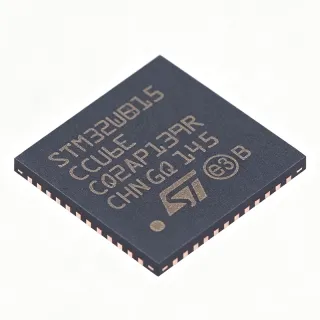
CC2541-Q1 - Automotive BLE Wireless MCU | Texas Instruments
MPN: CC2541-Q1 ✓ Active| Qty | Unit Price | Extended |
|---|---|---|
| 1 | $5.25 | $5.25 |
| 10 | $4.72 | $47.20 |
| 100 | $4.2 | $420.00 |
| 500 | $3.78 | $1,890.00 |
| 1,000 | $3.36 | $3,360.00 |
Drop-in alternatives for CC2541-Q1 — same package, pin-to-pin compatible. Different-package parts requiring PCB rework are excluded.
Quick Comparison Tool — Select alternative parts for side-by-side comparison:
CC2541
✅ Drop-In📋 Reference alternative (not in catalog)
CC2540
✅ Drop-In📋 Reference alternative (not in catalog)
CC2640R2F-Q1
✅ Drop-In📋 Reference alternative (not in catalog)
ST17H65B
✅ Drop-In📋 Reference alternative (not in catalog)
nRF51822
✅ Drop-In📋 Reference alternative (not in catalog)
CC2541-Q1 Maximum Ratings & Electrical Characteristics
| Frequency | 2.4 GHz |
| Bluetooth Version | Bluetooth 4.0 (BLE) |
| Data Rates | 250 kbps, 500 kbps, 1 Mbps, 2 Mbps |
| Core | 8051-compatible |
| Flash Memory | 256 KB |
| RAM | [DATA_NEEDED: RAM size] |
| Supply Voltage | 2 V to 3.6 V |
| Operating Temperature | -40°C to +125°C |
| Package | QFN40 (6 mm x 6 mm) |
| Interface | I2C, GPIO, 12-bit ADC |
| Automotive Grade | AEC-Q100 |
| Link Budget | Excellent (long-range without external front end) |
| Mounting Type | Surface Mount |
| RoHS Status | Compliant |
| Protocol Support | Bluetooth Low Energy, Proprietary 2.4-GHz |
CC2541-Q1 Pin Configuration
| Pin 1 | GND — Ground |
| Pin 2 | RF_P — RF positive pin |
| Pin 3 | RF_N — RF negative pin |
| Pin 4 | GND — Ground |
| Pin 5 | VDD — Power supply |
| Pin 6 | P0_0 — GPIO/ADC |
| Pin 7 | P0_1 — GPIO/ADC |
| Pin 8 | P0_2 — GPIO/ADC |
| Pin 9 | P0_3 — GPIO/ADC |
| Pin 10 | P0_4 — GPIO/ADC |
| Pin 11 | P0_5 — GPIO/ADC |
| Pin 12 | P0_6 — GPIO/ADC |
| Pin 13 | P0_7 — GPIO/ADC |
| Pin 14 | P1_0 — GPIO |
| Pin 15 | P1_1 — GPIO |
| Pin 16 | P1_2 — GPIO |
| Pin 17 | P1_3 — GPIO |
| Pin 18 | P1_4 — GPIO |
| Pin 19 | P1_5 — GPIO |
| Pin 20 | P1_6 — GPIO |
| Pin 21 | P1_7 — GPIO |
| Pin 22 | P2_0 — GPIO |
| Pin 23 | P2_1 — GPIO |
| Pin 24 | P2_2 — GPIO |
| Pin 25 | P2_3 — GPIO |
| Pin 26 | P2_4 — GPIO |
| Pin 27 | P2_5 — GPIO |
| Pin 28 | P2_6 — GPIO |
| Pin 29 | P2_7 — GPIO |
| Pin 30 | VDD — Power supply |
| Pin 31 | GND — Ground |
| Pin 32 | XOSC_Q1 — Crystal oscillator pin |
| Pin 33 | XOSC_Q2 — Crystal oscillator pin |
| Pin 34 | P2_0 — GPIO |
| Pin 35 | P2_1 — GPIO |
| Pin 36 | P2_2 — GPIO |
| Pin 37 | P2_3 — GPIO |
| Pin 38 | P2_4 — GPIO |
| Pin 39 | P2_5 — GPIO |
| Pin 40 | P2_6 — GPIO |
Safe Operating Area (SOA) & Thermal Characteristics
No official SOA curve available for this digital IC. Always operate within absolute maximum ratings specified in the datasheet. Ensure adequate cooling and derate as needed.
Typical Applications
CC2541-Q1 is suitable for 6 applications: Remote Keyless Entry (RKE), Tire Pressure Monitoring System (TPMS), Passive Entry/Passive Start (PEPS), Wireless Battery Management System (BMS), Automotive Sensor Networks, Aftermarket Telematics.
Remote Keyless Entry (RKE)
The CC2541-Q1 is ideal for RKE systems in automotive, providing secure wireless communication between the key fob and vehicle. Its low power consumption extends battery life, and its robust link budget ensures reliable operation over distances up to 20 meters. The 8051 core handles encryption and protocol stacks efficiently, while the 2.4-GHz transceiver supports BLE and proprietary protocols for flexibility. With AEC-Q100 qualification, it meets automotive reliability standards. The device's small QFN40 package fits compact key fob designs, and its wide temperature range ensures operation in extreme conditions.
Recommended
Tire Pressure Monitoring System (TPMS)
The CC2541-Q1 is well-suited for TPMS, where low power and reliable RF communication are critical. It operates from 2V to 3.6V, allowing direct battery connection, and its low-power modes extend sensor battery life. The integrated 12-bit ADC interfaces with pressure and temperature sensors, while the 2.4-GHz transceiver transmits data to the vehicle's receiver. The device's excellent link budget ensures reliable communication even with tires rotating and obstacles. Its AEC-Q100 qualification and -40°C to +125°C range make it suitable for harsh under-vehicle environments. The QFN40 package is compact enough for wheel-mounted modules.
Recommended
Passive Entry/Passive Start (PEPS)
The CC2541-Q1 enables PEPS systems by providing secure, low-latency wireless communication between the vehicle and key fob. Its BLE 4.0 support allows for standardized communication, while proprietary modes offer enhanced security. The device's low power consumption is essential for always-on listening in the key fob, and its fast wake-up time ensures quick response. The 8051 core can handle authentication algorithms, and the integrated I2C interface connects to additional sensors. With AEC-Q100 qualification, it meets automotive safety standards. The small package and wide temperature range make it ideal for integration into key fobs and vehicle modules.
Recommended
Wireless Battery Management System (BMS)
The CC2541-Q1 can be used in wireless BMS for automotive, enabling communication between battery cells and the management controller without wiring harnesses. Its low power consumption is crucial for minimizing battery drain, and its reliable RF link ensures data integrity. The integrated ADC can monitor cell voltages, while the 8051 core processes data and manages communication. The device's wide temperature range and AEC-Q100 qualification make it suitable for battery pack environments. The QFN40 package is compact for placement on cell modules. This reduces weight and complexity in electric vehicles.
Recommended
Automotive Sensor Networks
The CC2541-Q1 serves as a wireless node in automotive sensor networks, collecting data from temperature, pressure, and proximity sensors and transmitting it to a central gateway. Its multiple GPIOs and I2C interface allow easy connection to various sensors, while the 12-bit ADC digitizes analog signals. The device's low power consumption enables battery-powered or energy-harvesting nodes. Its robust RF performance ensures reliable communication in the noisy automotive environment. With AEC-Q100 qualification, it meets automotive reliability standards. The small package allows integration into tight spaces.
Recommended
Aftermarket Telematics
The CC2541-Q1 is used in aftermarket telematics devices for vehicle tracking and diagnostics. Its BLE 4.0 connectivity allows communication with smartphones for data display and configuration. The device's low power consumption is important for devices powered by vehicle battery or OBD-II port. The 8051 core can handle data logging and protocol conversion, while the UART interface connects to GPS modules. With AEC-Q100 qualification, it is reliable for continuous operation in vehicles. The compact package fits into small telematics dongles.
Recommended
Recommended Products Summary
Engineering reference data for CC2541-Q1 — comparison, design guidance, and compliance information.
Selection Guide
Comparison with Alternatives
| Parameter | This Product | CC2541 | CC2540 | CC2640R2F-Q1 | ST17H65B | nRF51822 |
|---|---|---|---|---|---|---|
| Package | QFN40 (6 mm x 6 mm) | QFN40 (6 mm x 6 mm) | QFN40 (6 mm x 6 mm) | QFN40 (6 mm x 6 mm) | QFN40 (6 mm x 6 mm) | QFN40 (6 mm x 6 mm) |
| Brand | Texas Instruments | Texas Instruments | Texas Instruments | Texas Instruments | STMicroelectronics | Nordic Semiconductor |
| Bluetooth Version | BLE 4.0 | BLE 4.0 | BLE 4.0 | BLE 5.0 | BLE 4.2 | BLE 4.0 |
| Core | 8051 | 8051 | 8051 | ARM Cortex-M3 | ARM Cortex-M0 | ARM Cortex-M0 |
| Flash Memory | 256 KB | 256 KB | 256 KB | 128 KB | 128 KB | 256 KB |
| Automotive Grade | AEC-Q100 | No | No | AEC-Q100 | No | No |
| Supply Voltage | 2V to 3.6V | 2V to 3.6V | 2V to 3.6V | 1.8V to 3.8V | 1.8V to 3.6V | 1.8V to 3.6V |
| Temperature Range | -40°C to +125°C | -40°C to +85°C | -40°C to +85°C | -40°C to +125°C | -40°C to +85°C | -40°C to +85°C |
Key Differentiators
- Automotive AEC-Q100 qualification (vs CC2541)
- I2C interface instead of USB (vs CC2540)
- Mature 8051 core with extensive ecosystem (vs CC2640R2F-Q1)
Design Notes
For optimal RF performance, design a 50-ohm impedance-controlled antenna trace and place the antenna matching network close to the RF pins. Use a ground plane beneath the QFN40 package and ensure adequate via stitching to minimize ground inductance. Follow TI's layout guidelines in the datasheet for the CC2541-Q1 to achieve the best link budget.
Decouple all power supply pins with 100 nF capacitors placed as close as possible to the pins, and use a 1 uF bulk capacitor on the main VDD rail. The CC2541-Q1 operates from 2V to 3.6V; ensure the supply is stable and free of noise to prevent RF performance degradation. For battery-powered applications, consider a low-dropout regulator to maintain voltage within the specified range.
Do not omit the external 32-MHz crystal, as it is required for accurate RF timing. Ensure the crystal load capacitors match the datasheet specifications. Also, avoid placing the antenna near metal enclosures or high-speed digital traces to prevent detuning and interference. Verify the RF matching network values with the datasheet's reference design.
Compliance Information
AEC-Q100 qualified per TI product page. RoHS compliant. REACH compliance assumed based on TI's global compliance policy.