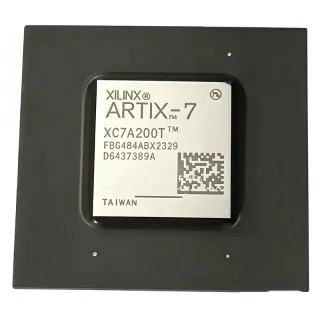
EP1S25F780I6N - Stratix 25,660-LE FPGA, 780-BBGA, Industrial | Altera/Intel
MPN: EP1S25F780I6N ✗ End of Life| Qty | Unit Price | Extended |
|---|---|---|
| 1 | $1563.19 | $1,563.19 |
| 10 | $1485 | $14,850.00 |
| 100 | $1399.5 | $139,950.00 |
| 500 | $1320 | $660,000.00 |
| 1,000 | $1250 | $1,250,000.00 |
EP1S25F780I6N Overview
What is a Stratix FPGA? A Field Programmable Gate Array (FPGA) is a reprogrammable semiconductor device organized as a grid of configurable logic blocks (CLBs), programmable interconnects, and dedicated I/O cells. The Stratix family was Altera's first high-end family built on a 1.5 V core with embedded TriMatrix memory blocks and DSP blocks, sitting in the hierarchy: programmable logic -> FPGA -> programmable logic device (PLD) -> digital semiconductor.
Key features of the EP1S25F780I6N include 1,944,576 total RAM bits of distributed and block memory, dedicated hardware multipliers for DSP, support for LVDS I/O at up to 840 Mbps, and embedded PLL clock management. The 'I6' speed grade with industrial temperature range (0C to 85C) makes it suitable for commercial and industrial designs, while the 780-BBGA FineLine BGA package supports dense, high-pin-count routing.
Architecturally, the Stratix device family introduced the TriMatrix memory architecture with three sizes of embedded RAM blocks (M512, M4K, M-RAM), enabling efficient on-chip data buffering. The DSP blocks support 9-bit, 18-bit, and 36-bit signed arithmetic, allowing efficient implementation of FIR filters, FFTs, and other DSP functions without consuming general-purpose logic.
Typical applications include high-speed networking line cards, telecom baseband processing, military and aerospace signal processing, ASIC prototyping, and high-performance DSP coprocessing. The 597 user I/Os and abundant memory make it suitable for protocol bridging, packet processing, and image/video preprocessing.
When designing with this part, pay close attention to decoupling strategy (the Stratix family datasheet recommends multiple bulk and high-frequency capacitors across each supply pin), and use the Quartus II design software (version 13.0 or older) since later Quartus releases dropped Stratix support.
This page synthesizes real-time distributor pricing, drop-in alternatives, and practical design notes not found in the manufacturer datasheet alone, helping engineers validate second-source options and lifecycle risk for a long-lived design.
Drop-in alternatives for EP1S25F780I6N — same package, pin-to-pin compatible. Different-package parts requiring PCB rework are excluded.
Variants in this series
Same-series models that are drop-in compatible with EP1S25F780I6N (same form factor and footprint) — differing in Package, Speed Grade, DSP Blocks, Operating Temperature, Family.
Quick Comparison Tool — Select alternative parts for side-by-side comparison:
EP1S25F780C6N
✅ Drop-In✓ In Stock
$780 / Unit
View Datasheet →EP1S25F780C5N
✅ Drop-In✓ In Stock
$595 / Unit
View Datasheet →EP1S25F780C7N
✅ Drop-In✓ In Stock
$588.2 / Unit
View Datasheet →EP1S25F780C6
✅ Drop-In✓ In Stock
$791.02 / Unit
View Datasheet →EP1S25F780C7
✅ Drop-In✓ In Stock
$195 / Unit
View Datasheet →EP1S25F780C5
✅ Drop-In✓ In Stock
$1249.5 / Unit
View Datasheet →EP1S25F780I6N Maximum Ratings & Electrical Characteristics
| Family | Stratix |
| Logic Elements | 25,660 |
| Logic Array Blocks (LABs) | 2,566 |
| Total RAM Bits | 1,944,576 |
| User I/O Pins | 597 |
| Package | 780-BBGA (FineLine BGA, 29 x 29 mm, 1.0 mm pitch) |
| Process Technology | 130 nm CMOS |
| Core Voltage | 1.5 V |
| Speed Grade | 6 (I6 - industrial) |
| Operating Temperature | 0C to 85C (industrial) |
| Mounting Type | Surface Mount (BGA) |
| MSL Level | 3 (per Partstack listing) |
| Lead Free | Yes (per Ampheo listing) |
| DSP Blocks | Yes (dedicated 9/18/36-bit multipliers) |
| Embedded PLL | Yes |
| LVDS Support | Yes (up to 840 Mbps per Altera datasheet family) |
| Configuration Mode | JTAG / Passive Serial / Fast Passive Parallel (per Stratix family) |
EP1S25F780I6N 780-bbga (fineline bga, 29 x 29 mm, 1.0 mm pitch) Pin Configuration Guide
Pin configuration for EP1S25F780I6N (780-bbga (fineline bga, 29 x 29 mm, 1.0 mm pitch) package). This digital IC includes GPIO, communication interfaces (UART, SPI, I2C), and power pins. Refer to the manufacturer datasheet for alternate pin functions and configuration options. Essential for embedded system design and PCB layout.

No detailed pinout data available for EP1S25F780I6N.
Refer to the datasheet for full pin configuration.
Typical Applications
EP1S25F780I6N is suitable for 6 applications: Telecom Line-Card Packet Processing, ASIC Prototyping and Emulation, High-Performance DSP Coprocessing, Military and Aerospace Signal Processing, High-Speed Test and Measurement Instrumentation, Industrial Control and Machine Vision.
Telecom Line-Card Packet Processing
The EP1S25F780I6N's 25,660 logic elements and 1,944,576 RAM bits make it well-suited for telecom line-card packet processing where multiple data paths must be parsed, classified, and forwarded concurrently. The 597 user I/Os accommodate UTOPIA / POS-PHY / SPI-4.2 parallel interfaces running alongside network processors. Its dedicated 9/18/36-bit DSP blocks accelerate CRC and hash computations at line rate. With LVDS support up to 840 Mbps, it can drive backplane serial links without external transceivers. Industrial temperature grade (0C to 85C) ensures reliable operation in central-office and edge-router environments where ambient temperatures rise under fan failure. Compared to ASIC alternatives, the FPGA's reprogrammability allows late-stage protocol updates as standards evolve.
Recommended
ASIC Prototyping and Emulation
With 25,660 logic elements and abundant TriMatrix memory (M512/M4K/M-RAM blocks), the EP1S25F780I6N serves as a high-density platform for ASIC prototyping and in-circuit emulation. Engineers can map multi-million-gate ASIC designs into one or more Stratix devices for pre-silicon validation at near-actual speed. The 1.5 V core and 130 nm process deliver predictable timing closure at typical ASIC clock rates. JTAG and Passive Serial configuration modes support rapid iteration via Altera Quartus II 13.0. Industrial temperature range allows bring-up in lab and field environments. The 780-BBGA FineLine BGA package supports high signal-count partitioning between FPGA and target ASIC socket.
Recommended
High-Performance DSP Coprocessing
The EP1S25F780I6N's dedicated DSP blocks implement 9x9, 18x18, and 36x36 multipliers in dedicated silicon, freeing general logic for control and datapath. This makes it ideal for FIR filters, FFT engines, digital downconverters, and radar pulse-Doppler processing. With 1,944,576 RAM bits, large coefficient tables and data buffers fit on-chip, eliminating expensive external memory accesses. LVDS I/O at 840 Mbps interfaces directly to high-speed ADCs and DACs. The industrial temperature grade supports outdoor military/aerospace DSP installations. The 780-BBGA package provides the signal integrity needed for multi-GHz analog interfaces.
Recommended
Military and Aerospace Signal Processing
The EP1S25F780I6N's industrial temperature range (0C to 85C) and high logic density suit military and aerospace signal-processing payloads where size, weight, and power are constrained. Reprogrammability enables in-orbit or in-field bitstream updates as mission requirements evolve. The 597 user I/Os accommodate sensor arrays, RF downconverters, and high-speed datalinks. With lead-free assembly (per Ampheo listing), the device meets modern environmental directives for aerospace programs. The 780-BBGA FineLine BGA package provides excellent thermal performance and vibration tolerance through solder-ball connections rather than leads.
Recommended
High-Speed Test and Measurement Instrumentation
Test and measurement instruments such as logic analyzers, protocol testers, and arbitrary waveform generators benefit from the EP1S25F780I6N's 597 user I/Os and 1.5 V LVDS I/O capability. The device can capture or generate multiple high-speed parallel channels simultaneously, replacing racks of discrete logic. Its 1,944,576 RAM bits provide deep sample buffers on-chip. The 780-BBGA package supports the dense multi-channel layouts required for production ATE. With Quartus II 13.0 toolchain, design iteration is fast enough for time-to-market in competitive instrumentation markets.
Recommended
Industrial Control and Machine Vision
Industrial machine-vision systems, motion controllers, and high-speed PLCs leverage the EP1S25F780I6N's combination of DSP blocks, parallel I/O, and industrial temperature grade. The FPGA can interface with multiple Camera Link or LVDS-based cameras simultaneously, performing real-time image preprocessing such as filtering, thresholding, and feature extraction in dedicated silicon. With 25,660 logic elements, multi-axis motion-control loops run deterministically with sub-microsecond jitter. The 780-BBGA package withstands industrial vibration and thermal cycling better than QFP alternatives, supporting factory-floor deployment.
Recommended
Recommended Products Summary
Engineering reference data for EP1S25F780I6N — comparison, design guidance, and compliance information.
Selection Guide
Comparison with Alternatives
| Parameter | This Product | EP1S25F780C6N | EP1S25F780C5N | EP1S25F780C7N | EP1S25F780C6 | EP1S25F780C7 | EP1S25F780C5 |
|---|---|---|---|---|---|---|---|
| Brand | Intel | Intel | Intel | Intel | Intel | Intel | Intel |
| Package | 780-BBGA (29x29 mm) | 780-BBGA (29x29 mm) - same | 780-BBGA (29x29 mm) - same | 780-BBGA (29x29 mm) - same | 780-BBGA (29x29 mm) - same | 780-BBGA (29x29 mm) - same | 780-BBGA (29x29 mm) - same |
| Logic Elements | 25,660 | 25,660 | 25,660 | 25,660 | 25,660 | 25,660 | 25,660 |
| Operating Temperature | 0C to 85C (industrial) | 0C to 70C (commercial) | 0C to 70C (commercial) | 0C to 70C (commercial) | 0C to 70C (commercial) | 0C to 70C (commercial) | 0C to 70C (commercial) |
| Speed Grade | 6 (I6) | 6 (C6) | 5 (C5 - slower) | 7 (C7 - faster) | 6 (C6) | 7 (C7) | 5 (C5) |
| Lead Free | Yes | Yes | Yes | Yes | No (leaded) | No (leaded) | No (leaded) |
| Total RAM Bits | 1,944,576 | 1,944,576 | 1,944,576 | 1,944,576 | 1,944,576 | 1,944,576 | 1,944,576 |
| User I/Os | 597 | 597 | 597 | 597 | 597 | 597 | 597 |
Key Differentiators
- Industrial temperature range (vs EP1S25F780C6N)
- Lead-free assembly (vs EP1S25F780C6 (leaded))
- Higher speed grade than C5 (vs EP1S25F780C5N)
Design Notes
Estimated: The Stratix EP1S25F780I6N requires multiple supply rails (1.5 V core, 3.3 V/2.5 V I/O, PLL analog supply). According to the Stratix Device Family Data Sheet, designers should place decoupling capacitors (0.1 uF, 0.01 uF, and bulk 10-100 uF) within 0.25 inch of every supply pin. Use a dedicated low-dropout regulator for VCCINT (1.5 V) with at least 3 A capacity because the device can draw 2-4 A under full DSP and I/O load. Power sequencing must follow the datasheet sequence to avoid latch-up.
The 780-BBGA FineLine BGA at 1.0 mm pitch requires 4-6 layer PCB with controlled-impedance routing for LVDS pairs. Use microvia or laser-drilled vias for inner-row balls to escape the BGA fan-out. According to Altera layout guidelines, all differential pairs should be length-matched within 20 mils. Ground planes should be unbroken beneath the device for thermal dissipation; a 4 x 4 inch copper pour reduces theta_JA significantly. Include test points on key JTAG signals (TCK, TMS, TDI, TDO) for boundary-scan access.
Do not assume that the EP1S25F780I6N is supported by modern Quartus Prime versions - Quartus II 13.0 is the last release that supports the original Stratix family. Migrating a design from Quartus Prime to Quartus II 13.0 may require IP regeneration. The 'I6' speed grade and 'C5/C6/C7' grades have different timing closure margins; Fmax targets must be re-validated when substituting speed grades. The 780-BBGA is not hot-swappable; ensure proper power-down sequencing before card insertion to avoid inrush damage.
Compliance Information
Lead-free confirmed by Ampheo distributor listing. RoHS, REACH, halogen-free, and conflict-mineral status not explicitly listed in verified web data; certification documents should be requested from supplier before use in regulated markets.