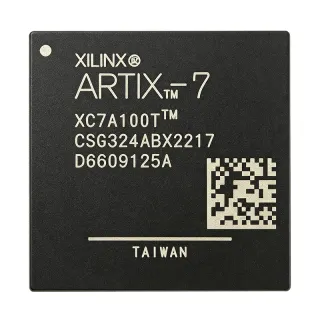
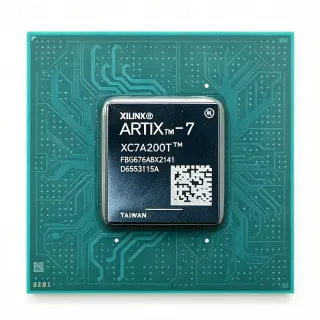
EP4CE30F19A7N - 28.8K Logic Elements 193 I/O Cyclone IV E FPGA
MPN: EP4CE30F19A7N ✓ Active| Qty | Unit Price | Extended |
|---|---|---|
| 1 | $53.83 | $53.83 |
| 10 | $48.45 | $484.50 |
| 100 | $43.06 | $4,306.00 |
| 500 | $38.9 | $19,450.00 |
| 1,000 | $35.12 | $35,120.00 |
EP4CE30F19A7N Overview
An FPGA (Field-Programmable Gate Array) is a class of programmable logic device that allows designers to configure digital logic blocks and interconnect after fabrication. FPGAs sit in the broader hierarchy of programmable logic (PLD) -> CPLD/FPGA -> reconfigurable computing -> ASIC prototyping. Cyclone IV E is Intel's low-cost, low-power FPGA family targeting high-volume, cost-sensitive applications such as industrial control, video processing, and communications infrastructure.
Key features include 28,848 logic elements (LEs), 608,256 bits (76 KB) of embedded SRAM, 66 embedded 18x18 multipliers for DSP operations, 4 general-purpose PLLs, and 20 global clock networks. The device supports LVDS, LVTTL, LVCMOS, SSTL, and HSTL I/O standards, with per-pin programmable drive strength and slew rate. Configuration is supported via JTAG, Active Serial (AS), and Passive Serial (PS) modes using industry-standard EPCS or EPCQ configuration devices.
Technically, the Cyclone IV E architecture combines LABs (Logic Array Blocks), M9K memory blocks, and DSP blocks with a multi-level interconnect hierarchy. The 60 nm process delivers lower static power than the previous Cyclone III generation while maintaining compatibility with Quartus Prime design software. Compared with the higher-end Cyclone V or Stratix families, the IV E family trades transceiver support for lower unit cost, making it suitable where serial gigabit transceivers are not required.
Typical applications include industrial motor control, factory automation controllers, video surveillance and image processing, telecom line cards, and ASIC prototyping. The 193 user I/O count and 4 PLLs make it well suited to glue-logic replacement and parallel sensor aggregation in embedded systems.
When designing with this device, allocate sufficient PCB area for the FBGA-324 footprint and follow Intel's recommended decoupling scheme. Quartus Prime Lite provides a free toolchain for synthesis, place-and-route, and timing analysis for this device family.
Drop-in alternatives for EP4CE30F19A7N — same package, pin-to-pin compatible. Different-package parts requiring PCB rework are excluded.
Variants in this series
Same-series models that are drop-in compatible with EP4CE30F19A7N (same form factor and footprint) — differing in Package, Configuration Modes, Embedded 18x18 Multipliers, RoHS Status, Process Technology.
Quick Comparison Tool — Select alternative parts for side-by-side comparison:
EP4CE30F19C7N
✅ Drop-In✓ In Stock
$52.8 / Unit
View Datasheet →EP4CE30F19I7N
✅ Drop-In📋 Reference alternative (not in catalog)
EP4CE30F23A7N
✅ Drop-In ⚠️ 参数待验证📋 Reference alternative (not in catalog)
EP4CE40F19A7N
✅ Drop-In✓ In Stock
$298.75 / Unit
View Datasheet →EP4CE22F17I7N
✅ Drop-In ⚠️ 参数待验证✓ In Stock
$43.4 / Unit
View Datasheet →EP4CE30F19A7N Maximum Ratings & Electrical Characteristics
| Series | Cyclone IV E |
| Logic Elements | 28,848 |
| Embedded Memory Bits | 608,256 (76 KB) |
| User I/O Count | 193 |
| Number of Pins | 324 |
| Package | FBGA-324 (F19) |
| Process Technology | 60 nm |
| Core Voltage | 1.0 V / 1.2 V |
| Embedded 18x18 Multipliers | 66 |
| General-Purpose PLLs | 4 |
| Global Clock Networks | 20 |
| Operating Temperature | Automotive / Industrial grade |
| Configuration Modes | JTAG, Active Serial, Passive Serial |
| RoHS Status | Compliant |
| Mounting Type | Surface Mount |
| Speed Grade | 7 |
EP4CE30F19A7N fbga-324 (f19) Pin Configuration Guide
Pin configuration for EP4CE30F19A7N (fbga-324 (f19) package). This digital IC includes GPIO, communication interfaces (UART, SPI, I2C), and power pins. Refer to the manufacturer datasheet for alternate pin functions and configuration options. Essential for embedded system design and PCB layout.

No detailed pinout data available for EP4CE30F19A7N.
Refer to the datasheet for full pin configuration.
Typical Applications
EP4CE30F19A7N is suitable for 6 applications: Industrial Motor Control, Video Surveillance and Image Processing, Telecom Line Cards and Network Appliances, ASIC Prototyping and Emulation, Factory Automation Controllers, Test and Measurement Instrumentation.
Industrial Motor Control
The EP4CE30F19A7N fits industrial motor control designs because it provides 28,848 logic elements, 66 embedded 18x18 multipliers, and 4 general-purpose PLLs, all of which can implement field-oriented control (FOC) loops and PWM generation. With 193 user I/O pins, the FPGA can interface directly with multiple encoder channels, Hall sensors, and gate-driver ICs while running real-time control algorithms. Compared to a microcontroller-only solution, the FPGA delivers deterministic timing and parallel processing for sensorless control. Quartus Prime Lite provides a free toolchain, and the device's low static power at 1.0/1.2 V core voltage keeps overall system thermal load manageable in enclosed motor-drive enclosures.
Recommended
Video Surveillance and Image Processing
The EP4CE30F19A7N suits video surveillance and image processing pipelines because it offers 608 Kbits of embedded memory and 66 DSP blocks that can implement real-time video filters, scaling, and motion-detection algorithms. Its 193 user I/O pins support parallel CMOS-camera interfaces, DDR memory controllers, and Ethernet MACs simultaneously. The Cyclone IV E family is widely used in mid-resolution IP-camera designs where low unit cost and moderate logic density are key. Compared with high-end SoC FPGAs, the EP4CE30 trades transceivers for unit-cost savings, which is acceptable for 720p/1080p camera SoCs.
Recommended
Telecom Line Cards and Network Appliances
The EP4CE30F19A7N fits telecom line-card and network-appliance designs because of its 28,848 logic elements capable of running packet-processing logic, glue logic, and protocol-bridge functions. The 4 PLLs and 20 global clock networks simplify multi-clock-domain designs such as TDM-to-Ethernet bridges. According to the Cyclone IV handbook, this family is widely deployed in legacy telecom infrastructure where low power and high reliability are priorities. The 1.0 V or 1.2 V core voltage enables efficient power tree design compared to higher-voltage FPGAs.
Recommended
ASIC Prototyping and Emulation
The EP4CE30F19A7N supports ASIC prototyping because its 28,848 logic elements, 608 Kbits of embedded memory, and 66 DSP blocks provide enough capacity to validate many pre-silicon designs. The Quartus Prime toolchain supports incremental compilation and LogicLock regions, which speed up design iteration cycles. Compared with dedicated emulation platforms, Cyclone IV E FPGAs offer a more accessible price point for small teams. The FBGA-324 footprint allows multiple FPGAs to be tiled on a single prototyping board via board-to-board mezzanine connectors.
Recommended
Factory Automation Controllers
The EP4CE30F19A7N fits factory automation controllers because its 193 user I/O pins and 4 PLLs support multiple fieldbus protocols (PROFIBUS, RS-485, RS-232, CAN, Ethernet) and parallel sensor aggregation in real time. The 28,848 logic elements allow soft-core CPU implementation (Nios II) alongside deterministic glue logic. Compared with discrete microcontroller solutions, the FPGA consolidates multiple interface peripherals into a single chip, reducing board area and BOM cost. The industrial temperature grade ensures operation in factory-floor thermal environments.
Recommended
Test and Measurement Instrumentation
The EP4CE30F19A7N fits test-and-measurement instrumentation because its high I/O count, embedded memory, and DSP blocks support arbitrary waveform generation, digital signal conditioning, and protocol-analyzer functions. The 4 PLLs enable precise timing synthesis required for high-speed digitizer applications. Compared with DSP-only solutions, the FPGA offers parallel processing that can handle multi-channel acquisition simultaneously. The Cyclone IV E family is widely used in mid-range oscilloscopes and logic analyzers where price/performance balance matters.
Recommended
Recommended Products Summary
Engineering reference data for EP4CE30F19A7N — comparison, design guidance, and compliance information.
Selection Guide
Comparison with Alternatives
| Parameter | This Product | EP4CE30F19C7N | EP4CE30F19I7N | EP4CE40F19A7N | EP4CE22F17I7N | EP4CE30F23A7N |
|---|---|---|---|---|---|---|
| Brand | Intel (formerly Altera) | Intel | Intel | Intel | Intel | Intel |
| Package | FBGA-324 (F19) | FBGA-324 (F19) | FBGA-324 (F19) | FBGA-324 (F19) | FBGA-256 (F17) | FBGA-484 (F23) |
| Logic Elements | 28,848 | 28,848 | 28,848 | 39,600 | 22,320 | 28,848 |
| User I/O | 193 | 193 | 193 | 193 | 153 | 328 |
| Embedded Memory (bits) | 608,256 | 608,256 | 608,256 | 1,161,216 | 608,256 | 608,256 |
| Embedded 18x18 Multipliers | 66 | 66 | 66 | 116 | 66 | 66 |
| PLLs | 4 | 4 | 4 | 4 | 4 | 4 |
| Operating Temperature Grade | Automotive | Commercial | Industrial | Automotive | Industrial | Automotive |
Key Differentiators
- Highest LE density in the F19-footprint Cyclone IV E family (vs EP4CE22F17I7N)
- Automotive temperature grade option (vs EP4CE30F19C7N)
- Compact FBGA-324 footprint with 193 I/O (vs EP4CE30F23A7N)
Design Notes
The FBGA-324 package uses 1.0 mm ball pitch, requiring 4-6 layer PCB with microvia or via-in-pad construction for reliable breakout routing. According to Intel Cyclone IV hardware design guidelines, allocate at least 4 decoupling capacitors per power rail (VCCINT, VCCA, VCCIO banks) within 100 mils of the package, with 10 uF bulk capacitors at the board edge. Use a continuous ground plane under the package to control return-path impedance for high-speed LVDS signals.
The EP4CE30F19A7N requires separate VCCINT (1.0 V or 1.2 V core), VCCA (2.5 V analog PLL supply), and VCCIO (1.2 V to 3.3 V per bank) rails. Estimated: at 100% logic utilization and 100 MHz operation, total core current can reach ~500 mA; design the regulator with at least 30% headroom. Power-on sequencing per Intel Cyclone IV handbook requires VCCINT and VCCA to ramp before or simultaneously with VCCIO to prevent latch-up.
Configuration mode pins MSEL[3..0] must be set correctly for Active Serial (AS), Passive Serial (PS), or JTAG modes per Intel Cyclone IV configuration handbook - incorrect MSEL settings prevent the device from configuring. JTAG TCK should be pulled to ground through a 1 kohm resistor when not in use to avoid floating-clock configuration failures. nCONFIG must be held high during power-up; a pull-up to VCCIO is recommended.
Estimated: at full logic utilization and 100 MHz clock rate, the EP4CE30 dissipates approximately 1.5 W to 2.5 W depending on toggle rate. The FBGA-324 package junction-to-ambient thermal resistance is approximately 18 C/W (per typical Intel characterization), so a 2 W dissipation yields a 36 C junction temperature rise. For high-utilization designs, thermal vias under the package center are recommended to spread heat to inner PCB copper planes.
Compliance Information
RoHS compliant per Intel Cyclone IV product family environmental documentation. AEC-Q100 qualification not formally published; verify directly with Intel for automotive qualification status of the 'A7N' speed/temperature code.