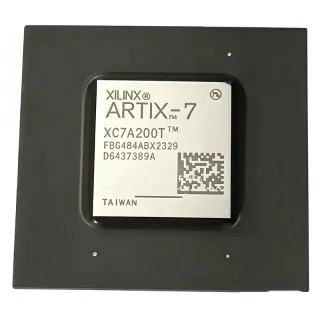
EP4CE30F29I8LN - Cyclone IV E FPGA, 28K LE, 780-BGA | Intel
MPN: EP4CE30F29I8LN ✓ Active| Qty | Unit Price | Extended |
|---|---|---|
| 1 | $168.5 | $168.50 |
| 10 | $152.4 | $1,524.00 |
| 100 | $137.25 | $13,725.00 |
| 500 | $121.8 | $60,900.00 |
| 1,000 | $109.95 | $109,950.00 |
EP4CE30F29I8LN Overview
What is an FPGA? A field-programmable gate array is a semiconductor device built around an array of configurable logic blocks (CLBs), programmable routing, and dedicated hard IP such as block RAM, DSP blocks, and PLLs. FPGAs sit between fixed-function ASICs and software-programmable processors in the design hierarchy: they provide hardware-level parallelism and timing determinism that microcontrollers cannot match, while remaining reprogrammable in the field. The Cyclone IV E family specifically targets low static power consumption (typically under 1.5 W at full utilization) and uses a TSMC 60 nm process node.
Key features of the EP4CE30F29I8LN include 66 embedded 18 x 18 multipliers for DSP operations, 4 general-purpose PLLs for clock management, and support for external memory interfaces including DDR/DDR2 SDRAM and QDRII SRAM. The device operates from a 1.2 V core supply with PLL and I/O banks requiring 2.5 V to 3.3 V, and offers hot-socketing capability for in-system configuration.
The Cyclone IV E architecture pairs a logic-rich fabric with hard PCIe Gen1 x4 IP and a configuration controller that supports JTAG (IEEE 1149.1), Active Serial (AS), and Passive Serial (PS) modes. The I8 speed grade and -40C to +100C industrial temperature range make this OPN (Ordering Part Number) suited to industrial, telecom, and test-and-measurement equipment.
Typical applications for the EP4CE30F29I8LN include industrial motor control, LED video wall drivers, software-defined radio baseband pre-processing, machine vision pre-processing pipelines, and PCI Express endpoint cards in cost-sensitive embedded systems. Designers choose this OPN when 28K logic elements are sufficient and a 780-BGA footprint is acceptable for high-density I/O.
When designing with the EP4CE30F29I8LN, allocate at least eight PCB layers for the 780-BGA breakout and follow Intel's Pin Connection Guidelines to tie unused pins to defined logic levels. Decouple every VCCINT and VCCA pin with 0.1 uF and 10 uF capacitors placed as close as possible to the package balls to meet the simultaneous-switching-noise (SSN) budget.
This page synthesizes distributor pricing, drop-in alternative OPNs from the same Cyclone IV E family, and practical PCB layout notes that go beyond what the manufacturer datasheet alone provides, supporting faster component selection and BOM validation.
Drop-in alternatives for EP4CE30F29I8LN — same package, pin-to-pin compatible. Different-package parts requiring PCB rework are excluded.
Variants in this series
Same-series models that are drop-in compatible with EP4CE30F29I8LN (same form factor and footprint) — differing in Package, Configuration Modes, Speed Grade, Core Voltage (VCCINT), Process Node.
Quick Comparison Tool — Select alternative parts for side-by-side comparison:
EP4CE30F29I8L
✅ Drop-In ⚠️ 参数待验证✓ In Stock
$41.85 / Unit
View Datasheet →EP4CE30F29I7N
✅ Drop-In✓ In Stock
$47.85 / Unit
View Datasheet →EP4CE30F29C8LN
✅ Drop-In📋 Reference alternative (not in catalog)
EP4CE30F29C8N
✅ Drop-In📋 Reference alternative (not in catalog)
EP4CE115F29C8N
✅ Drop-In✓ In Stock
$38.9 / Unit
View Datasheet →EP4CE30F29I8LN Maximum Ratings & Electrical Characteristics
| Family | Cyclone IV E |
| Device Logic Elements | 28,848 |
| Total Memory Bits | 608,256 |
| Embedded Multipliers (18x18) | 66 |
| General Purpose PLLs | 4 |
| Maximum User I/O Pins | 532 |
| Package | 780-BGA (F29, 29 mm) |
| Core Voltage (VCCINT) | 1.2 V |
| I/O Voltage Banks | 2.5 V / 3.3 V |
| Speed Grade | I8 |
| Operating Temperature (Industrial) | -40C to +100C |
| Process Node | 60 nm (TSMC) |
| Mounting Type | Surface Mount (BGA) |
| Configuration Modes | JTAG, Active Serial, Passive Serial |
| RoHS Status | Compliant |
EP4CE30F29I8LN 780-bga (f29, 29 mm) Pin Configuration Guide
Pin configuration for EP4CE30F29I8LN (780-bga (f29, 29 mm) package). This digital IC includes GPIO, communication interfaces (UART, SPI, I2C), and power pins. Refer to the manufacturer datasheet for alternate pin functions and configuration options. Essential for embedded system design and PCB layout.

No detailed pinout data available for EP4CE30F29I8LN.
Refer to the datasheet for full pin configuration.
Typical Applications
EP4CE30F29I8LN is suitable for 6 applications: Industrial Motor Control and Drive, LED Video Wall Display Driver, Software Defined Radio Baseband Pre-Processing, Machine Vision Pre-Processing Pipeline, PCI Express Endpoint Card, Test and Measurement Instrumentation.
Industrial Motor Control and Drive
The EP4CE30F29I8LN fits industrial motor control applications because its 28,848 logic elements and 66 embedded 18x18 multipliers provide sufficient DSP throughput to implement field-oriented control (FOC) loops, space-vector PWM, and encoder decoding for multi-axis AC and servo drives. The 532 user I/Os accommodate multiple quadrature encoder inputs, Hall-sensor feedback, current-sense ADCs, and PWM outputs without external muxing, and the industrial -40C to +100C temperature grade supports cabinet-free deployments on the factory floor.
Recommended
LED Video Wall Display Driver
LED video wall controllers rely on the EP4CE30F29I8LN's 608 Kbits of embedded block RAM to buffer scan-line data and its 532 I/Os to drive long parallel chains of high-speed LED driver buffers without external serializer ICs. The 4 general-purpose PLLs generate multiple pixel-clock domains simultaneously for varied panel resolutions. Compared with an ASIC, the Cyclone IV E cuts time-to-market and lets display OEMs ship multiple panel sizes from a single FPGA design.
Recommended
Software Defined Radio Baseband Pre-Processing
Software-defined radio systems use the EP4CE30F29I8LN as a baseband pre-processor because its 66 DSP blocks implement digital downconversion (DDC), channelization filters, and FFT pre-processing at sample rates up to 250 MSPS. The 60 nm low-power Cyclone IV E process keeps the FPGA below 1.5 W at typical SDR duty cycles, an advantage over higher-power Stratix families. The 780-BGA package supports the high pin count required for parallel ADC/DAC interfaces.
Recommended
Machine Vision Pre-Processing Pipeline
Machine vision systems leverage the EP4CE30F29I8LN's 28K logic elements to implement real-time image pre-processing pipelines including Bayer demosaicing, gamma correction, edge detection, and region-of-interest cropping before data is forwarded to a host processor. The FPGA's hard memory controllers handle high-bandwidth CMOS sensor interfaces (parallel LVDS) without external memory chips, and the industrial temperature grade supports camera deployments near process machinery.
Recommended
PCI Express Endpoint Card
PCIe Gen1 x4 endpoint cards use the EP4CE30F29I8LN because Cyclone IV E integrates a hard PCIe IP block supporting up to Gen1 x4 (2 Gbps per lane), eliminating the need for an external bridge chip. With 28K logic elements available for user logic, designers implement protocol engines, DMA controllers, and device-specific application layers in a single FPGA. The 780-BGA F29 footprint provides sufficient I/O for PCIe edge connector, local bus, and DDR2 memory interface.
Recommended
Test and Measurement Instrumentation
Test and measurement instruments use the EP4CE30F29I8LN for protocol-aware pattern generation, logic analysis state machines, and high-speed data acquisition front-ends. The 4 general-purpose PLLs generate the precise multi-rate clocks required for parallel bus protocols (I2C, SPI, UART, JTAG, MDIO) and the 608 Kbits block RAM buffers deep trace captures. Quartus Prime design flow allows rapid customization of test personalities across product generations without respinning a board.
Recommended
Recommended Products Summary
Engineering reference data for EP4CE30F29I8LN — comparison, design guidance, and compliance information.
Selection Guide
Comparison with Alternatives
| Parameter | This Product | EP4CE30F29I8L | EP4CE30F29I7N | EP4CE30F29C8LN | EP4CE30F29C8N | EP4CE115F29C8N |
|---|---|---|---|---|---|---|
| Brand | Intel (Altera) | Intel (Altera) | Intel (Altera) | Intel (Altera) | Intel (Altera) | Intel (Altera) |
| Package | 780-BGA (F29) | 780-BGA (F29) - same | 780-BGA (F29) - same | 780-BGA (F29) - same | 780-BGA (F29) - same | 780-BGA (F29) - same |
| Logic Elements | 28,848 | 28,848 | 28,848 | 28,848 | 28,848 | 114,480 |
| Speed Grade | I8 (industrial 8) | I8 | I7 (faster) | C8 (commercial 8) | C8 | C8 |
| Temperature Range | -40C to +100C (industrial) | -40C to +100C | -40C to +100C | 0C to +85C (commercial) | 0C to +85C | 0C to +85C |
| RoHS Compliance | Yes (Pb-free N suffix) | No (SnPb balls) | Yes | Yes | Yes | Yes |
| Total Memory Bits | 608,256 | 608,256 | 608,256 | 608,256 | 608,256 | 3,981,312 |
| User I/O Count | 532 | 532 | 532 | 532 | 532 | 528 |
| Embedded 18x18 Multipliers | 66 | 66 | 66 | 66 | 66 | 266 |
Key Differentiators
- Industrial temperature grade I8 speed grade combination (vs EP4CE30F29C8LN)
- RoHS lead-free Pb-free ball finish (vs EP4CE30F29I8L)
- Right-sized 28K logic elements for mid-complexity designs (vs EP4CE115F29C8N)
Design Notes
The 780-BGA F29 package has a 1.0 mm ball pitch requiring at least 8 PCB layers for fanout. Follow Intel's Cyclone IV BGA breakout guidelines: assign inner layers to signal escape routes, dedicate one layer each to GND and VCCINT (1.2 V), and use microvia-in-pad (VIP) technology where possible to break out the inner-row balls. Impedance-controlled 50 ohm single-ended and 100 ohm differential traces must be verified with the PCB stackup planner.
Decouple every VCCINT pin with a 0.1 uF ceramic capacitor placed within 50 mil of the ball, and add one 10 uF bulk capacitor per VCCINT region. The VCCA pins (PLL analog supply) require an LC pi-filter (10 uF + ferrite bead + 0.1 uF) to meet PLL jitter specifications. Estimate: with 28K LE at 60% utilization, expect approximately 800 mA on VCCINT and 200 mA on VCCIO; budget 1.5 A total for the regulator headroom.
Do not leave unused user I/O pins floating - tie each one to a defined logic level (VCCIO or GND via Quartus Prime assignments) to prevent excessive I/O leakage and SSO noise. The MSEL[3:0] pins must be hard-tied to select the configuration mode (AS, PS, JTAG) and cannot be left floating. Also ensure the nCONFIG, nSTATUS, and CONF_DONE pins are pulled up to 3.3 V per Cyclone IV handbook recommendations.
Estimated: at 100% LE utilization toggling at 100 MHz, the EP4CE30F29I8LN dissipates approximately 1.5 W. With a theta_JA of around 15 C/W for the F29 780-BGA package on a standard 8-layer PCB, junction temperature rise above ambient is approximately 22C. For sealed enclosures with no airflow, derate the maximum ambient temperature by 10C or add a small heatsink bonded to the package top with thermal pad.
Compliance Information
RoHS compliant per Intel Cyclone IV E product environmental compliance documentation. Lead-free (Pb-free) ball finish indicated by N suffix in OPN. AEC-Q100 is not applicable since this is an FPGA, not an automotive-grade IC - automotive qualification is left to the OEM integrator.