EPC4QI100N - 4Mb In-System Programmable FPGA Config PROM | Altera (Intel)
MPN: EPC4QI100N ✓ Active| Qty | Unit Price | Extended |
|---|---|---|
| 1 | $18.5 | $18.50 |
| 10 | $16.2 | $162.00 |
| 100 | $13.85 | $1,385.00 |
| 500 | $11.95 | $5,975.00 |
| 1,000 | $10.4 | $10,400.00 |
EPC4QI100N Overview
A configuration PROM is a non-volatile memory device that holds the FPGA's bitstream and, at power-on, serially (or in parallel) clocks that data into the FPGA to define its logic behavior before user code begins executing. Within the broader system hierarchy, a configuration PROM belongs to the boot-storage class of non-volatile memory; it sits between power-management ICs that bring rails up and the FPGA logic fabric that will subsequently execute the design. Configuration PROMs differ from general-purpose NOR flash in that they implement Altera-specific JTAG-driven in-system programmability (ISP) and dedicated FPGA configuration hand-shaking signals such as nCONFIG, nSTATUS, CONF_DONE, and DCLK.
Key features of the EPC4QI100N include 3.3 V single-supply operation (3.0 V to 3.6 V), in-system programmability via IEEE 1149.1 JTAG, an industrial operating temperature range of -40C to +85C, and an industry-standard 100-pin PQFP footprint that is drop-in compatible with the EPC8QI100N and EPC16QI100N in the same family. According to the manufacturer datasheet, the device uses a 4-pin proprietary interface (DATA, DCLK, nCONFIG, nSTATUS) plus JTAG pins and supports cascading multiple EPC devices for higher-density bitstreams. Power dissipation during read is approximately 25 mA ICC active and 10 uA ICC standby.
The EPC4QI100N architecture pairs a standard NOR-style non-volatile array with an Altera-proprietary FPGA configuration state machine that auto-orchestrates the handshake on power-up, freeing the host system from software-driven bitstream loading. Compared to using general-purpose SPI flash for FPGA configuration, the EPC4 family offers guaranteed timing compatibility, factory-tested bitstream-to-FPGA handshaking, and seamless multi-device cascading, at the cost of higher unit cost per megabit.
Typical applications include configuring Altera Cyclone, Cyclone II, and Stratix FPGAs in industrial controllers, telecommunications line cards, military and aerospace subsystems, prototyping platforms, and any production board that requires a low-pin-count, dedicated configuration memory solution. Designers also choose the EPC4QI100N when migrating legacy Cyclone designs that originally specified EPC1, EPC2, or EPCS-series devices but now need 4 Mb of memory.
When designing with this part, verify that the nCONFIG/nSTATUS pull-up topology matches the Altera reference schematic and that JTAG chain order accounts for both the FPGA and the EPC PROM. Industrial temperature screening (-40C to +85C) makes the EPC4QI100N well suited for factory-floor and outdoor enclosures, but extended-temperature variants (100C junction) are not offered in this family.
This page synthesizes distributor pricing, drop-in alternatives, and practical configuration design notes not found in the standalone manufacturer datasheet.
Drop-in alternatives for EPC4QI100N — same package, pin-to-pin compatible. Different-package parts requiring PCB rework are excluded.
Variants in this series
Same-series models that are drop-in compatible with EPC4QI100N (same form factor and footprint) — differing in Memory Size, Memory Type, Package, Operating Temperature, Interface.
Quick Comparison Tool — Select alternative parts for side-by-side comparison:
EPC8QI100N
✓ In Stock
$16.9 / Unit
View Datasheet →EPC16QI100N
✓ In Stock
$10.4 / Unit
View Datasheet →EPC4QI100
✓ In Stock
$19.85 / Unit
View Datasheet →EPC4QC100N
✓ In Stock
$8.1 / Unit
View Datasheet →EPC4QC100
✓ In Stock
$11.4 / Unit
View Datasheet →EPCQ4ASI8N
📋 Reference alternative (not in catalog)
EPC4QI100N Maximum Ratings & Electrical Characteristics
| Memory Type | In-System Programmable Configuration PROM (NOR flash) |
| Memory Size | 4 Mbit (4,194,304 bits) |
| Programmable Type | In System Programmable (ISP via JTAG) |
| Supply Voltage (VCC) | 3.0 V to 3.6 V |
| Interface | Altera serial (x1) configuration + JTAG |
| Operating Temperature | -40C to +85C (industrial) |
| Storage Temperature | -65C to +150C |
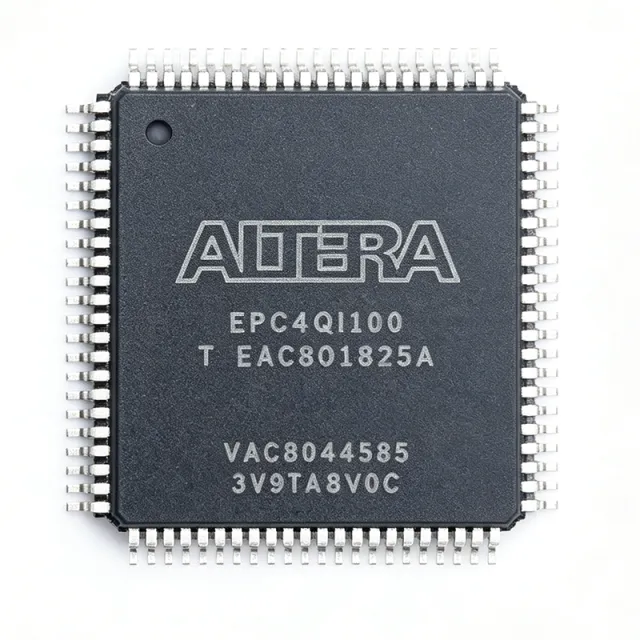
| Package | 100-pin PQFP (PowerPQFP, 20x14 mm) |
| Package Code | QI100 (PQFP-100, industrial) |
| Mounting Type | Surface Mount |
| JTAG Standard | IEEE 1149.1 boundary-scan / ISP |
| Cascading | Supported (multi-device daisy chain) |
| Target FPGAs | Altera Cyclone, Cyclone II, Stratix series |
EPC4QI100N qi100 (pqfp-100, industrial) Pin Configuration Guide
Pin configuration for EPC4QI100N (qi100 (pqfp-100, industrial) package). This digital IC includes GPIO, communication interfaces (UART, SPI, I2C), and power pins. Refer to the manufacturer datasheet for alternate pin functions and configuration options. Essential for embedded system design and PCB layout.

No detailed pinout data available for EPC4QI100N.
Refer to the datasheet for full pin configuration.
Typical Applications
EPC4QI100N is suitable for 6 applications: Altera Cyclone FPGA Configuration (Industrial Controllers), Telecommunications Line Card Boot Memory, Prototyping and Development Boards, Military and Aerospace Subsystems, Test and Measurement Instrumentation, Legacy Cyclone Design Migration.
Altera Cyclone FPGA Configuration (Industrial Controllers)
The EPC4QI100N is the canonical configuration memory for Altera Cyclone-series FPGAs in industrial PLC and motor-control designs. Its 4 Mb capacity comfortably fits EP1C3, EP1C4, EP1C6, and most EP1C12 bitstreams in serial x1 mode, while the 3.0-3.6 V supply matches the Cyclone core rail directly. The industrial -40C to +85C operating range allows deployment in factory-floor enclosures without thermal screening. The JTAG-based ISP allows in-field firmware updates through the existing JTAG chain without removing the PROM, simplifying field service. Compared to SPI NOR flash, the EPC4QI100N provides a guaranteed hand-shaking sequence with the Cyclone's nCONFIG/nSTATUS lines, eliminating software-driven FPGA loading code.
Recommended
Telecommunications Line Card Boot Memory
Telecom line cards typically pair a mid-density Altera FPGA with a dedicated configuration PROM, and the EPC4QI100N is widely deployed in legacy and current-generation designs. The 100-pin PQFP footprint supports standard IR-reflow profiles and the industrial temperature rating suits central-office deployments. The EPC4QI100N's JTAG-based ISP allows remote firmware updates when chained with the FPGA in a single JTAG scan path. The device's low standby current makes it suitable for always-on line cards where the FPGA may be held in reset while the PROM retains the bitstream. Cascading two EPC4QI100N devices in daisy-chain mode can support up to 8 Mb for higher-density FPGAs.
Recommended
Prototyping and Development Boards
FPGA development boards such as Altera's Nios II evaluation kits and many third-party Cyclone/Cyclone II boards use the EPC4QI100N as the on-board boot PROM. Its 4 Mb capacity is sufficient for the bundled reference designs and provides headroom for developer modifications. The JTAG header on these boards programs both the FPGA and the EPC4QI100N in a single chain, accelerating bring-up. Designers can re-use the same Altera Quartus programming flow whether the target is the development kit or the production board, simplifying the transition from prototype to manufacturing.
Recommended
Military and Aerospace Subsystems
Long-lifecycle defense and aerospace programs historically standardized on the EPC4 family because of Altera's controlled die revisions, stable pinout, and extended product support. The EPC4QI100N's industrial -40C to +85C operating range, surface-mount PQFP-100 package, and mature Altera configuration interface make it acceptable for many non-flight-critical subsystems and ground equipment. The dedicated nCONFIG/nSTATUS hand-shaking ensures deterministic FPGA boot, which simplifies DO-254-style verification artifacts. For flight hardware, designers should verify the specific lot and date code against the program's parts approval plan.
Recommended
Test and Measurement Instrumentation
Test instruments such as oscilloscopes, signal generators, and protocol analyzers commonly embed Altera Cyclone or Stratix FPGAs and require a reliable boot PROM. The EPC4QI100N's deterministic DCLK-driven configuration eliminates SPI-flash boot-loader code, reducing firmware complexity and bill of materials. The JTAG chain allows factory calibration routines to verify PROM contents against an expected CRC before passing control to user logic. The PQFP-100 footprint is easy to inspect and rework during prototype bring-up, which is helpful in instruments that go through multiple hardware revisions.
Recommended
Legacy Cyclone Design Migration
Designers migrating from EPC1 (1 Mb) or EPC2 (2 Mb) PROMs to higher-density parts commonly step to the EPC4QI100N as the natural next member of the same family. The 100-pin PQFP footprint on the EPC4QI100N matches the legacy EPC1LC20/EPC2LC20 footprints only with PCB rework, but matches the EPC4QC100/EPC8QI100N/EPC16QI100N footprints directly. The JTAG ISP flow is unchanged across the family, so existing programming tools and fixtures can be reused. This makes the EPC4QI100N a low-risk migration target when an existing EPC1/EPC2 design outgrows its current PROM capacity.
Recommended
Recommended Products Summary
Engineering reference data for EPC4QI100N — comparison, design guidance, and compliance information.
Selection Guide
Comparison with Alternatives
| Parameter | This Product | EPC8QI100N | EPC16QI100N | EPC4QI100 | EPC4QC100N | EPCQ4ASI8N |
|---|---|---|---|---|---|---|
| Brand | Altera (Intel PSG) | Altera (Intel PSG) | Altera (Intel PSG) | Altera (Intel PSG) | Altera (Intel PSG) | Altera (Intel PSG) |
| Package | 100-pin PQFP (20x14 mm) | 100-pin PQFP (20x14 mm) - same | 100-pin PQFP (20x14 mm) - same | 100-pin PQFP (20x14 mm) - same | 100-pin PQFP (20x14 mm) - same | 100-pin PQFP (20x14 mm) - same |
| Supply Voltage | 3.0 V to 3.6 V | 3.0 V to 3.6 V | 3.0 V to 3.6 V | 3.0 V to 3.6 V | 3.0 V to 3.6 V | 3.0 V to 3.6 V |
| In-System Programmability | Yes (JTAG / IEEE 1149.1) | Yes (JTAG) | Yes (JTAG) | Yes (JTAG) | Yes (JTAG) | Yes (JTAG) |
| Cascading Support | Yes (multi-device daisy chain) | Yes | Yes | Yes | Yes | Yes |
| Target FPGAs | Cyclone, Cyclone II, Stratix | Cyclone, Cyclone II, Stratix | Cyclone II, Stratix, Stratix II | Cyclone, Cyclone II, Stratix | Cyclone, Cyclone II, Stratix | Cyclone, Cyclone II, Stratix |
Key Differentiators
- Same PQFP-100 footprint across the EPC4 family for scalable density (vs EPC8QI100N (8 Mb) and EPC16QI100N (16 Mb))
- Industrial -40C to +85C temperature range (vs EPC4QC100N (commercial 0C to +70C))
- Dedicated Altera configuration interface vs general-purpose SPI flash (vs Generic SPI NOR flash (e.g. W25Q-series) used as configuration memory)
Design Notes
Place the EPC4QI100N as close as possible to the target FPGA's DATA and DCLK pins to minimize trace length and avoid reflections. Series-terminate DCLK with a 33 ohm resistor if the trace exceeds 25 mm or crosses a connector, and route nCONFIG and nSTATUS away from switching power nodes. Provide a 0.1 uF decoupling capacitor within 3 mm of every VCC pin and a single 10 uF bulk capacitor near the device. The JTAG signals (TCK, TMS, TDI, TDO) should be routed as a bus with consistent spacing and a chain topology that matches the schematic order.
Estimated: with VCC = 3.3 V and the EPC4QI100N in active configuration, the device draws approximately 25 mA from the 3.3 V rail (per family datasheet). During idle standby, current drops to single-digit microamps. For a 4-Mbit configuration lasting ~50 ms at startup, average current draw is negligible for thermal design but designers should still budget 100 mA peak on the 3.3 V rail to cover inrush. Tie all unused inputs (including the JTAG TRST if not used) through a 10 kohm resistor to a defined logic level to avoid floating-pin supply leakage.
A common design mistake is omitting the pull-up resistors on nCONFIG and nSTATUS - the Altera reference design specifies 10 kohm pull-ups to VCC. Without them, the FPGA may fail to recognize the PROM and remain in reset. Another pitfall is ordering the EPC4QI100N (industrial temp) when the design only needs commercial temperature; the EPC4QC100N is a pin-compatible commercial-temp alternative at lower cost. Finally, do not place the EPC4QI100N on the same JTAG chain segment as devices with non-3.3 V JTAG logic levels - use a level shifter or place the PROM in its own chain segment.
The Altera serial configuration interface uses DCLK as a unidirectional clock sourced by the FPGA, with DATA returning from the EPC4QI100N. The DATA edge should be sampled on the rising edge of DCLK at the FPGA - place a series resistor on DATA (typically 33 ohm) to dampen reflections on long traces. CONF_DONE and nSTATUS are open-drain signals that require external pull-ups; verify their pull-up voltage matches VCCIO of the FPGA's configuration bank. Multi-device cascading requires the nCASC pin to be connected correctly; consult the EPC4 datasheet's cascading section before laying out a multi-PROM chain.
Compliance Information
RoHS / REACH compliance not explicitly confirmed in the verified web data; verify with distributor CoC. The 'N' suffix on Altera PROMs typically indicates lead-free terminal finish but should be confirmed against the latest material declaration before compliance-critical designs.