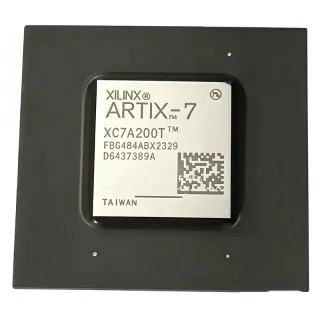
EPF10K50EFC256-3 - 50K Gates FLEX 10KE FPGA, 256-BGA | Intel / Altera
MPN: EPF10K50EFC256-3 ⚠ Last Time Buy| Qty | Unit Price | Extended |
|---|---|---|
| 1 | $89.5 | $89.50 |
| 10 | $78.2 | $782.00 |
| 100 | $65.4 | $6,540.00 |
| 500 | $54.1 | $27,050.00 |
| 1,000 | $46.75 | $46,750.00 |
EPF10K50EFC256-3 Overview
An FPGA (Field-Programmable Gate Array) is a type of programmable logic device (PLD) — semiconductor integrated circuits that can be configured by the customer after manufacturing to implement arbitrary digital logic. Within the broader hierarchy, FPGAs belong to the PLD family, which sits under logic ICs and ultimately semiconductor devices. Unlike fixed-function ASICs, FPGAs integrate configurable logic blocks (LABs in Altera terminology), programmable interconnect, and embedded array blocks (EABs) that include on-chip memory. The FLEX 10KE generation introduced embedded dual-port RAM via EABs and FastTrack interconnect for high-speed designs.
Key features of the EPF10K50EFC256-3 include 40,960 bits of embedded memory distributed across 10 EABs, 191 maximum user I/O pins, 5.0V tolerant inputs with 2.5V VCCINT core voltage, MultiVolt I/O interface support for mixed-voltage systems, and 4-input look-up table (LUT) based logic elements. The -3 speed grade provides the highest performance tier in the FLEX 10KE family, suitable for high-throughput glue logic, bus interfacing, and DSP co-processing.
Architecturally, the device uses the proven FLEX 10KE fabric with each LAB containing 8 logic elements (LEs), each LE built around a 4-input LUT, a programmable register, and a carry chain for fast arithmetic. The 10 embedded array blocks (EABs) implement dual-port RAM of up to 2,048 bits each, totaling 40,960 bits of block RAM, with true dual-port and parity options. Programmable FastTrack interconnect provides continuous routing rows and columns, and the I/O elements (IOEs) include registers, JTAG support, and MultiVolt compatibility.
Typical applications for the EPF10K50EFC256-3 include telecommunications line cards and cross-connects, industrial control and factory automation glue logic, military and aerospace signal processing, PCI bus interface controllers, DSP co-processors, and legacy system redesigns. The 256-FBGA FineLine BGA package and 2.5V core make it appropriate for compact, high-density designs where board area is constrained and a moderate logic capacity (50K gates) is sufficient.
When designing with this part, engineers should note that it is in the FLEX 10KE lifecycle and is generally considered mature/last-time-buy on Intel's product cycle, so pin-compatible drop-in alternatives (other FLEX 10KE members in the same 256-FBGA, such as EPF10K30EFC256-3 and EPF10K100EFC484-3 in larger packages) should be evaluated alongside new-generation Cyclone or MAX families for new designs.
This page synthesizes distributor pricing (Mouser/Heisener), verified Altera/Intel datasheet specifications, drop-in replacement alternatives from the same FLEX 10KE family, and engineering design notes — context not found in the manufacturer datasheet alone.
Drop-in alternatives for EPF10K50EFC256-3 — same package, pin-to-pin compatible. Different-package parts requiring PCB rework are excluded.
Variants in this series
Same-series models that are drop-in compatible with EPF10K50EFC256-3 (same form factor and footprint) — differing in Package, Process Technology, Logic Array Blocks (LABs), Logic Elements / Cells, Embedded Array Blocks (EABs).
Quick Comparison Tool — Select alternative parts for side-by-side comparison:
EPF10K50EFC256-3N
✅ Drop-In📋 Reference alternative (not in catalog)
EPF10K50EFC256-2
✅ Drop-In📋 Reference alternative (not in catalog)
EPF10K50EFC256-1
✅ Drop-In ⚠️ 参数待验证📋 Reference alternative (not in catalog)
EPF10K30EFC256-3
✅ Drop-In✓ In Stock
$24.6 / Unit
View Datasheet →EPF10K30EFC256-3N
✅ Drop-In✓ In Stock
$58 / Unit
View Datasheet →EPF10K50EFC256-3 Maximum Ratings & Electrical Characteristics
| Family | FLEX 10KE |
| Logic Elements / Cells | 2880 |
| Typical Gates | 50,000 |
| Logic Array Blocks (LABs) | 360 |
| Embedded Array Blocks (EABs) | 10 |
| Total Embedded Memory | 40,960 bits |
| Maximum User I/Os | 191 |
| Package | 256-pin FineLine BGA (FBGA-256) |
| Core Voltage (VCCINT) | 2.5 V |
| I/O Tolerance | 5.0 V (MultiVolt I/O interface) |
| Process Technology | 0.42 µm CMOS, SRAM-based |
| Internal Frequency (max) | 166.67 MHz |
| Propagation Delay (typical) | 0.6 ns |
| Speed Grade | -3 |
| Operating Temperature | 0 °C to +70 °C (Commercial) |
| JTAG Support | IEEE Std. 1149.1 Boundary-Scan |
| Programming Method | In-system SRAM, JTAG or EPC configuration device |
| RoHS Status | Compliant |
EPF10K50EFC256-3 256-pin fineline bga (fbga-256) Pin Configuration Guide
Pin configuration for EPF10K50EFC256-3 (256-pin fineline bga (fbga-256) package). This digital IC includes GPIO, communication interfaces (UART, SPI, I2C), and power pins. Refer to the manufacturer datasheet for alternate pin functions and configuration options. Essential for embedded system design and PCB layout.

No detailed pinout data available for EPF10K50EFC256-3.
Refer to the datasheet for full pin configuration.
Typical Applications
EPF10K50EFC256-3 is suitable for 6 applications: Telecommunications Line Cards & Cross-Connects, Industrial Control & Factory Automation Glue Logic, Legacy PCI Bus Interface Controllers, DSP Co-Processor & FIR Filter Acceleration, Military & Aerospace Signal Processing (Legacy), Test Equipment & Instrumentation Backplanes.
Telecommunications Line Cards & Cross-Connects
The EPF10K50EFC256-3's 50K-gate capacity, 191 user I/Os, and 5.0V MultiVolt I/O tolerance make it well-suited for legacy telecom line cards where it implements T1/E1 framers, channel-associated signaling glue logic, and cross-connect switching fabrics. Its 166.67 MHz internal frequency handles backplane bus rates common in central-office equipment, while the 256-FBGA package fits the high-density backplane PCB form factor. The JTAG 1149.1 boundary-scan simplifies in-system board test, and the embedded 40,960-bit EAB RAM is sufficient for small lookup tables and buffer pools. For new designs, Cyclone IV has superseded FLEX 10KE, but legacy installed bases continue to use this part.
Recommended
Industrial Control & Factory Automation Glue Logic
In industrial PLC and motor-control systems, the EPF10K50EFC256-3 serves as glue logic between microcontrollers, sensor front-ends, and high-voltage driver stages. The 5.0V-tolerant I/O directly interfaces with legacy 5V industrial sensors and 24V opto-isolated inputs without level shifters, simplifying the analog front-end. Its 0.6 ns propagation delay (-3 speed grade) is fast enough for real-time control loops in motor drives, and the 191 I/Os accommodate multiple encoder, resolver, and PWM channels. The 0-70 °C commercial operating range is suitable for factory-floor enclosures, and the JTAG boundary-scan enables automated factory test.
Recommended
Legacy PCI Bus Interface Controllers
The EPF10K50EFC256-3 was a popular choice for implementing PCI 2.1 bus interface controllers in late-1990s and early-2000s designs. Its 50K-gate capacity supports a full 32-bit/33 MHz PCI target or master core plus sideband logic, and the 191 user I/Os are sufficient for 32-bit multiplexed address/data plus control signals. The 2.5V core with 5.0V MultiVolt I/O directly drives the 5V PCI slot signals. The 10 EABs (40,960 bits) provide internal buffer memory for PCI bursts. New PCI Express designs should use Cyclone IV/V with PCIe hard IP, but PCI/PCI-X legacy add-in cards continue to use this part.
Recommended
DSP Co-Processor & FIR Filter Acceleration
The EPF10K50EFC256-3 functions as a DSP co-processor in radar, sonar, and baseband signal-processing systems. Its 360 LABs and 10 EABs allow implementation of parallel FIR filters, FFT butterflies, and correlators with deterministic latency. The 166.67 MHz internal frequency supports sample rates up to 100 MHz in pipelined DSP architectures, while the 4-input LUTs can be configured as small 16x4 ROMs for coefficient storage. The 5.0V I/O tolerance simplifies interface to legacy ADC/DAC front-ends. For higher-density DSP, the FLEX 10KE EPF10K100 or Cyclone III/IV families offer more logic capacity at similar price points.
Recommended
Military & Aerospace Signal Processing (Legacy)
The EPF10K50EFC256-3's commercial 0-70 °C temperature grade has limited its deployment in modern military programs, but it remains in long-lifecycle aerospace systems, avionics test equipment, and legacy radar processors. Designers should pair the part with industrial-temperature memory and qualify the full BOM for the target environment. The 256-FBGA package offers excellent shock/vibration resistance compared to QFP packages, and the SRAM-based configuration allows field firmware updates via JTAG. For new military designs, the FLEX 10KE has been superseded by radiation-hardened FPGAs from Microsemi/Microchip and Xilinx.
Recommended
Test Equipment & Instrumentation Backplanes
The EPF10K50EFC256-3 is used in ATE (Automated Test Equipment), oscilloscope backplanes, and logic-analyzer probe pods where its 191 I/Os accommodate many parallel test channels. The 5.0V-tolerant I/O directly drives legacy TTL-level test fixtures, and the 50K-gate capacity allows implementation of complex timing generators, pattern sequencers, and result-capture FIFOs. The 10 EABs provide local buffer memory for waveform storage, and the JTAG interface enables in-system test of the populated board before final integration. The 0.6 ns propagation delay (-3 speed) is sufficient for sub-ns timing edges in high-speed test applications.
Recommended
Recommended Products Summary
Engineering reference data for EPF10K50EFC256-3 — comparison, design guidance, and compliance information.
Selection Guide
Comparison with Alternatives
| Parameter | This Product | EPF10K50EFC256-3N | EPF10K50EFC256-2 | EPF10K30EFC256-3 | EPF10K30EFC256-3N |
|---|---|---|---|---|---|
| Brand | Intel (formerly Altera) | Intel | Intel | Intel | Intel |
| Package | 256-FBGA FineLine BGA | 256-FBGA FineLine BGA (same) | 256-FBGA FineLine BGA (same) | 256-FBGA FineLine BGA (same) | 256-FBGA FineLine BGA (same) |
| Family | FLEX 10KE | FLEX 10KE | FLEX 10KE | FLEX 10KE | FLEX 10KE |
| Logic Elements / Cells | 2880 | 2880 | 2880 | 1728 | 1728 |
| Typical Gates | 50K | 50K | 50K | 30K | 30K |
| Embedded Memory (EAB) | 40,960 bits (10 EABs) | 40,960 bits | 40,960 bits | 24,576 bits (6 EABs) | 24,576 bits (6 EABs) |
| User I/Os | 191 | 191 | 191 | 191 | 191 |
| Speed Grade / Internal Frequency | -3 / 166.67 MHz | -3 / 166.67 MHz | -2 / ~125 MHz | -3 / 166.67 MHz | -3 / 166.67 MHz |
| Core Voltage | 2.5 V | 2.5 V | 2.5 V | 2.5 V | 2.5 V |
| Lead-Free / RoHS | Standard (SnPb) | Lead-free (Pb-free) / RoHS | Standard (SnPb) | Standard (SnPb) | Lead-free (Pb-free) / RoHS |
Key Differentiators
- Industry-standard FLEX 10KE architecture with mature Quartus support (vs Generic 50K-gate Xilinx XC4000-series FPGAs)
- MultiVolt 5.0V I/O tolerance without level shifters (vs Modern Cyclone IV EP4CE6E22C8N)
- 256-FBGA FineLine BGA package offers high-density I/O in compact footprint (vs EPF10K50EQC240 (240-pin PQFP))
Design Notes
The EPF10K50EFC256-3 requires a 2.5V core supply (VCCINT) with typical Icore of ~200-400 mA depending on switching activity. The 5.0V MultiVolt I/O interfaces directly to 5V TTL/CMOS without external level shifters, but each bank can be configured for 3.3V or 2.5V VCCIO independently. Decouple VCCINT with 0.1 µF X7R ceramic + 10 µF tantalum per supply pin, placed within 5 mm of the BGA via. Power sequencing is generally not required between VCCINT and VCCIO for FLEX 10KE, but consult the datasheet section on hot-socketing if in-system insertion is required.
The 256-FBGA FineLine BGA has 1.0 mm pitch. PCB layout requires 4-6 layer stackup with continuous ground plane under the BGA, microvia or via-in-pad escape routing for inner rows, and 0.5 oz copper on outer layers with 1 oz on inner power/ground planes. Signal trace impedance should be 50 Ω single-ended / 100 Ω differential. Place configuration EEPROM (EPC2/EPC4/EPC8) and 33 Ω series-termination resistors close to the FPGA configuration pins. Use at least 8 ground vias distributed under the BGA thermal pad for thermal dissipation.
Three common pitfalls when designing with EPF10K50EFC256-3: (1) Forgetting that the configuration bitstream must be reloaded at every power-up — use an EPC-series configuration ROM or JTAG-driven boot loader, the device has no internal flash. (2) Confusing 'C' (commercial 0-70 °C) with 'I' (industrial -40-85 °C) suffixes — only the EPF10K50EFC256-3 is verified for 0-70 °C, not for industrial environments. (3) Mixing FLEX 10K (5V core) and FLEX 10KE (2.5V core) bitstreams — they are not interchangeable. Always verify the device ID over JTAG before programming.
The 5.0V MultiVolt I/O outputs have ~2-3 ns edge rates. For high-speed buses (>50 MHz), use series-termination resistors (22-33 Ω) at the driver to control ringing and over/undershoot. The FLEX 10KE supports LVTTL, LVCMOS, PCI, and SSTL I/O standards; consult the datasheet's I/O standard table for VCCIO requirements per standard. For PCI 33 MHz applications, no external termination is required because the FPGA's PCI-compliant I/O drivers include the necessary impedance matching.
Compliance Information
Standard EPF10K50EFC256-3 uses SnPb terminal finish (NOT lead-free). For RoHS Pb-free assembly, choose EPF10K50EFC256-3N suffix variant. Not AEC-Q100 qualified (commercial 0-70 °C only); for industrial -40-85 °C use the 'I' suffix variant. Halogen-free per Altera legacy materials declaration. REACH compliant per Intel product stewardship.