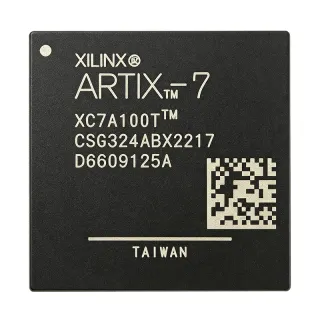
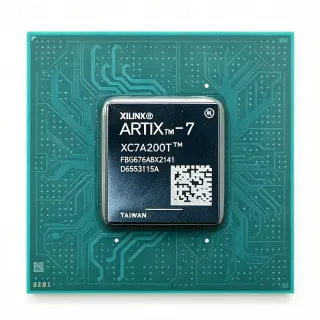
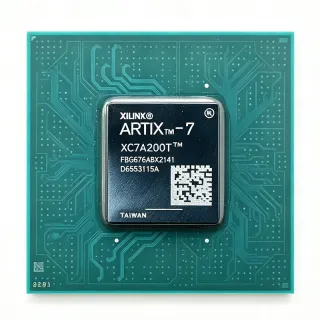
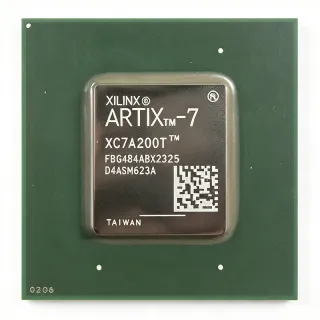
EPF10K30EFC256-3 - 30K FLEX 10KE FPGA, 1728 Cells, 256-BGA | Intel
MPN: EPF10K30EFC256-3 ✗ End of Life| Qty | Unit Price | Extended |
|---|---|---|
| 1 | $42.5 | $42.50 |
| 10 | $38.2 | $382.00 |
| 100 | $32.5 | $3,250.00 |
| 500 | $27.8 | $13,900.00 |
| 1,000 | $24.6 | $24,600.00 |
EPF10K30EFC256-3 Overview
A Field Programmable Gate Array (FPGA) is a programmable logic device (PLD) that combines gate-array-equivalent logic density with configurable interconnect, embedded memory blocks, and an I/O ring that can be programmed for multiple voltage and timing standards. FPGAs belong to the broader hierarchy: programmable logic device (PLD) -> FPGA -> SRAM-based FPGA -> look-up-table (LUT) + embedded-block architecture. The FLEX 10KE family pioneered embedded array block (EAB) integration for on-chip RAM and ROM, enabling single-chip implementation of memory-intensive functions like FIFOs and DSP datapaths.
Key features of the EPF10K30EFC256-3 include 216 logic array blocks (LABs), a built-in Joint Test Action Group (JTAG) boundary-scan interface (IEEE Std 1149.1 compliant), multi-voltage I/O standards support (LVTTL, LVCMOS, PCI), and the Altera SameFrame pin-compatibility migration path that allows board reuse across the 256-pin FineLine BGA family. The -3 speed grade targets designs where the highest toggle rates and shortest combinatorial delays are required.
Architecturally, the FLEX 10KE device connects each LAB through a continuous FastTrack Interconnect routing fabric, while embedded array blocks provide true dual-port RAM capability. Compared with pure gate-array ASICs, the FLEX 10KE family offers instant prototyping, in-system reconfigurability through the serial configuration device interface, and significantly lower non-recurring engineering (NRE) cost for low-to-medium-volume production.
Typical applications include telecommunications line cards, industrial control and factory automation backplanes, networking routers and switches, PCI bus bridges, and legacy ASIC-replacement designs. The 256-FBGA footprint and SameFrame pin migration also enable straightforward board reuse across the FLEX 10K family density ladder.
When designing with the EPF10K30EFC256-3, ensure that the configuration EPROM (EPC8 or equivalent) is correctly sized for the device bitstream and that all 2.5 V VCCINT and 3.3 V VCCIO rails are properly decoupled with bulk and high-frequency ceramic capacitors near the BGA balls.
This page synthesizes distributor pricing, SameFrame drop-in alternatives within the FLEX 10K family, and practical design notes that supplement the manufacturer datasheet to accelerate component selection.
Drop-in alternatives for EPF10K30EFC256-3 — same package, pin-to-pin compatible. Different-package parts requiring PCB rework are excluded.
Variants in this series
Same-series models that are drop-in compatible with EPF10K30EFC256-3 (same form factor and footprint) — differing in Package, Process Technology, Operating Temperature, Speed Grade, Core Supply Voltage.
Quick Comparison Tool — Select alternative parts for side-by-side comparison:
EPF10K30EFC256-2
✅ Drop-In✓ In Stock
$12.1 / Unit
View Datasheet →EPF10K30EFC256-1
✅ Drop-In✓ In Stock
$69.5 / Unit
View Datasheet →EPF10K30EFC256-2X
✅ Drop-In✓ In Stock
$17.95 / Unit
View Datasheet →EPF10K30EFC256-2N
✅ Drop-In✓ In Stock
$48.57 / Unit
View Datasheet →EPF10K30EFC256-2XN
✅ Drop-In✓ In Stock
$9.8 / Unit
View Datasheet →EPF10K30EFC256-3N
✅ Drop-In✓ In Stock
$58 / Unit
View Datasheet →EPF10K30EFC256-3 Maximum Ratings & Electrical Characteristics
| Family | FLEX 10KE |
| Typical Gates | 30,000 |
| Logic Elements / Cells | 1,728 |
| Logic Array Blocks (LABs) | 216 |
| Embedded RAM Bits | 24,576 |
| User I/O Pins | 176 |
| Maximum Operating Frequency | 200 MHz |
| Process Technology | 0.22 micrometer CMOS |
| Core Supply Voltage (VCCINT) | 2.5 V |
| I/O Supply Voltage (VCCIO) | 3.3 V (multi-voltage I/O standard support) |
| Package | 256-ball FineLine BGA |
| Mounting Type | Surface Mount (BGA) |
| Speed Grade | -3 (fastest) |
| Temperature Grade | Commercial |
| Configuration Interface | Serial (EPC8/EPC16) and JTAG (IEEE 1149.1) |
EPF10K30EFC256-3 256-ball fineline bga Pin Configuration Guide
Pin configuration for EPF10K30EFC256-3 (256-ball fineline bga package). This digital IC includes GPIO, communication interfaces (UART, SPI, I2C), and power pins. Refer to the manufacturer datasheet for alternate pin functions and configuration options. Essential for embedded system design and PCB layout.

No detailed pinout data available for EPF10K30EFC256-3.
Refer to the datasheet for full pin configuration.
Typical Applications
EPF10K30EFC256-3 is suitable for 6 applications: Telecommunications Line Cards, Industrial Control and Factory Automation, PCI Bus Bridge / Glue Logic, Networking Router and Switch Line-Card Glue, ASIC Replacement / Legacy Glue Logic, Test and Measurement Instrumentation Front-End.
Telecommunications Line Cards
The EPF10K30EFC256-3 fits telecommunications line cards where 30K gates of glue logic must glue framers, mappers, and physical-layer devices with deterministic 200 MHz performance. Its 24,576 embedded RAM bits simplify on-chip FIFO buffers between serial data paths and the backplane, while the 176 user I/O accommodate 16-bit buses plus serial control links. Compared with a CPLD-based design, the FLEX 10KE provides higher integration and shorter worst-case combinatorial paths, while still supporting JTAG-driven in-system reconfigurability for field upgrades.
Recommended
Industrial Control and Factory Automation
In factory automation backplanes, the EPF10K30EFC256-3 functions as a multi-protocol bridge that consolidates Profibus, EtherCAT, and discrete I/O scanning without an additional ASIC. Its 1,728 logic cells and 200 MHz fMAX support 32-bit datapath glue logic at typical industrial bus speeds (12 MHz SPI, 25 MHz parallel), while the 256-FBGA package provides mechanical robustness for vibration-prone factory environments. The SameFrame pin-compatibility lets designers migrate later to higher-density FLEX 10K parts (e.g., EPF10K100EFC256) without re-laying-out the PCB.
Recommended
PCI Bus Bridge / Glue Logic
The EPF10K30EFC256-3 is well-suited as a PCI bus bridge or address-mapper between a host processor and peripheral ASICs, where its 200 MHz internal frequency and 176 I/O support both 32-bit PCI (33 MHz) and a wide local bus concurrently. The 24 Kbit of embedded RAM enable fast transaction FIFOs and small cache structures, eliminating external SRAM and saving board area. Multi-voltage I/O standards (LVTTL/LVCMOS at 3.3 V plus 5.0 V PCI compatibility via open-drain with pull-up) simplify host bridge designs.
Recommended
Networking Router and Switch Line-Card Glue
In networking line cards, the EPF10K30EFC256-3 provides glue between PHY/MAC devices, switch fabrics, and lookup memories where its 1,728 logic cells and 200 MHz fMAX are enough for header parsing, queue management, and statistics counters. The embedded RAM blocks accelerate small CAM emulations and rate-limiters, while 176 I/O permit multiple SGMII/SerDes-adjacent interfaces plus management bus access. Designers can later migrate to the EPF10K100EFC256 in the same 256-FBGA footprint for higher port density.
Recommended
ASIC Replacement / Legacy Glue Logic
For designs that need to replace an aging ASIC or hard-to-source gate-array part, the EPF10K30EFC256-3 offers 30K typical gates of reprogrammable logic that can be re-spun instantly, eliminating NRE charges and shortening time-to-market. Its 200 MHz system frequency and PCI-compliant I/O support the timing and signaling needs of legacy 33 MHz/66 MHz bus systems, while the JTAG interface simplifies board-level test and in-field updates. SameFrame pin-compatibility with other FLEX 10K family members provides an in-design density upgrade path.
Recommended
Test and Measurement Instrumentation Front-End
In test and measurement instruments (logic analyzers, protocol analyzers, ATE fixtures), the EPF10K30EFC256-3 can implement custom capture sequencers, pattern generators, and trigger logic with deterministic 200 MHz timing. The 24,576 bits of embedded RAM buffer pre-trigger samples, while 176 user I/O drive high-density probe pods and parallel DAC buses. JTAG-based configuration allows fixture reprogramming for each new device-under-test, supporting rapid test-plan iteration.
Recommended
Recommended Products Summary
Engineering reference data for EPF10K30EFC256-3 — comparison, design guidance, and compliance information.
Selection Guide
Comparison with Alternatives
| Parameter | This Product | EPF10K30EFC256-2 | EPF10K30EFC256-1 | EPF10K30EFC256-2X | EPF10K30EFC256-2N | EPF10K30EFC256-3N |
|---|---|---|---|---|---|---|
| Brand | Intel (formerly Altera) | Intel (Altera) | Intel (Altera) | Intel (Altera) | Intel (Altera) | Intel (Altera) |
| Package | 256-ball FineLine BGA | 256-ball FineLine BGA - same | 256-ball FineLine BGA - same | 256-ball FineLine BGA - same | 256-ball FineLine BGA - same | 256-ball FineLine BGA - same |
| Speed Grade | -3 (fastest, 200 MHz fMAX) | -2 | -1 | -2X (industrial temp) | -2 (Pb-free) | -3 (Pb-free) |
| Logic Cells | 1,728 | 1,728 | 1,728 | 1,728 | 1,728 | 1,728 |
| Embedded RAM Bits | 24,576 | 24,576 | 24,576 | 24,576 | 24,576 | 24,576 |
| User I/O Pins | 176 | 176 | 176 | 176 | 176 | 176 |
| Typical Gates | 30K | 30K | 30K | 30K | 30K | 30K |
Key Differentiators
- Fastest speed grade in the FLEX 10K 30K-gate 256-FBGA family (vs EPF10K30EFC256-2)
- SameFrame pin-compatible with higher-density FLEX 10K parts (vs EPF10K100EFC256-3)
- Reprogrammable, in-system configurable via JTAG (vs ASIC replacement scenarios)
Design Notes
Decouple each VCCINT (2.5 V) and VCCIO (3.3 V) ball group with at least one 0.1 microfarad X7R ceramic capacitor placed within 5 mm of the BGA, plus a 10 microfarad tantalum or polymer bulk capacitor per supply plane. FPGAs draw high transient currents during configuration and during logic transitions; inadequate decoupling causes VCC droop and JTAG configuration failures. Source: Altera FLEX 10KE hardware guidelines.
The 256-ball FineLine BGA requires a 4-6 layer PCB with microvia fan-out or dog-bone escape routing for inner-row balls. Match the BGA pad diameter and solder mask defined (NSMD) pad geometry to the FLEX 10KE reference footprint for reliable assembly. Estimated: For a 1 mm pitch FineLine BGA, a 0.5 mm pad with 0.6 mm solder mask opening is a typical starting point - confirm against assembly house capability.
Do not reuse MSEL pin settings from a different FLEX 10K family member without verifying against the EPF10K30 datasheet - misconfigured MSEL pins can prevent configuration entirely. Always connect nCONFIG, nSTATUS, and CONF_DONE through the recommended pull-up resistor values from the datasheet, and verify the configuration EPC8/EPC16 device is correctly sized for the 1,728-cell / 24 Kbit bitstream of this specific device.
Compliance Information
RoHS/REACH/lead-free status not explicitly captured in the verified web data; 'N'-suffix variants (e.g., EPF10K30EFC256-3N) typically denote Pb-free finish per Altera ordering convention. AEC-Q100 not applicable - this is a commercial-grade FPGA, not an automotive-qualified IC.