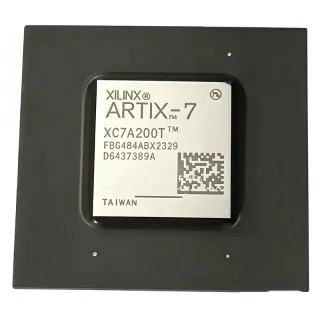
EPF81500AGC280-3 - FLEX 8000 FPGA 16K Gates 280-CPGA | Intel
MPN: EPF81500AGC280-3 ⚠ Last Time Buy| Qty | Unit Price | Extended |
|---|---|---|
| 1 | $285 | $285.00 |
| 10 | $245 | $2,450.00 |
| 50 | $215 | $10,750.00 |
| 100 | $195 | $19,500.00 |
| 250 | $175 | $43,750.00 |
EPF81500AGC280-3 Overview
A Field-Programmable Gate Array (FPGA) is a semiconductor device built around an array of configurable logic blocks (CLBs) connected by programmable interconnect. FPGAs sit within the broader taxonomy of programmable logic devices (PLDs) -> logic ICs -> integrated circuits. The FLEX 8000 family, introduced by Altera in the 1990s, was register-rich and SRAM-based, targeting system-level integration and in-circuit reconfigurability (ICR). This generation preceded modern SRAM-based FPGAs and is now classified as legacy hardware by Intel, which acquired Altera in 2015.
Key features include 1296 logic cells, a maximum internal frequency of 125 MHz in some datasheet figures, 204 I/O outputs, in-circuit reconfigurability via external configuration devices or intelligent controllers, and a commercial 0°C to +70°C operating range. The device supports system-level features including JTAG boundary-scan test, multi-volt I/O compatibility, and built-in JTAG-based reconfiguration. The FLEX 8000 architecture enables designers to integrate wide bus functions and complex state machines on a single chip.
Typical applications include legacy telecom switching systems, industrial control logic, prototyping glue logic for microprocessor systems, and embedded designs requiring high register count. The 280-CPGA package also made it popular in aerospace, military, and high-reliability through-hole designs where surface-mount BGA packages were unsuitable. Engineers working with industrial retrofits often specify the EPF81500AGC280-3 to maintain long-lifecycle designs already in field deployment.
When designing with this device, verify configuration memory requirements and supply decoupling. The FLEX 8000 family requires an external EPROM or microcontroller for SRAM-based configuration at every power-up. The commercial temperature grade limits this variant to benign environments; the EPF81500AGI280-3 industrial variant is preferred for extended-temperature designs. Designers should also consider that this part is now classified as legacy, and modern alternatives from Intel's Cyclone or MAX families offer higher density at lower cost.
This page synthesizes distributor pricing, drop-in alternatives, and practical design notes not found in the manufacturer datasheet alone.
Drop-in alternatives for EPF81500AGC280-3 — same package, pin-to-pin compatible. Different-package parts requiring PCB rework are excluded.
Variants in this series
Same-series models that are drop-in compatible with EPF81500AGC280-3 (same form factor and footprint) — differing in Mounting Type, Configuration Method, Package, Process Technology, Usable Gates.
Quick Comparison Tool — Select alternative parts for side-by-side comparison:
EPF81500AGI280-3
✅ Drop-In📋 Reference alternative (not in catalog)
EPF81500AGC280-4
✅ Drop-In✓ In Stock
$21.2 / Unit
View Datasheet →EPF81500AGC280-2
✅ Drop-In ⚠️ 参数待验证📋 Reference alternative (not in catalog)
EPF81500AGC280-3 Maximum Ratings & Electrical Characteristics
| Family | FLEX 8000 |
| Usable Gates | 16,000 |
| Logic Elements / Cells | 1,296 |
| Registers | 1,500 |
| Maximum I/O Pins | 204 |
| Pin-to-Pin Propagation Delay | 1.8 ns |
| Maximum Internal Frequency | 385 MHz |
| Process Technology | 0.42 µm CMOS |
| Core Supply Voltage | 5 V |
| Operating Temperature Range | 0 °C to +70 °C (Commercial) |
| Package | 280-pin CPGA (Ceramic Pin Grid Array) |
| Mounting Type | Through-Hole (Pin Grid Array) |
| Configuration Method | SRAM, external configuration device required |
| In-Circuit Reconfigurability (ICR) | Yes (via external configuration devices or intelligent controllers) |
EPF81500AGC280-3 280-pin cpga (ceramic pin grid array) Pin Configuration Guide
Pin configuration for EPF81500AGC280-3 (280-pin cpga (ceramic pin grid array) package). This digital IC includes GPIO, communication interfaces (UART, SPI, I2C), and power pins. Refer to the manufacturer datasheet for alternate pin functions and configuration options. Essential for embedded system design and PCB layout.

No detailed pinout data available for EPF81500AGC280-3.
Refer to the datasheet for full pin configuration.
Typical Applications
EPF81500AGC280-3 is suitable for 6 applications: Legacy Telecom Switching Systems, Industrial Control Logic, Glue Logic for Microprocessor Systems, Aerospace and Military Through-Hole Designs, Test and Measurement Instrumentation, Retrofit and Field-Replacement Designs.
Legacy Telecom Switching Systems
The EPF81500AGC280-3 is well suited to legacy telecom switching infrastructure where its 1,500-register count enables implementation of complex call-routing state machines and frame buffering. The 280-CPGA package's high pin count (204 I/O) supports wide parallel backplane buses typical of Class 4/5 switching systems. Its 1.8 ns propagation delay and 125 MHz internal clock allow time-division multiplexing at standard E1/T1 rates. The 5 V supply aligns with telecom central-office power rails. Although the FLEX 8000 family is legacy, telecom operators maintain deployed systems for decades, and the EPF81500AGC280-3 remains in service for spare-part replacement.
Recommended
Industrial Control Logic
The EPF81500AGC280-3's register-rich architecture and 204 I/O pins enable integration of multiple PLC-style control loops, sensor multiplexing, and actuator drivers on a single programmable device. The 280-CPGA package provides mechanical robustness suitable for factory-floor equipment subjected to vibration and thermal cycling. Industrial applications benefit from the 1,500-register capacity for sequential control and state-machine logic. For harsher industrial environments requiring extended temperature ranges, the EPF81500AGI280-3 industrial variant is recommended. The 5 V supply compatibility simplifies integration with existing industrial 24V-to-5V power systems.
Recommended
Glue Logic for Microprocessor Systems
The EPF81500AGC280-3 provides high-density glue logic between microprocessors, memory, and peripheral devices in legacy embedded systems. With 16K usable gates and 204 I/O pins, it can replace dozens of discrete 74-series TTL/CMOS logic chips, simplifying PCB layout and reducing BOM count. The in-circuit reconfigurability (ICR) feature allows field updates without desoldering. The 1.8 ns propagation delay supports fast memory-bus arbitration and DMA controller interfaces. The 280-CPGA through-hole package suits prototyping and laboratory instrumentation where socketed FPGAs simplify design iteration.
Recommended
Aerospace and Military Through-Hole Designs
The EPF81500AGC280-3's 280-pin Ceramic Pin Grid Array (CPGA) package was specifically designed for high-reliability through-hole PCB designs in aerospace and defense applications. The CPGA's metal-sealed ceramic body provides superior hermeticity, thermal performance, and resistance to shock/vibration compared to plastic packages. With 1,500 registers and 16K gates, it supports avionics display controllers, navigation processors, and secure-communication encryption logic. Although the FLEX 8000 family is now legacy, deployed military platforms with 20-30 year lifecycles continue to require this exact part for obsolescence management. The 5 V supply and SRAM configuration are well-documented for MIL-spec qualification.
Recommended
Test and Measurement Instrumentation
The EPF81500AGC280-3 fits test and measurement instruments requiring reconfigurable logic for protocol decoding, signal generation, and timing analysis. Its 1,500-register capacity supports deep state machines for serial protocol analyzers (I2C, SPI, UART), while the 204 I/O pins interface with high-speed ADC/DAC front-ends. The 1.8 ns propagation delay enables precise timing measurement at sub-nanosecond resolution when combined with delay lines. The 280-CPGA socketed package simplifies laboratory reconfiguration during prototype development. For modern benchtop instruments, however, newer Cyclone IV or MAX II devices provide similar functionality in smaller packages.
Recommended
Retrofit and Field-Replacement Designs
The EPF81500AGC280-3 is widely used in retrofit projects where existing equipment must be maintained or upgraded without complete redesign. Industrial customers with deployed machinery having 15-25 year operational lifecycles rely on exact-form-fit replacements for legacy FLEX 8000 designs. The 280-CPGA package matches original PGA socket footprints, eliminating PCB rework. The in-circuit reconfigurability allows firmware updates to add new features while preserving the original hardware investment. Distributors maintaining legacy inventory (Fly-Wing, Richard Electronics) serve this retrofit market. Buyers should specify exact MPN including the -3 speed grade suffix to ensure timing compliance.
Recommended
Recommended Products Summary
Engineering reference data for EPF81500AGC280-3 — comparison, design guidance, and compliance information.
Selection Guide
Comparison with Alternatives
| Parameter | This Product | EPF81500AGI280-3 | EPF81500AGC280-4 | EPF81500AGC280-2 |
|---|---|---|---|---|
| Package | 280-pin CPGA | 280-pin CPGA (same) | 280-pin CPGA (same) | 280-pin CPGA (same) |
| Brand | Intel (formerly Altera) | Intel (formerly Altera) | Intel (formerly Altera) | Intel (formerly Altera) |
| Usable Gates | 16,000 | 16,000 | 16,000 | 16,000 |
| Logic Cells | 1,296 | 1,296 | 1,296 | 1,296 |
| Registers | 1,500 | 1,500 | 1,500 | 1,500 |
| Pin-to-Pin Delay | 1.8 ns | 1.8 ns | ~2.0 ns (slower grade) | ~1.6 ns (faster grade) |
| Operating Temperature | 0 °C to +70 °C (Commercial) | -40 °C to +85 °C (Industrial) | 0 °C to +70 °C (Commercial) | 0 °C to +70 °C (Commercial) |
| Supply Voltage | 5 V | 5 V | 5 V | 5 V |
| Max User I/O | 204 | 204 | 204 | 204 |
Key Differentiators
- Highest logic capacity in FLEX 8000 family (vs EPF81188AQC240-3 (FLEX 8000 with 8K gates))
- Commercial temperature grade with high I/O count (vs EPF81500AGI280-3 (industrial variant))
- 280-CPGA package supports high-reliability through-hole designs (vs EPF8282ATC100-4 (FLEX 8000 with 100-pin TQFP))
Design Notes
The EPF81500AGC280-3 requires a stable 5 V supply within 4.75 V to 5.25 V tolerance. Place 0.1 µF decoupling capacitors adjacent to every VCC pin and a single 10 µF bulk capacitor near the package. The FLEX 8000 family draws significant inrush current during SRAM configuration at power-up; ensure the 5 V regulator can source at least 500 mA peak. Brown-out detection circuitry is recommended since SRAM configuration loss occurs if VCC drops below 4.5 V during operation.
Configuration memory is volatile SRAM, not flash. The device must be reconfigured at every power-up using an external configuration EPROM (e.g., Altera EPC1441) or microcontroller. Forgetting this requirement is the most common design error when migrating from CPLDs to FPGAs. The nCONFIG, nSTATUS, and CONF_DONE pins must be monitored and pulled up correctly per the FLEX 8000 datasheet. JTAG-based configuration via TCK/TMS/TDI/TDO is supported but requires the Altera ByteBlaster or equivalent download cable.
The 280-pin CPGA ceramic package provides excellent thermal dissipation compared to plastic packages. However, at maximum toggle frequency across all 204 I/O pins, internal power dissipation can reach 1.5-2 W. Estimate: with 204 outputs at 20 MHz switching 20 pF loads, dynamic current approximately equals CVf = 204 × 20 pF × 5 V × 20 MHz = 0.4 A, contributing ~2 W dissipation. Forced airflow or a heatsink is recommended for closed-enclosure designs operating at full I/O bandwidth.
The 280-CPGA package requires a matching PGA socket or PCB land pattern with plated through-holes arranged in a square grid. Standard 2.54 mm (0.1 inch) pin pitch is used. For soldered-in designs, ensure the PCB has sufficient through-hole plating thickness to withstand thermal cycling. Signal integrity benefits from matched-length traces for high-speed clock and bus signals. Place configuration EPROM (or configuration microcontroller) close to the FPGA's dedicated configuration pins (MSEL[2:0], nCONFIG, nSTATUS, CONF_DONE, DCLK) to minimize trace length.
Compliance Information
RoHS and REACH compliance not specified in provided data; the 280-CPGA ceramic package is a legacy through-hole form factor typically exempt from some lead-free requirements but should be verified for specific use cases. Not AEC-Q100 qualified; choose industrial-grade variants for automotive applications.