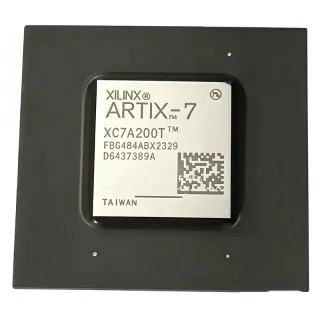
EPM5192AQI100-20 - MAX 5000 192-Macrocell EPLD, 20ns, PQFP-100 | Altera
MPN: EPM5192AQI100-20 ✗ End of Life| Qty | Unit Price | Extended |
|---|---|---|
| 1 | $38.5 | $38.50 |
| 10 | $33.2 | $332.00 |
| 100 | $27.85 | $2,785.00 |
| 500 | $22.4 | $11,200.00 |
| 1,000 | $18.9 | $18,900.00 |
EPM5192AQI100-20 Overview
A Programmable Logic Device (PLD) is a digital integrated circuit whose logic function is defined by the user after manufacture, falling within the broader hierarchy of programmable logic -> logic IC -> integrated circuit. EPLDs such as the EPM5192 use erasable CMOS (UV-erasable EPROM) technology to store the user's logic, and historically served as glue-logic replacements for multiple SSI/MSI 74-series parts. Within Altera's portfolio, the MAX 5000 family occupies the high-density tier above MAX 7000's predecessors and was widely adopted for bus interfacing, state machines, and peripheral controllers in the 1990s.
Key features of the EPM5192AQI100-20 include 12 Logic Array Blocks (LABs) interconnected by a Programmable Interconnect Array (PIA), 7 dedicated input pins, and 64 bidirectional I/O lines, all packaged in the JESD-30 R-PQFP-G100 outline (PQFP-100). The device provides predictable, deterministic timing and is supported by the Altera classic MAX+PLUS II design environment. The 100-pin PQFP format offers generous I/O for a part of this era, and the CMOS process delivers low static power compared to older bipolar PALs.
Typical applications for the EPM5192 family include legacy bus-interface bridges, address decoding, glue logic between microprocessors and peripherals, and custom peripheral controllers in industrial automation equipment. The 192 macrocells deliver substantial capacity for designs that would otherwise consume a dozen or more discrete logic packages, reducing board area and improving reliability. The PQFP-100 footprint remains compatible with many second-source sockets used in long-lifecycle industrial products.
When designing with this part, verify that target toolchains (MAX+PLUS II or compatible third-party compilers) are still available, and that the 5 V tolerant I/O and supply are compatible with downstream logic. Existing designs ported to newer Altera/Intel MAX families (MAX II, MAX V, MAX 10) typically migrate by re-synthesizing the original source, not by socket replacement, due to differing architectures and pinouts.
Drop-in alternatives for EPM5192AQI100-20 — same package, pin-to-pin compatible. Different-package parts requiring PCB rework are excluded.
Variants in this series
Same-series models that are drop-in compatible with EPM5192AQI100-20 (same form factor and footprint) — differing in Package, Technology, Device Type, Propagation Delay (tPD), Mounting Type.
Quick Comparison Tool — Select alternative parts for side-by-side comparison:
EPM5192AQC100-20
✅ Drop-In✓ In Stock
$11.85 / Unit
View Datasheet →EPM5192AQI100-15
✅ Drop-In✓ In Stock
$21.4 / Unit
View Datasheet →EPM5192AQC100-15
✅ Drop-In✓ In Stock
$9.95 / Unit
View Datasheet →EPM5192AQC-2
✅ Drop-In✓ In Stock
$21.5 / Unit
View Datasheet →EPM5192AQC-1
✅ Drop-In✓ In Stock
$17.4 / Unit
View Datasheet →EPM5192AQI100-20 Maximum Ratings & Electrical Characteristics
| Family | MAX 5000 EPLD |
| Device Series | EPM5192 |
| Technology | CMOS, UV-erasable EPROM |
| Propagation Delay | 20 ns (speed grade -20) |
| Logic Array Blocks (LABs) | 12 |
| Interconnect | Programmable Interconnect Array (PIA) |
| Macrocell Count | 192 |
| Dedicated Inputs | 7 |
| I/O Pins | 64 bidirectional |
| Package | 100-pin PQFP (R-PQFP-G100) |
| JEDEC Package Outline | R-PQFP-G100 |
| Operating Temperature | Industrial grade ("I" suffix) |
| Mounting Type | Surface Mount (PQFP) |
| Architecture | Classic EPLD, deterministic timing |
| Design Tool | Altera MAX+PLUS II (legacy) |
EPM5192AQI100-20 r-pqfp-g100 Pin Configuration Guide
Pin configuration for EPM5192AQI100-20 (r-pqfp-g100 package). This digital IC includes GPIO, communication interfaces (UART, SPI, I2C), and power pins. Refer to the manufacturer datasheet for alternate pin functions and configuration options. Essential for embedded system design and PCB layout.

No detailed pinout data available for EPM5192AQI100-20.
Refer to the datasheet for full pin configuration.
Typical Applications
EPM5192AQI100-20 is suitable for 6 applications: Legacy Industrial Bus Interface, Address Decoding and Chip-Select Generation, Custom Peripheral and State-Machine Controller, Glue-Logic Consolidation in Long-Lifecycle Products, Microprocessor-to-Peripheral Bus Bridge, Test and Measurement Front-End Logic.
Legacy Industrial Bus Interface
The EPM5192AQI100-20's 192 macrocells and 64 I/O lines make it well-suited to legacy industrial bus-interface bridges (e.g., ISA, PC/104, custom backplanes). It can absorb multiple 74-series glue-logic packages into a single CMOS EPLD, reducing board area and improving noise margins. Industrial temperature grade (-40 to 85 C) per the "I" suffix and 20 ns propagation delay comfortably meet the timing requirements of 8- and 16-bit bus cycles at legacy clock rates. Place the EPM5192AQI100-20 between the microprocessor bus and peripheral devices to consolidate address decoding, wait-state generation, and interrupt steering. Use the 7 dedicated inputs for high-fanout clock and control signals to preserve macrocell resources for logic.
Recommended
Address Decoding and Chip-Select Generation
The EPM5192AQI100-20 is frequently used as a dedicated address decoder and chip-select generator for multi-bank memory and peripheral subsystems. Its 192 macrocells easily handle the full address map of a 16- or 24-bit system, replacing dozens of 74LS138 / 74LS139 decoders. With 20 ns propagation delay the device fits within standard memory-access cycles without inserting wait states. The 100-pin PQFP package exposes enough I/O for both the address bus and the individual chip-select outputs to memory banks, ROM, and I/O peripherals. Designers can lock the resulting pinout via the MAX+PLUS II fitter and reuse the JEDEC file across product revisions.
Recommended
Custom Peripheral and State-Machine Controller
Use the EPM5192AQI100-20 to implement a custom peripheral controller where each of the 192 macrocells encodes one slice of a large finite-state machine or datapath sequencer. The deterministic LAB/PIA timing guarantees worst-case 20 ns state transitions, which simplifies verification compared with SRAM-based FPGAs of similar vintage. The PQFP-100 footprint is large enough to expose all state outputs to external actuators or indicators. Industrial temperature rating supports factory-floor enclosures without additional derating. Pair the EPM5192AQI100-20 with a microcontroller that handles the high-level protocol while the EPLD handles deterministic bit-level sequencing.
Recommended
Glue-Logic Consolidation in Long-Lifecycle Products
The EPM5192AQI100-20 is widely deployed as a single-package replacement for tens of SSI/MSI 74-series TTL parts in long-lifecycle products such as medical instruments, test equipment, and aerospace subsystems. Erasable CMOS EPROM technology lets the factory program each unit while still allowing field rework with a UV eraser and EPROM programmer. With 64 bidirectional I/O pins plus 7 dedicated inputs, the device has ample headroom for even dense glue-logic nets. The industrial temperature grade and PQFP-100 footprint fit the existing qualified BOMs of many legacy programs. Where field-returns must be repairable for decades, the established MAX 5000 supply chain is preferable to newer CPLDs with shorter support windows.
Recommended
Microprocessor-to-Peripheral Bus Bridge
Bridge an older microprocessor bus to a modern peripheral by routing data, address, and control signals through the EPM5192AQI100-20. With 192 macrocells and 64 I/O pins, the part can implement multiplexers, latches, and protocol converters in one device instead of multiple 74-series buffers. The 20 ns propagation delay adds minimal latency to memory or peripheral accesses, preserving throughput. Industrial temperature operation allows deployment in unattended outdoor cabinets and factory automation cells. Designers can field-update the bridge logic by erasing the EPROM and reprogramming with a new MAX+PLUS II JEDEC file.
Recommended
Test and Measurement Front-End Logic
The EPM5192AQI100-20 is well-suited to the front-end logic of bench-top and rack-mount test equipment, where it can multiplex sensor inputs, gate trigger signals, and drive displays. The 192 macrocells comfortably handle parallel data-acquisition state machines and timing generators, while the 64 I/O pins interface directly to ADC/DAC channels and front-panel switches. With 20 ns timing, the EPLD keeps up with typical 1-10 MSPS converter rates. Industrial temperature operation supports equipment that operates in non-climate-controlled labs. The PQFP-100 footprint also aids thermal dissipation in convection-cooled instruments.
Recommended
Recommended Products Summary
Engineering reference data for EPM5192AQI100-20 — comparison, design guidance, and compliance information.
Selection Guide
Comparison with Alternatives
| Parameter | This Product | EPM5192AQC100-20 | EPM5192AQI100-15 | EPM5192AQC100-15 | EPM5192AQC-2 | EPM5192AQC-1 |
|---|---|---|---|---|---|---|
| Brand | Altera | Altera | Altera | Altera | Altera | Altera |
| Package | PQFP-100 (R-PQFP-G100) | PQFP-100 - same | PQFP-100 - same | PQFP-100 - same | PQFP-100 - same | PQFP-100 - same |
| Macrocell Count | 192 | 192 | 192 | 192 | 192 | 192 |
| Logic Array Blocks (LABs) | 12 | 12 | 12 | 12 | 12 | 12 |
| Dedicated Inputs | 7 | 7 | 7 | 7 | 7 | 7 |
| Bidirectional I/O | 64 | 64 | 64 | 64 | 64 | 64 |
| Operating Temperature | Industrial (-40C to +85C) | Commercial (0C to +70C) | Industrial (-40C to +85C) | Commercial (0C to +70C) | Commercial (0C to +70C) | Commercial (0C to +70C) |
| Lifecycle Status | Obsolete | Obsolete | Obsolete | Obsolete | Obsolete | Obsolete |
Key Differentiators
- Industrial temperature grade for harsh environments (vs EPM5192AQC100-20)
- Balanced speed/power for legacy 8-16 bit systems (vs EPM5192AQI100-15)
- Drop-in compatibility with other MAX 5000 PQFP-100 variants (vs Modern MAX II CPLD EPM570T100C5N)
Design Notes
Estimated: When porting an EPM5192AQI100-20 design to MAX II or MAX V, do not assume pin-to-pin compatibility. The MAX II family uses a different package (typically TQFP-100 or BGA), a different JTAG-based ISP interface, and a different logic-element architecture (LUT-based versus MAX 5000's product-term macrocells). Migration requires re-running the original VHDL/Verilog or schematic through the Quartus II compiler with a MAX II library, plus PCB rework for the new package. Plan for a full re-characterization, not a socket swap.
The EPM5192AQI100-20 is a CMOS EPROM device and draws substantially higher quiescent current when erased or unprogrammed than when fully programmed with typical logic patterns. Always program the device before bench-testing power consumption, or expect to see elevated ICC values that may exceed the datasheet maximum. Decouple VCC with at least one 0.1 uF ceramic capacitor placed within 5 mm of each VCC/GND pair, plus a bulk tantalum or electrolytic cap of 10-22 uF on the supply rail per the MAX 5000 design guidelines.
The PQFP-100 package (R-PQFP-G100) has gull-wing leads on 0.635 mm pitch, which is well within the capability of standard SMT lines but requires careful reflow profile control to avoid coplanarity issues. Provide at least 6 mm of clearance around the package for inspection and rework. For long-lifecycle industrial designs, specify a lead-free or tin-lead finish explicitly when ordering, and confirm that the distributor's reels match the assembly house's process. Pin 1 orientation follows the standard PQFP convention (dot or bevel at pin 1).
Place the EPM5192AQI100-20 close to the bus drivers and memory/peripheral devices it interfaces to, minimizing stub lengths on high-speed control signals. Use a dedicated ground plane under the device to control switching noise; the PIA's programmable routing can otherwise pick up crosstalk on long parallel traces. Keep clock and dedicated inputs short and shielded by ground traces. Avoid routing noisy switching signals (e.g., from DC-DC converters) directly under the PQFP-100 footprint.
Compliance Information
RoHS, REACH, lead-free and halogen-free status are not stated in the verified web data for this obsolete part; original MAX 5000 family datasheets predate widespread RoHS documentation. The "I" suffix confirms industrial operating temperature, but is not an AEC-Q100 automotive qualification. Verify compliance with the supplier before placing orders for new product builds.