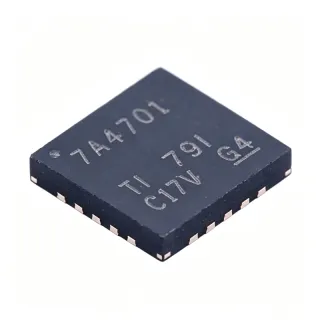
LP8860-Q1 - 4-Ch 150mA Automotive LED Driver | TI
MPN: LP8860-Q1 ✓ Active| Qty | Unit Price | Extended |
|---|---|---|
| 1 | $4.95 | $4.95 |
| 10 | $4.46 | $44.60 |
| 100 | $3.85 | $385.00 |
| 500 | $3.35 | $1,675.00 |
| 1,000 | $2.98 | $2,980.00 |
LP8860-Q1 Overview
An LED driver is a power management IC that regulates current through LEDs to guarantee consistent brightness and protect against overcurrent. The LP8860-Q1 belongs to the boost LED driver family, which steps up a lower input voltage to the higher voltage demanded by LED strings, integrating boost control, current sinks, and dimming logic into a complete automotive display backlighting solution.
Key features include hybrid PWM and current dimming, which reduces EMI, extends LED lifetime, and increases total optical efficiency. Phase-shift PWM reduces audible noise and output ripple. The switching frequency is adjustable from 100 kHz to 2.2 MHz with spread-spectrum operation, allowing designers to avoid AM radio band interference. Brightness can be controlled by a PWM input pin, an SPI or I2C master, or both, offering flexible system integration.
The device employs adaptive output voltage control based on LED string headroom, minimizing power dissipation and maximizing efficiency. Comprehensive fault protection includes LED open/short detection, overvoltage protection, and overtemperature protection. The low-EMI architecture meets stringent automotive electromagnetic compatibility requirements.
Typical applications include automotive infotainment displays, instrument clusters, and heads-up displays (HUD), where its wide input range and 4x150 mA capability suit 12 V automotive systems driving multi-LED strings.
Design tip: ensure proper PCB layout with adequate copper area for thermal dissipation, place the boost inductor and capacitors close to the IC, and use the ISET pin resistor to set LED current precisely. Pricing as of 2026-08-29.
Drop-in alternatives for LP8860-Q1 — same package, pin-to-pin compatible. Different-package parts requiring PCB rework are excluded.
Quick Comparison Tool — Select alternative parts for side-by-side comparison:
LP8860DQVFPRQ1
✅ Drop-In📋 Reference alternative (not in catalog)
LP8860BQVFPRQ1
✅ Drop-In📋 Reference alternative (not in catalog)
LP8860JQVFPRQ1
✅ Drop-In📋 Reference alternative (not in catalog)
LP8865C-Q1
⚡ Same Package📋 Reference alternative (not in catalog)
LP8860-Q1 Maximum Ratings & Electrical Characteristics
| Topology | Boost controller with 4 current sinks |
| Number of Channels | 4 |
| Current per Channel | 150 mA |
| Input Voltage Range | 3 V to 48 V |
| Dimming Method | Hybrid PWM and current dimming |
| Control Interface | PWM input, SPI, or I2C (or both) |
| Qualification | AEC-Q100 (automotive) |
| Package | 32-HLQFP (7x7 mm) |
| Mounting Type | Surface Mount |
| Applications | Automotive display backlighting |
| Protection Features | LED open/short, overvoltage, overtemperature |
| EMI Features | Low-EMI architecture, phase-shift PWM, spread spectrum |
LP8860-Q1 32-hlqfp (7x7 mm) Pin Configuration Guide
Pin configuration for LP8860-Q1 (32-hlqfp (7x7 mm) package). This power device features gate, drain, and source terminals. For non-polarized packages, refer to the manufacturer datasheet for exact pin 1 orientation and footprint details. Common applications include power supply design, motor driving, and load switching.

No detailed pinout data available for LP8860-Q1.
Refer to the datasheet for full pin configuration.
Typical Applications
LP8860-Q1 is suitable for 6 applications: Automotive Infotainment Display Backlighting, Instrument Cluster Backlighting, Heads-Up Display (HUD) Illumination, Rear-Seat Entertainment Displays, Automotive Ambient and Accent Lighting, Industrial Display Backlighting (Non-Automotive Derivative Use).
Automotive Infotainment Display Backlighting
The LP8860-Q1 drives up to four LED strings at 150 mA each for center-stack and infotainment LCDs. Its 3 V to 48 V input range tolerates cold-crank and load-dump transients, while hybrid PWM and current dimming cuts EMI and extends LED lifetime. Adaptive headroom control maximizes optical efficiency across brightness levels, and SPI/I2C feedback lets the host SoC monitor faults in real time for functional-safety-relevant diagnostics.
Recommended
Instrument Cluster Backlighting
Instrument clusters demand wide dimming range and fast fault response. The LP8860-Q1 provides four precision 150 mA sinks with PWM input, SPI, or I2C control, enabling smooth brightness transitions from daylight to night driving. LED open/short detection and overtemperature protection report failures immediately, supporting cluster reliability requirements. Its low-EMI phase-shift operation helps meet automotive EMC limits without bulky filtering in the gauge assembly.
Recommended
Heads-Up Display (HUD) Illumination
HUD units use high-brightness LED strings requiring stable, precisely regulated current. The LP8860-Q1's adjustable 100 kHz to 2.2 MHz switching frequency with spread spectrum lets designers avoid the AM radio band near the windshield projection optics, and phase-shift PWM reduces audible noise and output ripple. Hybrid dimming preserves color point at low brightness, critical for projected image quality in direct-sunlight-viewable HUD systems.
Recommended
Rear-Seat Entertainment Displays
Rear-seat entertainment panels benefit from the LP8860-Q1's flexible brightness control via PWM pin, SPI/I2C, or both, allowing the main head-unit to coordinate dimming across displays. Four 150 mA channels cover typical 10-12 inch panel backlight arrays from a 12 V rail, while adaptive output voltage minimizes power loss across the current sinks, reducing thermal load in enclosed seat-back housings without heatsinks.
Recommended
Automotive Ambient and Accent Lighting
Ambient lighting zones need precise, low-ripple current for consistent color across multiple LED strings. The LP8860-Q1's four 150 mA precision sinks can each drive a lighting zone with hybrid dimming that extends LED lifetime versus pure PWM schemes. Spread-spectrum switching keeps conducted emissions below automotive limits without extra chokes, and I2C diagnostics enable per-zone fault reporting in body-domain-controller architectures.
Recommended
Industrial Display Backlighting (Non-Automotive Derivative Use)
Though AEC-Q100 qualified for automotive, the LP8860-Q1's 3 V to 48 V input range and robust protection (overvoltage, LED open/short, overtemperature) also suit rugged industrial HMI displays. Four 150 mA channels illuminate mid-size LCDs from 24 V industrial rails, and adjustable switching frequency avoids sensitive communication bands. SPI/I2C control integrates with industrial PLC host systems for brightness scheduling and fault logging.
Recommended
Recommended Products Summary
Engineering reference data for LP8860-Q1 — comparison, design guidance, and compliance information.
Selection Guide
Comparison with Alternatives
| Parameter | This Product | LP8860DQVFPRQ1 | LP8860BQVFPRQ1 | LP8860JQVFPRQ1 | LP8865C-Q1 |
|---|---|---|---|---|---|
| Brand | Texas Instruments | Texas Instruments | Texas Instruments | Texas Instruments | Texas Instruments |
| AEC-Q100 Qualified | Yes (Q1 automotive) | Yes | Yes | Yes | Yes |
Key Differentiators
- Four 150 mA precision channels in one IC (vs TPS61196-Q1)
- Hybrid PWM + current dimming with phase shift (vs MP3394)
- Same-family drop-in variants available (vs LP8860DQVFPRQ1)
Design Notes
Place the boost inductor, input capacitors, and output capacitors as close to the LP8860-Q1 as possible with short, wide traces for the high-current boost loop. The 32-HLQFP (7x7 mm) exposed-lead package needs adequate copper area on all layers tied to ground for thermal dissipation; use via stitching under the thermal region. Follow the LP8860-Q1EVM (SNVU382A) layout as a reference.
Use the adjustable switching frequency (avoiding the AM radio band) and enable spread-spectrum operation to reduce peak conducted emissions. Phase-shift PWM among the four channels reduces output ripple and audible noise. For automotive EMC pre-compliance, verify the boost switch-node ringing with a short probe ground and add a small RC snubber if needed.
Set LED current precisely via the ISET pin resistor per datasheet equations. Verify boost component ratings against maximum string voltage - TI E2E discussions note that very long strings (e.g., 19 LEDs at ~57 V) require checking headroom and external MOSFET ratings against device limits. Ensure the 48 V absolute maximum input is never exceeded during load-dump events.
Compliance Information
AEC-Q100 qualified automotive catalog device per TI product page. RoHS/REACH status not stated in provided data - verify on TI.com.