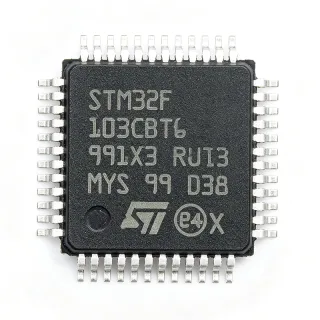
PIC10F222-E/MC - 8-bit Flash MCU 768B 4 I/O 8DFN | Microchip
MPN: PIC10F222-E/MC ✓ Active| Qty | Unit Price | Extended |
|---|---|---|
| 1 | $0.84 | $0.84 |
| 10 | $0.74 | $7.40 |
| 100 | $0.62 | $62.00 |
| 500 | $0.54 | $270.00 |
| 1,000 | $0.46 | $460.00 |
PIC10F222-E/MC Overview
An 8-bit microcontroller (MCU) is a small, self-contained computer-on-a-chip that integrates a CPU, RAM, non-volatile program memory (Flash), peripherals and I/O on a single die. Within the broader semiconductor hierarchy, MCUs sit inside the microcontroller product class, which in turn belongs to the integrated circuit family of digital logic devices used for embedded control. The PIC10F222 belongs to Microchip's PIC10 baseline family, which is the smallest-footprint branch of the PIC architecture tree, optimized for cost-sensitive and space-constrained applications where the design needs a small amount of intelligence with very few external pins.
Key differentiating features include 33 single-cycle RISC instructions (compared with typically 35-50 instructions in CISC competitors in the same price band), 2:1 code compression relative to other 8-bit MCUs in its class, an integrated 8-bit ADC eliminating the need for an external converter, and four I/O lines plus one input-only GP3 line. The Flash memory enables in-system reprogramming via ICSP, supporting fast customization of application parameters such as transmitter codes, appliance settings, and receiver frequencies without removing the device from the board.
The PIC10F222's architecture uses a 12-bit wide instruction word with Harvard-style separate program and data buses, allowing instruction fetch and operand read to occur in the same cycle. This pipeline delivers an effective throughput of approximately 4 MIPS at 4 MHz and 8 MIPS at 8 MHz, and the device operates fully statically (no minimum clock), enabling low-power sleep currents well-suited for battery-powered applications. The integrated 8-bit ADC with up to four input channels simplifies designs that need to measure analog signals such as light, temperature (via a thermistor), or potentiometer positions without external conversion hardware.
Typical applications include adding intelligence to LED lighting systems, low-cost remote-control transmitters, small appliance controllers, battery chargers, and consumer electronics such as toys and decorative lighting. The device's small footprint and low pin count make it well suited for designs where PCB real estate is at a premium but some level of programmable logic is required beyond simple discrete or analog circuitry.
When designing with the PIC10F222, ensure that the exposed pad (EP) of the DFN package is soldered to the board ground plane for proper thermal dissipation and electrical performance. Decoupling capacitors of 0.1 µF should be placed as close as possible to the VDD pin, and unused I/O pins should be configured as outputs low or inputs with internal weak pull-ups to minimize power consumption in sleep mode.
This page synthesizes distributor pricing, drop-in alternatives within the PIC10F family, and practical design notes that go beyond the standard Microchip datasheet content, providing engineers and procurement teams with a one-stop decision matrix for the PIC10F222-E/MC.
Drop-in alternatives for PIC10F222-E/MC — same package, pin-to-pin compatible. Different-package parts requiring PCB rework are excluded.
Variants in this series
Same-series models that are drop-in compatible with PIC10F222-E/MC (same form factor and footprint) — differing in Package, Internal Oscillator, Timers, Core Architecture, Instruction Set.
Quick Comparison Tool — Select alternative parts for side-by-side comparison:
PIC10F220-E/MC
✅ Drop-In✓ In Stock
$0.53 / Unit
View Datasheet →PIC10F220T-I/MC
✅ Drop-In✓ In Stock
$0.36 / Unit
View Datasheet →PIC10F222-E/OT
✅ Drop-In📋 Reference alternative (not in catalog)
PIC10F222-I/MC
✅ Drop-In✓ In Stock
$0.62 / Unit
View Datasheet →PIC10F200-E/MC
✅ Drop-In✓ In Stock
$0.52 / Unit
View Datasheet →PIC10F204-E/MC
✅ Drop-In✓ In Stock
$0.26 / Unit
View Datasheet →PIC10F222-E/MC Maximum Ratings & Electrical Characteristics
| Product Type | 8-bit Flash Microcontroller (MCU) |
| Core Architecture | PIC10 RISC, 12-bit instruction word |
| Program Memory (Flash) | 768 bytes |
| Data Memory (RAM) | 23 bytes |
| Number of I/O Pins | 4 (plus 1 input-only GP3) |
| ADC | 8-bit, up to 4 input channels |
| Instruction Set | 33 single-word/single-cycle instructions |
| Operating Voltage (VDD) | 2.0 V to 5.5 V |
| Internal Oscillator | 4 MHz / 8 MHz selectable |
| Operating Temperature | -40 °C to +125 °C (Extended, -E suffix) |
| Package | 8-pin DFN with Exposed Pad (MC) |
| Mounting Type | Surface Mount |
| ICSP Programming | Yes (In-Circuit Serial Programming) |
| RoHS Status | Compliant |
| MSL Level | 1 (per Microchip package profile) |
PIC10F222-E/MC Pin Configuration
| Pin 1 | GP0 — Bidirectional I/O / ADC channel 0 |
| Pin 2 | GP1 — Bidirectional I/O / ADC channel 1 |
| Pin 3 | GP2 — Bidirectional I/O / ADC channel 2 / T0CKI |
| Pin 4 | GP3 — Input-only / MCLR (reset) |
| Pin 5 | VSS — Ground reference |
| Pin 6 | GP4 — Bidirectional I/O / ADC channel 3 |
| Pin 7 | VDD — Positive supply voltage |
| Pin 8 | EP — Exposed pad, must be soldered to PCB ground plane |
Typical Applications
PIC10F222-E/MC is suitable for 7 applications: LED Lighting Control, Low-Cost Remote Control Transmitters, Small Appliance Controllers, Battery Chargers and Power Management, Toy and Hobby Electronics, Sensor Interface Modules, Automotive Interior Accessories.
LED Lighting Control
The PIC10F222-E/MC is well suited to add programmable intelligence to small LED lighting products such as decorative light strings, accent lamps, and color-changing fixtures. Its 4-channel 8-bit ADC can read ambient light via a photoresistor or potentiometer-driven dimming input, allowing the firmware to implement smooth PWM dimming, color cycling, or daylight-harvesting algorithms without any external converter. With 768 bytes of Flash, designers have ample room for fade tables, blink patterns, and user-preset modes. The 8-pin DFN (MC) exposed-pad package is small enough to fit inside a standard LED bulb base or fixture junction box, and the 2.0 V to 5.5 V operating range lets the MCU run from the same rectified supply that powers the LED string.
Recommended
Low-Cost Remote Control Transmitters
The PIC10F222-E/MC excels in handheld remote-control transmitters for toys, garage doors, and simple consumer appliances where 4 push buttons are sufficient. Its 33-instruction RISC core delivers compact code for IR or RF transmission routines, while the in-system programmable Flash lets manufacturers customize button mappings, encryption keys, or rolling-code sequences for each product variant without changing the hardware. The fully-static CMOS design and sub-microamp sleep current deliver multi-year battery life from a single coin cell. The 8-pin DFN exposed-pad package provides a tiny footprint that fits inside the slimmest remote housings, and the -40 °C to +125 °C extended temperature grade handles outdoor and automotive garage environments.
Recommended
Small Appliance Controllers
Appliances such as bread makers, slow cookers, fans, coffee grinders, and personal care devices benefit from the PIC10F222-E/MC's tiny footprint and integrated ADC. The MCU can read temperature from a thermistor or NTC, monitor a potentiometer for speed or intensity control, drive a relay or TRIAC through one of its I/O pins, and run state-machine firmware entirely within 768 bytes of Flash. The -40 °C to +125 °C extended temperature range covers the heat-soak conditions typical inside appliance enclosures. Designers can prototype using the PIC10F220/222 datasheet application notes and quickly move from breadboard to a compact DFN-based production board without external analog conversion components.
Recommended
Battery Chargers and Power Management
Simple CC-CV battery chargers for single-cell Li-ion, NiMH, or lead-acid packs can be built around the PIC10F222-E/MC by reading battery voltage and current through the on-chip ADC and driving a power MOSFET or load-switch via one of the I/O pins. The 2.0 V to 5.5 V operating range lets the MCU share the battery rail directly, eliminating auxiliary rails. The 768-byte Flash holds full charge-termination, timer-based safety, and LED status indication routines, and ICSP allows the same hardware platform to be reprogrammed for different battery chemistries without changing the PCB.
Recommended
Toy and Hobby Electronics
Cost-sensitive toys, model-train accessories, electronic dice, novelty sound modules, and hobbyist kits leverage the PIC10F222-E/MC's low unit cost, tiny 8-pin DFN footprint, and adequate Flash for sound playback tables, motor PWM, or LED animation patterns. The integrated 8-bit ADC can read position sensors, light sensors, or simple user inputs without extra parts. With Flash reprogrammability, manufacturers can ship hardware once and load different game variants, languages, or seasonal themes through the ICSP interface during production. The wide operating voltage range lets the MCU share the same supply as the toy motors or battery packs directly.
Recommended
Sensor Interface Modules
Compact sensor interface modules for industrial IoT edge nodes, smart-home sensors, and wearable indicators can use the PIC10F222-E/MC as a low-cost signal conditioner and protocol translator. The on-chip ADC digitizes analog sensor outputs (thermistor, photocell, potentiometer) and the MCU drives a simple digital interface (single-wire, UART bit-bang, or PWM-encoded data) over its I/O pins. The 768-byte Flash handles linearization lookup tables, calibration constants, and communication routines. The wide 2.0 V to 5.5 V supply range supports both 3.3 V coin-cell nodes and 5 V industrial rails, while the -40 °C to +125 °C extended temperature grade suits outdoor deployments.
Recommended
Automotive Interior Accessories
Low-current automotive interior accessories such as LED mood lighting, footwell illumination, simple switch panels, and door-warning indicators can be built around the PIC10F222-E/MC's extended -40 °C to +125 °C temperature grade. The wide operating voltage tolerates cranking transients and load-dump variations typical of 12 V automotive buses when paired with an external voltage regulator. The 8-pin DFN package is small enough to embed inside the wiring harness near each load, and the in-system Flash programmability lets one hardware design support multiple vehicle trim levels with different light patterns or switch behaviors.
Recommended
Recommended Products Summary
Engineering reference data for PIC10F222-E/MC — comparison, design guidance, and compliance information.
Selection Guide
Comparison with Alternatives
| Parameter | This Product | PIC10F220-E/MC | PIC10F220T-I/MC | PIC10F222-E/OT | PIC10F222-I/MC | PIC10F200-E/MC | PIC10F204-E/MC |
|---|---|---|---|---|---|---|---|
| Brand | Microchip Technology | Microchip Technology | Microchip Technology | Microchip Technology | Microchip Technology | Microchip Technology | Microchip Technology |
| Package | 8-pin DFN (MC) with Exposed Pad | 8-pin DFN (MC) with Exposed Pad | 8-pin DFN (MC) with Exposed Pad | 6-pin SOT-23 (OT) | 8-pin DFN (MC) with Exposed Pad | 8-pin DFN (MC) with Exposed Pad | 8-pin DFN (MC) with Exposed Pad |
| Program Memory (Flash) | 768 bytes | 768 bytes | 768 bytes | 768 bytes | 768 bytes | 256 bytes | 384 bytes |
| RAM | 23 bytes | 23 bytes | 23 bytes | 23 bytes | 23 bytes | 16 bytes | 23 bytes |
| ADC | 8-bit, 4 channels | None | None | 8-bit, 4 channels | 8-bit, 4 channels | None | None |
| Operating Voltage | 2.0 V to 5.5 V | 2.0 V to 5.5 V | 2.0 V to 5.5 V | 2.0 V to 5.5 V | 2.0 V to 5.5 V | 2.0 V to 5.5 V | 2.0 V to 5.5 V |
| Temperature Grade | -40 °C to +125 °C (Extended) | -40 °C to +125 °C (Extended) | -40 °C to +85 °C (Industrial) | -40 °C to +125 °C (Extended) | -40 °C to +85 °C (Industrial) | -40 °C to +125 °C (Extended) | -40 °C to +125 °C (Extended) |
| Internal Oscillator | 4 MHz / 8 MHz | 4 MHz / 8 MHz | 4 MHz / 8 MHz | 4 MHz / 8 MHz | 4 MHz / 8 MHz | 4 MHz / 8 MHz | 4 MHz / 8 MHz |
Key Differentiators
- Largest Flash and only ADC in PIC10 baseline family (vs PIC10F200-E/MC)
- Extended -40 °C to +125 °C temperature grade vs industrial grade (vs PIC10F222-I/MC)
- DFN package with exposed pad for improved thermal dissipation (vs PIC10F222-E/OT (SOT-23))
Design Notes
The exposed pad (EP, pin 8) of the 8-pin DFN (MC) package must be soldered to a sufficiently large copper pad tied to the PCB ground plane. Estimated thermal dissipation for the PIC10F222-E/MC is modest (typical MCU quiescent plus I/O drive current is well below 100 mW), so a small EP copper pour of approximately 0.25 square inch is adequate for thermal spreading. Failing to solder the EP can raise the die's junction temperature and may cause timing drift or device malfunction, especially at the +125 °C upper end of the extended temperature grade.
Place a 0.1 µF decoupling capacitor as close as possible to the VDD pin (pin 7) with the ground return to the VSS pin (pin 5) via a short, low-impedance trace. Add a bulk capacitor (e.g., 1 µF to 10 µF) on the same supply rail if the design switches heavy loads. For designs using the ADC, route analog signals (GP0, GP1, GP2, GP4) away from switching nodes and keep the analog ground separate from digital switching ground until they join at the EP ground pour.
Configure unused I/O pins as outputs low or as inputs with the internal weak pull-up enabled to minimize sleep current consumption. Do not leave any I/O pin floating, as floating inputs can draw extra current and may cause spurious interrupts. When using GP3 as MCLR, ensure the ICSP programmer can drive the pin during in-circuit programming or leave GP3 configured as a digital input only if MCLR is disabled in the configuration word.
The PIC10F222-E/MC supports a sleep mode with sub-microamp quiescent current when the internal oscillator is shut down. To wake the MCU, use the watchdog timer, an external interrupt on GP0/GP1/GP3, or a pin-change interrupt. Estimate battery life for a 220 mAh CR2032 coin cell driving a typical 0.5 µA sleep average and 2 mA active at 4 MHz duty-cycled at 1% to be approximately 3-5 years depending on load and temperature.
For designs that use the internal oscillator exclusively, no external crystal or resonator traces are required, which simplifies PCB layout. If GP3 is used as MCLR with an external pull-up resistor, place the resistor close to the pin to minimize noise coupling. Route the ICSP clock and data lines (typically on GP0 and GP1) with short traces and avoid running them parallel to switching signals; this keeps in-system programming reliable and reduces susceptibility to programming errors during production.
Compliance Information
RoHS and REACH compliant per Microchip product page. Lead-free and halogen-free per Microchip packaging specifications. AEC-Q100 not qualified; the PIC10F222-E/MC is targeted at industrial and consumer applications rather than automotive safety-critical use. For automotive designs requiring AEC-Q100, evaluate PIC12F or PIC16F families from Microchip.