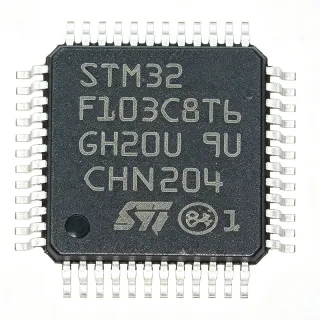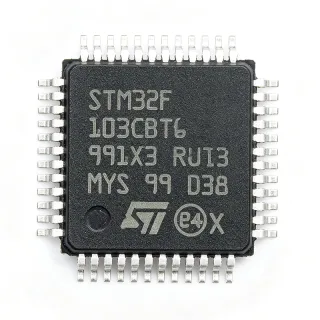
PIC12C672-04I/MF - 8-Bit 4MHz MCU, 3.5KB OTP, 8-DFN-S | Microchip
MPN: PIC12C672-04I/MF ✓ Active| Qty | Unit Price | Extended |
|---|---|---|
| 1 | $5.1 | $5.10 |
| 10 | $4.65 | $46.50 |
| 100 | $4.1 | $410.00 |
| 500 | $3.65 | $1,825.00 |
| 1,000 | $3.2 | $3,200.00 |
PIC12C672-04I/MF Overview
A microcontroller (MCU) is a single-chip computer containing a CPU core, program memory, working RAM, and configurable peripherals designed for embedded control. The PIC12C family uses Microchip's 8-bit Harvard RISC architecture with a small instruction set optimized for deterministic, low-overhead execution in cost-sensitive applications. Within the broader taxonomy, the PIC12C672 sits at the entry level of the PICmicro hierarchy — a baseline OTP mid-range device positioned between simple 6-pin PIC10F controllers and the larger 14-/18-/28-pin PIC16F and PIC18F families.
Key features include 3.5KB OTP program memory (2K x 14 words), 128 bytes of SRAM, 5 general-purpose I/O pins, an internal oscillator, and 4 channels of 8-bit A/D conversion. The 8-DFN-S (6 x 5 mm) package with an exposed thermal pad enables compact PCB layouts in space-constrained designs while providing adequate thermal dissipation for the industrial -40 °C to +85 °C operating range.
Architecturally, the PIC12C672 uses a 14-bit instruction word, single-cycle ALU operations, and a hardware stack, allowing most instructions to execute in one oscillator cycle. The internal oscillator eliminates the need for external clocking components, and the 8-bit A/D converter with 4 input channels supports direct sensor interfacing for battery monitoring, signal conditioning, and simple closed-loop control.
Typical applications include consumer electronics remote controls, small appliance controllers, sensor interface modules, battery-powered low-cost embedded products, and industrial auxiliary control where a 5-I/O, 8-bit, OTP-based controller delivers the right balance of integration and unit cost.
When designing with this device, allocate the 8-bit A/D converter's reference voltage through a stable rail — noisy VDD will directly degrade conversion accuracy. Note that OTP memory cannot be reprogrammed; for in-field firmware updates, consider a flash-based PIC12F or PIC16F variant in the same pinout family.
This page synthesizes distributor pricing, drop-in same-package alternatives, and practical design notes not found in the manufacturer datasheet, giving buyers and design engineers a single, citable reference for the PIC12C672-04I/MF.
Drop-in alternatives for PIC12C672-04I/MF — same package, pin-to-pin compatible. Different-package parts requiring PCB rework are excluded.
Variants in this series
Same-series models that are drop-in compatible with PIC12C672-04I/MF (same form factor and footprint) — differing in Program Memory Size, Data EEPROM, Operating Temperature, Oscillator Type, RAM Size.
Quick Comparison Tool — Select alternative parts for side-by-side comparison:
PIC12C671-04I/MF
✅ Drop-In✓ In Stock
$1.55 / Unit
View Datasheet →PIC12C672-04E/MF
✅ Drop-In✓ In Stock
$2.2 / Unit
View Datasheet →PIC12C672T-04I/MF
✅ Drop-In ⚠️ 参数待验证📋 Reference alternative (not in catalog)
PIC12CE674-04I/MF
✅ Drop-In📋 Reference alternative (not in catalog)
PIC12C672-04I/MF Maximum Ratings & Electrical Characteristics
| Manufacturer | Microchip Technology |
| Series | PIC® 12C |
| Core Processor | PIC 8-bit |
| Core Size | 8-Bit |
| Maximum Clock Frequency | 4 MHz |
| Program Memory Size | 3.5 KB (2K x 14) OTP |
| RAM Size | 128 x 8 bytes |
| Data EEPROM | 0 bytes |
| Number of I/O Pins | 5 |
| A/D Converter | 4 channels x 8-bit |
| Oscillator Type | Internal |
| Package / Case | 8-VDFN Exposed Pad (8-DFN-S, 6 x 5 mm) |
| Operating Temperature | -40 °C to +85 °C (Industrial) |
| Mounting Type | Surface Mount |
| Instruction Set | 14-bit, 35 instructions (PIC mid-range) |
| RoHS Status | Compliant |
| Lead-Free | Yes |
PIC12C672-04I/MF Pin Configuration
| Pin 1 | VSS — Ground reference |
| Pin 2 | GP5/MCLR/VPP — General-purpose I/O / Master Clear reset / Programming voltage |
| Pin 3 | GP4/AN3/T1G/OSC2 — GPIO / ADC channel 3 / Timer1 gate / oscillator output |
| Pin 4 | GP3/AN2/CCP1/OSC1 — GPIO / ADC channel 2 / Capture-Compare-PWM / oscillator input |
| Pin 5 | GP2/AN1 — GPIO / ADC channel 1 |
| Pin 6 | GP1/AN0 — GPIO / ADC channel 0 |
| Pin 7 | GP0 — General-purpose I/O |
| Pin 8 | VDD — Positive supply voltage |
Typical Applications
PIC12C672-04I/MF is suitable for 7 applications: Consumer Remote Controls, Small Appliance Controllers, Battery-Powered Sensor Modules, LED Lighting Controllers, Automotive Interior Accessories, Industrial Auxiliary Control Modules, Toy and Hobby Electronics.
Consumer Remote Controls
The PIC12C672-04I/MF is well-suited for consumer IR/RF remote controls where low unit cost, small footprint, and low standby power matter more than compute performance. Its 5 GPIO pins drive IR LED driver transistors, button-scan matrices, and indicator LEDs without external logic. The integrated 8-bit ADC on 4 channels reads battery voltage (typically 2-3V alkaline cells) and IR receiver signals, while 3.5KB of OTP memory holds IR protocol stacks (RC5, NEC, Sony SIRC). With only 128 bytes of RAM, the firmware must be lean, but for one-button or few-button remotes this is more than sufficient. The internal oscillator eliminates external crystal cost, and the 8-VDFN Exposed Pad package enables sub-10 mm x 10 mm PCB designs typical of TV/STB remotes.
Recommended
Small Appliance Controllers
For small appliances such as toaster ovens, coffee makers, fans, and personal-care devices, the PIC12C672-04I/MF delivers the right balance of GPIO count, ADC channels, and cost. The 5 GPIO pins drive relays, triac gates, LED indicators, and keypad scanning. The 4-channel 8-bit ADC reads temperature from NTC thermistors, water level sensors, and supply voltage for brownout detection. OTP memory is acceptable because appliance firmware rarely changes after qualification. The 4MHz max clock with 1µs instruction cycle is fast enough for PWM-controlled heater regulation or motor soft-start at a few hundred Hz. The -40 °C to +85 °C industrial temperature grade covers kitchen and laundry environments where ambient plus self-heating can exceed 70 °C.
Recommended
Battery-Powered Sensor Modules
In battery-powered sensor modules for IoT edge nodes, HVAC, and simple telemetry, the PIC12C672-04I/MF offers deterministic 8-bit RISC performance, integrated ADC, and a tiny 8-VDFN Exposed Pad (6 x 5 mm) footprint. The internal oscillator eliminates the BOM cost and PCB area of an external crystal. With proper use of the PIC sleep mode, average current can drop into the microamp range for duty-cycled sensor sampling. The 4-channel 8-bit ADC reads temperature, humidity (via analog sensor front-ends), battery voltage, and a generic analog input — sufficient for simple 4-sensor nodes. For longer battery life or wireless uplinks, however, a modern PIC12F or PIC16F XLP nanoWatt variant is recommended; the PIC12C672 lacks modern low-power peripherals.
Recommended
LED Lighting Controllers
For entry-level LED lighting controllers, accent lighting drivers, and decorative LED strips, the PIC12C672-04I/MF provides GPIO and ADC channels sufficient to drive constant-current LED driver ICs via PWM, MOSFET gates, or shift-register data lines. The 4MHz clock generates PWM frequencies above the audible band (e.g. 20 kHz) when combined with a hardware timer, eliminating coil whine. With 3.5KB of OTP code, designers can implement color-mixing algorithms, fade profiles, and basic DMX-512-style receive routines. The internal ADC monitors LED string current via a sense resistor for closed-loop brightness regulation. The 8-VDFN Exposed Pad package is small enough for inline LED strip cut-points and bulb-base PCBs.
Recommended
Automotive Interior Accessories
In non-safety automotive interior accessories such as cabin lighting, seat controllers, mirror adjusters, and dashboard ambient lighting, the PIC12C672-04I/MF delivers adequate GPIO and ADC functionality at a competitive cost. The 5 GPIO pins drive small relays, MOSFET gates, and LED strings; the 4-channel 8-bit ADC reads switch positions via resistive dividers and potentiometers (e.g. dimmer wheels). The -40 °C to +85 °C industrial temperature range covers most interior cabin environments. Note that for under-hood or direct engine-bay applications, an AEC-Q100-qualified part is required, so a PIC16F or PIC18F Q-grade part should be chosen instead. The 8-VDFN Exposed Pad enables low-profile PCB designs behind interior trim panels.
Recommended
Industrial Auxiliary Control Modules
For industrial auxiliary control such as DIN-rail signal-conditioning cards, status-indicator panels, and small process-control interface modules, the PIC12C672-04I/MF provides reliable 8-bit processing in a compact 8-VDFN Exposed Pad footprint. The 5 GPIO pins drive status LEDs, optocouplers, and small relays; the 4-channel 8-bit ADC reads 4-20 mA loop signals via shunt resistors, thermistor temperature, and supply rail voltage. The internal oscillator and absence of external components simplify IEC 61010-style surge and ESD compliance by reducing the BOM to the MCU and a decoupling capacitor. With 3.5KB of OTP code, designers can implement linearization, hysteresis, and alarm-threshold logic for simple loop-powered sensors.
Recommended
Toy and Hobby Electronics
Cost-sensitive toy, hobby, and educational electronic products benefit from the PIC12C672-04I/MF's combination of low unit cost, OTP memory (no field reprogramming needed for fixed-function toys), internal oscillator, and compact 8-VDFN Exposed Pad package. The 5 GPIO pins drive small DC motors via H-bridge driver ICs, LEDs, buzzers, and simple button inputs. The 4-channel 8-bit ADC reads battery voltage for low-battery LED warning, light sensors for auto-shutoff, and basic analog control inputs. With 3.5KB of OTP code, designers can implement sound effects, motor patterns, and simple state machines for toys. The industrial -40 °C to +85 °C range covers most indoor toy environments, and the surface-mount package suits automated assembly for high-volume toy manufacturing.
Recommended
Recommended Products Summary
Engineering reference data for PIC12C672-04I/MF — comparison, design guidance, and compliance information.
Selection Guide
Comparison with Alternatives
| Parameter | This Product | PIC12C671-04I/MF | PIC12C672-04E/MF | PIC12CE674-04I/MF |
|---|---|---|---|---|
| Brand | Microchip Technology | Microchip Technology | Microchip Technology | Microchip Technology |
| Package | 8-VDFN Exposed Pad (8-DFN-S, 6x5 mm) | 8-VDFN Exposed Pad (8-DFN-S, 6x5 mm) - same | 8-VDFN Exposed Pad (8-DFN-S, 6x5 mm) - same | 8-VDFN Exposed Pad (8-DFN-S, 6x5 mm) - same |
| Core / Architecture | 8-bit PIC RISC, 14-bit instructions | 8-bit PIC RISC, 14-bit instructions - same | 8-bit PIC RISC, 14-bit instructions - same | 8-bit PIC RISC, 14-bit instructions - same |
| Maximum Clock Frequency | 4 MHz | 4 MHz | 4 MHz | 4 MHz |
| Program Memory Size (OTP) | 3.5 KB (2K x 14) | 1.75 KB (1K x 14) - 50% smaller | 3.5 KB (2K x 14) - same | 3.5 KB (2K x 14) - same |
| RAM Size | 128 bytes | 128 bytes | 128 bytes | 128 bytes |
| Data EEPROM | 0 bytes | 0 bytes | 0 bytes | 16 bytes - added benefit |
| Number of I/O Pins | 5 | 5 | 5 | 5 |
| A/D Converter | 4 channels x 8-bit | 4 channels x 8-bit | 4 channels x 8-bit | 4 channels x 8-bit |
| Operating Temperature | -40 °C to +85 °C (Industrial) | -40 °C to +85 °C (Industrial) | -40 °C to +125 °C (Extended) | -40 °C to +85 °C (Industrial) |
Key Differentiators
- Largest OTP program memory in PIC12C67x family (vs PIC12C671-04I/MF)
- Zero on-chip EEPROM (vs PIC12CE674-04I/MF)
- Industrial temperature grade (-40 °C to +85 °C) (vs PIC12C672-04E/MF)
Design Notes
The PIC12C672-04I/MF integrates an internal oscillator so no external crystal or resonator is required, simplifying power-supply design. Place a 0.1 µF ceramic decoupling capacitor as close as possible to the VDD pin (pin 8), and add a 10 µF bulk capacitor on the same rail if the supply source is more than a few centimeters away. The ADC reference is internally tied to VDD; supply-rail noise above 50 mV peak-to-peak will directly degrade 8-bit conversion accuracy, so add an LC pi-filter or ferrite bead if the supply is shared with switching regulators or relay coils.
The 8-VDFN Exposed Pad (8-DFN-S, 6 x 5 mm) package includes a thermal pad on the underside that MUST be soldered to a PCB copper pour for both mechanical reliability and thermal dissipation. The exposed pad should be tied to VSS and connected to a copper area of at least 25 mm² on the top or bottom layer with multiple thermal vias to the opposite plane. Without proper soldering of the exposed pad, the package can overheat at sustained high GPIO loads and the part may exceed its maximum junction temperature during sustained 20 mA-per-pin GPIO operation.
Three common pitfalls to avoid with the PIC12C672-04I/MF: (1) OTP memory is one-time-programmable — once written, firmware cannot be erased or updated; design with a flash-based PIC12F or PIC16F equivalent if in-field firmware updates are required. (2) GP3 is input-only when MCLR is disabled — do not assign GP3 as an output in your schematic. (3) The device has NO on-chip debug (ICD) support in OTP variants; use a flash equivalent (PIC12F675) for development and prototype debugging, then migrate to PIC12C672-04I/MF for production cost reduction.
For the 8-VDFN Exposed Pad package, use a land pattern that follows the manufacturer recommended PCB footprint with a center pad equal to or slightly smaller than the package exposed pad. Apply solder paste to the center pad using a stencil aperture designed to deliver 50-70% paste coverage to avoid excessive solder volume that could lift the package. Use no-clean SAC305 lead-free solder paste compatible with the RoHS-compliant Pb-free finish. After reflow, perform X-ray inspection on a sample of boards to verify center-pad solder voiding is below 25% per IPC-7093 Class 2/3.
Compliance Information
RoHS and lead-free compliant per Microchip product page. PIC12C672-04I/MF is NOT AEC-Q100 qualified — for AEC-Q100 automotive applications, use the PIC16F or PIC18F Q-grade equivalents instead.