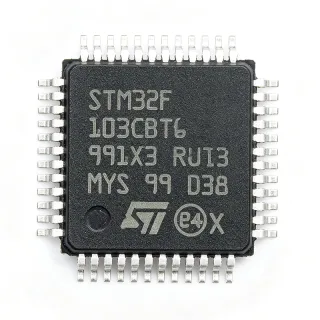
PIC16C505T-20I/SL - 8-Bit OTP MCU, 1.5KB, 20MHz | Microchip
MPN: PIC16C505T-20I/SL ✗ End of Life| Qty | Unit Price | Extended |
|---|---|---|
| 1 | $1.85 | $1.85 |
| 10 | $1.66 | $16.60 |
| 100 | $1.48 | $148.00 |
| 500 | $1.3 | $650.00 |
| 1,000 | $1.18 | $1,180.00 |
PIC16C505T-20I/SL Overview
An 8-bit microcontroller (MCU) is a single-chip computer that integrates a CPU, RAM, program memory, and peripherals. The PIC16C family belongs to Microchip's baseline 8-bit architecture using a Harvard RISC design with 12-bit wide instructions, providing approximately 2:1 code compression versus competitors in the same class. Within the broader taxonomy, this device sits as: PIC16C505 -> PIC16C family -> PIC microcontroller -> 8-bit MCU -> microcontroller -> embedded IC -> semiconductor.
Key features include 72 bytes of RAM, 11 digital I/O pins, 33 single-word instructions, a hardware 8-bit timer, watchdog timer, internal oscillator option, and a wide 3.0V to 5.5V supply voltage range. The PIC16C505's OTP program memory enables fast prototyping and small-to-medium volume production, while the 14-pin SOIC package supports compact PCB designs. The integrated RC oscillator reduces external component count.
Technically, the PIC16C505 uses a 12-bit instruction word with single-cycle execution except for program branches (two cycles). Its RISC architecture delivers deterministic 200 ns instruction time at 20 MHz. The device supports in-circuit serial programming (ICSP) for OTP programming, low-power SLEEP mode with wake-on-pin-change, and brown-out reset protection on most variants, making it suitable for battery-powered and industrial control applications.
Typical applications include consumer appliance controls, automotive body electronics, industrial sensor interfaces, low-cost remote controls, lighting ballasts, and battery chargers. The wide operating voltage (3.0V to 5.5V) and industrial temperature range suit harsh-environment deployments, while the small 14-pin footprint targets space-constrained designs.
When designing with this device, note that OTP memory requires programming before deployment - unlike flash-based PIC16F505, code cannot be erased or rewritten. Allocate PCB space for the ICSP header (RB6/RB7 pins) to enable factory programming and field firmware updates if needed.
This page synthesizes distributor pricing, drop-in alternatives, and engineering notes not consolidated in any single manufacturer document.
Drop-in alternatives for PIC16C505T-20I/SL — same package, pin-to-pin compatible. Different-package parts requiring PCB rework are excluded.
Variants in this series
Same-series models that are drop-in compatible with PIC16C505T-20I/SL (same form factor and footprint) — differing in Package, Number of I/O Pins, Operating Temperature, Timers, ADC.
Quick Comparison Tool — Select alternative parts for side-by-side comparison:
PIC16F505T-I/SL
✅ Drop-In📋 Reference alternative (not in catalog)
PIC16C505-20I/SL
✅ Drop-In📋 Reference alternative (not in catalog)
PIC16F506T-I/SL
✅ Drop-In📋 Reference alternative (not in catalog)
PIC12F629-I/SN
✅ Drop-In ⚠️ 参数待验证✓ In Stock
$0.82 / Unit
View Datasheet →PIC16C505T-20I/SL Maximum Ratings & Electrical Characteristics
| Series | PIC16C |
| Core Processor | PIC |
| Core Size | 8-bit |
| Speed | 20 MHz |
| Instruction Execution Time | 200 ns |
| Program Memory Size | 1.5 KB (1K x 12) OTP |
| RAM Size | 72 x 8 bytes |
| Number of I/O | 11 |
| Supply Voltage | 3.0 V to 5.5 V |
| Operating Temperature | -40C to +85C (industrial) |
| Package | 14-SOIC (3.90 mm width) |
| Mounting Type | Surface Mount |
| Packaging | Tape & Reel |
| Instruction Set | 33 single-word instructions |
| Architecture | CMOS, Harvard RISC, 12-bit instruction word |
| Peripherals | Watchdog Timer, 8-bit Timer, ICSP |
| RoHS Status | Compliant |
| MSL Level | 1 (unlimited) |
PIC16C505T-20I/SL Pin Configuration
| Pin 1 | VDD — Positive power supply (3.0V to 5.5V) |
| Pin 2 | OSC1/CLKIN — Oscillator input or external clock input |
| Pin 3 | OSC2/CLKOUT — Oscillator output or clock output |
| Pin 4 | RA0 — Digital I/O, PORTA bit 0 |
| Pin 5 | RA1 — Digital I/O, PORTA bit 1 |
| Pin 6 | RA2 — Digital I/O, PORTA bit 2 |
| Pin 7 | RA3 — Digital I/O, PORTA bit 3 (input only) |
| Pin 8 | RA4 — Digital I/O, PORTA bit 4 (open-drain output) |
| Pin 9 | VSS — Ground reference |
| Pin 10 | RB0/INT — Digital I/O, PORTB bit 0, external interrupt |
| Pin 11 | RB1 — Digital I/O, PORTB bit 1 |
| Pin 12 | RB2 — Digital I/O, PORTB bit 2 |
| Pin 13 | RB3 — Digital I/O, PORTB bit 3 |
| Pin 14 | RB4 — Digital I/O, PORTB bit 4 |
Typical Applications
PIC16C505T-20I/SL is suitable for 6 applications: Consumer Appliance Control, Automotive Body Electronics, Industrial Sensor Interface, Low-Cost Remote Control, LED Lighting Ballasts, Battery Charger Controller.
Consumer Appliance Control
The PIC16C505T-20I/SL suits consumer appliance controls such as washing machine timers, microwave oven keypads, and dishwasher cycle controllers, where its 11 I/O pins directly drive relays, LEDs, and matrix keypads without external logic. The 3.0V-5.5V supply range matches standard 5V appliance rails and 3.3V low-power designs. The 20 MHz PIC RISC core executes control loops with 200 ns deterministic timing, ensuring precise motor and heater actuation. OTP memory locks in final firmware at production, eliminating field modification and reducing per-unit cost versus flash parts. The industrial -40C to +85C temperature range survives under-cabinet thermal stress in laundry and kitchen environments.
Recommended
Automotive Body Electronics
The PIC16C505T-20I/SL is well-suited to automotive body modules such as window lift controllers, mirror adjusters, interior lighting drivers, and seat position sensors. Its industrial -40C to +85C rating covers cabin thermal environments, and the 11 I/O pins interface directly with switches, Hall sensors, and LED drivers. The 20 MHz instruction cycle delivers deterministic response times for safety-relevant functions like anti-pinch detection in power windows. OTP memory locks production firmware against unauthorized field modification. The 14-SOIC package fits the compact PCB footprints required behind dashboard panels and door modules.
Recommended
Industrial Sensor Interface
The PIC16C505T-20I/SL serves as a low-cost front-end for industrial 4-20 mA sensor conditioning, digital thermocouple scanning, and binary limit-switch aggregation where 11 I/O pins accommodate multiple sensor inputs. The 3.0V-5.5V supply range powers directly from 24V-to-5V industrial rails after regulation, while the 20 MHz core handles Modbus RTU framing and ADC sequencing (when paired with an external ADC). Industrial temperature rating ensures operation inside sealed control cabinets. OTP memory prevents unauthorized firmware tampering in factory-floor deployments.
Recommended
Low-Cost Remote Control
The PIC16C505T-20I/SL excels in cost-sensitive remote control transmitters for ceiling fans, garage door openers, and RF-controlled lighting, where the small 14-SOIC footprint fits inside handheld enclosures. The 11 I/O pins scan 4x4 matrix keypads while driving an RF encoder IC, and the 200 ns instruction time responds to button presses with negligible latency. OTP memory locks each remote to a unique button-to-command mapping, preventing cloning. Operating from 3.0V, the device pairs with single-cell Li-ion or two-AAA battery packs with no additional regulator. Low SLEEP current extends battery life when idle.
Recommended
LED Lighting Ballasts
The PIC16C505T-20I/SL drives LED ballast circuits for architectural and signage lighting, where it executes PWM dimming, color mixing, and over-temperature protection algorithms at 20 MHz. The 11 I/O pins generate multiple PWM channels for RGB or warm-white LED strings while reading thermistor inputs for thermal foldback. The 3.0V-5.5V range matches standard LED driver rails. OTP memory locks color calibration tables at production, ensuring consistent bin-to-bin output. The industrial -40C to +85C rating handles enclosed fixture thermal rise. The 14-SOIC package allows compact PCB integration inside slim linear LED housings.
Recommended
Battery Charger Controller
The PIC16C505T-20I/SL implements CC/CV charge profiles for lead-acid, NiMH, and Li-ion battery chargers in cordless tools, e-bikes, and UPS backup units. The 11 I/O pins monitor battery voltage, current shunt, temperature thermistor, and drive MOSFET gate drivers for buck converter stages. The 20 MHz core executes PID charge control loops with 200 ns resolution. OTP memory locks safety-critical charge parameters (CV voltage, CC current limits) preventing field tampering. Wide supply voltage (3.0-5.5V) allows operation from auxiliary 5V rails while the battery stack is being charged.
Recommended
Recommended Products Summary
Engineering reference data for PIC16C505T-20I/SL — comparison, design guidance, and compliance information.
Selection Guide
Comparison with Alternatives
| Parameter | This Product | PIC16F505T-I/SL | PIC16C505-20I/SL | PIC16F506T-I/SL |
|---|---|---|---|---|
| Brand | Microchip Technology | Microchip Technology | Microchip Technology | Microchip Technology |
| Package | 14-SOIC (3.90 mm) | 14-SOIC (3.90 mm) - same | 14-SOIC (3.90 mm) - same | 14-SOIC (3.90 mm) - same |
| Program Memory Type | 1.5 KB OTP | 1.5 KB Flash | 1.5 KB OTP | 1.5 KB Flash |
| Program Memory Size | 1.5 KB (1K x 12) | 1.5 KB (1K x 12) | 1.5 KB (1K x 12) | 1.5 KB (1K x 12) |
| Supply Voltage | 3.0 V to 5.5 V | 2.0 V to 5.5 V | 3.0 V to 5.5 V | 2.0 V to 5.5 V |
| Operating Temperature | -40C to +85C | -40C to +85C | -40C to +85C | -40C to +85C |
| Number of I/O | 11 | 11 | 11 | 11 |
| Core Speed | 20 MHz (200 ns) | 20 MHz (200 ns) | 20 MHz (200 ns) | 20 MHz (200 ns) |
| Reprogrammable | No (OTP) | Yes (Flash, 10K cycles) | No (OTP) | Yes (Flash, 10K cycles) |
Key Differentiators
- Same-family flash upgrade with broader voltage range (vs PIC16F505T-I/SL)
- Same die, same footprint, different packaging format (vs PIC16C505-20I/SL)
- Adds analog peripherals without footprint change (vs PIC16F506T-I/SL)
Design Notes
Estimated: Place a 0.1 uF decoupling capacitor as close as possible (within 5 mm trace length) to the VDD pin (pin 1) and a bulk capacitor (4.7 uF to 10 uF) on the same VDD net. For ICSP programming, expose the RB6 and RB7 pins to a 6-pin header (or test points) with pull-down resistors on RB6/RB7 to prevent spurious entry into programming mode. Use a ground plane under the SOIC package to reduce EMI and provide thermal dissipation. Keep high-current switching traces (relays, LEDs) away from the OSC1/OSC2 oscillator pins to avoid injection of switching noise into the clock reference.
The PIC16C505T-20I/SL supply voltage is 3.0V-5.5V; do not connect directly to a 12V or 24V rail without regulation. Use a linear regulator (e.g., 7805 for 5V, or LP2985 for 3.3V) with input/output caps per the regulator datasheet. For battery applications, the device can operate directly from a single-cell Li-ion (3.0V-4.2V) or two alkaline cells (2.0V-3.4V requires the F variant). SLEEP mode current is in the microamp range, ideal for battery-powered remote controls.
OTP memory can be programmed only once - verify firmware completely using a PIC16F505 development board (flash-based) before committing to OTP programming. The PIC16C505 does NOT support self-programming in-circuit; once programmed it cannot be updated without device replacement. Brown-out reset (BOR) and watchdog timer (WDT) must be configured in the configuration word at programming time. The MCLR pin must be pulled high through a 10 kohm resistor; leaving it floating causes intermittent resets. RA3 is input-only and cannot drive outputs. RA4 is open-drain and requires an external pull-up.
For long trace lengths (>50 mm) on RB0/INT or other I/O pins carrying fast signals, add a 100 ohm series resistor to dampen reflections. The PIC16C505 outputs can source/sink up to 25 mA per pin; if driving higher current loads, use a MOSFET driver or Darlington array (e.g., ULN2003). When using the internal RC oscillator, expect +/- 1% frequency tolerance over temperature; for UART communication, use the external crystal mode or compensate baud rate in firmware. Keep oscillator traces short and surround them with ground pour to minimize jitter.
Compliance Information
RoHS compliant per Microchip product page. Not AEC-Q100 qualified; for automotive safety-critical designs consider AEC-Q100-qualified PIC16F variants. Halogen-free status not specified in verified data.