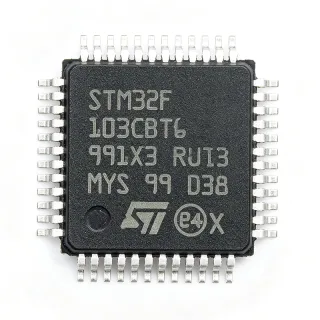
PIC16C54-10/SO - 8-bit OTP MCU, 10MHz, SOIC-18 | Microchip
MPN: PIC16C54-10/SO ✗ End of Life| Qty | Unit Price | Extended |
|---|---|---|
| 1 | $1.55 | $1.55 |
| 10 | $1.42 | $14.20 |
| 100 | $1.28 | $128.00 |
| 500 | $1.15 | $575.00 |
| 1,000 | $1.02 | $1,020.00 |
PIC16C54-10/SO Overview
An 8-bit microcontroller (MCU) is a small, self-contained computing element that integrates a CPU, non-volatile program memory, working RAM, and peripheral blocks (timers, I/O, sometimes ADC/UART) on a single die. Microcontrollers occupy the tier between fixed-function ASICs and full microprocessors, sitting hierarchically under embedded computing and above discrete logic. The PIC16C5x family specifically belongs to Microchip's original low-cost, high-performance, fully static OTP/EPROM/ROM lineup; within that family the PIC16C54 is the smallest-memory variant (no ADC, no interrupts beyond TMR0 overflow), making it a stepping stone from discrete logic into programmable control.
Key features of the PIC16C54-10/SO include a 4 MHz internal oscillator option, a wide 2.0 V to 6.0 V operating supply range (commercial 0C to +70C), a two-level deep hardware stack, and three addressing modes (direct, indirect, relative). The -10 speed grade specifies a 10 MHz maximum clock at 4.5 V to 5.5 V VDD, with 250 ns minimum instruction cycle. Special-function hardware registers are limited to seven or eight, keeping the core deliberately tiny. Brown-out and watchdog peripherals are absent on this original C-generation part; designers needing them should consider the PIC16C54A or PIC16F54 successors.
Typical applications include low-cost consumer appliances, simple sensor and switch interfaces, LED driving sequencers, replacement of discrete 74HC logic, hobby projects, and legacy industrial controllers that were originally designed around the PIC16C5x family. Its fully static CMOS design also makes it well-suited to battery-powered and slow-clock applications where dynamic power can be minimized by lowering the oscillator frequency.
When designing with this part, remember it is OTP-only and not reprogrammable in-circuit; production code must be generated by a device programmer such as the MPLAB PM3. Designers should also budget for the lack of interrupts, missing ADC, and limited stack depth - code organization must avoid heavy call nesting.
This page synthesizes distributor pricing, drop-in same-brand and cross-brand alternatives, lifecycle context, and practical design notes not found on any single manufacturer or distributor page.
Drop-in alternatives for PIC16C54-10/SO — same package, pin-to-pin compatible. Different-package parts requiring PCB rework are excluded.
Variants in this series
Same-series models that are drop-in compatible with PIC16C54-10/SO (same form factor and footprint) — differing in Package, Program Memory Size, Program Memory Type, Timers, Core Architecture.
Quick Comparison Tool — Select alternative parts for side-by-side comparison:
PIC16C54A-10/SO
✅ Drop-In✓ In Stock
$1.05 / Unit
View Datasheet →PIC16F54-I/SO
✅ Drop-In📋 Reference alternative (not in catalog)
PIC16F505-I/SO
✅ Drop-In📋 Reference alternative (not in catalog)
PIC16C54-10I/SO
✅ Drop-In✓ In Stock
$0.82 / Unit
View Datasheet →PIC16C54-10E/SO
✅ Drop-In✓ In Stock
$1.82 / Unit
View Datasheet →PIC16CR54-10/SO
✅ Drop-In📋 Reference alternative (not in catalog)
PIC16C54-10/SO Maximum Ratings & Electrical Characteristics
| Manufacturer | Microchip Technology |
| Series | PIC 16C |
| Core | 8-bit RISC (33 single-word instructions) |
| Program Memory Type | OTP EPROM/ROM |
| Program Memory Size | 768 bytes (512 x 12) |
| RAM | 25 bytes |
| Maximum Clock Frequency | 10 MHz |
| Instruction Cycle Time | 400 ns (10 MHz, 4.5 V to 5.5 V VDD) |
| Operating Supply Voltage | 2.0 V to 6.0 V |
| I/O Pins | 12 |
| Timers | 1 x 8-bit (TMR0) |
| Hardware Stack Depth | 2 levels |
| ADC | None |
| Watchdog Timer | None |
| Brown-out Reset | None |
| Interrupts | None (polled TMR0 overflow only) |
| Operating Temperature | 0 C to +70 C |
| Package | SOIC-18 (7.50 mm width) |
| Mounting Type | Surface Mount |
| Architecture | Harvard (separate program/data buses) |
| Instruction Width | 12 bits |
| Data Path Width | 8 bits |
| Addressing Modes | Direct, indirect, relative |
| RoHS Status | Compliant |
PIC16C54-10/SO Pin Configuration
| Pin 1 | RA2 — General-purpose I/O bit 2 (Port A) |
| Pin 2 | RA3 — General-purpose I/O bit 3 (Port A) |
| Pin 3 | RA4/T0CKI — General-purpose I/O bit 4 / TMR0 external clock input |
| Pin 4 | MCLR/VPP — Master clear (active low reset) / programming voltage input |
| Pin 5 | VSS — Ground reference |
| Pin 6 | RB0 — General-purpose I/O bit 0 (Port B) |
| Pin 7 | RB1 — General-purpose I/O bit 1 (Port B) |
| Pin 8 | RB2 — General-purpose I/O bit 2 (Port B) |
| Pin 9 | RB3 — General-purpose I/O bit 3 (Port B) |
| Pin 10 | RB4 — General-purpose I/O bit 4 (Port B) |
| Pin 11 | VDD — Positive supply voltage |
| Pin 12 | RB5 — General-purpose I/O bit 5 (Port B) |
| Pin 13 | RB6 — General-purpose I/O bit 6 (Port B) |
| Pin 14 | RB7 — General-purpose I/O bit 7 (Port B) |
| Pin 15 | OSC1 — Oscillator input / external clock input |
| Pin 16 | OSC2 — Oscillator output (crystal/RC mode) |
| Pin 17 | RA0 — General-purpose I/O bit 0 (Port A) |
| Pin 18 | RA1 — General-purpose I/O bit 1 (Port A) |
Typical Applications
PIC16C54-10/SO is suitable for 7 applications: Low-Cost Consumer Appliance Control, LED Sequencing and Light Chaser, Replacement of 74HC Discrete Logic, Simple Sensor and Switch Interface, Hobby and Educational Embedded Projects, Legacy Industrial Controller Reproduction, Battery-Operated Slow-Clock Embedded Devices.
Low-Cost Consumer Appliance Control
The PIC16C54-10/SO fits low-cost consumer appliance control because its 768 bytes of OTP program memory, 12 digital I/O pins, and 10 MHz clock are enough to scan key matrices, drive LED indicators, sequence relays, and read simple switch inputs. With 33 single-cycle instructions and a 400 ns instruction cycle, the part handles 8-10 kHz polling loops and PWM-like bit-banging with no trouble, and the SOIC-18 7.50 mm package is small enough for toaster-oven or coffee-maker control boards. Its main limitation is OTP-only programming - the firmware must be fully validated before masked production runs.
Recommended
LED Sequencing and Light Chaser
The PIC16C54-10/SO is well-suited to LED sequencing and light-chaser circuits because its TMR0 timer and 12 I/O pins can multiplex up to 12 individual LEDs or scan an 8x4 LED matrix using charlieplexing or direct drive. The 10 MHz clock generates bit-banged PWM at audio-friendly frequencies (sub-20 kHz) with no flicker, and the 2-level hardware stack is sufficient for short ISR-like TMR0 overflow handlers. The 25 bytes of RAM comfortably hold a 12-byte pattern buffer plus state, while the SOIC-18 package keeps the BOM small for hobby and decorative lighting kits.
Recommended
Replacement of 74HC Discrete Logic
The PIC16C54-10/SO can replace 74HC-series glue logic by mapping custom combinatorial and sequential behavior into firmware, eliminating the board area and routing complexity of multiple 74HC00, 74HC74, 74HC138, and 74HC595 packages. With a 10 MHz clock and 400 ns instruction cycle, the part emulates propagation delays of sub-microsecond 74HC logic, and the 33-instruction RISC core makes state machines trivial to implement. The SOIC-18 footprint fits where 2-3 SOIC-14/16 logic ICs would otherwise have been placed, dramatically simplifying PCB layout and reducing assembly cost.
Recommended
Simple Sensor and Switch Interface
The PIC16C54-10/SO handles simple sensor and switch interface boards by reading up to 12 contact closures or digital sensors and driving relay or optocoupler outputs in response. The 2.0 V to 6.0 V supply range allows direct connection to 3.3 V or 5 V sensors without level shifters, and the fully static CMOS design lets the oscillator be slowed to 32 kHz for ultra-low-power battery operation (microamp range typical). The TMR0 counter can measure pulse widths up to several seconds for flow, rotation, or occupancy sensors, making the part a cost-effective bridge between electromechanical sensors and downstream control logic.
Recommended
Hobby and Educational Embedded Projects
The PIC16C54-10/SO is widely used in hobby and educational embedded projects because its 33-instruction RISC core is small enough to teach an entire assembly language in one sitting, while the 12-bit instruction width and Harvard architecture illustrate real-world microprocessor concepts. With 768 bytes of OTP, students can complete meaningful projects such as digital thermometers (with external sensor), dice games, motor speed controllers, and alarm timers without paying for emulator-grade silicon. The SOIC-18 package is breadboard-friendly with a breakout adapter, and the device programmer ecosystem (K150, PICSTART Plus, MPLAB PM3) keeps lab costs low.
Recommended
Legacy Industrial Controller Reproduction
The PIC16C54-10/SO remains the correct choice for legacy industrial controller reproduction where the original equipment was designed around PIC16C5x silicon and where bit-exact firmware compatibility matters. The original OTP memory contents can be re-issued from archived PROM files using an MPLAB PM3 or PICSTART Plus programmer, and the SOIC-18 footprint matches original PCBs without rework. For one-off repairs or low-volume legacy rebuilds, the PIC16C54-10/SO is irreplaceable - even though new designs should adopt the PIC16F54 or PIC16F505, production replacements for field-deployed controllers must stay on the original silicon.
Recommended
Battery-Operated Slow-Clock Embedded Devices
The PIC16C54-10/SO is well-suited to battery-operated slow-clock embedded devices because its fully static CMOS design allows the clock to be reduced to DC for sub-microamp sleep current, then woken by an external interrupt or watchdog edge. At 32 kHz the part consumes well under 100 uA while still able to drive LEDs, monitor a battery voltage divider, and pulse a piezo buzzer. The 2.0 V minimum VDD lets the device run down to two nearly-depleted AA cells, and the SOIC-18 package is small enough for wearables, remote controls, and wireless sensor end nodes.
Recommended
Recommended Products Summary
Engineering reference data for PIC16C54-10/SO — comparison, design guidance, and compliance information.
Selection Guide
Comparison with Alternatives
| Parameter | This Product | PIC16C54A-10/SO | PIC16F54-I/SO | PIC16F505-I/SO | PIC16C54-10I/SO | PIC16C54-10E/SO | PIC16CR54-10/SO |
|---|---|---|---|---|---|---|---|
| Brand | Microchip Technology | Microchip Technology | Microchip Technology | Microchip Technology | Microchip Technology | Microchip Technology | Microchip Technology |
| Package | SOIC-18 (7.50 mm) | SOIC-18 (same) | SOIC-18 (same) | SOIC-18 (same) | SOIC-18 (same) | SOIC-18 (same) | SOIC-18 (same) |
| Program Memory Type | OTP EPROM | OTP EPROM | Flash (in-circuit reprogrammable) | Flash (in-circuit reprogrammable) | OTP EPROM | OTP EPROM | Mask ROM (factory-programmed) |
| Program Memory Size | 768 B (512 x 12) | 768 B (same) | 768 B (same) | 1.5 KB (larger) | 768 B (same) | 768 B (same) | 768 B (same) |
| Maximum Clock Frequency | 10 MHz | 10 MHz (same) | 20 MHz (higher) | 20 MHz (higher) | 10 MHz (same) | 10 MHz (same) | 10 MHz (same) |
| Operating Temperature | 0 C to +70 C (commercial) | 0 C to +70 C (commercial) | -40 C to +85 C (industrial) | -40 C to +85 C (industrial) | -40 C to +85 C (industrial) | -40 C to +125 C (extended) | 0 C to +70 C (commercial) |
| Watchdog / Brown-out | None / None | Yes (WDT) / Yes (BOR) | Yes (WDT) / Yes (BOR) | Yes (WDT) / Yes (BOR) | None / None | None / None | None / None |
| Lifecycle Status | NRND | Active | Active | Active | NRND | NRND | NRND |
Key Differentiators
- Original-silicon compatibility for legacy reproduction (vs PIC16C54A-10/SO)
- Flash reprogrammability via ICSP (vs PIC16F54-I/SO)
- Smaller, faster, and feature-rich flash successor (vs PIC16F505-I/SO)
- Industrial temperature range in identical footprint (vs PIC16C54-10I/SO)
Design Notes
Estimated: at VDD=5 V and 10 MHz external clock, the PIC16C54-10/SO draws roughly 2-5 mA active and <1 uA in sleep. Decouple VDD (pin 11) with a 100 nF ceramic placed within 5 mm of the pin, plus a 10 uF bulk capacitor if the supply is shared with relays or LEDs. Because the original C54 has no brown-out reset, ensure the supply ramp time is fast (<50 ms) or add an external reset supervisor to avoid code execution at indeterminate VDD.
The PIC16C54 has only a 2-level hardware stack - subroutines can only nest one level deep, and ISRs are not supported. Code with CALL inside CALL or CALL inside interrupt-like polling will silently overwrite the return PC. Estimated: reorganize logic into flat state machines using GOTO rather than CALL where possible. Also remember the part is OTP-only: there is no ICSP, no debug header, no in-circuit reprogram - any firmware change requires a new device and a programmer such as the MPLAB PM3.
Keep the crystal or resonator traces (pins 15 OSC1, 16 OSC2) short (<5 mm) and guard them with a ground pour to avoid coupling noise from RB7 or other switching outputs. Place a 1 M-ohm resistor in parallel with the crystal if using a low-power watch crystal, and add 10-33 pF load capacitors per crystal manufacturer datasheet. Keep MCLR/VPP (pin 4) routed away from switching nodes to prevent spurious resets; add a 10 k-ohm pull-up to VDD and a 100 nF cap to ground for noise immunity.
When migrating legacy PIC16C54 code to the PIC16C54A, PIC16F54, or PIC16F505, verify that the new device's configuration bits (watchdog enable, brown-out threshold, oscillator mode) are set correctly - the A-suffix and F-suffix parts add configuration registers at addresses the original C54 does not have. Source code typically ports unchanged because the 33-instruction core is identical, but the CONFIG register addresses and default reset values differ. Always rebuild the project in MPLAB X IDE rather than blindly reusing the old .hex file.
Compliance Information
RoHS compliant per Microchip product page. Not AEC-Q100 qualified - the part targets consumer and industrial markets, not automotive. Halogen-free status not explicitly stated on the distributor pages reviewed; verify with Microchip directly if required.