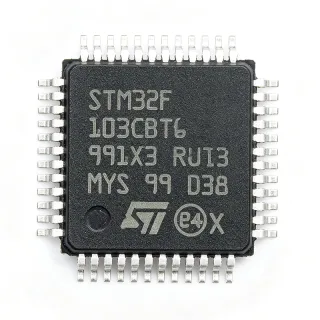
PIC16C54-LPI/SS - 8-bit EPROM MCU, 12 I/O, SSOP-20 | Microchip
MPN: PIC16C54-LPI/SS ✓ Active| Qty | Unit Price | Extended |
|---|---|---|
| 1 | $3.81 | $3.81 |
| 10 | $3.43 | $34.30 |
| 100 | $3.04 | $304.00 |
| 500 | $2.71 | $1,355.00 |
| 1,000 | $2.41 | $2,410.00 |
PIC16C54-LPI/SS Overview
A microcontroller (MCU) is a single-chip computer containing a processor core, program memory, data RAM, and programmable I/O peripherals. The PIC16C5X family uses a RISC architecture with only 33 single-word/single-cycle instructions, giving it a 2:1 code compression advantage over competing 8-bit MCUs in the same price category. Within the broader taxonomy, this places the PIC16C54 as a micro-controller -> embedded processor -> semiconductor device. Its Harvard-style separate program/data buses and 12-bit wide instruction word allow deterministic single-cycle execution of most opcodes.
Key features include a 12-bit instruction word, an 8-bit data path, two-level hardware stack, an 8-bit real-time clock/counter (TMR0), and direct/indirect/relative addressing modes. Seven or eight special-function hardware registers support rapid context save/restore. The device has a maximum clock speed of 40 MHz, providing up to 10 MIPS instruction throughput. As an OTP (one-time programmable) EPROM-based part, the PIC16C54-LPI/SS is well suited to legacy, low-cost, low-volume embedded designs where Flash reprogrammability is not required.
Typical applications include industrial controllers, simple sensor interfaces, appliance control boards, LED driving circuits, hobbyist projects, and replacement of older discrete logic in legacy systems. Because of its small footprint and ultra-low cost, it remains common in mature designs and educational kits where deterministic execution and minimal BOM are priorities.
When designing with the PIC16C54-LPI/SS, ensure your programmer supports OTP/EPROM devices (e.g., MPLAB PM3) and provide adequate decoupling (typically 0.1 µF) close to VDD. As an OTP device, code must be committed at production time; consider PIC16F54 if in-field Flash reprogrammability is required.
This page synthesizes distributor pricing, drop-in SSOP-20 alternatives from the same PIC16C5X family, and practical design considerations not found in the bare manufacturer datasheet.
Drop-in alternatives for PIC16C54-LPI/SS — same package, pin-to-pin compatible. Different-package parts requiring PCB rework are excluded.
Variants in this series
Same-series models that are drop-in compatible with PIC16C54-LPI/SS (same form factor and footprint) — differing in Package, Program Memory Size, Program Memory Type, Core Architecture, Timers.
Quick Comparison Tool — Select alternative parts for side-by-side comparison:
PIC16C54-LPE/SS
✅ Drop-In📋 Reference alternative (not in catalog)
PIC16C54C-04/SS
✅ Drop-In✓ In Stock
$0.65 / Unit
View Datasheet →PIC16C54A-04/SS
✅ Drop-In✓ In Stock
$1.18 / Unit
View Datasheet →PIC16C54AT-10/SS
✅ Drop-In✓ In Stock
$1.82 / Unit
View Datasheet →PIC16C54-10/SS
✅ Drop-In✓ In Stock
$1.55 / Unit
View Datasheet →PIC16C54T-LPE/SS
✅ Drop-In✓ In Stock
$1.45 / Unit
View Datasheet →PIC16C54-LPI/SS Maximum Ratings & Electrical Characteristics
| Core Architecture | 8-bit PIC RISC |
| Program Memory Type | EPROM (OTP) |
| Program Memory Size | 768 bytes (0.75 KB) |
| RAM Size | 25 bytes |
| I/O Pins | 12 |
| Instruction Set Width | 12-bit |
| Number of Instructions | 33 single-word/single-cycle |
| Hardware Stack Depth | 2 levels |
| Timers | 8-bit TMR0 |
| Supply Voltage (VDD) | 2.5 V to 6.25 V |
| Maximum Clock Frequency | 40 MHz |
| Operating Temperature | -40 °C to +85 °C (Industrial) |
| Package | SSOP-20 (208 mil) |
| Mounting Type | Surface Mount |
| RoHS Status | Compliant |
PIC16C54-LPI/SS Pin Configuration
| Pin 1 | RA2 — Bidirectional I/O port A bit 2 |
| Pin 2 | RA3 — Bidirectional I/O port A bit 3 |
| Pin 3 | RB0 — Bidirectional I/O port B bit 0 |
| Pin 4 | /MCLR — Master Clear reset (active low) |
| Pin 5 | VSS — Ground reference |
| Pin 6 | RB1 — Bidirectional I/O port B bit 1 |
| Pin 7 | RB2 — Bidirectional I/O port B bit 2 |
| Pin 8 | RB3 — Bidirectional I/O port B bit 3 |
| Pin 9 | RB4 — Bidirectional I/O port B bit 4 |
| Pin 10 | RB5 — Bidirectional I/O port B bit 5 |
| Pin 11 | RB6 — Bidirectional I/O port B bit 6 |
| Pin 12 | RB7 — Bidirectional I/O port B bit 7 |
| Pin 13 | RA0 — Bidirectional I/O port A bit 0 |
| Pin 14 | RA1 — Bidirectional I/O port A bit 1 |
| Pin 15 | OSC2 — Oscillator output |
| Pin 16 | OSC1 — Oscillator input |
| Pin 17 | NC — Not connected (per datasheet) |
| Pin 18 | NC — Not connected (per datasheet) |
| Pin 19 | VSS — Ground reference |
| Pin 20 | VDD — Positive supply voltage |
Typical Applications
PIC16C54-LPI/SS is suitable for 6 applications: Industrial Control Logic Replacement, Appliance Control Boards, Simple Sensor Interface Hubs, LED Driver and Display Controllers, Hobbyist and Educational MCU Projects, Automotive Interior Accessories (Non-Safety).
Industrial Control Logic Replacement
The PIC16C54-LPI/SS replaces legacy 74-series discrete logic in industrial controllers with 12 GPIO and deterministic single-cycle RISC execution at up to 40 MHz. Its 768-byte EPROM stores compact control sequences, while the 2-level hardware stack and 25-byte RAM are sufficient for simple state machines. The -40 to +85 °C industrial temp grade handles factory-floor environments. Decoupling with 0.1 µF ceramic close to VDD is recommended. Engineers use it where cost per node is critical and Flash reprogrammability is unnecessary.
Recommended
Appliance Control Boards
The PIC16C54-LPI/SS fits appliance controllers (washing machines, dishwashers, microwave ovens) that require 8-bit GPIO control of relays, valves, and indicator LEDs. Its 2.5-6.25 V supply range tolerates unregulated 5 V rails typical in white goods. The 33 single-cycle instructions deliver deterministic response to sensor inputs via TMR0, while 768 bytes of OTP EPROM holds fixed appliance sequences. The SSOP-20 footprint supports compact PCB designs behind front panels.
Recommended
Simple Sensor Interface Hubs
The PIC16C54-LPI/SS acts as a low-cost sensor interface for digital switches, contact closures, and quadrature encoders. Its 12 GPIO can scan up to 12 discrete sensor inputs directly, while TMR0 timestamps events at microsecond resolution. The OTP EPROM prevents accidental firmware modification in the field. The 2.5-6.25 V supply matches battery-powered wireless sensor node rails. A 4 MHz resonator drives the LP oscillator mode for sub-mA active current in duty-cycled applications.
Recommended
LED Driver and Display Controllers
The PIC16C54-LPI/SS drives LED matrices, seven-segment displays, and Charlieplexed indicators using its 12 GPIO and software-driven bit-banging. With 768 bytes of EPROM and 25 bytes of RAM, the device holds complex display refresh routines and lookup tables for numeric/hex character encoding. The 40 MHz clock ensures flicker-free multiplexed refresh up to several hundred Hz. Industrial temp grade tolerates enclosed lighting fixture environments.
Recommended
Hobbyist and Educational MCU Projects
The PIC16C54-LPI/SS is widely adopted in educational kits and hobbyist projects because its 33-instruction RISC core is straightforward to learn and the SSOP-20 package is breadboard-friendly with a breakout adapter. The 768-byte EPROM teaches OTP programming concepts, while 25 bytes of RAM exercises register-level programming. The industrial temp grade lets students run experiments in varied conditions. The Microchip PM3 programmer supports device programming in academic labs.
Recommended
Automotive Interior Accessories (Non-Safety)
For non-safety automotive interior accessories such as ambient lighting controllers, vanity mirror timers, or seat-position memory, the PIC16C54-LPI/SS provides compact OTP logic with industrial temp tolerance. The SSOP-20 package fits behind dashboard panels where PCB area is constrained. The 12 GPIO drive MOSFETs controlling LED strings or small motors. Engineers verify EMC behavior with the LP oscillator mode to minimize EMI in the noisy automotive environment.
Recommended
Recommended Products Summary
Engineering reference data for PIC16C54-LPI/SS — comparison, design guidance, and compliance information.
Selection Guide
Comparison with Alternatives
| Parameter | This Product | PIC16C54-LPE/SS | PIC16C54C-04/SS | PIC16C54A-04/SS | PIC16C54AT-10/SS | PIC16C54-10/SS | PIC16C54T-LPE/SS |
|---|---|---|---|---|---|---|---|
| Package | SSOP-20 | SSOP-20 (same) | SSOP-20 (same) | SSOP-20 (same) | SSOP-20 (same) | SSOP-20 (same) | SSOP-20 (same) |
| Brand | Microchip Technology | Microchip Technology | Microchip Technology | Microchip Technology | Microchip Technology | Microchip Technology | Microchip Technology |
| Program Memory | 768 bytes EPROM | 768 bytes EPROM | 768 bytes EPROM | 768 bytes EPROM | 768 bytes EPROM | 768 bytes EPROM | 768 bytes EPROM |
| RAM | 25 bytes | 25 bytes | 25 bytes | 25 bytes | 25 bytes | 25 bytes | 25 bytes |
| I/O Pins | 12 | 12 | 12 | 12 | 12 | 12 | 12 |
| Supply Voltage | 2.5 V to 6.25 V | 2.5 V to 6.25 V | 2.5 V to 6.25 V | 2.5 V to 6.25 V | 2.5 V to 6.25 V | 2.5 V to 6.25 V | 2.5 V to 6.25 V |
| Max Clock Speed | 40 MHz (LP oscillator) | 40 MHz | 4 MHz | 4 MHz | 10 MHz | 10 MHz | 40 MHz |
| Temperature Grade | Industrial -40 °C to +85 °C | Extended -40 °C to +125 °C | Industrial -40 °C to +85 °C | Industrial -40 °C to +85 °C | Industrial -40 °C to +85 °C | Industrial -40 °C to +85 °C | Extended -40 °C to +125 °C |
Key Differentiators
- Lowest-cost PIC16C5X variant with industrial temp range (vs PIC16C54-LPE/SS)
- Highest speed grade within the PIC16C54 family (vs PIC16C54C-04/SS)
- Tape-and-reel packaging availability for high-volume assembly (vs PIC16C54A-04/SS)
Design Notes
The PIC16C54-LPI/SS draws microamp-level current in sleep mode but milliamps when active at 40 MHz. Place a 0.1 µF ceramic decoupling capacitor within 5 mm of the VDD pin (pin 20) and a 10 µF bulk capacitor on the supply rail. The /MCLR pin (pin 4) requires a pull-up resistor (typically 10 kΩ) to VDD for normal operation; add a 100 nF capacitor from /MCLR to VSS for noise immunity if the reset line is long or exposed to ESD.
Because the PIC16C54-LPI/SS uses OTP EPROM, code cannot be reprogrammed in the field. Verify your firmware thoroughly before committing production parts. The 2-level hardware stack limits call depth - subroutines cannot nest more than 2 deep without stack overflow. Use computed goto (table lookups) rather than deep call chains in 768-byte programs. The LP oscillator mode requires specific low-power crystal or resonator loading capacitance per the datasheet, otherwise startup may fail.
Route the oscillator traces (OSC1 pin 16, OSC2 pin 15) as short as possible and guard them with a ground pour to minimize EMI coupling. Place the resonator and its load capacitors within 5 mm of the MCU. The SSOP-20 package has a thermal pad on the underside that should be soldered to a moderate copper pour (0.5 sq inch minimum) for mechanical reliability and thermal dissipation. Use 0.1 µF bypass capacitors on every supply pin pair.
Compliance Information
RoHS compliant per LCSC distributor listing. Lead-free SSOP-20 package. Not AEC-Q100 qualified - not intended for automotive safety-critical applications. REACH compliance assumed from Microchip product policy but not explicitly stated in distributor data.