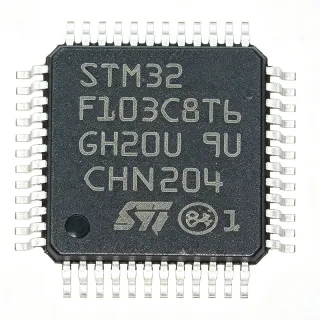
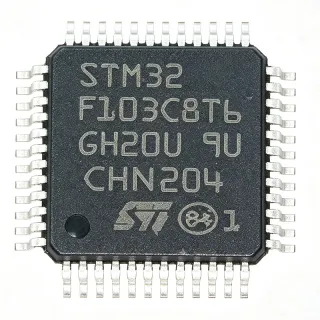
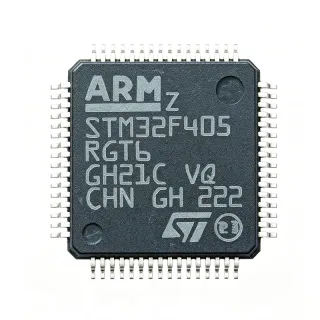
PIC16C54A-04E/SS - 4MHz 768B OTP 8-Bit MCU | Microchip SSOP-20
MPN: PIC16C54A-04E/SS ✓ Active| Qty | Unit Price | Extended |
|---|---|---|
| 1 | $2.45 | $2.45 |
| 10 | $2.18 | $21.80 |
| 100 | $1.79 | $179.00 |
| 500 | $1.55 | $775.00 |
| 1,000 | $1.32 | $1,320.00 |
PIC16C54A-04E/SS Overview
An OTP-based 8-bit microcontroller (also called a One-Time-Programmable MCU) is a single-chip computer that integrates CPU, non-volatile program memory, RAM, and peripherals on one die. Program memory is written once with a device programmer and cannot be erased, making these parts common in low-cost, fixed-function products. The PIC16C5X family falls under the taxonomy: microcontroller -> 8-bit MCU -> RISC MCU -> PIC16C family -> CMOS OTP microcontroller, and the PIC16C54A represents the 512 × 12 (≈768 byte) code-density tier of that family.
Key features of the PIC16C54A-04E/SS include: 12 I/O pins with individual direction registers; a 33-instruction RISC instruction set with 12-bit-wide opcodes yielding 2:1 code compression over typical 8-bit CISC MCUs; Power-On Reset (POR), Watchdog Timer (WDT) and a selectable oscillator type (RC, XT, LP, HS); and 8-bit timer/counter. The -04 speed grade indicates a 4 MHz maximum oscillator frequency, and the SS package denotes a 20-pin SSOP.
The PIC16C5X architecture uses a Harvard structure with separate program and data paths, 2-stage pipeline execution, and a fully-static core that allows the clock to be stopped without losing register state. The 12-bit instruction word matches the 12-bit program-memory organization, and the device address space is paged into two halves for code fetches above 0x1FF. Because it is CMOS and uses EPROM rather than flash for program storage, quiescent current is low in standby (≈ 1 µA typical for the family, depending on oscillator mode) and the part is well-suited to mains- or battery-powered appliances.
Typical applications for the PIC16C54A-04E/SS include simple remote controls, small appliance controllers (toasters, coffee makers, fans), toys and educational hardware, sensor interface modules, and any high-volume, fixed-function logic replacement where 12-bit-wide RISC code density and an OTP part minimize unit cost. Designers also pick this family when they need a tiny, low-pin-count MCU that runs deterministically from a basic RC or crystal oscillator.
When designing with this device, plan toolchain support carefully. PIC16C54A OTP parts are programmed with a Microchip device programmer (e.g., MPLAB PM3) and developed with MPLAB IDE / XC8 legacy compiler support; some modern MPLAB X features target the flash-based PIC16F equivalents instead. Always derate oscillator frequency for the chosen oscillator mode (RC, XT, LP, HS) and validate WDT behavior with MPLAB SIM before committing code to OTP parts.
This page synthesizes distributor availability, drop-in package-compatible alternatives from the PIC16C5X family, and practical design notes that go beyond the manufacturer datasheet's brief device summary.
Drop-in alternatives for PIC16C54A-04E/SS — same package, pin-to-pin compatible. Different-package parts requiring PCB rework are excluded.
Variants in this series
Same-series models that are drop-in compatible with PIC16C54A-04E/SS (same form factor and footprint) — differing in Package, Program Memory Size, Program Memory Type, Core Architecture, Operating Temperature Range.
Quick Comparison Tool — Select alternative parts for side-by-side comparison:
PIC16C54A-04/SS
✅ Drop-In✓ In Stock
$1.18 / Unit
View Datasheet →PIC16C54C-04E/SS
✅ Drop-In📋 Reference alternative (not in catalog)
PIC16C54C-04I/SS
✅ Drop-In ⚠️ 参数待验证✓ In Stock
$1.34 / Unit
View Datasheet →PIC16C55A-04E/SS
✅ Drop-In ⚠️ 参数待验证✓ In Stock
$2.05 / Unit
View Datasheet →PIC16C56A-04E/SS
✅ Drop-In ⚠️ 参数待验证✓ In Stock
$1.32 / Unit
View Datasheet →PIC16F54-I/SS
✅ Drop-In📋 Reference alternative (not in catalog)
PIC16C54A-04E/SS Maximum Ratings & Electrical Characteristics
| Core Architecture | 8-bit PIC RISC (Harvard) |
| Family | PIC16C5X (PIC® 16C) |
| Maximum Clock Frequency | 4 MHz (-04 speed grade) |
| Program Memory Type | EPROM (OTP) |
| Program Memory Size | 768 bytes (512 x 12 bits) |
| Data RAM | 25 x 8 bytes |
| I/O Pins | 12 |
| Supply Voltage (VDD) | 4.5 V to 5.5 V |
| Operating Temperature | 0 °C to +70 °C (E = commercial) |
| Package | 20-pin SSOP (SS) |
| Mounting Type | Surface Mount |
| Instruction Set | 33 single-word / single-cycle instructions (12-bit opcodes) |
| Peripherals | POR, WDT, 8-bit Timer/Counters (TMRO) |
| Oscillator Modes | RC, XT, LP, HS (configuration-fuse selectable) |
| RoHS Status | Compliant |
PIC16C54A-04E/SS Pin Configuration
| Pin 1 | RA2 — Bidirectional I/O port A bit 2 |
| Pin 2 | RA3 — Bidirectional I/O port A bit 3 |
| Pin 3 | T0CKI/MCLR — Timer0 clock input / Master Clear (reset) input |
| Pin 4 | GND — Ground reference |
| Pin 5 | RA0 — Bidirectional I/O port A bit 0 |
| Pin 6 | RA1 — Bidirectional I/O port A bit 1 |
| Pin 7 | OSC1 — Oscillator input (RC / XT / LP / HS mode) |
| Pin 8 | OSC2 — Oscillator output / CLKOUT |
| Pin 9 | RB0 — Bidirectional I/O port B bit 0 (interrupt-on-change) |
| Pin 10 | RB1 — Bidirectional I/O port B bit 1 (interrupt-on-change) |
| Pin 11 | RB2 — Bidirectional I/O port B bit 2 (interrupt-on-change) |
| Pin 12 | RB3 — Bidirectional I/O port B bit 3 (interrupt-on-change) |
| Pin 13 | RB4 — Bidirectional I/O port B bit 4 (interrupt-on-change) |
| Pin 14 | RB5 — Bidirectional I/O port B bit 5 (interrupt-on-change) |
| Pin 15 | RB6 — Bidirectional I/O port B bit 6 (interrupt-on-change) |
| Pin 16 | RB7 — Bidirectional I/O port B bit 7 (interrupt-on-change) |
| Pin 17 | NC — Not connected (no internal bond on this package pin) |
| Pin 18 | VDD — Positive supply (4.5 V to 5.5 V) |
| Pin 19 | RA4 — Bidirectional I/O port A bit 4 |
| Pin 20 | RA5 — Bidirectional I/O port A bit 5 |
Typical Applications
PIC16C54A-04E/SS is suitable for 6 applications: Remote Control Handsets, Small Appliance Controllers, Toys and Educational Hardware, Sensor Interface Modules, Logic Replacement / Glue Controllers, Automotive Body and Comfort Submodules.
Remote Control Handsets
The PIC16C54A-04E/SS suits handheld IR remote controls because its 12-bit RISC instructions yield dense keypad-scan and IR-modulation firmware in just a few hundred bytes of OTP memory. With 12 I/O pins, the device can directly drive a 3×4 matrix keypad plus a status LED while running the IR carrier on the timer output, eliminating any external logic. The 4.5–5.5 V supply range lets it run from a single CR2032 with a low-dropout boost, and the fully-static core lets the designer stop the oscillator in standby to extend battery life. Its OTP program memory keeps the unit cost low enough for high-volume consumer SKUs.
Recommended
Small Appliance Controllers
Coffee makers, toaster ovens, and small fan controllers benefit from the PIC16C54A-04E/SS's deterministic RISC core, fixed-function OTP memory, and 12 I/O pins that can scan a 3×4 keypad plus drive a triac/relay, an LED, and a buzzer directly. The 4 MHz oscillator is fast enough for zero-crossing triac timing and PWM fan-speed control, while 768 bytes of OTP program memory is sufficient for menu logic, timer state, and basic safety interlocks. Low quiescent current in the EPROM-based CMOS process keeps standby power well under 100 mW for energy-star designs, and the SSOP-20 package fits inside compact appliance control boards.
Recommended
Toys and Educational Hardware
Toy controllers, learning kits, and STEM-class hardware modules pick the PIC16C54A-04E/SS because 768 bytes of OTP code is enough for sound patterns, LED sequences, motor drive, and simple sensor logic, while the 33-instruction RISC set is famously easy to teach. The 20-pin SSOP package and 12 I/O lines give plenty of room for a speaker driver, several LEDs, and two motor outputs without external glue. Because OTP memory is one-time-programmable, factory programming cost is minimal and clone protection is inherent. The 0 °C to +70 °C commercial temperature range is sufficient for indoor toy environments.
Recommended
Sensor Interface Modules
Sensor hubs for industrial panels, building automation, and HVAC peripherals use the PIC16C54A-04E/SS to read multiple low-speed analog/digital sensors and forward the data over UART or a simple wire protocol. The 12 I/O pins can sample several switches and a single analog channel via the on-chip comparator, while 768 bytes of OTP code is ample for averaging, calibration lookup, and protocol formatting. The 4.5–5.5 V supply range lets the module share a regulated 5 V rail with analog front ends, and the SSOP-20 footprint is easy to place on small interface PCBs. Stable performance is guaranteed by the fully-static Harvard core, which is immune to clock stretch artifacts.
Recommended
Logic Replacement / Glue Controllers
Designers use the PIC16C54A-04E/SS as a one-chip replacement for clusters of 74-series logic gates when a custom sequence, debouncer, or timing pattern is required but a standard PAL/GAL is overkill. Its 12 I/O pins and 4 MHz instruction cycle (250 ns per instruction) deliver deterministic state-machine behavior without external clock generation beyond a 4 MHz RC network. OTP programming prevents field modification, ideal for fixed-function consumer or industrial logic modules. The SSOP-20 footprint occupies less board area than a typical 16-pin SOIC plus discrete gate array.
Recommended
Automotive Body and Comfort Submodules
Sub-modules such as mirror adjusters, lighting controllers, and seat-position memory that sit in less thermally demanding cabin locations can use the PIC16C54A-04E/SS or its industrial-temperature sibling PIC16C54A-04I/SS. The 4 MHz core and 12-bit instruction set are sufficient for PWM mirror/lighting drivers, switch debouncing, and basic LIN or simple serial handshakes with the BCM. For under-hub or harsher body locations, Microchip explicitly recommends migrating to AEC-Q100-qualified PIC16F equivalents, but the 16C54A series remains a cost-effective choice for non-safety cabin applications. The SSOP-20 package is pin-compatible across the PIC16C5X OTP family.
Recommended
Recommended Products Summary
Engineering reference data for PIC16C54A-04E/SS — comparison, design guidance, and compliance information.
Selection Guide
Comparison with Alternatives
| Parameter | This Product | PIC16C54A-04/SS | PIC16C54C-04E/SS | PIC16C54C-04I/SS | PIC16C55A-04E/SS | PIC16C56A-04E/SS | PIC16F54-I/SS |
|---|---|---|---|---|---|---|---|
| Package | 20-pin SSOP | 20-pin SSOP - same | 20-pin SSOP - same | 20-pin SSOP - same | 20-pin SSOP - same | 20-pin SSOP - same | 20-pin SSOP - same |
| Brand | Microchip Technology | Microchip Technology | Microchip Technology | Microchip Technology | Microchip Technology | Microchip Technology | Microchip Technology |
| Program Memory (bytes) | 768 (512 × 12) OTP | 768 (512 × 12) OTP | 768 (512 × 12) OTP | 768 (512 × 12) OTP | ≈1024 OTP | ≈1536 OTP | 768 flash |
| Max Clock Frequency | 4 MHz | 4 MHz | 4 MHz | 4 MHz | 4 MHz | 4 MHz | 20 MHz |
| Program Memory Type | EPROM (OTP) | EPROM (OTP) | EPROM (OTP) | EPROM (OTP) | EPROM (OTP) | EPROM (OTP) | Flash (reprogrammable) |
| Data RAM | 25 × 8 bytes | 25 × 8 bytes | 25 × 8 bytes | 25 × 8 bytes | ≈41 × 8 bytes | ≈72 × 8 bytes | 25 × 8 bytes |
| Operating Temperature | 0 °C to +70 °C (E grade) | 0 °C to +70 °C | 0 °C to +70 °C | -40 °C to +85 °C (I grade) | 0 °C to +70 °C | 0 °C to +70 °C | -40 °C to +85 °C (I grade) |
| Core / Instruction Set | PIC16C5X RISC, 33 instr., 12-bit opcode | PIC16C5X RISC, 33 instr., 12-bit | PIC16C5X RISC, 33 instr., 12-bit | PIC16C5X RISC, 33 instr., 12-bit | PIC16C5X RISC, 33 instr., 12-bit | PIC16C5X RISC, 33 instr., 12-bit | PIC16F enhanced mid-range, 14-bit opcode |
| Supply Voltage (VDD) | 4.5 V to 5.5 V | 4.5 V to 5.5 V | 4.5 V to 5.5 V | 4.5 V to 5.5 V | 4.5 V to 5.5 V | 4.5 V to 5.5 V | 2.0 V to 5.5 V (broader) |
| Recommended by Microchip for new designs | No (legacy OTP) | No (legacy OTP) | No (legacy OTP) | No (legacy OTP) | No (legacy OTP) | No (legacy OTP) | Yes (explicit Microchip recommendation) |
Key Differentiators
- Industry-standard 8-bit RISC core with 12-bit opcodes (vs PIC16F54-I/SS)
- Lowest unit cost in the PIC16C5X OTP family (vs PIC16C55A-04E/SS)
- Commercial 0 °C to +70 °C temperature grade (vs PIC16C54C-04I/SS)
- Microchip-recommended migration path is the flash-based PIC16F54 (vs PIC16F54-I/SS)
Design Notes
Place a 100 nF ceramic decoupling capacitor as close as possible to pin 18 (VDD) and pin 4 (GND) of the SSOP-20 footprint. For a noisy 5 V rail driving relays or triacs, add a 10 µF tantalum or ceramic bulk capacitor within 10 mm of the VDD pin to absorb inrush current and prevent code execution glitches during power-line zero-crossing events.
Estimated oscillator-mode guidance (per Microchip PIC16C5X datasheet family): for 4 MHz operation use XT mode with a 4 MHz crystal and 22 pF load caps; for low-cost designs XT mode also works with a ceramic resonator. For sub-500 kHz designs use LP mode for lowest current. Avoid routing OSC1/OSC2 traces near high-current switching nodes (relay drivers, triacs) to prevent oscillator corruption and watchdog resets.
PIC16C54A OTP parts can only be programmed once - any code bug in the production image becomes a custom-marked scrap part. Always validate firmware in the flash-equivalent PIC16F54 (same SSOP-20 footprint) or in MPLAB SIM before committing to OTP programming. Also note that PIC16C54A has only 25 bytes of RAM, so C compiler stack usage must be planned carefully; assembly language programming is still common for this family.
Estimated: at 5 V supply, 4 MHz oscillator and 12 I/O pins each driving a 5 mA LED, the PIC16C54A-04E/SS dissipates under 50 mW internally. Junction rise above ambient is negligible for the SSOP-20 package at this power level. Industrial-temp variant PIC16C54A-04I/SS is recommended for any design exposed to automotive under-hub or outdoor temperatures beyond the 0 °C to +70 °C commercial range.
Compliance Information
RoHS-compliant per Microchip product documentation and distributor listings. AEC-Q100 not qualified - this is a commercial-temperature PIC16C5X family part. For automotive designs, Microchip recommends the flash-based PIC16F equivalents which carry AEC-Q100 qualifications. Lead-free plating on SSOP package supports 260 °C peak reflow per JEDEC J-STD-020.