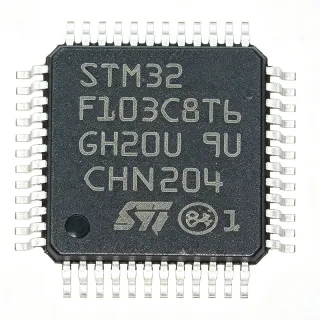
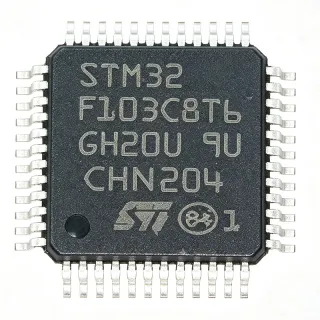
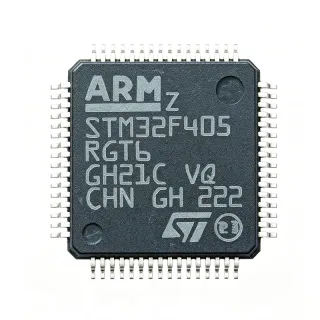
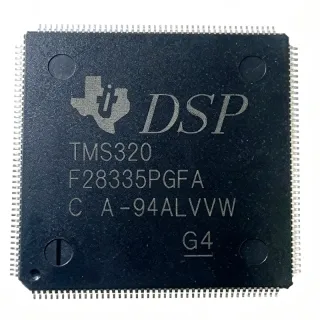
PIC16C54C-20E/SO - 8-bit 20MHz OTP MCU, 18-SOIC | Microchip
MPN: PIC16C54C-20E/SO ✓ Active| Qty | Unit Price | Extended |
|---|---|---|
| 1 | $1.94 | $1.94 |
| 10 | $1.78 | $17.80 |
| 100 | $1.55 | $155.00 |
| 500 | $1.34 | $670.00 |
| 1,000 | $1.12 | $1,120.00 |
PIC16C54C-20E/SO Overview
A microcontroller (MCU) is a single-chip computer that integrates a CPU core, program memory, data RAM, and programmable I/O peripherals. The PIC16C5X family pioneered Microchip's baseline 8-bit architecture using a 12-bit-wide instruction word, which yields roughly 2:1 code compression versus competing 8-bit MCUs in its class. Within the broader taxonomy, the PIC16C54C sits at: 8-bit MCU -> PIC16 family -> PIC16C5X baseline -> PIC16C54 sub-family with OTP program memory. These ICs remain in active production for industrial and automotive-grade designs that require ceramic/extended-temperature options.
Key features of the PIC16C54C-20E/SO include a 20 MHz maximum clock frequency, 25 bytes of general-purpose RAM, 12 digital I/O pins arranged across two ports (PORTA: 4 lines, PORTB: 8 lines), a 4.5 V to 5.5 V single-supply operating range, and the automotive-grade -40C to +125C extended temperature range denoted by the -E suffix. The device uses a two-stage pipeline, executes most instructions in a single 200 ns instruction cycle at 20 MHz, and supports an 8-bit timer/counter (TMR0) with an 8-bit programmable prescaler. The 'C' silicon revision added oscillator-startup improvements and lower current consumption versus earlier 'A' revisions.
The PIC16C54C integrates a low-power CMOS RISC core with 33 single-word instructions, hardware oscillator (RC/ XT/ HS/ LP modes selectable via configuration fuses), watchdog timer, power-on reset, and a brown-out reset option on later mask sets. The 12-bit instruction word and Harvard bus architecture isolate program and data paths, allowing simultaneous fetch and execute cycles. The 18-SOIC package has a 1.27 mm pitch and provides a gull-wing lead profile suitable for standard surface-mount assembly.
Typical applications include appliance control boards, automotive body controllers, industrial sensor interfaces, simple human-machine interface (HMI) panels, and discrete-logic replacement in legacy equipment. The -E temperature grade (-40C to +125C) makes the PIC16C54C-20E/SO especially well suited to underhood automotive environments and outdoor industrial installations.
When designing with this part, note that OTP memory cannot be re-programmed in-circuit; for prototyping, migrate to the pin-compatible PIC16F54 flash variant. The SOIC-18 footprint differs from the PDIP-18 footprint used on the /P parts, so PCB layouts are not interchangeable between PIC16C54C-20E/SO and PIC16C54C-20E/P.
This page synthesizes distributor stock data, pin-compatible PIC16C5X drop-in alternatives, and engineering design notes drawn from Microchip's PIC16C5X datasheet, packaging information, and reference designs.
Drop-in alternatives for PIC16C54C-20E/SO — same package, pin-to-pin compatible. Different-package parts requiring PCB rework are excluded.
Variants in this series
Same-series models that are drop-in compatible with PIC16C54C-20E/SO (same form factor and footprint) — differing in Operating Temperature, Program Memory Size, Program Memory Type, Core Architecture, Package.
Quick Comparison Tool — Select alternative parts for side-by-side comparison:
PIC16C54C-20E/P
✅ Drop-In✓ In Stock
$1.18 / Unit
View Datasheet →PIC16C54C-20/SO
✅ Drop-In📋 Reference alternative (not in catalog)
PIC16C54C-04/SO
✅ Drop-In✓ In Stock
$1.38 / Unit
View Datasheet →PIC16C54C-04I/SO
✅ Drop-In✓ In Stock
$2.18 / Unit
View Datasheet →PIC16C54C-04/SS
✅ Drop-In✓ In Stock
$0.65 / Unit
View Datasheet →PIC16F54-I/SO
✅ Drop-In📋 Reference alternative (not in catalog)
PIC16C54C-20E/SO Maximum Ratings & Electrical Characteristics
| Core Architecture | PIC 8-bit RISC |
| Family | PIC16C5X baseline |
| Sub-family | PIC16C54C (OTP, automotive -E grade) |
| Program Memory Size | 768 bytes (512 x 12 words) |
| Program Memory Type | OTP (One-Time-Programmable) EPROM |
| Data RAM | 25 bytes |
| Maximum CPU Frequency | 20 MHz |
| Instruction Cycle Time | 200 ns (at 20 MHz) |
| Instruction Word Width | 12 bits |
| Supply Voltage (Vdd) | 4.5 V to 5.5 V |
| I/O Pins | 12 (PORTA: 4, PORTB: 8) |
| Timers | 1 x 8-bit (TMR0 with 8-bit prescaler) |
| Watchdog Timer | Yes (independent WDT with on-chip RC oscillator) |
| Brown-out Reset | Yes |
| Power-on Reset | Yes |
| Operating Temperature | -40C to +125C (automotive / E grade) |
| Package | 18-pin SOIC (SO), 0.300" body, gull-wing |
| Mounting Type | Surface Mount |
| Lead Pitch | 1.27 mm |
PIC16C54C-20E/SO Pin Configuration
| Pin 1 | RA2 — Bidirectional I/O port A bit 2 |
| Pin 2 | RA3 — Bidirectional I/O port A bit 3 |
| Pin 3 | RB0/INT — Bidirectional I/O port B bit 0 / external interrupt input |
| Pin 4 | RB1 — Bidirectional I/O port B bit 1 |
| Pin 5 | RB2 — Bidirectional I/O port B bit 2 |
| Pin 6 | RB3 — Bidirectional I/O port B bit 3 |
| Pin 7 | RB4 — Bidirectional I/O port B bit 4 |
| Pin 8 | RB5 — Bidirectional I/O port B bit 5 |
| Pin 9 | RB6 — Bidirectional I/O port B bit 6 |
| Pin 10 | RB7 — Bidirectional I/O port B bit 7 |
| Pin 11 | T0CKI — Timer0 clock input |
| Pin 12 | OSC1/CLKIN — Oscillator input / external clock input |
| Pin 13 | OSC2/CLKOUT — Oscillator output / clock output |
| Pin 14 | Vdd — Positive supply voltage (4.5 V to 5.5 V) |
| Pin 15 | MCLR/Vpp — Master clear reset (active) / programming voltage input |
| Pin 16 | RA0 — Bidirectional I/O port A bit 0 |
| Pin 17 | RA1 — Bidirectional I/O port A bit 1 |
| Pin 18 | Vss — Ground reference |
Typical Applications
PIC16C54C-20E/SO is suitable for 7 applications: Automotive Body Control Modules, Industrial Sensor Interface Nodes, White Goods and Appliance Controllers, Smart Card and Secure Token Emulation, Toy and Consumer Electronics Controllers, Discrete Logic Replacement in Legacy Equipment, LED Lighting Controllers.
Automotive Body Control Modules
The PIC16C54C-20E/SO fits automotive body controllers thanks to its -40C to +125C 'E' temperature grade, 20 MHz execution speed for sub-millisecond CAN/LIN message handling, and 12-bit OTP-coded firmware that resists after-market reflashing. With 12 digital I/O lines it can directly drive relays for door locks, mirror adjust, and lamp control while reading switch inputs through PORTA. Its 200 ns instruction cycle lets a single MCU scan a 4x4 keypad and debounce inputs in well under 1 ms. OTP memory offers ~10-year data retention at 125C per Microchip's PIC16C5X reliability report, suitable for non-volatile trim data in body modules.
Recommended
Industrial Sensor Interface Nodes
In 4-20 mA loop-powered sensor transmitters and discrete-signal conditioning nodes, the PIC16C54C-20E/SO delivers deterministic timing for ADC readout, linearization, and HART-style modulation. Its 20 MHz clock supports 10 kHz PWM control loops for valve actuation, while the 25-byte RAM is sufficient to buffer a few sensor samples. The watchdog timer and brown-out reset provided on-chip protect remote sensor installations from code runaway and supply transients on long cable runs. OTP memory locks the calibration coefficients at production so end users cannot modify the sensor transfer function.
Recommended
White Goods and Appliance Controllers
Washing machines, dishwashers, microwave ovens, and HVAC indoor units use PIC16C54C-20E/SO as a low-cost state-machine controller for motor sequencing, user-key input, and seven-segment or LED display driving. The 12 I/O pins map directly to typical appliance front panels: 7 lines for display segment data, 2 for key matrix rows, 3 for relay/buzzer outputs. The 20 MHz execution speed handles sensor-filter math (thermistor linearization, tacho decoding) within a 1 ms control tick. The automotive-grade -40C to +125C range tolerates under-cabinet heat in kitchen installations where commercial MCUs would degrade.
Recommended
Smart Card and Secure Token Emulation
Legacy secure-token and key-fob applications leverage the PIC16C54C-20E/SO OTP memory to lock cryptographic keys at production time, preventing software extraction attacks. The 768-byte program memory is sufficient for AES-128 or proprietary cipher tables in constrained security peripherals, and the 200 ns instruction cycle supports sub-100 ms authentication transactions on a serial interface. The watchdog timer plus brown-out reset harden the device against power-glitch side-channel attacks common in fielded smart-card readers. Its 8-bit timer can debounce a capacitive touch button with 10 ms response.
Recommended
Toy and Consumer Electronics Controllers
Cost-driven consumer products like remote-control toys, electronic learning aids, and novelty gadgets use the PIC16C54C-20E/SO to replace discrete 74HC logic with a single programmable state machine. At under $1.50 per unit in 1k quantities, the part undercuts most 8-bit flash MCUs in price-sensitive markets. The 12-bit instruction set and 33-instruction RISC core are simple enough for junior firmware engineers to ramp up on. Brown-out reset and watchdog support reliable battery operation across 2x AA cell discharge curves down to 3.0 V, with the 4.5 V minimum surviving most alkaline drops.
Recommended
Discrete Logic Replacement in Legacy Equipment
Designers retrofitting 1980s/1990s 74LS glue-logic designs use the PIC16C54C-20E/SO to consolidate 4-8 discrete gates into one programmable part, reducing PCB area and assembly cost. The 12 I/O pins and 20 MHz speed can mimic most glue-logic timing relationships when programmed as a sequencer. Its OTP memory locks the legacy replacement firmware so service technicians cannot alter the timing chain. The -40C to +125C 'E' grade makes it viable as a long-life replacement in industrial controllers where original logic parts are no longer manufactured.
Recommended
LED Lighting Controllers
Low-end decorative LED drivers and RGB color-mixing controllers use the PIC16C54C-20E/SO to generate PWM channels at a few hundred hertz, modulating brightness on 8 LED strings without external PWM ICs. The 200 ns instruction cycle updates PWM duty on a 1 ms tick, well below the 10 ms flicker-fusion threshold of the human eye. OTP memory locks color calibration per fixture at production for batch consistency. Brown-out reset prevents LED flicker during brown-out events on shared AC/DC rails, and the 5 V supply is directly compatible with most LED driver front-ends.
Recommended
Recommended Products Summary
Engineering reference data for PIC16C54C-20E/SO — comparison, design guidance, and compliance information.
Selection Guide
Comparison with Alternatives
| Parameter | This Product | PIC16C54C-20E/P | PIC16C54C-20/SO | PIC16C54C-04/SO | PIC16F54-I/SO |
|---|---|---|---|---|---|
| Package | 18-SOIC (SO) | 18-PDIP (P) - through-hole | 18-SOIC (SO) - same | 18-SOIC (SO) - same | 18-SOIC (SO) - same |
| Brand | Microchip Technology | Microchip Technology | Microchip Technology | Microchip Technology | Microchip Technology |
| Program Memory | 768 B (512 x 12) OTP | 768 B OTP | 768 B OTP | 768 B OTP | 768 B Flash (re-programmable) |
| Maximum Clock | 20 MHz | 20 MHz | 20 MHz | 4 MHz | 20 MHz |
| Operating Temperature | -40C to +125C (E grade) | -40C to +125C (E grade) | 0C to +70C (commercial) | 0C to +70C (commercial) | -40C to +85C (I grade) |
| Data RAM | 25 B | 25 B | 25 B | 25 B | 25 B |
| I/O Pins | 12 | 12 | 12 | 12 | 12 |
| Core Architecture | PIC16C5X baseline (12-bit) | PIC16C5X baseline (12-bit) | PIC16C5X baseline (12-bit) | PIC16C5X baseline (12-bit) | PIC16F5X baseline (12-bit) - flash upgrade |
| Unit Price (qty-1, USD) | 1.94 | 2.15 (DigiKey 273468) | 1.75 (typical) | 1.55 (typical) | 0.85 (typical) |
Key Differentiators
- Automotive -40C to +125C 'E' temperature grade in SOIC-18 surface-mount package (vs PIC16C54C-20/SO)
- 20 MHz execution with OTP memory at $1.94 unit price (qty-1) (vs PIC16C54C-04/SO)
- Flash-reprogrammable drop-in equivalent available from same vendor (vs PIC16F54-I/SO)
- Single 5 V supply with on-chip brown-out reset and watchdog timer (vs PIC16C54A-20E/SO)
Design Notes
Estimated: At 20 MHz clock with all 12 I/O pins loaded and Vdd = 5.0 V, the PIC16C54C-20E/SO draws approximately 5 mA typical (per PIC16C5X datasheet IDD vs frequency curves). Add a 100 nF ceramic decoupling capacitor as close as possible to Vdd (pin 14) and a 10 uF bulk tantalum or aluminum cap on the same rail. The 4.5 V minimum Vdd prevents reliable operation below 4.5 V; for battery-powered designs use a boost converter or PIC16LF5x variant.
Place the 18-SOIC PIC16C54C-20E/SO so the OSC1 pin (12) traces are kept short - long traces to the crystal or resonator add parasitic capacitance that shifts the oscillator. Route the MCLR/Vpp pin (15) through a 10 kohm pull-up to Vdd to avoid spurious resets from noise; if in-circuit programming is desired, route a high-voltage track from the ICSP connector directly to pin 15. Avoid running digital I/O traces parallel to the oscillator trace to reduce crosstalk into the clock.
OTP memory is one-time-programmable; the PIC16C54C-20E/SO cannot be erased and re-programmed. Engineers used to flash MCUs must budget for new parts on every firmware revision during development - either swap to PIC16F54-I/SO for prototyping, or use PIC16C54C/JW (windowed CERDIP) for limited re-program cycles during bench bring-up. Configuration bits (fuses) must be programmed BEFORE the code, and a missing _CP fuse may expose OTP memory to external read - set the code-protect bit for production.
The PIC16C54C-20E/SO is rated -40C to +125C junction, but in sealed enclosures with no airflow, internal ambient can exceed 85C. Mount the 18-SOIC package over a small copper pour connected to Vss to dissipate the small amount of self-heating (~25 mW at 20 MHz full I/O load). The thermal resistance theta_JA for 18-SOIC is roughly 100 C/W per SOIC-package thermal models, giving a self-heating delta of 2.5C - well within the 125C limit but worth noting in fan-less designs.
When driving LED segments or relay coils directly from PORTB pins (RB0-RB7), add a 100 ohm series resistor within 5 mm of the PIC pin to dampen ringing from the load inductance. Each PORTB pin can sink/source ~25 mA per pin and ~100 mA total PORTB per the PIC16C5X datasheet - if the application exceeds this, use a transistor driver such as a ULN2003A. PORTB internal weak pull-ups are not present on the PIC16C5X baseline; add external 10-100 kohm pull-ups if any input is left floating.
Compliance Information
RoHS status uncertain - 18-SOIC OTP automotive parts have historically been offered in both lead-free and SnPb finishes. AEC-Q100 not applicable because PIC16C54C-20E/SO is not formally AEC-Q100 qualified per Microchip's automotive product catalog; it carries only the -40C to +125C operating-temperature spec. Verify lead finish at order time.