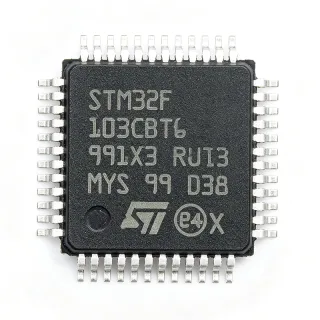
PIC16C55-10I/SP - 8-bit PIC MCU, 768B OTP, 10MHz, 28-SPDIP | Microchip
MPN: PIC16C55-10I/SP ✓ Active| Qty | Unit Price | Extended |
|---|---|---|
| 1 | $4.22 | $4.22 |
| 10 | $3.95 | $39.50 |
| 100 | $3.55 | $355.00 |
| 500 | $3.1 | $1,550.00 |
| 1,000 | $2.75 | $2,750.00 |
PIC16C55-10I/SP Overview
An 8-bit microcontroller (MCU) is a single-chip computer that integrates a CPU, non-volatile program memory, working RAM, and peripheral I/O on one die. The PIC16C5x family uses a 12-bit wide instruction word with a RISC architecture and a two-level deep hardware stack, allowing compact code density versus typical 8-bit CISC controllers in the same price category. Within Microchip's taxonomy, the PIC16C5x sits under PIC16 baseline microcontrollers -> 8-bit PIC MCUs -> microcontrollers -> integrated circuits.
Key features of the PIC16C55-10I/SP include a programmable 8-bit real-time clock/counter (TMR0) with 8-bit prescaler, direct/indirect/relative addressing modes, seven or eight special function hardware registers, a watchdog timer for reliable unattended operation, and an internal power-on reset. The "I" suffix denotes the industrial temperature grade of -40 C to +85 C, and the "-10" speed suffix specifies the 10 MHz maximum oscillator frequency. The OTP memory is factory- or field-programmable once, which is well suited to low-to-medium volume production.
Architecturally, the device is built on a CMOS process with EPROM program memory that retains code without battery backup. The 20 I/O pins are grouped into three ports (RA, RB, RC) and are individually configurable for digital input or output. Power consumption is reduced through SLEEP mode with wake-up via pin change or watchdog overflow, making the part attractive for battery- and line-powered appliances.
Typical applications include consumer appliances, automotive sub-systems, security and alarm panels, simple motor controls, low-end remote controls, and industrial timers. The wide 3.0 V to 6.0 V supply range and industrial temperature grade make it usable in both commercial and harsh-environment products.
When designing with the PIC16C55-10I/SP, note that this is an OTP part, so firmware bugs discovered after programming require part replacement rather than re-flash. The 2-level hardware stack means interrupt service routines and deep subroutines must be carefully structured. Decouple VDD with a 0.1 uF ceramic capacitor placed within 5 mm of the supply pin.
This page synthesizes distributor pricing, drop-in alternatives, and practical design guidance that the manufacturer datasheet does not present in a single view.
Drop-in alternatives for PIC16C55-10I/SP — same package, pin-to-pin compatible. Different-package parts requiring PCB rework are excluded.
Variants in this series
Same-series models that are drop-in compatible with PIC16C55-10I/SP (same form factor and footprint) — differing in Operating Temperature, Package, Program Memory Size, Program Memory Type, RAM Size.
Quick Comparison Tool — Select alternative parts for side-by-side comparison:
PIC16C55-10/SP
✅ Drop-In✓ In Stock
$2.45 / Unit
View Datasheet →PIC16C55A-10I/SP
✅ Drop-In ⚠️ 参数待验证📋 Reference alternative (not in catalog)
PIC16F54-10I/P
✅ Drop-In📋 Reference alternative (not in catalog)
PIC16C54-10I/P
✅ Drop-In✓ In Stock
$1.18 / Unit
View Datasheet →PIC16C55-10I/SP Maximum Ratings & Electrical Characteristics
| Manufacturer | Microchip Technology |
| Series | PIC 16C |
| Core Processor | PIC |
| Core Size | 8-bit |
| Program Memory Size | 768 B (512 x 12) OTP |
| RAM Size | 24 B |
| Number of I/O | 20 |
| Maximum Clock Frequency | 10 MHz |
| Instruction Cycle Time | 200 ns @ 10 MHz (4:1 divider) |
| Supply Voltage (Vdd) | 3.0 V to 6.0 V |
| Operating Temperature | -40 C to +85 C (Industrial) |
| Package / Case | 28-SPDIP (0.300 inch, 7.62 mm) |
| Mounting Type | Through-Hole |
| Peripherals | TMR0 (8-bit timer/counter with 8-bit prescaler), WDT, POR |
| Program Memory Type | OTP (EPROM) |
| Oscillator Type | External RC or XT/HS crystal |
| Tube Quantity | 15 per tube |
PIC16C55-10I/SP Pin Configuration
| Pin 1 | RA2 — Bidirectional I/O port A bit 2 |
| Pin 2 | RA3 — Bidirectional I/O port A bit 3 |
| Pin 3 | RA4/T0CKI — Bidirectional I/O port A bit 4 / Timer0 clock input |
| Pin 4 | /MCLR — Master Clear (active-low reset) input |
| Pin 5 | Vss — Ground reference |
| Pin 6 | RB0/INT — Bidirectional I/O port B bit 0 / External interrupt input |
| Pin 7 | RB1 — Bidirectional I/O port B bit 1 |
| Pin 8 | RB2 — Bidirectional I/O port B bit 2 |
| Pin 9 | RB3 — Bidirectional I/O port B bit 3 |
| Pin 10 | RB4 — Bidirectional I/O port B bit 4 |
| Pin 11 | RB5 — Bidirectional I/O port B bit 5 |
| Pin 12 | RB6 — Bidirectional I/O port B bit 6 |
| Pin 13 | RB7 — Bidirectional I/O port B bit 7 |
| Pin 14 | Vdd — Positive supply (3.0 V to 6.0 V) |
| Pin 15 | OSC2/CLKOUT — Oscillator crystal output / Clock output (Fosc/4) |
| Pin 16 | OSC1/CLKIN — Oscillator crystal input / External clock input |
| Pin 17 | RC0 — Bidirectional I/O port C bit 0 |
| Pin 18 | RC1 — Bidirectional I/O port C bit 1 |
| Pin 19 | RC2 — Bidirectional I/O port C bit 2 |
| Pin 20 | RC3 — Bidirectional I/O port C bit 3 |
| Pin 21 | RC4 — Bidirectional I/O port C bit 4 |
| Pin 22 | RC5 — Bidirectional I/O port C bit 5 |
| Pin 23 | RC6 — Bidirectional I/O port C bit 6 |
| Pin 24 | RC7 — Bidirectional I/O port C bit 7 |
| Pin 25 | RA0 — Bidirectional I/O port A bit 0 |
| Pin 26 | RA1 — Bidirectional I/O port A bit 1 |
| Pin 27 | Vss — Ground reference |
| Pin 28 | VDD — Positive supply (3.0 V to 6.0 V) |
Typical Applications
PIC16C55-10I/SP is suitable for 6 applications: Consumer Appliance Control, Security and Alarm Panels, Automotive Body Electronics, Low-End Remote Controls, Industrial Timers and Counters, Hobby and Educational Boards.
Consumer Appliance Control
The PIC16C55-10I/SP fits consumer appliance control boards because it combines 20 I/O pins for keypad and indicator LEDs, 768 bytes of OTP for fixed-function firmware, and a 10 MHz core that executes 5 MIPS for routine sensor polling and motor timing. Its 3.0 V to 6.0 V supply range allows direct operation from rectified mains with a simple linear regulator, while the industrial -40 C to +85 C temperature grade tolerates kitchen and laundry environments. The OTP memory holds code securely without battery backup, lowering BOM cost in washing-machine controllers, microwave user interfaces, and rice-cooker timer boards where firmware is finalized at production. Engineers typically pair it with a triac driver like the MOC3021 for AC load switching and use the TMR0 with prescaler for software PWM dimming of LED or seven-segment displays.
Recommended
Security and Alarm Panels
The PIC16C55-10I/SP is well suited to wired security alarm panels where the 20 I/O scan a matrix of magnetic-reed door sensors, PIR motion detectors, and keypad inputs. The hardware watchdog timer (WDT) and power-on reset (POR) recover the panel from brownouts and ESD-induced lockups that commonly occur in security installations. The two-level hardware stack is sufficient for the simple main-and-interrupt structure typical of alarm firmware: scan sensors in a tight loop and service the timer interrupt for the entry/exit delay. OTP memory prevents code tampering, and the industrial temperature grade supports indoor unheated enclosures. The on-chip TMR0 with 8-bit prescaler generates the audible piezo buzzer tones for arm, disarm, and intrusion alerts without external timer ICs.
Recommended
Automotive Body Electronics
The PIC16C55-10I/SP serves cost-sensitive automotive body controllers such as seat-belt reminder modules, mirror-fold drivers, and simple lighting timers that do not require CAN or LIN. Its 28-SPDIP through-hole package is mechanically rugged against vehicle vibration versus fine-pitch QFN alternatives, and the -I industrial temperature grade tolerates under-dash thermal swings near 85 C. The PIC RISC core's deterministic 200 ns instruction cycle supports precise software timing for sequential turn-signal or interior-light fade control, and the 24-byte RAM is sufficient for these state-machine tasks. Design teams typically pair it with an automotive-grade voltage regulator and use the WDT to recover from load-dump events that reset supply rails.
Recommended
Low-End Remote Controls
Handheld IR remote controls benefit from the PIC16C55-10I/SP's low cost, OTP code security, and SLEEP-mode current below 4 uA that lets two AAA batteries last multiple years. The 20 I/O handle a 4-by-4 matrix keypad or up to 20 individual buttons plus status LEDs, while TMR0 generates the 38 kHz carrier for the IR LED without external timer hardware. The 3.0 V to 6.0 V supply window matches alkaline, NiMH, and lithium chemistries directly without boost conversion. Engineers choose OTP to prevent code extraction by competitors and rely on the 768-byte program memory to hold complete button-mapping tables plus protocol-frame encoders for NEC, RC5, or Sony SIRC formats.
Recommended
Industrial Timers and Counters
The PIC16C55-10I/SP functions as a programmable industrial timer, event counter, or process-interval generator where 10 MHz speed, 24-byte RAM, and 20 I/O are sufficient. Its TMR0 with 8-bit prescaler measures up to 51.2 ms per overflow at 10 MHz, easily extended in software to seconds or minutes, and the two-level hardware stack supports nested interrupt and main-loop patterns for batching-machine or conveyor-belt control. The 28-SPDIP package is field-replaceable with through-hole IC extraction tools, simplifying factory-floor maintenance. Industrial -40 C to +85 C operation tolerates cabinet environments, and the OTP memory holds certified timing parameters that cannot drift over decades of operation.
Recommended
Hobby and Educational Boards
The PIC16C55-10I/SP is widely adopted in university microcontroller courses and DIY hobby kits because its 28-SPDIP package fits standard 0.1 inch pitch breadboards and ZIF sockets, allowing quick device swapping. The 768-byte OTP forces students to plan memory carefully and learn assembly-level optimization, building foundational RISC skills that transfer to PIC18 and PIC32 families later. The 20 I/O expose enough pins to wire up seven-segment displays, character LCDs in 4-bit mode, and several pushbuttons for complete lab projects without external mux logic. The 3.0 V to 6.0 V supply range is forgiving of unregulated wall adapters used in classroom settings, and the industrial temperature grade allows outdoor weather-station projects year-round.
Recommended
Recommended Products Summary
Engineering reference data for PIC16C55-10I/SP — comparison, design guidance, and compliance information.
Selection Guide
Comparison with Alternatives
| Parameter | This Product | PIC16C55-10/SP | PIC16C55A-10I/SP | PIC16F54-10I/P | PIC16C54-10I/P | PIC16C55-10I/SO |
|---|---|---|---|---|---|---|
| Package | 28-SPDIP (through-hole) | 28-SPDIP (through-hole) - same | 28-SPDIP (through-hole) - same | 28-PDIP (through-hole) - same | 28-PDIP (through-hole) - same | 28-SOIC (surface-mount) - different |
| Brand | Microchip Technology | Microchip Technology - same | Microchip Technology - same | Microchip Technology - same | Microchip Technology - same | Microchip Technology - same |
| Program Memory | 768 B OTP | 768 B OTP | 768 B OTP | 512 B Flash (-33%) | 512 B OTP (-33%) | 768 B OTP |
| Number of I/O | 20 | 20 | 20 | 12 (-40%) | 12 (-40%) | 20 |
| Max Clock Frequency | 10 MHz | 10 MHz | 10 MHz | 10 MHz | 10 MHz | 10 MHz |
| Supply Voltage | 3.0 V to 6.0 V | 3.0 V to 6.0 V | 3.0 V to 6.0 V | 2.0 V to 5.5 V (wider low end) | 3.0 V to 6.0 V | 3.0 V to 6.0 V |
| Operating Temperature | -40 C to +85 C (Industrial) | 0 C to +70 C (Commercial) | -40 C to +85 C (Industrial) | -40 C to +85 C (Industrial) | -40 C to +85 C (Industrial) | -40 C to +85 C (Industrial) |
| Memory Type | OTP EPROM | OTP EPROM | OTP EPROM | Flash (reprogrammable) | OTP EPROM | OTP EPROM |
| Core Architecture | PIC16C5x baseline 12-bit instruction | PIC16C5x baseline 12-bit | PIC16C5x baseline 12-bit | PIC16C5x baseline 12-bit | PIC16C5x baseline 12-bit | PIC16C5x baseline 12-bit |
Key Differentiators
- Higher I/O count in baseline PIC family (vs PIC16C54-10I/P)
- Industry-standard through-hole footprint for field service (vs PIC16C55-10I/SO)
- OTP code security at the lowest unit cost (vs PIC16F54-10I/P)
Design Notes
Place a 0.1 uF ceramic decoupling capacitor within 5 mm of the PIC16C55-10I/SP Vdd pin (pin 14 or pin 28, both tied together per the SPDIP pinout) and a bulk 10 uF electrolytic on the supply rail. The PIC16C5x core draws brief current spikes during instruction fetches, and without local decoupling these spikes appear as Vdd droops that can cause spurious resets or EEPROM corruption. Use a star-ground topology that ties digital and analog grounds at the regulator if mixed-signal peripherals exist.
The PIC16C55-10I/SP uses a two-level hardware stack, which means at most two subroutine calls can be nested before the stack overflows and PC wraps to 0x000. Plan interrupt service routines as flat state machines rather than deeply nested call chains, and avoid recursive function patterns that worked on PIC18 or PIC24. Also note that this part is OTP - firmware bugs discovered after programming cannot be patched and require part scrappage, so prototype with a flash PIC16F54-10I/P first.
Keep the crystal or resonator traces from OSC1 (pin 16) and OSC2 (pin 15) short (<10 mm) and guarded by a ground ring to limit radiated EMI. If using an external RC oscillator instead of crystal, place the resistor and capacitor within 5 mm of OSC1. The /MCLR pin (pin 4) requires a 10 kohm pull-up to Vdd; add a 100 nF cap to ground on /MCLR to filter ESD events that otherwise trigger spurious resets in field-deployed appliances.
Compliance Information
RoHS, REACH, lead-free, halogen-free, and conflict-mineral statuses are not present in the verified web data and should be confirmed against the latest Microchip material declaration before volume purchase. AEC-Q100 is not applicable as this is an OTP industrial-grade baseline PIC, not an automotive-qualified MCU.