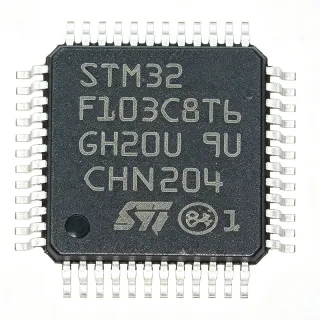
PIC16C554T-04E/SO - 8-Bit OTP MCU, 4MHz, 13 I/O, 18-SOIC
MPN: PIC16C554T-04E/SO ✓ Active| Qty | Unit Price | Extended |
|---|---|---|
| 1 | $3.64 | $3.64 |
| 10 | $3.21 | $32.10 |
| 100 | $2.78 | $278.00 |
| 500 | $2.41 | $1,205.00 |
| 1,000 | $2.05 | $2,050.00 |
PIC16C554T-04E/SO Overview
An 8-bit microcontroller (MCU) is a small computer-on-a-chip that integrates a CPU, RAM, non-volatile program memory (ROM/EPROM/OTP/Flash), I/O peripherals and timers into a single package. The PIC16C5xx family belongs to the classic baseline PIC architecture, which sits within the broader hierarchy: 8-bit MCU -> microcontroller -> embedded processor -> semiconductor IC. These devices are favored for low-cost, deterministic, interrupt-driven control tasks in cost-sensitive designs.
Key features of the PIC16C554T-04E/SO include a 4 MHz maximum operating frequency, a 12-bit instruction word with a RISC-style instruction set, an 8-bit-wide data path, and a Watchdog Timer for reliable operation in noisy environments. The 13 I/O pins can source/sink sufficient current to directly drive LEDs and small relays. The OTP memory allows one-time programming at production time, lowering unit cost versus windowed or Flash parts.
Architecturally, the PIC16C554T-04E/SO uses a Harvard architecture with separate program and data buses, allowing instruction fetch and operand read to occur in a single cycle. The 4 MHz oscillator with a 4:1 internal divider yields a 1 MHz instruction cycle, providing deterministic 1 us instruction timing for time-critical control loops. The reduced instruction set and accumulator-based ALU simplify code generation and verification.
Typical applications include appliance control (white goods, coffee machines, washing machines), simple sensor interfacing, LED drivers, low-end consumer electronics, and industrial control subsystems where cost dominates over memory size or peripheral richness. The 13 I/O and built-in Watchdog Timer also make it a common choice for safety-critical or unattended embedded systems that require self-recovery from firmware faults.
When designing with this device, note that the 'E' suffix denotes the Extended (-40C to +125C) operating temperature range and the 'T' suffix denotes Tape & Reel packaging; the '04' denotes 4 MHz CPU clock. For prototype builds consider the windowed PIC16C554JW for code iteration, or migrate to PIC16F554 (Flash) if field reprogrammability is required.
This page synthesizes distributor pricing, parametric cross-references and design guidance not consolidated on any single manufacturer or distributor page.
Drop-in alternatives for PIC16C554T-04E/SO — same package, pin-to-pin compatible. Different-package parts requiring PCB rework are excluded.
Variants in this series
Same-series models that are drop-in compatible with PIC16C554T-04E/SO (same form factor and footprint) — differing in Program Memory Size, Core Architecture, Instruction Set, Operating Temperature Range, Package.
Quick Comparison Tool — Select alternative parts for side-by-side comparison:
PIC16C554-04E/SO
✅ Drop-In✓ In Stock
$2.1 / Unit
View Datasheet →PIC16C554T-04/SO
✅ Drop-In✓ In Stock
$1.15 / Unit
View Datasheet →PIC16C554-04/SO
✅ Drop-In✓ In Stock
$1.62 / Unit
View Datasheet →PIC16F554-I/SO
✅ Drop-In ⚠️ 参数待验证📋 Reference alternative (not in catalog)
PIC16C554T-04E/SO Maximum Ratings & Electrical Characteristics
| Core Architecture | PIC 8-bit RISC |
| Family | PIC16C5xx (baseline) |
| CPU Core | 8-bit |
| Maximum CPU Frequency | 4 MHz |
| Instruction Cycle | 1 us at 4 MHz oscillator |
| Program Memory Type | OTP (One-Time Programmable) EPROM |
| Program Memory Size | 896 B (512 x 14 bits) |
| Data RAM | 80 B |
| Number of I/O Pins | 13 |
| Supply Voltage Range | 3 V to 5.5 V |
| Operating Temperature Range | -40 C to +125 C (Extended, 'E' suffix) |
| Package | 18-SOIC (0.295 inch / 7.50 mm body width) |
| Mounting Type | Surface Mount |
| Packaging | Tape & Reel (TR), 'T' suffix |
| Watchdog Timer | Yes (on-chip WDT) |
PIC16C554T-04E/SO Pin Configuration
| Pin 1 | RA2 — Bidirectional I/O port A bit 2 |
| Pin 2 | RA3 — Bidirectional I/O port A bit 3 |
| Pin 3 | RB0 — Bidirectional I/O port B bit 0 |
| Pin 4 | RB1 — Bidirectional I/O port B bit 1 |
| Pin 5 | RB2 — Bidirectional I/O port B bit 2 |
| Pin 6 | RB3 — Bidirectional I/O port B bit 3 |
| Pin 7 | RB4 — Bidirectional I/O port B bit 4 |
| Pin 8 | RB5 — Bidirectional I/O port B bit 5 |
| Pin 9 | RB6 — Bidirectional I/O port B bit 6 |
| Pin 10 | RB7 — Bidirectional I/O port B bit 7 |
| Pin 11 | Vss — Ground reference |
| Pin 12 | Vdd — Positive supply (3V to 5.5V) |
| Pin 13 | OSC2/CLKOUT — Oscillator crystal output or CLKOUT |
| Pin 14 | OSC1/CLKIN — Oscillator crystal input or external clock in |
| Pin 15 | RA0 — Bidirectional I/O port A bit 0 |
| Pin 16 | RA1 — Bidirectional I/O port A bit 1 |
| Pin 17 | MCLR — Master Clear (active-low reset) input |
| Pin 18 | T0CKI — Timer0 clock input |
Typical Applications
PIC16C554T-04E/SO is suitable for 6 applications: White Goods Appliance Control, LED Driver and Lighting Control, Industrial Sensor Interface, Low-Cost Consumer Remote Controls, Automotive Body and Comfort Electronics, Battery-Operated Sensor Nodes.
White Goods Appliance Control
The PIC16C554T-04E/SO suits white-goods appliance control (washing machines, dishwashers, coffee makers, microwave ovens) because of its 13 robust digital I/O pins and Extended -40C to +125C temperature grade. At 4 MHz the deterministic 1 us instruction cycle drives motor and relay sequencing without jitter, while the on-chip Watchdog Timer recovers the appliance from mains-born EMI faults that would otherwise latch up a less-protected MCU. Cost-sensitive high-volume white goods prefer the OTP version over Flash parts to minimize per-unit BOM cost. The 80-byte RAM holds the active state machine; firmware patterns are well-documented in Microchip application notes for capacitive-touch buttons, triac-firing zero-cross detection, and water-level sensing, all of which fit comfortably within 896 bytes of program memory.
Recommended
LED Driver and Lighting Control
The PIC16C554T-04E/SO works as the control core of low-to-mid-complexity LED drivers and architectural lighting controllers. Its 13 I/O pins can directly drive MOSFET gate drivers for constant-current LED strings, while the 4 MHz instruction rate supports PWM dimming frequencies above the flicker fusion threshold (>100 Hz). The OTP memory prevents accidental field reprogramming, preserving photometric calibration. Extended temperature operation suits enclosed luminaire environments where ambient can exceed 70C. According to the Microchip PIC16C5xx family datasheet, the 25 mA source/sink capability and interrupt-on-change wake-up on RB ports minimize external components in dimmer and occupancy-sensor designs.
Recommended
Industrial Sensor Interface
Industrial sensor interface modules (4-20 mA loop transmitters, thermocouple front-ends, limit-switch aggregators) commonly use the PIC16C554T-04E/SO. Its 3V to 5.5V supply matches both 3.3V sensor ASICs and legacy 5V analog front-ends, and the -40C to +125C extended range supports factory-floor cabinets. With 13 I/O, the MCU can scan multiple sensor inputs through a multiplexer, debounce mechanical contacts, and serialize results via UART bit-banged on general-purpose I/O. The on-chip Watchdog Timer is critical for unattended operation where manual reset is impractical. The 896-byte OTP program memory holds sensor linearization tables and Modbus-RTU framing without external storage.
Recommended
Low-Cost Consumer Remote Controls
The PIC16C554T-04E/SO powers low-end IR/RF remote controls for consumer A/V and HVAC equipment, where 13 I/O is more than enough to scan a 4x4 keypad matrix plus drive an IR LED or SAW transmitter. The 4 MHz instruction rate gives microsecond-accurate IR carrier generation (typically 38 kHz / 40 kHz) without external timer ICs. OTP memory prevents unauthorized firmware duplication, an advantage for OEMs worried about cloning. The Watchdog Timer resets the MCU on battery brown-out events, while the 3V rail is compatible with two AAA cells through a low-dropout regulator. Compact 18-SOIC packaging fits inside slim handheld enclosures.
Recommended
Automotive Body and Comfort Electronics
The Extended -40C to +125C operating range of the PIC16C554T-04E/SO qualifies it for non-safety automotive body and comfort modules such as seat controllers, mirror adjusters, window lift logic and HVAC blend-door actuators. The 18-SOIC footprint tolerates automotive underhood thermal stress when PCB placement follows AEC-Q100 layout guidelines. With 13 I/O, the MCU drives multiple H-bridge enable lines and reads Hall-effect position sensors simultaneously. OTP memory secures the firmware against tampering while reducing die cost versus Flash MCUs in cost-sensitive trim-level variants. For safety-critical applications such as ABS or airbag, migrate to a Q-graded part with lockstep diagnostics.
Recommended
Battery-Operated Sensor Nodes
The PIC16C554T-04E/SO serves battery-powered sensor nodes in remote-monitoring and IoT edge applications where its 3V minimum supply is compatible with two alkaline cells or a single Li-MnO2 coin cell. The 80-byte RAM and 13 I/O accommodate periodic sensor sampling plus a UART or I2C bit-banged uplink. OTP memory eliminates Flash wear-out concerns during long unattended deployment cycles. The Watchdog Timer wakes the part from sleep on a programmed interval and the 4 MHz CPU completes measurement plus RF transmission within the active window before returning to sleep, minimizing average current draw. The 18-SOIC package is small enough for credit-card-sized wireless sensor PCBs.
Recommended
Recommended Products Summary
Engineering reference data for PIC16C554T-04E/SO — comparison, design guidance, and compliance information.
Selection Guide
Comparison with Alternatives
| Parameter | This Product | PIC16C554-04E/SO | PIC16C554T-04/SO | PIC16C554-04/SO | PIC16F554-I/SO |
|---|---|---|---|---|---|
| Package | 18-SOIC (7.50 mm) | 18-SOIC (7.50 mm) - same | 18-SOIC (7.50 mm) - same | 18-SOIC (7.50 mm) - same | 18-SOIC (7.50 mm) - same |
| Brand | Microchip Technology | Microchip Technology | Microchip Technology | Microchip Technology | Microchip Technology |
| CPU Core | 8-bit PIC16C5xx | 8-bit PIC16C5xx | 8-bit PIC16C5xx | 8-bit PIC16C5xx | 8-bit PIC16F5xx (Flash) |
| Maximum CPU Frequency | 4 MHz | 4 MHz | 4 MHz | 4 MHz | 4 MHz |
| Program Memory | 896 B OTP | 896 B OTP | 896 B OTP | 896 B OTP | 896 B Flash |
| Data RAM | 80 B | 80 B | 80 B | 80 B | 80 B |
| Number of I/O | 13 | 13 | 13 | 13 | 13 |
| Supply Voltage | 3.0 V to 5.5 V | 3.0 V to 5.5 V | 3.0 V to 5.5 V | 3.0 V to 5.5 V | 2.0 V to 5.5 V (wider) |
| Operating Temperature | -40 C to +125 C (Extended) | -40 C to +125 C (Extended) | 0 C to +70 C (Commercial) | 0 C to +70 C (Commercial) | -40 C to +85 C (Industrial) |
| Shipping Packaging | Tape & Reel | Tube | Tape & Reel | Tube | Tube or T&R by suffix |
Key Differentiators
- Extended -40C to +125C temperature grade (vs PIC16C554T-04/SO)
- OTP cost-down architecture (vs PIC16F554-I/SO)
- Tape & Reel shipping for high-volume SMT (vs PIC16C554-04E/SO)
Design Notes
Decouple Vdd with a 100 nF X7R ceramic capacitor placed within 5 mm of pin 12 and a bulk 10 uF tantalum or aluminum-polymer capacitor shared with the rest of the board. The PIC16C554T-04E/SO draws approximately 2 mA active at 4 MHz with all I/O static and significantly less in sleep. Tie MCLR (pin 17) high through a 10 kohm pull-up; an optional 100 nF cap on MCLR adds noise immunity to in-circuit programming on OTP-only designs.
For 18-SOIC layout, use 0.95 mm pitch pads with 1.27 mm drill-free land pattern per IPC-7351 nominal density. Keep the crystal or resonator within 5 mm of OSC1/OSC2 (pins 13/14) and guard the traces with a ground pour to suppress EMI injection into the oscillator. Route RB port interrupts with short stubs to minimize parasitic coupling; the interrupt-on-change feature on RB<7:4> is sensitive to high-impedance traces longer than 25 mm.
OTP memory cannot be erased. Confirm firmware with a windowed PIC16C554JW (or PIC16F554 for Flash) before committing to OTP programming. Do not exceed 5.5V on Vdd or 8V on MCLR or the EPROM cell retention may degrade. Brown-out detection is not present on baseline PIC16C5xx parts; use an external voltage supervisor (e.g. MCP100) for safety-critical or battery-backed designs where supply droop must trigger a clean reset.
Compliance Information
PIC16C5xx OTP parts in 18-SOIC are typically supplied in lead-free finishes per Microchip product ecology documentation; however, RoHS, REACH and halogen-free status for this specific lot were not present in the verified distributor data and are flagged [DATA_NEEDED]. AEC-Q100 qualification status was not confirmed by the Microchip product page for this part number.