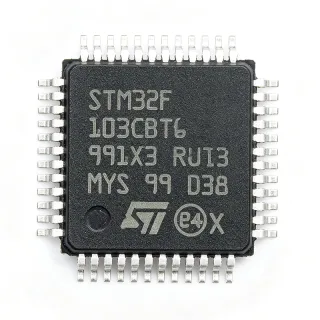
PIC16C558-20E/P - 8-Bit 20MHz OTP MCU, 3.5KB | Microchip
MPN: PIC16C558-20E/P ✓ Active| Qty | Unit Price | Extended |
|---|---|---|
| 1 | $5.2 | $5.20 |
| 10 | $4.65 | $46.50 |
| 100 | $4.1 | $410.00 |
| 500 | $3.62 | $1,810.00 |
| 1,000 | $3.2 | $3,200.00 |
PIC16C558-20E/P Overview
An 8-bit microcontroller (MCU) is a single-chip computer that integrates a CPU, RAM, non-volatile program memory (here OTP), and peripherals. It sits at the base of the embedded hierarchy: 8-bit MCU -> microcontroller -> embedded processor -> semiconductor IC. PIC16C-series parts use a RISC architecture with only 35 single-word instructions, easing code development and minimizing learning curves for new designs.
Key features of the PIC16C558-20E/P include the 20MHz maximum clock (5MHz oscillator input), 13 I/O pins, two 8-bit timers (Timer0, Timer2) plus one 16-bit timer (Timer1), a Watchdog Timer with its own on-chip RC oscillator, and wide operating voltage support. The -E suffix denotes the Extended automotive temperature grade (-40C to +125C), distinguishing it from commercial/industrial grade variants. The 18-pin PDIP package is through-hole for prototyping and legacy designs.
The PIC16C558 architecture uses a Harvard-style separate program/data bus design with a 14-bit instruction word. This contrasts with later PIC16F flash parts which offer re-programmability. The OTP memory requires a device programmer at production time but offers lower per-unit cost in mature, unchanging firmware applications.
Typical applications include automotive body controllers, appliance controls, sensor signal conditioning, simple motor control, and industrial automation subsystems. The extended temperature grade makes it particularly attractive for under-hood automotive modules and harsh industrial environments. The legacy 18-pin PDIP footprint suits through-hole assembly lines and educational/development platforms where socketed parts are preferred.
When designing with this part, note that OTP devices cannot be reprogrammed in-circuit - firmware bugs require part replacement. Designers should prototype with the pin-compatible PIC16F558 (flash) variant, then transition to PIC16C558-20E/P for cost-optimized production runs. Decoupling capacitors (100nF) must be placed within 6mm of VDD, and unused I/O pins should be configured as outputs to minimize current draw.
This page synthesizes distributor pricing, drop-in PIC16C558 family alternatives, and practical design notes not found in the manufacturer datasheet alone.
Drop-in alternatives for PIC16C558-20E/P — same package, pin-to-pin compatible. Different-package parts requiring PCB rework are excluded.
Variants in this series
Same-series models that are drop-in compatible with PIC16C558-20E/P (same form factor and footprint) — differing in Program Memory Size, Program Memory Type, Core Architecture, Package, Mounting Type.
Quick Comparison Tool — Select alternative parts for side-by-side comparison:
PIC16C558-20/P
✅ Drop-In✓ In Stock
$1.72 / Unit
View Datasheet →PIC16F558-I/P
✅ Drop-In📋 Reference alternative (not in catalog)
PIC16C558-04/P
✅ Drop-In✓ In Stock
$4.2 / Unit
View Datasheet →PIC16C554-04/P
✅ Drop-In✓ In Stock
$2.85 / Unit
View Datasheet →PIC16C55-10/P
✅ Drop-In ⚠️ 参数待验证✓ In Stock
$3.65 / Unit
View Datasheet →PIC16C558-20E/P Maximum Ratings & Electrical Characteristics
| Core Architecture | PIC 8-bit RISC |
| Instruction Set | 35 single-word instructions, 14-bit word |
| Program Memory Type | OTP (One-Time Programmable) |
| Program Memory Size | 3.5KB (2K x 14) |
| RAM | 128 bytes |
| Data EEPROM | Not present |
| Maximum CPU Frequency | 20 MHz |
| Instruction Cycle Time | 200 ns |
| Operating Voltage Range | 3.0 V to 5.5 V |
| I/O Pins | 13 |
| Timers | Timer0 (8-bit), Timer1 (16-bit), Timer2 (8-bit) |
| Watchdog Timer | Yes (with dedicated on-chip RC oscillator) |
| Operating Temperature Range | -40 C to +125 C (Extended automotive grade) |
| Package Type | 18-pin PDIP (Plastic DIP, 0.300 inch / 7.62mm row spacing) |
| Mounting Type | Through-Hole |
| Pin Count | 18 |
PIC16C558-20E/P Pin Configuration
| Pin 1 | RA2 — Bidirectional I/O port A bit 2 |
| Pin 2 | RA3 — Bidirectional I/O port A bit 3 |
| Pin 3 | RA4/T0CKI — I/O port A bit 4 / Timer0 clock input |
| Pin 4 | MCLR — Master Clear (Reset) input, active low |
| Pin 5 | VSS — Ground reference |
| Pin 6 | RB0/INT — I/O port B bit 0 / External interrupt input |
| Pin 7 | RB1 — Bidirectional I/O port B bit 1 |
| Pin 8 | RB2 — Bidirectional I/O port B bit 2 |
| Pin 9 | RB3 — Bidirectional I/O port B bit 3 |
| Pin 10 | RB4 — Bidirectional I/O port B bit 4 |
| Pin 11 | RB5 — Bidirectional I/O port B bit 5 |
| Pin 12 | RB6 — Bidirectional I/O port B bit 6 |
| Pin 13 | RB7 — Bidirectional I/O port B bit 7 |
| Pin 14 | VDD — Positive supply voltage (3.0V to 5.5V) |
| Pin 15 | OSC2/CLKOUT — Oscillator output / Clock output (Fosc/4) |
| Pin 16 | OSC1/CLKIN — Oscillator input / External clock input |
| Pin 17 | RA0 — Bidirectional I/O port A bit 0 |
| Pin 18 | RA1 — Bidirectional I/O port A bit 1 |
Typical Applications
PIC16C558-20E/P is suitable for 6 applications: Automotive Body Control Modules, Industrial Sensor Signal Conditioning, Appliance Control Boards, Legacy Through-Hole Educational Platforms, Simple Motor Speed Controllers, Display and Keypad Interface Controllers.
Automotive Body Control Modules
The PIC16C558-20E/P is well suited for automotive body control modules - interior lighting controllers, seat position memories, and door lock actuators - because its -40C to +125C Extended automotive temperature grade covers under-dash and under-hood thermal environments. Its 20MHz CPU executes control loops in 200ns, allowing real-time PWM for LED dimming and motor actuation. The 13 I/O pins directly drive relays and H-bridges via MOSFET drivers, while the Watchdog Timer with dedicated RC oscillator protects against firmware lockup in noisy automotive electrical environments. Compared with newer PIC16F1xxx flash parts, this OTP MCU offers lower unit cost for mature, frozen-firmware body controllers shipped in millions per year.
Recommended
Industrial Sensor Signal Conditioning
The PIC16C558-20E/P fits industrial sensor signal conditioning front-ends where Extended temperature operation and stable supply-voltage tolerance (3.0V to 5.5V) are required. Its 20MHz throughput digitizes thermocouple, RTD, and pressure-bridge signals at 10kHz sample rates using external ADCs, applying linearization in firmware. The 3.5KB OTP holds fixed calibration tables for production, and the 128B RAM buffers serial data to upstream PLCs. Watchdog Timer and brown-out protection (where implemented in this family) ensure recovery from factory-floor brown-outs and ESD events.
Recommended
Appliance Control Boards
In white goods - washing machines, dishwashers, microwave ovens - the PIC16C558-20E/P provides deterministic real-time control of pumps, valves, and user-interface keypads. The 200ns instruction cycle handles multi-tasking of motor PWM, water-level sensing, and button debouncing without RTOS overhead. Its 13 I/O drive seven-segment displays, LED indicators, and triac optocouplers directly. The Extended automotive-grade temperature (-40C to +125C) covers the heat-soaked oven-control environment, and OTP memory protects against accidental firmware tampering in field-deployed appliances.
Recommended
Legacy Through-Hole Educational Platforms
Universities and training institutes use the PIC16C558-20E/P in 18-pin PDIP as a teaching vehicle because its through-hole footprint fits breadboards and solderless prototyping - unlike QFP or QFN packages. Students write assembly programs for 35 single-word instructions, learning RISC fundamentals without flash reprogramming complications. The 20MHz CPU introduces timing concepts at 200ns granularity, and 3.5KB OTP forces efficient code structure. Each lab unit costs a few dollars, affordable for class sets of 20-30 students.
Recommended
Simple Motor Speed Controllers
For low-cost brushed DC motor speed control in fans, pumps, and small appliances, the PIC16C558-20E/P generates PWM at up to 20kHz using Timer2 with hardware compare, driving external MOSFET half-bridges. Its 200ns instruction cycle updates the duty cycle fast enough for closed-loop PID at 1kHz control bandwidth. The Extended -40C to +125C temperature rating covers enclosed motor housings, and 13 I/O pins accept tachometer feedback and run/stop commands without external logic.
Recommended
Display and Keypad Interface Controllers
The PIC16C558-20E/P serves as a slave display controller in vending machines, kiosks, and HVAC panels - scanning 4x4 keypad matrices and refreshing multiplexed seven-segment or character LCDs. Its 13 I/O drive row/column lines directly with internal weak pull-ups on PORTB, while the 20MHz CPU debounces keys in software without external filters. The Extended temperature grade handles outdoor and rooftop-mounted equipment. OTP memory locks down the user-interface firmware to prevent field modification.
Recommended
Recommended Products Summary
Engineering reference data for PIC16C558-20E/P — comparison, design guidance, and compliance information.
Selection Guide
Comparison with Alternatives
| Parameter | This Product | PIC16C558-20/P | PIC16F558-I/P | PIC16C558-04/P | PIC16C554-04/P |
|---|---|---|---|---|---|
| Package | PDIP-18 (through-hole, 7.62mm) | PDIP-18 (same) | PDIP-18 (same) | PDIP-18 (same) | PDIP-18 (same) |
| Brand | Microchip Technology | Microchip Technology | Microchip Technology | Microchip Technology | Microchip Technology |
| Program Memory Type | OTP (3.5KB / 2K x 14) | OTP (3.5KB / 2K x 14) | Flash (3.5KB) | OTP (3.5KB / 2K x 14) | OTP (3.5KB / 2K x 14) |
| Max CPU Frequency | 20 MHz (200ns instruction cycle) | 20 MHz | 20 MHz | 4 MHz | 4 MHz |
| Temperature Grade | Extended (-40C to +125C) | Standard (0C to +70C) | Industrial (-40C to +85C) | Standard (0C to +70C) | Standard (0C to +70C) |
| RAM | 128 bytes | 128 bytes | 128 bytes | 128 bytes | 128 bytes |
| I/O Pins | 13 | 13 | 13 | 13 | 13 |
| Reprogrammable | No (OTP) | No (OTP) | Yes (Flash, 1000 erase cycles) | No (OTP) | No (OTP) |
| Peripherals (Timers/WDT) | TMR0/TMR1/TMR2, WDT | TMR0/TMR1/TMR2, WDT | TMR0/TMR1/TMR2, WDT | TMR0/TMR1/TMR2, WDT | TMR0/TMR1/TMR2, WDT |
Key Differentiators
- Extended automotive temperature grade (-40C to +125C) at OTP price (vs PIC16C558-20/P (standard 0C to +70C grade))
- Drop-in compatible with flash PIC16F558-I/P for prototyping flexibility (vs PIC16F558-I/P (flash-based, same PDIP-18 footprint))
- 20MHz instruction throughput with deterministic 200ns cycle (vs PIC16C558-04/P (4MHz, 1us instruction cycle))
Design Notes
Place a 100nF ceramic decoupling capacitor within 6mm of the VDD pin (pin 14) and a 10uF bulk capacitor near the MCLR pull-up network. The PIC16C558-20E/P draws approximately 5-15mA active at 20MHz depending on I/O loading. Unused I/O pins should be configured as outputs (logic low) to minimize current draw from floating input transitions; floating CMOS inputs can source/sink several mA through both transistors.
For 20MHz operation, use a fundamental-mode crystal with 15-33pF load capacitors (C1 and C2) sized per the crystal manufacturer's CL specification. Series resistor Rs (typically 100-470 ohm) prevents overtone-mode oscillation at harmonics. If using an external clock driver, drive OSC1 (pin 16) and leave OSC2 (pin 15) open. The HS oscillator mode is mandatory above 4MHz - LP or XT modes will not reliably start at 20MHz.
Because the PIC16C558-20E/P is OTP (One-Time Programmable), firmware bugs cannot be fixed in-circuit - a fresh MCU must be programmed and the old one discarded. Prototype with the pin-compatible flash-based PIC16F558-I/P first, validate firmware thoroughly, then transition to the OTP part for production. MCLR (pin 4) must be tied to VDD through a 10kohm pull-up resistor; leaving MCLR floating causes erratic resets. Watchdog Timer must be explicitly disabled in configuration bits if unused, or it will reset the MCU every ~18ms.
Keep crystal traces short and symmetric (matched length to OSC1/OSC2 within 2-3mm) and surround them with a ground pour to minimize EMI. Place MCLR reset circuitry (10kohm pull-up + optional 100nF cap) close to the pin. Route RB6/RB7 (programming clock/data on older ICSP variants) with no series resistance; ICSP programmers (PICkit 2/3) expect direct access to these pins for in-circuit programming during prototype debug with flash parts.
Estimated: at 5.0V VDD, 20MHz CPU clock, and typical I/O loading of 20mA total, the PIC16C558-20E/P dissipates approximately 150mW internally. The 18-pin PDIP package has theta_JA around 70 C/W (estimated, typical for PDIP-18), producing a junction temperature rise of about 10.5 C above ambient - well within the +125 C maximum. No heatsink is required for normal operation. In enclosed automotive enclosures at +85 C ambient, junction rises to roughly +95 C, leaving 30 C margin.
Compliance Information
PIC16C558-20E/P is a legacy Microchip automotive-grade OTP part. The -E suffix denotes Extended temperature grade. RoHS, REACH, and AEC-Q100 status not explicitly confirmed in verified web data - check Microchip material declaration for current compliance. All listed alternatives are also Microchip Technology parts.