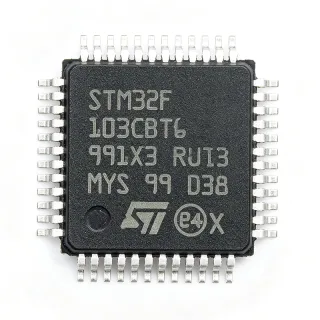
PIC16C558T-04/SO - 8-bit 4MHz MCU, 3.5KB OTP, 18-SOIC | Microchip
MPN: PIC16C558T-04/SO ✗ End of Life| Qty | Unit Price | Extended |
|---|---|---|
| 1 | $2.12 | $2.12 |
| 10 | $2.05 | $20.50 |
| 100 | $1.92 | $192.00 |
| 500 | $1.78 | $890.00 |
| 1,000 | $1.65 | $1,650.00 |
PIC16C558T-04/SO Overview
A microcontroller (MCU) is a single-chip computer containing a processor core, program memory, working RAM, and programmable I/O peripherals on one die. Within the broader taxonomy, this device sits in the 8-bit microcontrollers category, which belongs to microcontrollers and, higher up, integrated circuits and semiconductors. PIC16C5x parts are classical Harvard-architecture MCUs using the PIC instruction set, and they were widely adopted in automotive, industrial, and appliance products because of their small footprint, deterministic timing, and only 35 single-word instructions.
Key features include a 4 MHz maximum oscillator frequency (4 MHz internal instruction rate of 5 MIPS equivalent), a 12-bit instruction word, 8-bit data path, 2.0 V to 6.25 V operating voltage range (the /SO part is the commercial 0 to +70 C grade), an 8-bit timer/counter, watchdog timer, internal pull-ups on port B, and code protection. The 18-SOIC wide-body package offers 7.5 mm (0.300 inch) creepage distance, which is useful when the part sits next to mains-isolated sections in consumer white goods.
The PIC16C558T-04/SO uses Microchip's proven OTP process technology, allowing prototype cost flexibility while still offering one-time field programming. The architecture separates program and data buses (Harvard) so that an instruction fetch and a data access happen in parallel, simplifying deterministic timing for control loops. With 13 usable I/O pins, designers can drive LED indicators, read keypad matrices, and interface to sensors without external glue logic.
Typical applications include automotive body controllers and interior lighting, industrial control panels, appliance controllers (rice cookers, microwave ovens, washing machines), low-end remote-control toys, simple sensor interfaces, and battery chargers. The /04 speed grade specifies 4 MHz maximum oscillator, while the /SO suffix designates the SOIC wide-body commercial package.
When designing with this device, remember that OTP memory cannot be erased, so firmware must be fully validated before committing to production units. Decoupling the VDD pin with 0.1 uF ceramic placed within 5 mm of the package, plus a bulk 1-10 uF tantalum or aluminum capacitor, is recommended for noisy industrial environments.
This page synthesizes distributor pricing, drop-in same-package alternatives from the Microchip PIC16C5x family, and practical design notes that go beyond what the manufacturer datasheet alone provides, giving engineers a complete selection view.
Drop-in alternatives for PIC16C558T-04/SO — same package, pin-to-pin compatible. Different-package parts requiring PCB rework are excluded.
Variants in this series
Same-series models that are drop-in compatible with PIC16C558T-04/SO (same form factor and footprint) — differing in Program Memory Size, Program Memory Type, Operating Temperature Range, Package, RAM Size.
Quick Comparison Tool — Select alternative parts for side-by-side comparison:
PIC16C558-04/SO
✅ Drop-In📋 Reference alternative (not in catalog)
PIC16C558-20/SO
✅ Drop-In✓ In Stock
$2.05 / Unit
View Datasheet →PIC16C558-04I/SO
✅ Drop-In✓ In Stock
$3.11 / Unit
View Datasheet →PIC16C554T-04/SO
✅ Drop-In✓ In Stock
$1.15 / Unit
View Datasheet →PIC16C554-04/SO
✅ Drop-In✓ In Stock
$1.62 / Unit
View Datasheet →PIC16F88-I/SO
✅ Drop-In📋 Reference alternative (not in catalog)
PIC16C558T-04/SO Maximum Ratings & Electrical Characteristics
| Core | PIC16C5x (Harvard, 8-bit data, 12-bit instruction) |
| Instruction Set Size | 35 single-word instructions |
| Instruction Execution Time | 200 ns at 4 MHz |
| Maximum Oscillator Frequency | 4 MHz (/04 speed grade) |
| Program Memory Type | OTP (One-Time Programmable) |
| Program Memory Size | 3.5 KB (2K x 14 words) |
| RAM | 128 bytes |
| I/O Pins | 13 |
| Timers | 1 x 8-bit timer/counter |
| Watchdog Timer | Yes |
| Operating Voltage (VDD) | 2.0 V to 6.25 V |
| Operating Temperature | 0 C to +70 C (commercial, /SO suffix) |
| Package | 18-pin SOIC wide-body (SO, 7.5 mm / 0.300 inch) |
| Mounting Type | Surface Mount |
| Code Protection | Yes (per Microchip datasheet 30453C) |
| Data EEPROM | None (no on-chip EEPROM on PIC16C558) |
PIC16C558T-04/SO Pin Configuration
| Pin 1 | RA2 — Port A bit 2 (digital I/O) |
| Pin 2 | RA3 — Port A bit 3 (digital I/O) |
| Pin 3 | RA4/T0CKI — Port A bit 4 / Timer0 clock input |
| Pin 4 | MCLR — Master Clear (reset, active low) |
| Pin 5 | VSS — Ground reference |
| Pin 6 | RB0/INT — Port B bit 0 / External interrupt |
| Pin 7 | RB1 — Port B bit 1 (digital I/O) |
| Pin 8 | RB2 — Port B bit 2 (digital I/O) |
| Pin 9 | RB3 — Port B bit 3 (digital I/O) |
| Pin 10 | RB4 — Port B bit 4 (digital I/O) |
| Pin 11 | RB5 — Port B bit 5 (digital I/O) |
| Pin 12 | RB6 — Port B bit 6 (digital I/O) |
| Pin 13 | RB7 — Port B bit 7 (digital I/O) |
| Pin 14 | VDD — Positive supply voltage (2.0 V to 6.25 V) |
| Pin 15 | OSC2/CLKOUT — Oscillator output / clock out |
| Pin 16 | OSC1/CLKIN — Oscillator input / external clock in |
| Pin 17 | RA0 — Port A bit 0 (digital I/O) |
| Pin 18 | RA1 — Port A bit 1 (digital I/O) |
Typical Applications
PIC16C558T-04/SO is suitable for 6 applications: Appliance Control Board, Automotive Body Electronics (Cabin), Industrial Control Panel, Remote Control and Toy Electronics, Battery Charger Controller, Sensor Interface Module.
Appliance Control Board
The PIC16C558T-04/SO is well suited to rice cooker, microwave oven, washing machine, and dishwasher control boards where a low-cost 8-bit MCU drives relays, LEDs, and keypads. Its 13 I/O pins easily handle 7-segment displays plus membrane keypads, while the 4 MHz instruction rate is more than enough for temperature sensing and timer logic. The 18-SOIC wide-body package provides the 7.5 mm creepage distance often required by safety standards for line-isolated appliance sections. Unlike flash parts, the OTP memory keeps per-unit cost at the minimum for high-volume production runs above 100k units.
Recommended
Automotive Body Electronics (Cabin)
Within the automotive cabin (where ambient stays below +70 C), the PIC16C558T-04/SO handles low-speed body functions such as interior lighting controllers, seat-position switches, mirror adjusters, and chime generators. The Harvard architecture delivers deterministic interrupt latency that body-control firmware relies on for switch debouncing and PWM dimming. For under-hood or AEC-Q100 designs, migrate to the automotive-grade PIC16C558-04E/SO, which is qualified to -40 C to +125 C. The 18-SOIC wide-body withstands the conformal coating and vibration stress typical of body-electronics modules.
Recommended
Industrial Control Panel
Factory-floor control panels for motor starters, pump controllers, and conveyor interlocks commonly use the PIC16C558T-04/SO as a low-cost sequencing brain. The 13 I/O scan limit-switch inputs, drive relay coils, and blink status LEDs without external logic. Its 200 ns instruction cycle handles 5 ms scan loops comfortably while leaving CPU margin for serial diagnostic output via bit-banged UART. For panels mounted near VFDs or welding equipment, pair the MCU with a watchdog supervisor such as MCP130 and isolated 5 V supply to ride through EMI events without latchup.
Recommended
Remote Control and Toy Electronics
Toy-grade remote controls, RC receivers, and educational electronics kits often use the PIC16C558T-04/SO because its 3.5 KB OTP stores 1000 to 2000 instructions, which is sufficient for IR protocol stacks (RC5, NEC) plus simple motor PWM. The 2.0 V lower VDD bound supports 2 AA cell battery operation, extending playtime. With 128 bytes of RAM the MCU buffers received IR frames and remembers channel settings without external memory. Cost-optimized OTP pricing keeps the bill-of-materials under $3 even at qty 1.
Recommended
Battery Charger Controller
Lead-acid and NiMH battery charger designs use the PIC16C558T-04/SO to implement constant-current/constant-voltage charge profiles with temperature compensation. The MCU reads current via a sense amplifier, toggles a MOSFET through PWM, and ends charge when delta-V or delta-T criteria are met. The 18-SOIC package handles the moderate power dissipation of a charger control section while staying below thermal shutdown. OTP memory prevents accidental firmware corruption from battery transients that could otherwise brick a flash-based MCU.
Recommended
Sensor Interface Module
Dedicated sensor interface PCBs for temperature, humidity, and gas sensors often integrate the PIC16C558T-04/SO as a local signal conditioner and data packager. The MCU digitizes analog sensor outputs through an external ADC (such as MCP3201) over SPI, then transmits readings over UART to a host controller. The 4 MHz clock rate handles 1 kHz sampling loops with room for averaging and linearization math in firmware. The commercial temperature grade suits indoor HVAC and building-automation sensor nodes.
Recommended
Recommended Products Summary
Engineering reference data for PIC16C558T-04/SO — comparison, design guidance, and compliance information.
Selection Guide
Comparison with Alternatives
| Parameter | This Product | PIC16C558-04/SO | PIC16C558-20/SO | PIC16C558-04I/SO | PIC16C554T-04/SO | PIC16F88-I/SO |
|---|---|---|---|---|---|---|
| Brand | Microchip Technology | Microchip Technology - same | Microchip Technology - same | Microchip Technology - same | Microchip Technology - same | Microchip Technology - same |
| Package | 18-SOIC wide-body (SO) | 18-SOIC (SO) - same | 18-SOIC (SO) - same | 18-SOIC (SO) - same | 18-SOIC (SO) - same | 18-SOIC (SO) - same |
| Program Memory | 3.5 KB OTP | 3.5 KB OTP | 3.5 KB OTP | 3.5 KB OTP | 3.5 KB OTP | 7 KB Flash |
| RAM | 128 bytes | 128 bytes | 128 bytes | 128 bytes | 512 bytes | 368 bytes |
| Maximum Frequency | 4 MHz | 4 MHz | 20 MHz | 4 MHz | 4 MHz | 20 MHz |
| I/O Pins | 13 | 13 | 13 | 13 | 13 | 16 |
| Operating Temperature | 0 C to +70 C (commercial) | 0 C to +70 C (commercial) | 0 C to +70 C (commercial) | -40 C to +85 C (industrial) | 0 C to +70 C (commercial) | -40 C to +85 C (industrial) |
| Data EEPROM | None | None | None | None | None | 256 bytes |
Key Differentiators
- Tape-and-Reel packaging for high-volume SMT lines (vs PIC16C558-04/SO)
- Commercial 0 C to +70 C grade at lowest cost (vs PIC16C558-04I/SO)
- Pin-compatible flash migration path exists (vs PIC16C554T-04/SO)
Design Notes
Decouple VDD (pin 14) with a 0.1 uF X7R ceramic capacitor placed within 5 mm of the package, plus a bulk 1 uF to 10 uF tantalum or aluminum electrolytic capacitor. The PIC16C558T-04/SO does not include internal brown-out reset on the commercial /SO grade, so add an external voltage supervisor such as MCP100T-315I/OT if your supply can dip below 2.0 V during motor inrush or relay switching events typical in appliance and industrial panels.
Route the MCLR reset line (pin 4) away from switching signals such as relay coils and PWM outputs; add a 10 kohm pull-up to VDD and a 100 nF cap to ground for noise immunity. Keep the OSC1/OSC2 traces short and surround the crystal or resonator with a ground guard ring to avoid spurious clock glitches. The 18-SOIC wide-body is preferred over the 18-SOIC narrow-body for line-isolated designs because the 7.5 mm body width gives the required 7 mm creepage.
OTP memory on PIC16C558T-04/SO cannot be erased or rewritten, so every firmware bug becomes a stranded inventory. Always program and verify at least 5 production samples before committing to a full OTP batch. Also note that PIC code-protect fuses, once enabled, cannot be un-set, and protected OTPs cannot be verified by a programmer; build a final golden unit from each lot for warranty traceability.
Compliance Information
Compliance flags not present in the verified web data. PIC16C558T-04/SO is NOT AEC-Q100 qualified - use PIC16C558-04E/SO for AEC-Q100 automotive designs. RoHS / lead-free status marked unknown because the part is in the obsolete Microchip catalog and was originally released before RoHS was widely enforced.