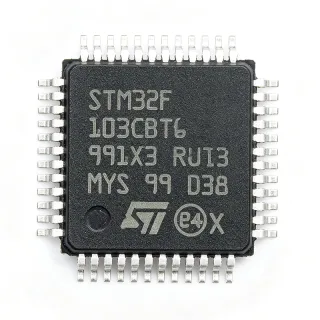
PIC16C55T-HSE/SS - 8-Bit 16MHz OTP MCU, 768B, 28-SSOP | Microchip
MPN: PIC16C55T-HSE/SS ✗ End of Life| Qty | Unit Price | Extended |
|---|---|---|
| 1 | $5.5 | $5.50 |
| 10 | $4.85 | $48.50 |
| 100 | $4.2 | $420.00 |
| 500 | $3.65 | $1,825.00 |
| 1,000 | $3.1 | $3,100.00 |
PIC16C55T-HSE/SS Overview
A microcontroller (MCU) is an integrated circuit that combines a CPU core, memory (ROM/EPROM/RAM), and programmable peripherals into one device. Within the broader semiconductor taxonomy, microcontrollers belong to embedded processors, sitting below microprocessors in complexity but above fixed-function logic ICs. The PIC16C5X family is the foundational, low-cost, high-performance branch of Microchip's PIC architecture, distinguished by its 12-bit wide instruction set that delivers 2:1 code compression versus competing 8-bit MCUs in its class.
Key features of the PIC16C55T-HSE/SS include fully static CMOS design for low power consumption, a Harvard architecture with separate program and data buses, and an instruction cycle time of 250 ns at 16 MHz. The HSE suffix denotes the High-Speed External oscillator variant with a 16 MHz ceramic resonator or crystal, while the T suffix indicates tape-and-reel packaging, and SS designates the 28-SSOP package. The device supports 12 I/O pins, a watchdog timer, and a power-on reset circuit, providing reliable standalone operation in harsh industrial environments.
Architecturally, the PIC16C55T employs a RISC-style instruction set with only 33 single-word/single-cycle instructions, enabling deterministic execution and rapid interrupt response. The 12-bit program word and dedicated PC counter eliminate the fetch-decode overlap of CISC architectures, giving predictable timing suitable for real-time control loops in cost-sensitive applications.
Typical applications include appliance controls, security and access systems, automotive subsystems (non-safety), industrial sensor interfaces, and battery-powered consumer devices where the OTP memory's low cost outweighs the inability to reprogram. The 28-SSOP footprint also makes it suitable for low-profile through-hole-replacement designs transitioning from DIP to surface-mount assembly.
When designing with this MCU, note that the OTP memory prevents firmware updates after programming, so production firmware must be fully validated before commit. The lack of an on-chip debug interface requires emulation or third-party programmers, and the limited RAM (24 bytes) constrains stack depth and variable storage.
This page consolidates distributor pricing, drop-in alternatives within the PIC16C5X family, and practical design notes that extend beyond the manufacturer datasheet to support sourcing and component selection.
Drop-in alternatives for PIC16C55T-HSE/SS — same package, pin-to-pin compatible. Different-package parts requiring PCB rework are excluded.
Variants in this series
Same-series models that are drop-in compatible with PIC16C55T-HSE/SS (same form factor and footprint) — differing in Program Memory Size, Package, Program Memory Type, Oscillator Type, Series.
Quick Comparison Tool — Select alternative parts for side-by-side comparison:
PIC16C55T-HSE/SO
✅ Drop-In✓ In Stock
$5.74 / Unit
View Datasheet →PIC16C55T-HS/SO
✅ Drop-In✓ In Stock
$2.78 / Unit
View Datasheet →PIC16C55-LPI/SS
✅ Drop-In✓ In Stock
$2.85 / Unit
View Datasheet →PIC16C55-HSI/SS
✅ Drop-In✓ In Stock
$1.4 / Unit
View Datasheet →PIC16C55-10I/SS
✅ Drop-In✓ In Stock
$2.55 / Unit
View Datasheet →PIC16C55AT-20I/SP
✅ Drop-In📋 Reference alternative (not in catalog)
PIC16C55T-HSE/SS Maximum Ratings & Electrical Characteristics
| Series | PIC16C5X |
| Core Processor | PIC |
| Core Size | 8-Bit |
| Core Architecture | Harvard (RISC) |
| Maximum Clock Speed | 16 MHz |
| Program Memory Type | OTP (One-Time Programmable) EPROM |
| Program Memory Size | 768 B (512 x 12-bit words) |
| RAM Size | 24 B |
| Number of I/O Pins | 12 |
| Supply Voltage | 5 V |
| Oscillator Type | External (HS - High Speed, ceramic resonator or crystal) |
| Instruction Set | 33 single-word instructions, 12-bit wide |
| Instruction Cycle Time | 250 ns at 16 MHz |
| Package | 28-SSOP (Shrink Small Outline Package) |
| Package Body Width | 5.30 mm (0.209 in) |
| Mounting Type | Surface Mount |
| Packaging | Tape & Reel (T suffix) |
| RoHS Status | Compliant |
| Lead-Free | Yes |
| Watchdog Timer | Yes |
| Power-On Reset | Yes |
| Peripheral Features | Watchdog timer, power-on reset |
PIC16C55T-HSE/SS Pin Configuration
| Pin 1 | /MCLR — Master Clear (Reset) input, active low |
| Pin 2 | RA0 — PORTA bit 0, digital I/O |
| Pin 3 | RA1 — PORTA bit 1, digital I/O |
| Pin 4 | RA2 — PORTA bit 2, digital I/O |
| Pin 5 | RA3 — PORTA bit 3, digital I/O |
| Pin 6 | OSC1 — Oscillator input (HS mode, 16 MHz crystal/resonator) |
| Pin 7 | OSC2 — Oscillator output |
| Pin 8 | VSS — Ground reference |
| Pin 9 | VDD — Positive supply voltage (5 V) |
| Pin 10 | RB0 — PORTB bit 0, digital I/O |
| Pin 11 | RB1 — PORTB bit 1, digital I/O |
| Pin 12 | RB2 — PORTB bit 2, digital I/O |
| Pin 13 | RB3 — PORTB bit 3, digital I/O |
| Pin 14 | RB4 — PORTB bit 4, digital I/O |
| Pin 15 | RB5 — PORTB bit 5, digital I/O |
| Pin 16 | RB6 — PORTB bit 6, digital I/O |
| Pin 17 | RB7 — PORTB bit 7, digital I/O |
| Pin 18 | VSS — Ground reference |
| Pin 19 | VDD — Positive supply voltage (5 V) |
| Pin 20 | RC0 — PORTC bit 0, digital I/O |
| Pin 21 | RC1 — PORTC bit 1, digital I/O |
| Pin 22 | RC2 — PORTC bit 2, digital I/O |
| Pin 23 | RC3 — PORTC bit 3, digital I/O |
| Pin 24 | RC4 — PORTC bit 4, digital I/O |
| Pin 25 | RC5 — PORTC bit 5, digital I/O |
| Pin 26 | RC6 — PORTC bit 6, digital I/O |
| Pin 27 | RC7 — PORTC bit 7, digital I/O |
| Pin 28 | VSS — Ground reference |
Typical Applications
PIC16C55T-HSE/SS is suitable for 7 applications: Appliance Control Boards, Security and Access Control Panels, Industrial Sensor Interfaces, Battery-Powered Consumer Devices, Automotive Non-Safety Subsystems, LED Display and Lighting Controllers, Hobby and Educational Projects.
Appliance Control Boards
The PIC16C55T-HSE/SS fits appliance control boards (washing machines, microwaves, dishwashers) due to its 16 MHz clock, 768B OTP memory, and 12 I/O pins sufficient for relay drivers, sensor inputs, and LED indicators. Its 12-bit Harvard RISC architecture executes control loops in 250 ns, easily handling PWM for motor speed regulation. The OTP memory locks firmware in production, preventing field tampering and reducing per-unit cost by eliminating reprogramming overhead. With 24 bytes of RAM, the MCU manages state variables for wash cycles, timer counters, and sensor debouncing without external memory. The 28-SSOP package enables low-profile board designs required by modern slim appliances.
Recommended
Security and Access Control Panels
The PIC16C55T-HSE/SS is suitable for security panel controllers in alarm keypads, access card readers, and door strike controllers. Its 16 MHz processing speed supports keypad scanning, authentication logic, and relay control within tight timing budgets. The 768B OTP memory stores fixed authentication sequences and alarm state machines without risk of firmware extraction and reverse engineering. With 12 I/O pins, the MCU interfaces with keypads, magnetic card sensors, buzzers, and relay outputs. The watchdog timer and power-on reset ensure reliable operation in unattended security installations. The 28-SSOP footprint fits compact panel enclosures.
Recommended
Industrial Sensor Interfaces
The PIC16C55T-HSE/SS serves industrial sensor interface modules where deterministic 16 MHz performance and OTP firmware lock are valuable. The 250 ns instruction cycle processes sensor data, threshold comparisons, and digital filtering in real time without timing jitter. The 768B OTP memory stores calibration tables and protocol handlers for Modbus RTU or proprietary sensor buses. With 12 I/O pins, the MCU connects to 4-20 mA current loops, digital switches, and isolated serial transceivers. Industrial-grade temperature variants in the PIC16C5X family operate reliably in factory environments with electrical noise and temperature extremes.
Recommended
Battery-Powered Consumer Devices
The PIC16C55T-HSE/SS powers battery-driven consumer products such as remote controls, electronic toys, and small handheld instruments where low cost and small footprint matter most. Its CMOS static design draws minimal quiescent current, extending battery life when the MCU is in sleep mode between user inputs. The 768B OTP memory provides ample program space for device logic, button debouncing, and LED driving patterns. The 12 I/O pins connect to keypads, IR LEDs, piezo buzzers, and LCD segment drivers. The 28-SSOP package suits thin consumer enclosures.
Recommended
Automotive Non-Safety Subsystems
The PIC16C55T-HSE/SS fits non-safety automotive subsystems such as interior lighting controllers, seat memory modules, and accessory timers where AEC-Q100 qualification is not required. Its 16 MHz speed handles multiplexing of dashboard switches and LED matrix drivers, while the 12-bit Harvard architecture executes timing-critical routines predictably. The 768B OTP memory locks production firmware against warranty tampering. For safety-critical applications, however, designers must migrate to AEC-Q100 qualified PIC16F variants. The 28-SSOP package suits compact automotive PCBAs.
Recommended
LED Display and Lighting Controllers
The PIC16C55T-HSE/SS controls multi-channel LED drivers and lighting effects in decorative and architectural lighting systems. At 16 MHz, the MCU generates PWM signals at frequencies high enough to avoid visible flicker, driving RGB color mixing and brightness ramp transitions smoothly. The 12 I/O pins multiplex to LED driver chips such as the TLC5940 or WS2811 chains. The 768B OTP memory stores fixed lighting sequences, color palettes, and fade tables. The 28-SSOP footprint fits within slim lighting fixture housings and controller boxes.
Recommended
Hobby and Educational Projects
The PIC16C55T-HSE/SS appears in hobbyist electronics and university embedded systems courses due to its low cost, simple RISC architecture, and abundant teaching materials. The 33-instruction PIC instruction set is easy to learn, and the 768B OTP memory challenges students to write efficient code within tight constraints. The 16 MHz clock introduces students to timing-critical embedded programming. The 28-SSOP package can be socketed on breakout boards for repeated programming during lab sessions. Documentation and example code are widely available from Microchip and the PIC enthusiast community.
Recommended
Recommended Products Summary
Engineering reference data for PIC16C55T-HSE/SS — comparison, design guidance, and compliance information.
Selection Guide
Comparison with Alternatives
| Parameter | This Product | PIC16C55T-HSE/SO | PIC16C55T-HS/SO | PIC16C55-LPI/SS | PIC16C55-HSI/SS | PIC16C55-10I/SS | PIC16C55AT-20I/SP |
|---|---|---|---|---|---|---|---|
| Package | 28-SSOP (5.30 mm) | 28-SOIC (7.50 mm) | 28-SOIC (7.50 mm) | 28-SSOP (5.30 mm) - same | 28-SSOP (5.30 mm) - same | 28-SSOP (5.30 mm) - same | 28-SPDIP (through-hole) |
| Brand | Microchip Technology | Microchip Technology | Microchip Technology | Microchip Technology | Microchip Technology | Microchip Technology | Microchip Technology |
| Maximum Clock Speed | 16 MHz | 16 MHz | 20 MHz | 4 MHz | 16 MHz | 10 MHz | 20 MHz |
| Program Memory Size | 768 B (512 x 12) | 768 B (512 x 12) | 768 B (512 x 12) | 768 B (512 x 12) | 768 B (512 x 12) | 768 B (512 x 12) | 768 B (512 x 12) |
| RAM Size | 24 B | 24 B | 24 B | 24 B | 24 B | 24 B | 24 B |
| Oscillator Mode | HS External (16 MHz) | HS External (16 MHz) | HS External (20 MHz) | LP External (low-power) | HS Internal | Standard (10 MHz) | HS External (20 MHz) |
| Lifecycle Status | Obsolete | Obsolete | Obsolete | Obsolete | Obsolete | Obsolete | Obsolete |
| Packaging | Tape & Reel | Tape & Reel | Tape & Reel | Tube | Tube | Tube | Tube |
Key Differentiators
- Tape-and-reel packaging for high-volume SMT assembly (vs PIC16C55-HSI/SS)
- HSE external oscillator mode at 16 MHz (vs PIC16C55-LPI/SS)
- Compact 28-SSOP footprint for space-constrained designs (vs PIC16C55AT-20I/SP)
- Standard PIC16C5X 12-bit Harvard RISC architecture (vs PIC16C55-10I/SS)
Design Notes
The PIC16C55T-HSE/SS requires a stable 5 V supply with decoupling capacitors placed close to the VDD pins (pin 9 and pin 19). Use a 100 nF ceramic capacitor on each VDD pin and a 10 uF bulk capacitor on the main supply rail. The MCU draws approximately 2-5 mA active and <1 uA in sleep mode, depending on oscillator configuration. Add a bulk capacitor if driving relays or other inductive loads that cause supply transients.
In HSE mode, connect a 16 MHz ceramic resonator or crystal between OSC1 (pin 6) and OSC2 (pin 7) with appropriate load capacitors (typically 15-33 pF each side). PCB layout must keep oscillator traces away from high-noise signals and minimize trace length to prevent EMI and clock jitter. The high-speed mode requires careful grounding; use a ground pour under the oscillator area to shield against radiated noise.
OTP memory cannot be erased or reprogrammed - any code error requires physical part replacement. Ensure the /MCLR pin (pin 1) has a proper pull-up resistor (typically 10 kohm) to VDD and is not left floating, or the MCU may intermittently reset. Configure unused I/O pins as outputs and tie them low to minimize power consumption and EMI susceptibility. Verify the watchdog timer configuration in software; an unconfigured watchdog may reset the MCU unexpectedly during development.
The 28-SSOP package has a 0.65 mm pitch requiring careful PCB layout. Use solder mask defined (SMD) pads rather than non-solder mask defined (NSMD) for stronger solder joints. Maintain at least 0.2 mm clearance between pad edges for reliable reflow soldering. The exposed pad (if present) should be soldered to a grounded copper pour for thermal dissipation, though the PIC16C55T-HSE/SS SSOP variant typically lacks an exposed pad.
Compliance Information
RoHS compliant per Microchip product page. Not AEC-Q100 qualified - unsuitable for automotive safety applications. Lifecycle status: obsolete.