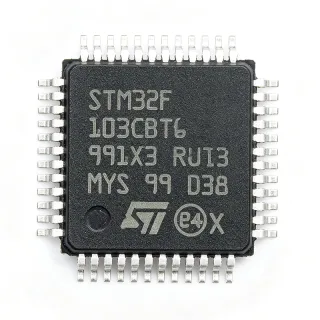
PIC16C55T-RC/SO - 4MHz 8-bit OTP MCU 28-SOIC | Microchip
MPN: PIC16C55T-RC/SO ✗ End of Life| Qty | Unit Price | Extended |
|---|---|---|
| 1 | $3.95 | $3.95 |
| 10 | $3.55 | $35.50 |
| 100 | $3.1 | $310.00 |
| 500 | $2.78 | $1,390.00 |
| 1,000 | $2.45 | $2,450.00 |
PIC16C55T-RC/SO Overview
A microcontroller (MCU) is a single-chip computer that combines a CPU, memory, and programmable I/O peripherals. The PIC16C5x family is built on a RISC core using 33 single-word single-cycle instructions and 12-bit-wide opcodes, delivering roughly 2:1 code density advantage over competing 8-bit architectures at the time. Within the power-management IC taxonomy, MCUs sit one level above logic and below system-level SoCs, serving as the decision-making element in embedded products.
Key features include Power-On Reset (POR), a Watchdog Timer (WDT) for reliable unattended operation, an internal oscillator option, and code protection for the OTP array. The Harvard-bus architecture separates program and data paths, allowing instruction fetch and operand access in the same clock cycle, which gives deterministic execution timing for real-time control loops.
The 20 I/O pins can be individually configured for digital input or output, with weak pull-ups and pin-change interrupts. The 8-bit timer (TMR0) with a programmable prescaler supports event counting, delay generation, and periodic interrupts. The brown-out reset, sleep-mode current (low-power halt), and EPROM/OTP-based code storage make the part suitable for high-volume cost-sensitive products.
Typical applications include consumer appliances, simple industrial controllers, automotive subsystems (non-safety), white goods user interfaces, remote controls, and sensor conditioning front-ends. The PIC16C55 family is widely deployed as a glue-replacement for discrete logic in legacy designs.
When designing with this part, allocate at least one full instruction-cycle budget to interrupt latency and verify the 4 MHz RC oscillator accuracy against timing-critical peripherals such as UART or PWM outputs. The T suffix and /SO suffix denote tape-and-reel packaging in the 28-SOIC form factor.
Drop-in alternatives for PIC16C55T-RC/SO — same package, pin-to-pin compatible. Different-package parts requiring PCB rework are excluded.
Variants in this series
Same-series models that are drop-in compatible with PIC16C55T-RC/SO (same form factor and footprint) — differing in Package, RoHS Status, Program Memory Size, Program Memory Type, Core Architecture.
Quick Comparison Tool — Select alternative parts for side-by-side comparison:
PIC16C55-RC/SO
✅ Drop-In📋 Reference alternative (not in catalog)
PIC16C55AT-04/SO
✅ Drop-In✓ In Stock
$0.79 / Unit
View Datasheet →PIC16C55-RCI/SO
✅ Drop-In✓ In Stock
$1.85 / Unit
View Datasheet →PIC16C558-20/SO
✅ Drop-In✓ In Stock
$2.05 / Unit
View Datasheet →PIC16C554-04/SO
✅ Drop-In✓ In Stock
$1.62 / Unit
View Datasheet →PIC16F716-I/SO
✅ Drop-In📋 Reference alternative (not in catalog)
PIC16C55T-RC/SO Maximum Ratings & Electrical Characteristics
| Core | PIC 8-bit RISC |
| Program Memory | 768 B (512 x 12) OTP |
| RAM Size | 24 B |
| Maximum Clock Frequency | 4 MHz |
| I/O Pins | 20 |
| Supply Voltage | 3.0 V to 6.25 V |
| Operating Temperature | 0C to +70C (Commercial) |
| Package | 28-SOIC (7.50 mm / 0.295" width) |
| Mounting Type | Surface Mount (Gull-wing) |
| Instruction Set Width | 12-bit |
| Instruction Count | 33 single-word / single-cycle |
| Architecture | Harvard |
| On-chip Peripherals | POR, WDT, TMR0 |
| Oscillator Type | RC (this part), with HS/XT/LP options in family |
| Packaging Form | Tape and Reel |
| RoHS Status | Non-compliant (OTP EPROM windowless part) |
| Lead-free | Contains lead (SnPb or Pb-bearing termination historically) |
PIC16C55T-RC/SO Pin Configuration
| Pin 1 | RA2 — I/O port A bit 2 |
| Pin 2 | RA3 — I/O port A bit 3 |
| Pin 3 | RA4/T0CKI — I/O port A bit 4 / Timer0 clock input |
| Pin 4 | /MCLR — Master Clear (active-low reset) |
| Pin 5 | VSS — Ground reference |
| Pin 6 | RB0/INT — I/O port B bit 0 / external interrupt |
| Pin 7 | RB1 — I/O port B bit 1 |
| Pin 8 | RB2 — I/O port B bit 2 |
| Pin 9 | RB3 — I/O port B bit 3 |
| Pin 10 | RB4 — I/O port B bit 4 |
| Pin 11 | RB5 — I/O port B bit 5 |
| Pin 12 | RB6 — I/O port B bit 6 |
| Pin 13 | RB7 — I/O port B bit 7 |
| Pin 14 | VSS — Ground reference |
| Pin 15 | OSC1/CLKIN — Oscillator input / external clock input (RC network) |
| Pin 16 | OSC2/CLKOUT — Oscillator output / clock out |
| Pin 17 | RC0 — I/O port C bit 0 |
| Pin 18 | RC1 — I/O port C bit 1 |
| Pin 19 | RC2 — I/O port C bit 2 |
| Pin 20 | RC3 — I/O port C bit 3 |
| Pin 21 | RC4 — I/O port C bit 4 |
| Pin 22 | RC5 — I/O port C bit 5 |
| Pin 23 | RC6 — I/O port C bit 6 |
| Pin 24 | RC7 — I/O port C bit 7 |
| Pin 25 | RA0 — I/O port A bit 0 |
| Pin 26 | RA1 — I/O port A bit 1 |
| Pin 27 | VDD — Positive supply voltage |
| Pin 28 | VDD — Positive supply voltage |
Typical Applications
PIC16C55T-RC/SO is suitable for 6 applications: Consumer Appliance Control, Industrial Sensor Interface, Remote Control Transmitter, Automotive Body Electronics (Non-Safety), White Goods User Interface, Glue-Logic Replacement.
Consumer Appliance Control
The PIC16C55T-RC/SO fits consumer appliance control boards - washing machines, microwave ovens, dishwashers, and HVAC thermostats - because of its 20 digital I/O pins that can directly drive LEDs, keypads, triac interfaces, and 7-segment displays. The 768-byte OTP memory is sufficient for state-machine-based appliance logic, and the 4 MHz RC oscillator eliminates the cost and PCB area of a crystal. The integrated Watchdog Timer provides unattended fault recovery that meets typical appliance safety requirements, while the POR circuit guarantees clean startup after power interruptions.
Recommended
Industrial Sensor Interface
The PIC16C55T-RC/SO suits industrial sensor-conditioning front-ends and signal-conditioning modules where its 20 I/O pins can scan multiple switch contacts, drive status LEDs, and output relay or transistor commands. The Harvard architecture with 12-bit opcodes and 33 instructions gives deterministic timing for polled sensor reads, while the TMR0 with prescaler handles debounce intervals and periodic sampling without software overhead. Its 3.0 V to 6.25 V supply range lets it operate directly from 5 V industrial backplanes or regulated 3.3 V rails.
Recommended
Remote Control Transmitter
For handheld IR/RF remote controls, the PIC16C55T-RC/SO provides the low-cost, low-pin-count controller needed to scan a 4x4 key matrix and generate PPM or PWM-modulated carrier waveforms. The 768-byte OTP holds key-code lookup tables and protocol bit patterns for TV/set-top/air-conditioner command sets. The internal RC oscillator at 4 MHz is fast enough for 38 kHz IR carrier generation and keeps the BOM small by removing the external resonator.
Recommended
Automotive Body Electronics (Non-Safety)
The PIC16C55T-RC/SO fits non-safety automotive body modules such as interior lighting controllers, mirror adjusters, seat-position memories, and HVAC blend-door actuators where 20 I/O pins and 768 bytes of OTP memory are sufficient. Its 4 MHz instruction rate handles 10 ms CAN/LIN-friendly timing budgets when paired with an external transceiver. Designers should target the industrial -40C to +125C variants (PIC16C55-RCI/SO) for under-hood or cabin-temperature extremes.
Recommended
White Goods User Interface
In washing-machine, refrigerator, and dishwasher user-interface boards, the PIC16C55T-RC/SO drives 7-segment or LCD character displays, scans capacitive or resistive touch keys, and produces beeper tones through bit-banged PWM. The 24-byte RAM accommodates display refresh buffers and key-debounce state machines, while the Watchdog Timer recovers from ESD-induced firmware lockups common near power-switching circuitry.
Recommended
Glue-Logic Replacement
The PIC16C55T-RC/SO is widely used to replace 74-series discrete CMOS logic in legacy designs where multiple glue functions (timers, latches, state machines, decoders) need consolidation on a single chip. Its 20 I/O pins and 33-instruction RISC core can absorb what previously required 4-6 logic ICs, reducing PCB area and assembly cost. The OTP memory locks the logic at production time, providing IP protection for the consolidated function.
Recommended
Recommended Products Summary
Engineering reference data for PIC16C55T-RC/SO — comparison, design guidance, and compliance information.
Selection Guide
Comparison with Alternatives
| Parameter | This Product | PIC16C55-RC/SO | PIC16C55AT-04/SO | PIC16C558-20/SO | PIC16F716-I/SO |
|---|---|---|---|---|---|
| Brand | Microchip Technology | Microchip Technology | Microchip Technology | Microchip Technology | Microchip Technology |
| Package | 28-SOIC (7.50 mm) | 28-SOIC (7.50 mm) - same | 28-SOIC (7.50 mm) - same | 28-SOIC (7.50 mm) - same | 28-SOIC (7.50 mm) - same |
| Program Memory | 768 B (512 x 12) OTP | 768 B OTP | 768 B OTP | 2 KB (1.5K x 12) OTP | 2 KB Flash |
| Maximum Clock Frequency | 4 MHz | 4 MHz | 4 MHz | 20 MHz | 20 MHz |
| I/O Pins | 20 | 20 | 20 | 20 | 13 |
| Program Memory Type | OTP (one-time) | OTP | OTP | OTP | Flash (re-programmable) |
| Operating Temperature | 0C to +70C (Commercial) | 0C to +70C | 0C to +70C | 0C to +70C | -40C to +85C (Industrial) |
| Lifecycle Status | NRND | NRND | NRND | NRND | Active |
| Approx. Unit Price (100 qty) | $3.10 | $3.10 | $3.20 | $3.40 | $2.20 |
Key Differentiators
- Compact 28-SOIC with 20 I/O pins and 768 B OTP (vs PIC16F716-I/SO)
- RC oscillator on-chip option eliminates external crystal (vs PIC16C55-XT/SO)
- 33-instruction RISC core with 12-bit opcodes (vs PIC16C54T-RC/SO)
- Tape-and-reel packaging for high-volume SMT assembly (vs PIC16C55-RC/SO (tube))
Design Notes
Decouple VDD with a 100 nF ceramic capacitor placed within 5 mm of pins 27 and 28, plus a bulk 10 uF tantalum or aluminum electrolytic cap on the same supply trace. The PIC16C5x core draws brief switching current spikes on each oscillator cycle - inadequate decoupling causes VDD droop that can corrupt EEPROM writes or trigger spurious brown-out resets. Keep digital VDD separate from any high-current relay or motor-driver supply, joining them only at a single ground-return star point.
For the -RC variant, the RC timing components connect between OSC1/CLKIN (pin 15) and VSS, with OSC2/CLKOUT (pin 16) usable as a general-purpose I/O on PIC16C5x. Choose R between 5 kOhm and 100 kOhm and C above 20 pF to keep the oscillator within 5% accuracy. Estimated: at R=10 kOhm and C=100 pF the nominal frequency is approximately 4 MHz but tolerance depends on parasitic capacitance and supply voltage - calibrate in production if UART timing is required.
OTP memory cannot be erased or re-written - any firmware bug discovered after programming is unrecoverable and requires a new masked part (PIC16CR55) or a flash-based redesign. Verify firmware with a windowed PIC16C55/JW on the dev bench before committing to OTP volume orders. Additionally, ensure /MCLR (pin 4) is either tied to VDD through a 10 kOhm pull-up or driven by a supervisor IC; leaving it floating causes erratic resets in noisy environments.
Route the oscillator traces (OSC1/OSC2) as short as possible and guard them with a ground pour to minimize EMI pickup. The RC components should be placed within 5 mm of the MCU with their ground return connected directly to the VSS pin. Keep the high-current traces (relay drivers, triac outputs) at least 10 mm away from the oscillator network to avoid frequency pulling or jitter. Use a 4-layer PCB with a continuous ground plane if the product must meet EN 55022 Class B emissions.
The PIC16C5x I/O pins have limited sink/source current (typically 25 mA per pin, 200 mA total package) - never drive relays or LEDs directly without a transistor driver. For long PCB traces or external cable connections, add series resistors (100-470 Ohm) to limit ringing and ESD ingress. Unused I/O pins should be configured as outputs driving low or as inputs with weak pull-ups enabled to avoid floating-input shoot-through current (typically 0.5-2 mA per floating pin).
Compliance Information
PIC16C55T-RC/SO is a pre-RoHS OTP EPROM part historically supplied with lead-bearing terminations; not RoHS compliant. For RoHS-constrained designs, use flash-based PIC16F716-I/SO or PIC16F88-I/SO equivalents in the same 28-SOIC footprint. Reach SVHC declaration status is compliant per Microchip product environmental data. Not AEC-Q100 qualified - choose industrial-grade PIC16C55-RCI/SO variants for non-safety automotive body modules.