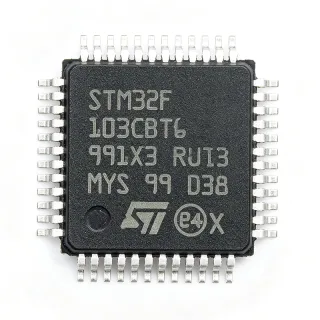
PIC16C56-HS/SS - 8-Bit 20MHz CMOS MCU, 1KB EPROM | Microchip
MPN: PIC16C56-HS/SS ✗ End of Life| Qty | Unit Price | Extended |
|---|---|---|
| 1 | $2.45 | $2.45 |
| 10 | $2.18 | $21.80 |
| 100 | $1.91 | $191.00 |
| 500 | $1.74 | $870.00 |
| 1,000 | $1.62 | $1,620.00 |
PIC16C56-HS/SS Overview
An 8-bit RISC microcontroller (Reduced Instruction Set Computer) is a microprocessor that executes one instruction per clock cycle from a small, fixed-format instruction set. The PIC16C5X architecture is a foundational RISC MCU line from Microchip, offering 33 single-word single-cycle instructions, a two-level deep hardware stack, and direct, indirect, and relative addressing modes. Microcontrollers in this class are widely used as embedded controllers, sensor interface chips, and low-cost logic replacements in industrial and consumer products.
The PIC16C56-HS/SS delivers up to 20 MHz CPU execution, eight-bit timer/counter (TMR0) with an 8-bit prescaler, Power-On Reset (POR), Watchdog Timer (WDT) with its own on-chip RC oscillator, and an operating voltage range of 4.5V to 5.5V. The 12-bit wide instructions produce a typical 2:1 code compression versus competitive 8-bit MCUs, and the device consumes less than 2 mA at 5V/4 MHz typical, with standby current under 4 uA. These specifications place it in the classic low-cost embedded controller category.
Typical applications include appliance control, sensor signal conditioning, LED and relay drivers, automotive body electronics (pre-CAN modules), battery chargers, and simple human-machine interface (HMI) panels. Its low pin count and small SSOP footprint allow integration into space-constrained PCBAs where a few dozen I/O toggles suffice.
A critical design consideration with EPROM-based PIC16C5X parts is that they require a quartz windowed package (JW) or one-time-programmable (OTP) programming, and they cannot be reprogrammed in-circuit without erasing via UV. Engineers migrating to flash memory should consider the pin-compatible PIC16F54 or PIC16F57 families. The PIC16C56 is now a mature, mature-lifecycle product; verify last-time-buy status before designing it into new platforms.
This page synthesizes distributor pricing, drop-in SSOP-20 alternatives, parametric comparisons, and practical design notes that go beyond the raw manufacturer datasheet to help procurement, design, and reliability engineers evaluate the PIC16C56-HS/SS for both legacy maintenance and new low-cost 8-bit MCU designs.
Drop-in alternatives for PIC16C56-HS/SS — same package, pin-to-pin compatible. Different-package parts requiring PCB rework are excluded.
Variants in this series
Same-series models that are drop-in compatible with PIC16C56-HS/SS (same form factor and footprint) — differing in Package, Core Architecture, RoHS Status, Program Memory Size, Program Memory Type.
Quick Comparison Tool — Select alternative parts for side-by-side comparison:
PIC16C55-HS/SS
✅ Drop-In📋 Reference alternative (not in catalog)
PIC16C56A-20/SS
✅ Drop-In📋 Reference alternative (not in catalog)
PIC16C56AT-20/SS
✅ Drop-In✓ In Stock
$0.85 / Unit
View Datasheet →PIC16C56AT-20E/SS
✅ Drop-In✓ In Stock
$2.21 / Unit
View Datasheet →PIC16C56A-04E/SS
✅ Drop-In📋 Reference alternative (not in catalog)
PIC16C56/SS
✅ Drop-In📋 Reference alternative (not in catalog)
PIC16C56-HS/SS Maximum Ratings & Electrical Characteristics
| Family | PIC16C5X |
| Core Architecture | 8-bit RISC |
| Program Memory Type | EPROM (UV-erasable, OTP windowless) |
| Program Memory Size | 1024 words (1 KB x 12-bit) |
| Data RAM | 25 bytes |
| Maximum Clock Frequency | 20 MHz |
| Instruction Count | 33 single-word single-cycle instructions |
| Instruction Width | 12 bits |
| Data Path Width | 8 bits |
| Operating Voltage | 4.5 V to 5.5 V |
| I/O Pins | 12 |
| Timers | 1 x 8-bit (TMR0) with 8-bit prescaler |
| Watchdog Timer (WDT) | Yes, with dedicated on-chip RC oscillator |
| Stack Depth | 2 levels (hardware) |
| Package | SSOP-20 (Shrink Small Outline Package), 0.65 mm pitch |
| Operating Temperature | 0C to +70C (commercial) |
| Power-On Reset (POR) | Yes |
| Supply Current (5V, 4 MHz) | < 2 mA typical |
| Standby Current | < 4 uA typical |
| Mounting Type | Surface Mount |
| RoHS Status | Non-compliant (contains Pb) |
PIC16C56-HS/SS Pin Configuration
| Pin 1 | RA2 — Bidirectional I/O port A bit 2 |
| Pin 2 | RA3 — Bidirectional I/O port A bit 3 |
| Pin 3 | RTCC — TMR0 timer/counter clock input (schmitt trigger) |
| Pin 4 | MCLR — Master Clear (reset) input, active low |
| Pin 5 | VSS — Ground reference |
| Pin 6 | RB0 — Bidirectional I/O port B bit 0 |
| Pin 7 | RB1 — Bidirectional I/O port B bit 1 |
| Pin 8 | RB2 — Bidirectional I/O port B bit 2 |
| Pin 9 | RB3 — Bidirectional I/O port B bit 3 |
| Pin 10 | RB4 — Bidirectional I/O port B bit 4 |
| Pin 11 | RB5 — Bidirectional I/O port B bit 5 |
| Pin 12 | RB6 — Bidirectional I/O port B bit 6 |
| Pin 13 | RB7 — Bidirectional I/O port B bit 7 |
| Pin 14 | VSS — Ground reference |
| Pin 15 | OSC1 — Oscillator input (HS crystal mode) |
| Pin 16 | OSC2 — Oscillator output (HS crystal mode) |
| Pin 17 | RC0 — Bidirectional I/O port C bit 0 |
| Pin 18 | RC1 — Bidirectional I/O port C bit 1 |
| Pin 19 | RC2 — Bidirectional I/O port C bit 2 |
| Pin 20 | VDD — Positive supply voltage (4.5V to 5.5V) |
Typical Applications
PIC16C56-HS/SS is suitable for 6 applications: Appliance Control (Washing Machines, Microwaves), Sensor Signal Conditioning Modules, LED and Relay Driver Controllers, Automotive Body Electronics (Pre-CAN Era), Battery Chargers and Power Management, Simple HMI Panels (Keypad + LCD).
Appliance Control (Washing Machines, Microwaves)
The PIC16C56-HS/SS fits appliance-control applications because it offers 12 bidirectional I/O lines, an 8-bit timer (TMR0) with prescaler, and a hardware watchdog timer - all the peripherals needed to drive relays, read keypad inputs, and sequence motor/valve actuators. Its 1 KB EPROM program memory is sufficient for state-machine style washing-cycle or microwave-oven firmware, while the SSOP-20 footprint fits the compact PCBA typical of white goods. The 20 MHz execution rate delivers 5 MIPS, comfortably handling debounce, LED multiplexing, and triac zero-cross timing without DMA or interrupts.
Recommended
Sensor Signal Conditioning Modules
For low-cost sensor-interface boards (thermistor bridges, photodiode amplifiers, hall-effect switches), the PIC16C56-HS/SS provides 25 bytes of RAM, 12 I/O lines, and 5 MIPS throughput - enough to digitize analog signals via the on-chip comparator path (where available) or via external ADC. The hardware watchdog with dedicated RC oscillator ensures the module recovers from brownouts in unattended installations, while the 4.5V-5.5V supply matches typical 5V sensor rails. The SSOP-20 footprint occupies less than 30 mm^2 of board area, ideal for inline sensor modules.
Recommended
LED and Relay Driver Controllers
The PIC16C56-HS/SS is well suited as a sequencer for LED chasers, sign boards, and multi-channel relay drivers. Its 12 I/O pins can directly sink/source LEDs via current-limiting resistors, or drive relay coils through BJTs/MOSFETs. The TMR0 8-bit timer with prescaler enables software PWM for LED dimming without external hardware. Operating from 4.5V-5.5V, the part coexists with 5V relay coils and 5V LED strings. The PIC16C5X RISC instruction set produces compact code for chase-pattern lookup tables and timing sequences.
Recommended
Automotive Body Electronics (Pre-CAN Era)
Legacy automotive body controllers (window lifters, mirror adjusters, simple climate controls) used PIC16C56-class MCUs before CAN bus proliferation. The PIC16C56-HS/SS HS variant supports 20 MHz operation needed for switch-debounce and motor-PWM loops. Note that the commercial 0C to +70C grade is unsuitable for under-hood applications; automotive designs required the PIC16C56A-20E/SS extended-temperature variant. The hardware watchdog timer ensures recovery from load-dump-induced resets common in 12V automotive electrical systems.
Recommended
Battery Chargers and Power Management
Low-end NiCd/NiMH battery chargers and simple CC/CV power supplies benefit from the PIC16C56-HS/SS's 5 MIPS throughput and 8-bit TMR0 timer for current-measurement integration. The part's 4.5V-5.5V supply matches single-cell lithium charger architectures with external regulators, and its 12 I/O lines can switch charge FETs, monitor thermistors, and drive status LEDs without external logic. The hardware watchdog prevents lockup if the charger enters an unexpected state. Designers should add an external voltage reference for accurate termination voltage.
Recommended
Simple HMI Panels (Keypad + LCD)
Human-Machine Interface panels for industrial equipment, security keypads, and access control often use the PIC16C56-HS/SS as the scan-and-decode controller. Its 12 I/O pins can matrix-scan a 3x4 or 4x4 keypad and drive a character LCD via 4-bit mode using only 6-7 I/O lines. The 5 MIPS throughput comfortably handles debounce and character-encoding. With 1 KB EPROM, the firmware can store protocol state machines (e.g., Wiegand output for access control). The SSOP-20 footprint suits the slim panel enclosures typical of wall-mounted HMIs.
Recommended
Recommended Products Summary
Engineering reference data for PIC16C56-HS/SS — comparison, design guidance, and compliance information.
Selection Guide
Comparison with Alternatives
| Parameter | This Product | PIC16C55-HS/SS | PIC16C56A-20/SS | PIC16C56AT-20/SS | PIC16C56AT-20E/SS | PIC16C56A-04E/SS | PIC16C56/SS |
|---|---|---|---|---|---|---|---|
| Package | SSOP-20 | SSOP-20 - same | SSOP-20 - same | SSOP-20 - same | SSOP-20 - same | SSOP-20 - same | SSOP-20 - same |
| Brand | Microchip Technology | Microchip Technology | Microchip Technology | Microchip Technology | Microchip Technology | Microchip Technology | Microchip Technology |
| Program Memory | 1024 words EPROM | 512 words EPROM (-50%) | 1024 words EPROM (same) | 1024 words EPROM (same) | 1024 words EPROM (same) | 1024 words EPROM (same) | 1024 words EPROM (same) |
| Data RAM | 25 bytes | 25 bytes | 25 bytes | 25 bytes | 25 bytes | 25 bytes | 25 bytes |
| Max Clock Frequency | 20 MHz (HS oscillator) | 20 MHz | 20 MHz | 20 MHz | 20 MHz | 4 MHz (-80%) | 4 MHz typical, RC oscillator (-80%) |
| I/O Pins | 12 | 12 | 12 | 12 | 12 | 12 | 12 |
| Operating Temperature | 0C to +70C (commercial) | 0C to +70C | 0C to +70C | 0C to +70C | -40C to +125C (extended) | -40C to +125C (extended) | 0C to +70C |
| Watchdog Timer | Yes (dedicated RC oscillator) | Yes | Yes | Yes | Yes | Yes | Yes |
Key Differentiators
- Highest program memory density in SSOP-20 PIC16C5X family (vs PIC16C55-HS/SS)
- Mature, broadly-documented PIC16C5X RISC architecture (vs Generic 8051 8-bit MCUs)
- Extended-temperature family variants available with same SSOP-20 footprint (vs PIC16F54-I/SS flash-based successor)
Design Notes
Estimated: At 20 MHz clock and 5V supply, the PIC16C56-HS/SS typically draws <2 mA active and <4 uA standby per the PIC16C5X datasheet. For brownout-sensitive applications, add a 10 uF bulk capacitor plus 0.1 uF decoupling close to VDD (pin 20) and VSS (pins 5, 14). The dedicated WDT RC oscillator runs independently of the main clock, ensuring watchdog operation even if the primary oscillator fails - critical for unattended embedded designs.
The PIC16C56-HS/SS has a two-level hardware stack - deeply nested CALLs will overwrite the stack pointer and cause unpredictable returns. Keep call depth to two or fewer, or refactor code into iterative state machines. Additionally, the EPROM program memory cannot be reprogrammed in-circuit; OTP (one-time-programmable) windowless packages require a separate EPROM programmer (e.g., MPLAB PM3). Verify programming socket adapter compatibility before production ramp.
The SSOP-20 package has a 0.65 mm pin pitch with thermal pad considerations; allocate at least 0.4 mm clearance between traces and 1.0 mm between pads and via arrays. Keep the OSC1/OSC2 traces short and symmetric, and place the crystal within 5 mm of the pins with guard traces to ground to minimize EMI. For noisy environments (relay-coil boards), add a 10-100 ohm series resistor at MCLR to limit inrush current during power-up.
The TMR0 input (pin 3, RTCC) shares its pin with the Schmitt-trigger comparator path; use a 1 kohm-10 kohm series resistor for clean digital input signals to avoid false triggering. The RTCC pin can be software-configured to increment on internal instruction cycle clock or external transitions. When using external RTCC, ensure signal rise time < 10 ns to avoid TMR0 miscounts at 20 MHz system clock.
Compliance Information
PIC16C56-HS/SS uses SnPb solder finish (non-RoHS); not AEC-Q100 qualified - extended-temperature PIC16C56AT-20E/SS variant exists for automotive-grade designs but is also non-RoHS. RoHS-compliant flash-based PIC16F54-I/SS is the recommended successor for new designs.