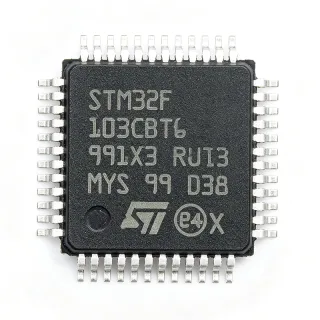
PIC16C56-LP/SO - 8-Bit 40MHz OTP MCU 1.5KB | Microchip SOIC-18
MPN: PIC16C56-LP/SO ✗ End of Life| Qty | Unit Price | Extended |
|---|---|---|
| 1 | $2.85 | $2.85 |
| 10 | $2.56 | $25.60 |
| 100 | $2.28 | $228.00 |
| 500 | $2.05 | $1,025.00 |
| 1,000 | $1.82 | $1,820.00 |
PIC16C56-LP/SO Overview
An 8-bit microcontroller (MCU) is a single-chip computer that integrates a CPU, non-volatile program memory, working RAM, and programmable I/O on a single silicon die. The PIC16C5X family belongs to the broader category of microcontrollers -> 8-bit MCUs -> RISC microcontrollers -> CMOS EPROM/ROM-based MCUs -> embedded controllers. This class of devices is the workhorse of cost-sensitive, deterministic control applications where predictable instruction timing and ultra-low sleep current matter more than raw compute.
Key features of the PIC16C56-LP/SO include 12 I/O pins (bidirectional), a two-level hardware stack, direct/indirect/relative addressing modes, an 8-bit real-time clock/counter (TMR0) with 8-bit prescaler, a Watchdog Timer with on-chip RC oscillator for reliable recovery, and a low-power 3.3V/5V operating range. The EPROM-based OTP memory allows prototype and small-volume production programming with a standard programmer such as the MPLAB PM3. Special function hardware registers are mapped in two banks, and the device supports power-on reset, brown-out detection via configuration bits, and a code-protect bit for software security.
Architecturally, the PIC16C56 uses a Harvard RISC core with a 12-bit wide instruction word and an 8-bit wide data path, delivering 33 single-word instructions and achieving roughly 2:1 code compression versus typical 8-bit CISC MCUs. The fully static CMOS design eliminates minimum clock-rate requirements, allowing the part to be stopped in software for nano-power sleep. The internal oscillator, optional external RC, crystal, or resonator clock modes, and the EPROM code-protect fuse round out the silicon feature set.
Typical applications span low-cost embedded control such as appliance control boards, simple sensor interfaces, automotive body electronics (non-safety), industrial timers and counters, consumer remote controls, and hobbyist/educational 8-bit development. It is often used as a cost-optimized replacement for discrete logic in high-volume products.
When designing with this part, note that the OTP EPROM cannot be re-programmed in-circuit - for prototypes, a windowed CERDIP (JW) version exists. Always place a 0.1 uF decoupling capacitor within 5 mm of VDD, and route MCLR through the recommended resistor-capacitor network to ensure clean resets. Compared with Flash-based PIC16F successors, the PIC16C56 offers cost advantages for high-volume production but trades off field re-programmability.
This page synthesizes distributor pricing, drop-in alternatives, and practical design notes not found in the manufacturer datasheet.
Drop-in alternatives for PIC16C56-LP/SO — same package, pin-to-pin compatible. Different-package parts requiring PCB rework are excluded.
Variants in this series
Same-series models that are drop-in compatible with PIC16C56-LP/SO (same form factor and footprint) — differing in Package, Oscillator Type, RoHS Status, Program Memory Size, Operating Temperature.
Quick Comparison Tool — Select alternative parts for side-by-side comparison:
PIC16C56-LP/P
✅ Drop-In✓ In Stock
$3.39 / Unit
View Datasheet →PIC16C56A-04/SO
✅ Drop-In📋 Reference alternative (not in catalog)
PIC16C56-HSI/SO
✅ Drop-In📋 Reference alternative (not in catalog)
PIC16C56T-LP/SO
✅ Drop-In✓ In Stock
$1.89 / Unit
View Datasheet →PIC16C56-LPE/P
✅ Drop-In✓ In Stock
$2.78 / Unit
View Datasheet →PIC16C56-LP/SO Maximum Ratings & Electrical Characteristics
| Series | PIC 16C |
| Core Processor | PIC |
| Core Size | 8-Bit |
| Maximum Clock Frequency | 40 MHz |
| Instruction Cycle | 200 ns |
| Program Memory Type | OTP EPROM |
| Program Memory Size | 1.5 KB (1K x 12) |
| RAM Size | 25 B |
| Number of I/O Pins | 12 |
| Supply Voltage Range | 3.0 V to 6.25 V (3.3V/5V nominal) |
| Operating Temperature | 0C to +70C (LP = Low-Power commercial) |
| Package / Case | 18-SOIC (0.295", 7.50 mm Width) |
| Mounting Type | Surface Mount |
| Peripherals | POR (Power-On Reset), WDT (Watchdog Timer) |
| Oscillator Type | External (RC/XT/LP/HS modes) |
| Connectivity | None (stand-alone MCU) |
| Data Converters | None |
| RoHS Status | Non-Compliant (OTP EPROM, leaded package code) |
PIC16C56-LP/SO Pin Configuration
| Pin 1 | MCLR/VPP — Master Clear (reset) input / programming voltage |
| Pin 2 | RA0 — Bidirectional I/O port A bit 0 |
| Pin 3 | RA1 — Bidirectional I/O port A bit 1 |
| Pin 4 | RB0 — Bidirectional I/O port B bit 0 |
| Pin 5 | RB1 — Bidirectional I/O port B bit 1 |
| Pin 6 | RB2 — Bidirectional I/O port B bit 2 |
| Pin 7 | VSS — Ground reference |
| Pin 8 | RB3 — Bidirectional I/O port B bit 3 |
| Pin 9 | RB4 — Bidirectional I/O port B bit 4 |
| Pin 10 | RB5 — Bidirectional I/O port B bit 5 |
| Pin 11 | RB6 — Bidirectional I/O port B bit 6 |
| Pin 12 | RB7 — Bidirectional I/O port B bit 7 |
| Pin 13 | RA2 — Bidirectional I/O port A bit 2 |
| Pin 14 | RA3 — Bidirectional I/O port A bit 3 |
| Pin 15 | VDD — Positive supply (3.3V/5V nominal) |
| Pin 16 | OSC2/CLKOUT — Oscillator output / clock out |
| Pin 17 | OSC1/CLKIN — Oscillator input / external clock in |
| Pin 18 | T0CKI — Timer0 clock input (also functions as RA4) |
Typical Applications
PIC16C56-LP/SO is suitable for 6 applications: Appliance Control Boards, Automotive Body Electronics (Non-Safety), Industrial Timer and Counter Modules, Consumer Remote Controls and IR Transmitters, Educational and Hobbyist 8-bit Development, Cost-Optimized Discrete Logic Replacement.
Appliance Control Boards
The PIC16C56-LP/SO is well-suited for low-cost appliance control boards such as washing-machine timer modules, microwave oven keypads, and toaster-oven controllers. Its 1.5KB OTP EPROM comfortably fits appliance-state-machine firmware (mode select, sensor polling, relay sequencing, and LED indicator updates) without external memory. The 12 GPIO pins can directly drive triac optocouplers, button matrices, and seven-segment displays via current-limiting resistors, eliminating external glue logic. At 5V/4 MHz the part draws approximately 2 mA active, allowing linear regulator dissipation under 100 mW for thermally constrained under-cabinet installations. Engineers should pair each GPIO driving an AC load with a snubber network and route MCLR with a 10 kohm pull-up to ensure clean resets during brownouts.
Recommended
Automotive Body Electronics (Non-Safety)
For non-safety automotive body modules such as interior lighting controllers, seat-position memory, and HVAC flap motors, the PIC16C56-LP/SO provides a deterministic RISC core that survives under-hood electrical noise better than complex CISC alternatives. The 1.5KB OTP stores seat-recall positions or HVAC damper curves, while the 25-byte RAM tracks button debounce state. Although the LP grade is rated 0C to +70C, automotive cabin environments typically meet this range; for under-hood use, upgrade to PIC16C56-HSI/SO (industrial -40C to +85C). Place a 0.1 uF decoupling capacitor within 5 mm of VDD, route MCLR with the recommended 10 kohm pull-up, and add a TVS diode on VDD to clamp load-dump transients below the 6.25V abs-max supply rating.
Recommended
Industrial Timer and Counter Modules
Industrial timer and counter modules benefit from the PIC16C56-LP/SO's 8-bit hardware timer TMR0 with 8-bit programmable prescaler, supporting event counts up to 50 million ticks per second at 40 MHz. The 33 single-word RISC instructions let a single instruction cycle (200 ns at 40 MHz) execute a deterministic state transition, eliminating the interrupt jitter typical of larger CISC controllers. Industrial panel-meter counters, conveyor-belt pulse counters, and packaging-machine batch timers all map cleanly to 1.5KB of OTP firmware. Galvanic isolation between the GPIO inputs and field sensors via opto-isolators is recommended for factory-floor installations with high common-mode noise; the low 2 mA active supply current keeps 24V-to-5V linear regulator dissipation under 50 mW.
Recommended
Consumer Remote Controls and IR Transmitters
Low-cost IR/RF remote controls use the PIC16C56-LP/SO because its 1.5KB OTP holds the entire RC-5/RC-6 or proprietary button-to-IR code table, while its 12 GPIOs directly drive a 4x4 key matrix plus IR-LED output transistor without external latches. The fully-static CMOS core allows the MCU to enter sleep mode between button presses, drawing under 1 uA, so two AAA batteries last the typical 5-year shelf life. The Watchdog Timer with internal RC oscillator prevents lockup if firmware enters an invalid state. PCB layout should place the IR-LED driver transistor within 10 mm of the GPIO pin and add a 100 ohm series resistor to limit peak LED current to 100 mA within the 200 mA package I/O budget.
Recommended
Educational and Hobbyist 8-bit Development
The PIC16C56-LP/SO remains a popular teaching vehicle for 8-bit RISC fundamentals because its PIC16C5X core has only 33 instructions, all single-cycle, allowing students to learn assembly-language timing analysis in a single lab session. The 18-SOIC package is breadboard-compatible with SparkFun and Adafruit SOIC-to-DIP breakouts, while the 12 I/O pins comfortably support the classic 'blink-LED, read-button, drive-servo' curriculum. For lab settings where firmware is iterated multiple times per session, instructors should substitute the PIC16F506-I/SL (Flash-based, same instruction set) since the OTP EPROM cannot be erased and re-written. The 0C to +70C LP commercial temperature grade suits classroom environments, and the 25-byte RAM is more than enough for student counter and accumulator exercises.
Recommended
Cost-Optimized Discrete Logic Replacement
When designers need to replace 5-10 discrete CMOS logic gates with a single programmable device to reduce PCB area, the PIC16C56-LP/SO delivers up to 1.5KB of configurable logic in a single SOIC-18. The 200 ns instruction cycle reliably debounces mechanical switches, sequences power-up relays, and multiplexes seven-segment displays with no external 74HC logic. The 12 GPIO pins can directly sink LED current through resistors, eliminating buffer ICs entirely. At approximately $1.82 per unit in 1000-piece reels (as of 2026-09-16), the PIC16C56-LP/SO is cost-competitive with mid-density 4000-series CMOS. Always validate timing in worst-case (40 MHz, 6.25V, 0C) corners using the PIC16C5X datasheet timing diagrams to ensure deterministic behavior across production lots.
Recommended
Recommended Products Summary
Engineering reference data for PIC16C56-LP/SO — comparison, design guidance, and compliance information.
Selection Guide
Comparison with Alternatives
| Parameter | This Product | PIC16C56-LP/P | PIC16C56A-04/SO | PIC16C56-HSI/SO | PIC16C56T-LP/SO | PIC16C56-LPE/P |
|---|---|---|---|---|---|---|
| Package | 18-SOIC | 18-PDIP | 18-SOIC - same | 18-SOIC - same | 18-SOIC - same | 18-PDIP |
| Brand | Microchip Technology | Microchip Technology | Microchip Technology | Microchip Technology | Microchip Technology | Microchip Technology |
| Program Memory | 1.5 KB (1K x 12) OTP EPROM | 1.5 KB (1K x 12) OTP EPROM | 1.5 KB (1K x 12) OTP EPROM | 1.5 KB (1K x 12) OTP EPROM | 1.5 KB (1K x 12) OTP EPROM | 1.5 KB (1K x 12) OTP EPROM |
| RAM Size | 25 B | 25 B | 25 B | 25 B | 25 B | 25 B |
| Max Clock Frequency | 40 MHz | 40 MHz | 40 MHz | 40 MHz | 40 MHz | 40 MHz |
| Operating Temperature | 0C to +70C (LP grade) | 0C to +70C (LP grade) | 0C to +70C | -40C to +85C (industrial) | 0C to +70C (LP grade) | -40C to +125C (extended) |
| Power-Down Current | 4 uA typical | 4 uA typical | 1 uA typical | 4 uA typical | 4 uA typical | 4 uA typical |
| Oscillator Grade | LP (low-power, 32-200 kHz) | LP (low-power) | XT (4 MHz standard) | HS (high-speed, 4-40 MHz) | LP (low-power) | LP (low-power, extended temp) |
| Packaging Format | Tube (SOIC) | Tube (PDIP) | Tube (SOIC) | Tube (SOIC) | Tape & Reel (SOIC) | Tube (PDIP) |
Key Differentiators
- 18-SOIC surface-mount OTP EPROM MCU in NRND lifecycle (vs PIC16C56-LP/P (PDIP variant))
- Enhanced silicon revision (A-suffix) with lower power-down current (vs PIC16C56A-04/SO)
- Industrial -40C to +85C temperature grade for harsh environments (vs PIC16C56-HSI/SO)
Design Notes
Place a 0.1 uF ceramic decoupling capacitor within 5 mm of the VDD pin (pin 15), with the trace to VDD as short and wide as possible. The PIC16C56-LP/SO draws brief current spikes during internal EPROM read cycles; a local bypass prevents supply droop that could trigger spurious brown-out resets. Add a bulk 10 uF tantalum or aluminum capacitor if the PCB has long VDD traces or shares the supply with relays or other switching loads.
Route the MCLR pin (pin 1) through a 10 kohm pull-up to VDD and a 100 pF capacitor to ground to form the standard Microchip reset network. Keep this RC network within 10 mm of the MCLR pin to filter EMI that could cause unintended resets in industrial environments. If the design uses in-system programming, route the ICSPDAT/ICSPCLK traces away from switching nodes and add 4.7 kohm series resistors to limit programming-voltage injection into the rest of the circuit.
The PIC16C56-LP/SO uses OTP EPROM that cannot be re-programmed or erased in-circuit - a single programming fault bricks the part. Always validate the firmware image on a PIC16C56/JW (CERDIP windowed) prototype before committing to the OTP SOIC version. The maximum 6.25V absolute-max supply rating is easily exceeded by load-dump transients on automotive 12V buses; always include a TVS clamp or series resistor on VDD if the device is used in any vehicular environment. Finally, the LP oscillator grade is optimized for 32-200 kHz crystals - using a 4 MHz crystal with the LP grade will fail oscillator startup at cold temperatures; use HS or XT grades for faster crystals.
Compliance Information
Non-RoHS due to OTP EPROM die and lead-based SOIC lead-frame finish required by the OTP window programming process. REACH compliant per Microchip product declarations. Not AEC-Q100 qualified - for automotive safety applications, choose PIC16C56-HSI/SO with extended temp range and validate against AEC-Q100 requirements at the system level. Halogen-free status not explicitly disclosed in the verified web data; treat as unknown unless confirmed via manufacturer declaration.