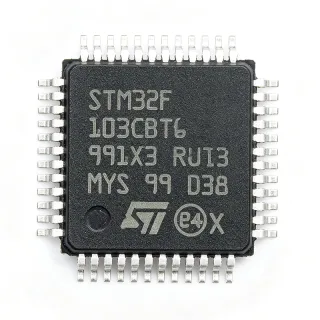
PIC16C56-RC/P - 8-Bit 4MHz OTP MCU 1.5KB | Microchip
MPN: PIC16C56-RC/P ✓ Active| Qty | Unit Price | Extended |
|---|---|---|
| 1 | $8.5725 | $8.57 |
| 10 | $7.2 | $72.00 |
| 100 | $5.85 | $585.00 |
| 500 | $5.1 | $2,550.00 |
| 1,000 | $4.65 | $4,650.00 |
PIC16C56-RC/P Overview
What is an 8-bit OTP microcontroller? An 8-bit microcontroller is a small computer-on-a-chip that processes data 8 bits at a time, typically used for embedded control tasks. OTP (One-Time Programmable) means the program memory can be written only once after manufacture, offering lower per-unit cost than flash-based MCUs while still providing permanent code storage. The PIC architecture falls within the broader hierarchy: microcontroller -> embedded processor -> semiconductor IC. The PIC16C5X family is positioned as Microchip's baseline 12-bit instruction, 8-bit data path RISC architecture.
Key differentiating features of the PIC16C56-RC/P include a 12-bit wide instruction set with 33 single-word/cycle instructions providing 2:1 code compression over comparable CISC 8-bit MCUs, a two-level deep hardware stack for subroutine nesting, and direct/indirect/relative addressing modes for both data and instructions. The integrated 8-bit Timer0 (TMR0) with a programmable prescaler provides event counting and timing functions, while a watchdog timer improves system reliability in unattended applications.
The PIC16C56 uses a Harvard architecture with separate program and data buses, which allows instruction fetch and data access to occur in the same instruction cycle. The RC oscillator variant ('RC' suffix code) accepts an external resistor/capacitor network at the OSC1 pin for low-cost clock generation, eliminating the need for a crystal or ceramic resonator. Power-down (Sleep) mode reduces current consumption to microamp levels for battery-powered applications.
Typical applications include low-cost consumer appliances, remote controls, sensor interface nodes, simple motor controllers, LED display drivers, and battery-powered devices such as toys and handheld instruments. The 12 I/O pins can directly drive LEDs or interface to analog circuitry through external components.
When designing with this device, engineers should note that OTP memory cannot be reprogrammed in-circuit, so development typically uses a windowed (JW) or flash-based sibling first. Ensure RC oscillator component values follow Microchip's recommended ranges for stable operation across the operating temperature range.
This page synthesizes distributor pricing, drop-in alternative MPNs from Microchip's PIC16C5X family, and practical design notes that are not consolidated in the manufacturer datasheet, enabling faster component selection.
Drop-in alternatives for PIC16C56-RC/P — same package, pin-to-pin compatible. Different-package parts requiring PCB rework are excluded.
Variants in this series
Same-series models that are drop-in compatible with PIC16C56-RC/P (same form factor and footprint) — differing in Package, Timers, Core Architecture, Program Memory Size, Program Memory Type.
Quick Comparison Tool — Select alternative parts for side-by-side comparison:
PIC16C56-LPI/P
✅ Drop-In✓ In Stock
$1.09 / Unit
View Datasheet →PIC16C56-LP/P
✅ Drop-In✓ In Stock
$3.39 / Unit
View Datasheet →PIC16C56-HSI/P
✅ Drop-In✓ In Stock
$1.62 / Unit
View Datasheet →PIC16C56-HS/P
✅ Drop-In📋 Reference alternative (not in catalog)
PIC16C56AT-04E/P
✅ Drop-In📋 Reference alternative (not in catalog)
PIC16C56A-04E/P
✅ Drop-In✓ In Stock
$1.21 / Unit
View Datasheet →PIC16C56-RC/P Maximum Ratings & Electrical Characteristics
| Core Architecture | PIC 8-bit RISC (Harvard) |
| Program Memory Type | OTP (One-Time Programmable) |
| Program Memory Size | 1.5 KB (1K x 12) |
| RAM Size | 25 bytes |
| Data EEPROM | None |
| Maximum CPU Frequency | 4 MHz |
| Supply Voltage Range | 2.5 V to 6.0 V |
| Oscillator Type | External RC network |
| Number of I/O Pins | 12 |
| Timers | 1 x 8-bit (TMR0 with prescaler) |
| Watchdog Timer | Yes |
| Hardware Stack Depth | 2 levels |
| Instruction Set Width | 12 bits |
| Number of Instructions | 33 |
| Interrupt Sources | External + peripheral |
| Package | 18-pin PDIP (0.300" / 7.62 mm) |
| Mounting Type | Through-Hole |
| Operating Temperature | 0C to +70C (commercial) |
| Lead-Free / RoHS | Compliant per Microchip product page |
PIC16C56-RC/P Pin Configuration
| Pin 1 | RA2 — Bidirectional I/O pin, Port A bit 2 |
| Pin 2 | RA3 — Bidirectional I/O pin, Port A bit 3 |
| Pin 3 | NC — Not connected (no internal connection per datasheet) |
| Pin 4 | MCLR — Master Clear reset input (active low) |
| Pin 5 | VSS — Ground reference |
| Pin 6 | RB0 — Bidirectional I/O pin, Port B bit 0 |
| Pin 7 | RB1 — Bidirectional I/O pin, Port B bit 1 |
| Pin 8 | RB2 — Bidirectional I/O pin, Port B bit 2 |
| Pin 9 | RB3 — Bidirectional I/O pin, Port B bit 3 |
| Pin 10 | RB4 — Bidirectional I/O pin, Port B bit 4 |
| Pin 11 | RB5 — Bidirectional I/O pin, Port B bit 5 |
| Pin 12 | RB6 — Bidirectional I/O pin, Port B bit 6 |
| Pin 13 | RB7 — Bidirectional I/O pin, Port B bit 7 |
| Pin 14 | VDD — Positive supply voltage (2.5V to 6.0V) |
| Pin 15 | OSC2/CLKOUT — Oscillator output / clock out (RC mode: 1/4 fosc) |
| Pin 16 | OSC1/CLKIN — Oscillator input / external clock in (RC mode: R-C network) |
| Pin 17 | RA0 — Bidirectional I/O pin, Port A bit 0 |
| Pin 18 | RA1 — Bidirectional I/O pin, Port A bit 1 |
Typical Applications
PIC16C56-RC/P is suitable for 7 applications: Low-Cost Consumer Appliance Controller, Remote Control Transmitter, Battery-Powered Sensor Interface Node, LED Display Driver Controller, Simple Motor Speed Controller, Automotive Accessory Timer, Educational Microcontroller Trainer.
Low-Cost Consumer Appliance Controller
The PIC16C56-RC/P is well suited for low-cost consumer appliance controllers such as toasters, coffee makers, and small kitchen devices. Its 1.5 KB OTP program memory stores fixed appliance control logic, 12 I/O pins drive relays, LEDs, and keypads, and the RC oscillator eliminates crystal cost. The 4 MHz clock is sufficient for sequencing heating elements, timing buzzer alerts, and reading switch inputs. Compared to flash MCUs, the OTP-only PIC16C56 cuts per-unit cost in high-volume production runs above 100k units.
Recommended
Remote Control Transmitter
The PIC16C56-RC/P fits IR/RF remote control transmitter designs where small code size and low cost dominate. Its 33-instruction RISC core executes button-debounce and encoding routines in under 1 KB, leaving room for multiple protocol tables. The 2.5V-6.0V VDD range accepts a single 3V coin cell, while the RC oscillator with internal MCLR enables sub-USD BOM. Sleep mode drops current below 1 uA, extending battery life to multi-year standby. The 12 I/O pins multiplex keypad scanning and LED indicators.
Recommended
Battery-Powered Sensor Interface Node
The PIC16C56-RC/P serves as the controller for simple sensor interface nodes in IoT edge devices, reading temperature, humidity, or contact sensors and transmitting via UART or GPIO bit-banging. Its 4 MHz RC clock supports UART at 9600 baud for low-rate telemetry, and the 25-byte RAM handles short packet buffering. The 2.5V minimum VDD enables direct operation from a single CR2032 coin cell. OTP memory locks the firmware to prevent field tampering. Sleep mode between sensor reads extends battery life to years.
Recommended
LED Display Driver Controller
The PIC16C56-RC/P drives 7-segment or matrix LED displays in scoreboards, vending machines, and signage. Its 12 I/O pins with 20 mA source/25 mA sink drive directly interface to common-cathode or common-anode LED arrays, eliminating external transistor drivers. The 4 MHz clock multiplexes 4-digit displays at 100+ Hz refresh rate with no perceptible flicker. The Harvard architecture ensures predictable timing for Charlieplexing or PWM dimming across multiple display banks.
Recommended
Simple Motor Speed Controller
The PIC16C56-RC/P implements basic DC motor or small stepper motor speed controllers using Timer0 PWM and 12 I/O pins for H-bridge gate drive. The 8-bit TMR0 with prescaler generates PWM frequencies from 1 kHz to 40 kHz suitable for brushed DC motors. Software-controlled acceleration profiles and current limiting fit within 1.5 KB OTP. The 4 MHz instruction rate executes PID control loops at 10 kHz update rate. Hardware stack depth of 2 limits nested interrupts but suffices for single-loop motor control.
Recommended
Automotive Accessory Timer
The PIC16C56-RC/P (industrial temp grade variant -I/P) controls automotive accessories such as interior light delay-off, headlight reminders, and accessory power timeout circuits. Its 12 I/O pins interface to switches, relays, and indicator LEDs, while TMR0 delivers accurate timing from 100 ms to hours. The wide 2.5V-6.0V supply tolerates 12V automotive bus via external regulator. OTP memory locks the timing algorithm to prevent warranty-voiding firmware tampering by end users.
Recommended
Educational Microcontroller Trainer
The PIC16C56-RC/P serves as the target processor for low-cost educational microcontroller trainers and university embedded systems labs. Its simple 33-instruction RISC architecture is pedagogically approachable, the 1.5 KB OTP fits classic textbook examples (LED blink, keypad scanner, UART echo), and the through-hole PDIP package survives repeated insertion into trainer sockets. The 4 MHz RC oscillator requires no crystal selection, letting students focus on firmware rather than hardware bring-up.
Recommended
Recommended Products Summary
Engineering reference data for PIC16C56-RC/P — comparison, design guidance, and compliance information.
Selection Guide
Comparison with Alternatives
| Parameter | This Product | PIC16C56-LPI/P | PIC16C56-LP/P | PIC16C56-HSI/P | PIC16C56AT-04E/P |
|---|---|---|---|---|---|
| Brand | Microchip Technology | Microchip Technology | Microchip Technology | Microchip Technology | Microchip Technology |
| Package | 18-pin PDIP | 18-pin PDIP - same | 18-pin PDIP - same | 18-pin PDIP - same | 18-pin PDIP - same |
| Program Memory | 1.5 KB OTP (1K x 12) | 1.5 KB OTP (1K x 12) | 1.5 KB OTP (1K x 12) | 1.5 KB OTP (1K x 12) | 1.5 KB OTP (1K x 12) |
| Maximum Clock Frequency | 4 MHz (RC oscillator) | 4 MHz (RC oscillator) | 4 MHz (LP oscillator) | 20 MHz (HS crystal) | 4 MHz (extended temp) |
| Supply Voltage Range | 2.5 V to 6.0 V | 2.5 V to 6.0 V | 2.0 V to 6.0 V | 2.5 V to 6.0 V | 2.5 V to 6.0 V |
| I/O Pins | 12 | 12 | 12 | 12 | 12 |
| Operating Temperature | 0C to +70C | -40C to +85C (industrial) | 0C to +70C (commercial) | -40C to +85C (industrial) | -40C to +125C (extended) |
| Pin-to-Pin Compatible | Reference | Yes - drop-in | Yes - drop-in | Yes - drop-in (clock circuit differs) | Yes - drop-in |
Key Differentiators
- Lowest-cost OTP MCU in 18-pin PDIP footprint (vs PIC16F54-I/P (flash variant))
- RC oscillator eliminates crystal cost (vs PIC16C56-HSI/P (crystal variant))
- Extended temperature variants in same footprint (vs PIC16C56AT-04E/P (extended temp))
Design Notes
Do not exceed the maximum supply voltage of 6.0V on VDD - even brief transients above 7V can damage the OTP memory cells. Add a 0.1 uF ceramic decoupling capacitor as close to VDD (pin 14) as possible, plus a 10 uF bulk capacitor if the supply traces are longer than 50 mm. For battery-powered designs, place a 100 kohm pull-up on MCLR (pin 4) to ensure clean reset behavior at power-up; floating MCLR causes undefined startup states.
For the RC oscillator variant, place the external resistor and capacitor within 5 mm of the OSC1/CLKIN pin (pin 16) to minimize parasitic capacitance that affects the oscillator frequency. Per Microchip's PIC16C5X datasheet, the RC oscillator frequency tolerance is typically +/- 20% across temperature and supply voltage - use the 'HS' crystal variant if UART or timing-critical applications require better than +/- 5% clock accuracy.
Estimated: at 5 V VDD and 4 MHz clock, active current is approximately 2 mA, while Sleep mode drops current to under 1 uA. For ultra-low-power designs, switch to the PIC16C56-LP/P or PIC16C56-LPI/P variants which draw approximately 0.5 mA active current at the same frequency. Add a software Sleep-mode entry every 10 ms when the MCU is idle to extend coin-cell battery life from months to years.
The 18-pin PDIP through-hole package accepts standard 0.300 inch row spacing and 0.1 inch pin pitch, enabling direct insertion into breadboards and IC sockets for prototyping. For production PCBs, route RA0-RA3 and RB0-RB7 signals with 50 ohm controlled impedance if any pin drives signals faster than 1 MHz, and add ground vias adjacent to VSS (pin 5) to minimize ground bounce during high-current LED switching loads of 20 mA per pin.
Compliance Information
RoHS and REACH compliance per Microchip product page. The standard PIC16C56-RC/P is commercial temperature grade (0C to +70C); choose PIC16C56AT-04E/P for AEC-Q100-like automotive environments with -40C to +125C support.