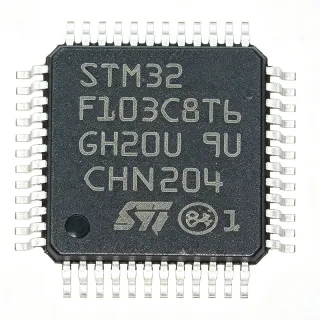
PIC16C57-10E/SS - 8-bit OTP MCU 2Kx12 10MHz SSOP-28 | Microchip
MPN: PIC16C57-10E/SS ✓ Active| Qty | Unit Price | Extended |
|---|---|---|
| 1 | $5.92 | $5.92 |
| 10 | $5.32 | $53.20 |
| 100 | $4.74 | $474.00 |
| 500 | $4.26 | $2,130.00 |
| 1,000 | $3.78 | $3,780.00 |
PIC16C57-10E/SS Overview
An 8-bit microcontroller (MCU) is a single-chip computer that integrates a CPU, memory, and I/O peripherals. The PIC16C5x family uses a RISC architecture with only 33 single-word/12-bit instructions, achieving 2:1 code compression over other 8-bit microcontrollers in its class. PIC microcontrollers belong to the broader category of microcontrollers -> embedded processors -> semiconductors, and have been a dominant architecture for low-power and deterministic control since the 1990s.
Key features of the PIC16C57-10E/SS include a 10 MHz maximum clock frequency, 20 I/O pins, two 8-bit timers/counters, a watchdog timer, and a power-on reset circuit. The 'E' suffix denotes the extended industrial temperature range (-40C to +125C), and the 'SS' suffix designates the 28-lead SSOP package. The device operates from a single 2.5V to 5.5V supply, drawing low quiescent current suitable for battery-powered and energy-conscious designs.
The PIC16C57-10E/SS uses a Harvard architecture with separate program and data buses, enabling simultaneous instruction fetch and data access. Its OTP EPROM program memory allows prototype and small-volume production programming using devices such as the MPLAB PM3. The architecture delivers deterministic interrupt response and predictable instruction timing, which is critical for real-time control loops.
Typical applications include consumer appliance control, automotive body electronics, industrial sensor interfaces, security and alarm systems, and low-cost remote-control transmitters. The wide operating voltage range and small SSOP footprint also suit handheld instrumentation and IoT edge nodes where board space is at a premium.
When designing with this device, note that OTP memory cannot be electrically erased - firmware must be fully validated before programming. For engineering development, a windowed ceramic package variant (PIC16C57-10E/JW) or a Flash-based PIC16F57 should be used to allow iterative code changes.
This page synthesizes distributor inventory, parametric comparisons, and design considerations for engineers evaluating the PIC16C57-10E/SS as a drop-in 8-bit MCU solution.
Drop-in alternatives for PIC16C57-10E/SS — same package, pin-to-pin compatible. Different-package parts requiring PCB rework are excluded.
Variants in this series
Same-series models that are drop-in compatible with PIC16C57-10E/SS (same form factor and footprint) — differing in Program Memory Size, Program Memory Type, Watchdog Timer, Operating Temperature Range, Supply Voltage Range.
Quick Comparison Tool — Select alternative parts for side-by-side comparison:
PIC16C57-10E/SP
✅ Drop-In📋 Reference alternative (not in catalog)
PIC16F57-I/SS
✅ Drop-In📋 Reference alternative (not in catalog)
PIC16C56-10E/SS
✅ Drop-In📋 Reference alternative (not in catalog)
PIC16C55-10E/SS
✅ Drop-In✓ In Stock
$4.85 / Unit
View Datasheet →PIC16C57C-10E/SS
✅ Drop-In📋 Reference alternative (not in catalog)
PIC16C57-10E/SS Maximum Ratings & Electrical Characteristics
| Core Architecture | 8-bit PIC RISC |
| Instruction Set | 33 instructions, 12-bit wide |
| Program Memory Type | OTP EPROM |
| Program Memory Size | 2K x 12 words (3 KB) |
| Data RAM | 72 bytes |
| Data EEPROM | Not present |
| Maximum Clock Frequency | 10 MHz |
| Supply Voltage Range | 2.5 V to 5.5 V (5 V nominal) |
| I/O Pins | 20 |
| Timers/Counters | 1 x 8-bit RTCC + WDT |
| Watchdog Timer | Yes (on-chip, dedicated RC oscillator) |
| Interrupts | Yes (external + timer) |
| Operating Temperature Range | -40 C to +125 C (extended industrial, 'E') |
| Package Type | 28-pin SSOP (5.30 mm body width) |
| Mounting Type | Surface Mount |
| MSL Level | 1 (unlimited floor life at <30 C / 85% RH) |
| RoHS Status | Compliant (lead-free SSOP) |
| Programming Method | ICSP via MPLAB PM3 or compatible programmer |
PIC16C57-10E/SS Pin Configuration
| Pin 1 | RA3 — Bidirectional I/O port A bit 3 / T0CKI (timer 0 clock input) |
| Pin 2 | RA2 — Bidirectional I/O port A bit 2 |
| Pin 3 | RA1 — Bidirectional I/O port A bit 1 |
| Pin 4 | RA0 — Bidirectional I/O port A bit 0 |
| Pin 5 | OSC1/CLKIN — Oscillator crystal input / external clock input |
| Pin 6 | OSC2/CLKOUT — Oscillator crystal output / clock output (Fosc/4) |
| Pin 7 | VSS — Ground reference |
| Pin 8 | RC0 — Bidirectional I/O port C bit 0 |
| Pin 9 | RC1 — Bidirectional I/O port C bit 1 |
| Pin 10 | RC2 — Bidirectional I/O port C bit 2 |
| Pin 11 | RC3 — Bidirectional I/O port C bit 3 |
| Pin 12 | RC4 — Bidirectional I/O port C bit 4 |
| Pin 13 | RC5 — Bidirectional I/O port C bit 5 |
| Pin 14 | RC6 — Bidirectional I/O port C bit 6 |
| Pin 15 | RC7 — Bidirectional I/O port C bit 7 |
| Pin 16 | VSS — Ground reference |
| Pin 17 | VSS — Ground reference |
| Pin 18 | RB7 — Bidirectional I/O port B bit 7 / RB0 interrupt-on-change |
| Pin 19 | RB6 — Bidirectional I/O port B bit 6 |
| Pin 20 | RB5 — Bidirectional I/O port B bit 5 |
| Pin 21 | RB4 — Bidirectional I/O port B bit 4 |
| Pin 22 | RB3 — Bidirectional I/O port B bit 3 |
| Pin 23 | RB2 — Bidirectional I/O port B bit 2 |
| Pin 24 | RB1 — Bidirectional I/O port B bit 1 |
| Pin 25 | RB0 — Bidirectional I/O port B bit 0 / INT external interrupt |
| Pin 26 | VDD — Positive supply voltage |
| Pin 27 | VDD — Positive supply voltage |
| Pin 28 | MCLR/VPP — Master clear reset input (active low) / programming voltage input |
Typical Applications
PIC16C57-10E/SS is suitable for 6 applications: Consumer Appliance Control, Automotive Body Electronics, Industrial Sensor Interfaces, Security and Alarm Systems, Remote Control Transmitters, IoT Edge Sensor Nodes.
Consumer Appliance Control
The PIC16C57-10E/SS fits low-to-mid complexity consumer appliance controllers such as washing machine timers, microwave oven keypads, and rice cooker thermal controllers. Its 2K x 12 OTP program memory holds typical appliance state machines with 10-20 I/O control points (relays, triacs, LEDs, keypads) while the 10 MHz instruction rate is more than adequate for slow electromechanical loops. The extended -40C to +125C temperature range handles under-cabinet and motor-adjacent thermal environments, and the SSOP-28 footprint enables slim PCB layouts behind front-panel displays. Power consumption is low enough that the MCU can run continuously from a small linear regulator on the appliance mains. For higher-volume designs the PIC16F57-I/SS Flash variant may be preferred for last-minute firmware tweaks during product launch.
Recommended
Automotive Body Electronics
In automotive body modules (mirror controllers, seat position memories, simple lighting drivers) the PIC16C57-10E/SS provides 20 I/O lines that comfortably drive relays, H-bridges, and LED arrays. Its 10 MHz execution supports 10 kHz-class PWM for soft-start bulb dimming and motor ramp profiles without DSP hardware. The 'E' extended industrial temperature rating covers under-dash and door-module thermal exposure, and the 28-SSOP SMD package survives engine-bay vibration when the PCB is properly strain-relieved. Watchdog timer and brown-out detection improve field reliability. For new designs requiring CAN/LIN, migrate to PIC16F1829 or dsPIC33; the PIC16C57-10E/SS is best suited to legacy body modules and aftermarket retrofits where code compatibility and BOM stability matter more than connectivity.
Recommended
Industrial Sensor Interfaces
The PIC16C57-10E/SS suits industrial sensor-conditioning front-ends for thermocouple, RTD, and 4-20 mA loop transmitters where deterministic timing and low cost outweigh connectivity. Its 10 MHz clock supports 100 kHz PWM outputs for analog signal conditioning and software-driven sigma-delta conversion at kHz sample rates. The 72-byte RAM handles local calibration tables and linearization coefficients for temperature-pressure lookups. With a 2.5-5.5 V supply it accepts power directly from 24V industrial bus through a small LDO. The extended temperature range tolerates factory-floor heat, and the SSOP package suits sealed sensor housings. Where IEC 61508 SIL compliance is required, migrate to a certified 16-bit MCU; the PIC16C57-10E/SS remains a strong fit for non-safety sensor nodes.
Recommended
Security and Alarm Systems
For PIR motion detectors, door/window contact panels, and basic alarm keypads, the PIC16C57-10E/SS delivers the right balance of I/O count, code space, and cost. Its 20 I/O pins connect directly to multiple reed switches, PIR outputs, piezo buzzers, status LEDs, and a 4x4 matrix keypad without external muxes. The 2K x 12 OTP memory holds event-logging state machines and simple encryption for wireless retransmission. The on-chip watchdog timer catches firmware lockups caused by EMI transients on long sensor wiring - critical in security applications where a hang means a missed alarm event. The wide 2.5-5.5 V supply supports battery-backed operation with a CR2032 or 9V backup. Low quiescent current extends standby time to multi-year levels in battery-only sensors.
Recommended
Remote Control Transmitters
The PIC16C57-10E/SS is a classic fit for IR/RF remote control transmitters (TV, STB, garage-door openers) where its 2K x 12 OTP holds protocol stacks like RC-5, NEC, or proprietary Manchester-encoded commands with overhead. Its 10 MHz instruction rate generates accurate 38 kHz / 40 kHz carrier frequencies in software using timer interrupts, eliminating the need for an external PWM modulator IC. The 20 I/O pins accommodate 8x8 key matrices plus status LEDs, IR LED driver, and a learning-mode UART. The extended temperature range handles in-car and outdoor garage environments. OTP memory prevents casual firmware cloning by aftermarket clone makers. For voice or Bluetooth remotes migrate to PIC16F18446 or PIC32MM; the PIC16C57-10E/SS remains the lowest-cost 28-SSOP solution for matrix-key transmitters.
Recommended
IoT Edge Sensor Nodes
For low-bandwidth IoT edge nodes that wake periodically to read a sensor and transmit via LoRa, sub-GHz, or NB-IoT modem, the PIC16C57-10E/SS acts as an ultra-low-cost application controller. Its 10 MHz execution handles sensor I2C/SPI transactions and modest protocol framing between deep-sleep intervals. The 2.5-5.5 V range accepts power directly from a 3.6 V lithium thionyl chloride battery, and the low quiescent current extends multi-year battery life. The on-chip watchdog and brown-out reset protect against modem-induced supply dips during transmit bursts. The 28-SSOP footprint fits 25 mm coin-cell sensor PCBs. For higher-throughput edge AI workloads, migrate to PIC32MX or SAMD21; the PIC16C57-10E/SS is the budget choice for simple threshold-reporting nodes.
Recommended
Recommended Products Summary
Engineering reference data for PIC16C57-10E/SS — comparison, design guidance, and compliance information.
Selection Guide
Comparison with Alternatives
| Parameter | This Product | PIC16C57-10E/SP | PIC16F57-I/SS | PIC16C56-10E/SS | PIC16C55-10E/SS | PIC16C57C-10E/SS |
|---|---|---|---|---|---|---|
| Brand | Microchip Technology | Microchip Technology | Microchip Technology | Microchip Technology | Microchip Technology | Microchip Technology |
| Package | 28-pin SSOP | 28-pin SPDIP - NOT same footprint | 28-pin SSOP - same | 28-pin SSOP - same | 28-pin SSOP - same | 28-pin SSOP - same |
| Program Memory Type | OTP EPROM (2K x 12) | OTP EPROM (2K x 12) | Flash (2K x 14 words) | OTP EPROM (1K x 12) | OTP EPROM (512 x 12) | OTP EPROM CMOS (2K x 12) |
| Maximum Clock Frequency | 10 MHz | 10 MHz | 20 MHz | 10 MHz | 10 MHz | 10 MHz |
| Data RAM | 72 bytes | 72 bytes | 72 bytes | 72 bytes | 72 bytes | 72 bytes |
| Operating Voltage Range | 2.5 V to 5.5 V | 2.5 V to 5.5 V | 2.0 V to 5.5 V | 2.5 V to 5.5 V | 2.5 V to 5.5 V | 2.5 V to 5.5 V |
| Operating Temperature | -40 C to +125 C | -40 C to +125 C | -40 C to +85 C | -40 C to +125 C | -40 C to +125 C | -40 C to +125 C |
| I/O Pins | 20 | 20 | 20 | 20 | 20 | 20 |
Key Differentiators
- Industry-standard 28-SSOP PIC16C5X platform with broad toolchain support (vs PIC16F57-I/SS)
- Larger program memory than smaller PIC16C5X family members (vs PIC16C56-10E/SS)
- Extended industrial -40 C to +125 C temperature range (vs PIC16F57-I/SS)
Design Notes
The PIC16C57-10E/SS uses one-time-programmable (OTP) EPROM and cannot be electrically erased. Validate firmware on a windowed ceramic JW-package sample (PIC16C57-10E/JW) or on the Flash-equivalent PIC16F57-I/SS during development. Programming on production units is permanent - any firmware bug discovered after programming requires scrapping the device. Use the MPLAB PM3 or a compatible programmer (e.g., PICkit 3 with adapter) for production programming. The device is fully static, so the oscillator can be stopped to save power without losing internal register state.
Decouple VDD with a 0.1 uF ceramic capacitor placed within 5 mm of pins 26-27, plus a bulk 10 uF tantalum or aluminum capacitor on the same rail. According to Microchip's PIC16C5X datasheet, VDD rise time during power-on reset must be monotonic and fast enough to ensure a clean POR; if the supply ramps slowly, add an external RC on MCLR to extend the reset pulse. Two VDD pins (26, 27) and two VSS pins (16, 17) are present - both must be connected for proper operation. For battery-powered designs, the on-chip watchdog timer draws 7-15 uA and should be disabled if standby current is critical.
Route the oscillator traces (OSC1/OSC2 on pins 5-6) as short as possible and surround them with a ground guard ring to minimize radiated EMI. Place the 0.1 uF decoupling capacitor directly at the VDD/VSS pin pairs. For SSOP-28 hand-soldering or rework, use a hot-air station with a 28-SSOP nozzle; the 0.65 mm pin pitch is finer than DIP and easy to bridge. Leave a continuous ground plane on the bottom layer and stitch vias around the SSOP perimeter to reduce EMI susceptibility. The MCLR pin (28) requires a 10 kohm pull-up to VDD and a 0.1 uF capacitor to VSS for proper reset behavior.
Compliance Information
RoHS-compliant lead-free SSOP-28 package per Microchip product page. AEC-Q100 not qualified - this is a general-purpose industrial MCU, not an automotive-qualified part. Halogen-free status not stated in verified web data - set to unknown.