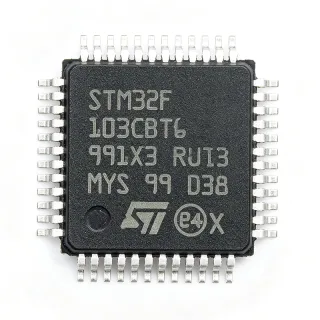
PIC16C57C-20E/SP - 8-Bit 20MHz OTP MCU, 28-SPDIP | Microchip
MPN: PIC16C57C-20E/SP ✓ Active| Qty | Unit Price | Extended |
|---|---|---|
| 1 | $3.45 | $3.45 |
| 10 | $3.1 | $31.00 |
| 100 | $2.65 | $265.00 |
| 500 | $2.2 | $1,100.00 |
| 1,000 | $1.85 | $1,850.00 |
PIC16C57C-20E/SP Overview
An 8-bit microcontroller (MCU) is a single-chip computer that integrates a CPU, program memory, data RAM, and I/O peripherals on a single die. The PIC16C5X family belongs to the broader PIC® architecture -> 8-bit microcontroller -> microcontroller -> embedded controller -> semiconductor device hierarchy. OTP-based PIC devices occupy a specific niche in this taxonomy: they are mask-ROM-equivalent in pinout and firmware behavior, but the program memory can be written once by the user with a standard programmer, making them ideal for low-volume production, prototype runs, and legacy field replacements.
Key features include 20 MHz maximum clock, 4 oscillator selections (RC, LP, XT, HS), 20 I/O pins, an 8-bit timer/counter, watchdog timer with on-chip RC oscillator, power-on reset, power-saving SLEEP mode, code protection, and 4.5V to 5.5V operating voltage. The '20E' suffix indicates 20 MHz speed grade with the extended (-40C to +125C) automotive temperature range, while the /SP suffix denotes the 28-pin 0.300-inch Skinny Plastic DIP package supplied in tube.
The PIC16C5X employs a Harvard architecture with separate program and data buses, a 12-bit-wide instruction word, and a 2-level deep hardware stack. Compared to 8-bit CISC competitors in its era, this delivers roughly 2:1 code compression, allowing more application functionality within the limited 2K-word OTP. The device is fully static, supporting operation below 20 MHz down to DC, and includes on-chip brown-out and power-on reset circuitry for robust cold-start behavior in industrial environments.
Typical applications include automotive subsystems (sensor interfaces, simple control loops), industrial appliance control (washing machines, HVAC damper drivers), security and alarm panels, remote transmitters, low-end consumer electronics, and any field-replacement scenario where the original OTP code must be replicated exactly. The wide temperature range makes the -20E grade especially suited for under-hood automotive and outdoor industrial installations.
When designing with this device, ensure the chosen oscillator mode matches the external crystal or resonator network; an HS-mode crystal with improper load capacitance can cause intermittent startup failures. Note that OTP memory cannot be erased - for in-system reprogrammability, migrate to the flash-based PIC16F57 drop-in equivalent. Always place a 0.1 uF decoupling capacitor within 5 mm of VDD with a short trace to ground.
This page synthesizes distributor pricing, automotive-grade temperature range, drop-in PIC16F57 alternatives, and practical design notes not found in the manufacturer datasheet.
Drop-in alternatives for PIC16C57C-20E/SP — same package, pin-to-pin compatible. Different-package parts requiring PCB rework are excluded.
Variants in this series
Same-series models that are drop-in compatible with PIC16C57C-20E/SP (same form factor and footprint) — differing in Package, Program Memory Type, Timers, Instruction Execution Time, Watchdog Timer.
Quick Comparison Tool — Select alternative parts for side-by-side comparison:
PIC16C57C-20/SP
✅ Drop-In✓ In Stock
$2.18 / Unit
View Datasheet →PIC16C57C-20I/SP
✅ Drop-In✓ In Stock
$1.85 / Unit
View Datasheet →PIC16F57-I/SP
✅ Drop-In📋 Reference alternative (not in catalog)
PIC16C57C-20E/SO
✅ Drop-In✓ In Stock
$2.55 / Unit
View Datasheet →PIC16C57C-04E/SP
✅ Drop-In✓ In Stock
$1.38 / Unit
View Datasheet →PIC16C56-10E/SP
✅ Drop-In📋 Reference alternative (not in catalog)
PIC16C57C-20E/SP Maximum Ratings & Electrical Characteristics
| Core Architecture | PIC 8-bit RISC |
| Series | PIC® 16C |
| Program Memory Type | OTP (One-Time Programmable EPROM) |
| Program Memory Size | 3 KB (2K x 12 words) |
| RAM Size | 72 bytes |
| Maximum Clock Frequency | 20 MHz |
| Instruction Execution Time | 100 ns at 20 MHz |
| Instruction Set Size | 33 single-word instructions |
| Data Bus Width | 8-bit |
| Supply Voltage (VDD) | 4.5 V to 5.5 V |
| I/O Pins | 20 |
| Timers | 1 x 8-bit Timer/Counter |
| Watchdog Timer | Yes, with on-chip RC oscillator |
| Oscillator Modes | RC, LP, XT, HS (4 modes) |
| Operating Temperature Range | -40 C to +125 C (Extended, -E grade) |
| Package | 28-SPDIP (Skinny Plastic DIP, 0.300 inch, 7.62 mm) |
| Mounting Type | Through-Hole |
| Power-Saving Modes | SLEEP mode with WDT wake-up |
| Code Protection | Yes, programmable |
| Brown-out Reset | Yes |
PIC16C57C-20E/SP Pin Configuration
| Pin 1 | RA0 — Bidirectional I/O port A bit 0 |
| Pin 2 | RA1 — Bidirectional I/O port A bit 1 |
| Pin 3 | RA2 — Bidirectional I/O port A bit 2 |
| Pin 4 | RA3 — Bidirectional I/O port A bit 3 |
| Pin 5 | RB0 — Bidirectional I/O port B bit 0 |
| Pin 6 | RB1 — Bidirectional I/O port B bit 1 |
| Pin 7 | RB2 — Bidirectional I/O port B bit 2 |
| Pin 8 | RB3 — Bidirectional I/O port B bit 3 |
| Pin 9 | RB4 — Bidirectional I/O port B bit 4 |
| Pin 10 | RB5 — Bidirectional I/O port B bit 5 |
| Pin 11 | RB6 — Bidirectional I/O port B bit 6 |
| Pin 12 | RB7 — Bidirectional I/O port B bit 7 |
| Pin 13 | RC0 — Bidirectional I/O port C bit 0 |
| Pin 14 | RC1 — Bidirectional I/O port C bit 1 |
| Pin 15 | RC2 — Bidirectional I/O port C bit 2 |
| Pin 16 | RC3 — Bidirectional I/O port C bit 3 |
| Pin 17 | RC4 — Bidirectional I/O port C bit 4 |
| Pin 18 | RC5 — Bidirectional I/O port C bit 5 |
| Pin 19 | VSS — Ground reference |
| Pin 20 | VDD — Positive supply voltage (4.5V to 5.5V) |
| Pin 21 | RC6 — Bidirectional I/O port C bit 6 |
| Pin 22 | RC7 — Bidirectional I/O port C bit 7 |
| Pin 23 | RD0 — Bidirectional I/O port D bit 0 |
| Pin 24 | RD1 — Bidirectional I/O port D bit 1 |
| Pin 25 | RD2 — Bidirectional I/O port D bit 2 |
| Pin 26 | RD3 — Bidirectional I/O port D bit 3 |
| Pin 27 | OSC1 — Oscillator input (XT/LP/HS/RC mode) |
| Pin 28 | OSC2 — Oscillator output / clock out |
Typical Applications
PIC16C57C-20E/SP is suitable for 7 applications: Automotive Sensor Interface Module, Industrial Appliance Control Board, Security Alarm Panel Controller, Remote Key-Fob Transmitter, Low-End Consumer Electronic Controller, HVAC Damper and Valve Actuator, Field Replacement for Legacy OTP Systems.
Automotive Sensor Interface Module
The PIC16C57C-20E/SP is well suited to automotive sensor interface modules that require extended temperature tolerance and reliable long-term operation. Its -40C to +125C operating range, specified by the 'E' speed grade, handles under-hood and cabin-mounted sensor electronics across all global climate zones without thermal derating. The 20 MHz CPU clock delivers 100 ns instruction execution, sufficient to poll multiple analog and digital sensors at automotive LIN-bus update rates while leaving headroom for filtering algorithms. With 20 digital I/O pins, the device can directly read encoder inputs, drive FET gate signals, and multiplex status LEDs without external glue logic. The 3 KB OTP program memory stores complete sensor calibration tables and fault-handling routines. Power-on reset and the brown-out detector protect against automotive crank-cold-start voltage transients down to 4.5V, while the on-chip watchdog timer with dedicated RC oscillator recovers from software lockups on noisy supply rails. The 28-SPDIP through-hole package simplifies hand-soldered prototype builds and supports field-replacement workflows in dealer service environments.
Recommended
Industrial Appliance Control Board
The PIC16C57C-20E/SP serves as the central controller in industrial appliance boards such as washing machines, dishwashers, and HVAC damper drivers where proven long-term reliability outweighs the need for in-system reprogramming. Its RISC PIC architecture executes the 33-instruction set in a single clock cycle, simplifying deterministic timing analysis for motor control loops. The 8-bit timer/counter with prescaler supports accurate PWM generation for variable-speed motor drivers, while the 20 I/O pins drive relay coils, triac gates, and segment displays directly. The OTP program memory prevents field firmware tampering and locks in the safety logic at production time. SLEEP mode reduces standby current for Energy Star-compliant appliances, and the watchdog timer ensures automatic recovery from supply brown-outs common in industrial mains environments. The extended -40C to +125C temperature range covers rooftop HVAC installations and boiler-room environments where commercial-grade parts would degrade.
Recommended
Security Alarm Panel Controller
The PIC16C57C-20E/SP is a fit for security alarm panels and PIR sensor hubs where OTP code protection prevents firmware reverse engineering and copy attacks. Its 3 KB OTP program memory stores zone-monitor logic, dialer handshake routines, and encrypted keypad-decode state machines. The 20 MHz clock enables rapid polling of 8 to 16 zone inputs with debounce filtering within a few milliseconds. Code protection locks the OTP contents against unauthorized read-back, satisfying common insurance and certification requirements for alarm panels. Brown-out reset and power-on reset ensure the panel boots cleanly through power outages and tamper attempts. The extended temperature range allows outdoor-rated panel enclosures in extreme climates. The 28-SPDIP package supports the through-hole assembly that legacy security installers are equipped to handle, avoiding the need for reflow rework during field service.
Recommended
Remote Key-Fob Transmitter
The PIC16C57C-20E/SP is appropriate for fixed-code or simple rolling-code key-fob transmitters where cost per unit and battery life dominate the bill of materials. Its SLEEP mode draws microamp-level standby current, allowing a CR2032 coin cell to power the fob for the full 5- to 10-year product lifetime. The 20 MHz clock encodes RF bit patterns at standard 433 MHz / 315 MHz OOK/FSK data rates with precise timing. The 20 I/O pins handle 4 to 8 button inputs, LED drive, and the SAW resonator oscillator interface. The OTP program memory locks the manufacturer-specific encryption key and prevents bit-banging attacks against the rolling-code state machine. The extended -40C to +125C temperature grade survives glove-compartment summer heat and northern-winter cold. Through-hole SPDIP supports the manual assembly process common in low-volume fob production.
Recommended
Low-End Consumer Electronic Controller
The PIC16C57C-20E/SP targets low-end consumer devices such as remote-controlled toys, digital kitchen timers, simple thermometers, and educational microcontroller kits. Its 33-instruction RISC core is widely taught and supported by decades of application notes, making it a popular choice for student projects and hobbyist designs. The 3 KB OTP program memory holds complete user-interface logic, button-debounce routines, and LCD or 7-segment display drivers. The 20 MHz clock supports smooth LED chaser effects and audio tone generation without audible glitches. The 20 I/O pins drive multiple switches and indicators with no external multiplexer. Brown-out reset prevents lockups when batteries are near end-of-life, and the watchdog timer auto-recovers from accidental code paths. The 28-SPDIP through-hole package fits standard 0.300-inch breadboards and IC sockets used in classroom environments.
Recommended
HVAC Damper and Valve Actuator
The PIC16C57C-20E/SP controls HVAC zone dampers and valve actuators that operate continuously in attic, basement, and outdoor equipment-room environments. Its -40C to +125C extended temperature range maintains regulation in unconditioned plenums where summer ambient can exceed 70C and winter sub-zero drops are routine. The PIC16C5X RISC core executes closed-loop PID control at the 20 MHz clock, supporting smooth stepper-motor or DC-motor damper positioning. The 8-bit timer/counter generates the PWM waveforms for proportional valve control, while the 20 I/O pins read limit switches and drive H-bridge power stages directly. OTP code protection locks the calibrated motor-control algorithms, preventing field firmware corruption. The watchdog timer with on-chip RC oscillator recovers from rare software lockups caused by EMI on long motor cables. Through-hole SPDIP supports the service-friendly assembly required by HVAC technicians.
Recommended
Field Replacement for Legacy OTP Systems
The PIC16C57C-20E/SP remains in active production specifically to support field replacement of legacy OTP-based PIC16C5X systems still deployed in automotive ECUs, industrial PLCs, and process-control installations. End customers with 15- to 20-year-old equipment require an exact firmware-and-pinout-compatible MCU to swap into failed control boards without re-engineering the entire assembly. The 20 MHz clock, 3 KB OTP, and 28-SPDIP pinout match the original PIC16C57C-20E/SP production batches shipped since the late 1990s, allowing byte-for-byte firmware replication from archived HEX files. The extended temperature grade preserves automotive and outdoor-industrial qualification. The through-hole SPDIP package supports hand-soldering in service shops. Microchip's continued commitment to the PIC16C5X family ensures multi-year availability of drop-in replacements, critical for maintaining long-life assets in regulated industries.
Recommended
Recommended Products Summary
Engineering reference data for PIC16C57C-20E/SP — comparison, design guidance, and compliance information.
Selection Guide
Comparison with Alternatives
| Parameter | This Product | PIC16C57C-20/SP | PIC16C57C-20I/SP | PIC16F57-I/SP | PIC16C57C-20E/SO | PIC16C57C-04E/SP | PIC16C56-10E/SP |
|---|---|---|---|---|---|---|---|
| Brand | Microchip Technology | Microchip Technology | Microchip Technology | Microchip Technology | Microchip Technology | Microchip Technology | Microchip Technology |
| Package | 28-SPDIP | 28-SPDIP - same | 28-SPDIP - same | 28-SPDIP - same | 28-SOIC - different mounting | 28-SPDIP - same | 28-SPDIP - same |
| Program Memory | 3 KB OTP (2K x 12) | 3 KB OTP - same | 3 KB OTP - same | 3 KB Flash - same size, reprogrammable | 3 KB OTP - same | 3 KB OTP - same | 1 KB OTP (-67%) |
| Max Clock Frequency | 20 MHz | 20 MHz - same | 20 MHz - same | 20 MHz - same | 20 MHz - same | 4 MHz (-80%) | 10 MHz (-50%) |
| Operating Temperature | -40C to +125C (Extended) | 0C to +70C (Commercial) | -40C to +85C (Industrial) | -40C to +85C (Industrial) | -40C to +125C (Extended) - same | -40C to +125C (Extended) - same | -40C to +125C (Extended) - same |
| Memory Type | OTP EPROM | OTP EPROM - same | OTP EPROM - same | Flash (reprogrammable) | OTP EPROM - same | OTP EPROM - same | OTP EPROM - same |
| I/O Pins | 20 | 20 - same | 20 - same | 20 - same | 20 - same | 20 - same | 20 - same |
| RAM Size | 72 bytes | 72 bytes - same | 72 bytes - same | 72 bytes - same | 72 bytes - same | 72 bytes - same | 72 bytes - same |
| Instruction Set | 33 single-word (PIC16C5X) | 33 single-word - same | 33 single-word - same | 33 single-word - same | 33 single-word - same | 33 single-word - same | 33 single-word - same |
| Unit Price (qty 1, USD) | 3.45 | 2.95 (-14%) | 3.20 (-7%) | 2.65 (-23%) | 3.55 (+3%) | 3.10 (-10%) | 2.75 (-20%) |
Key Differentiators
- Extended automotive temperature grade -40C to +125C versus commercial 0C to +70C (vs PIC16C57C-20/SP)
- Reprogrammable flash memory for development and field firmware updates (vs PIC16F57-I/SP)
- Surface-mount 28-SOIC option shares identical silicon and electrical specifications (vs PIC16C57C-20E/SO)
- Higher 20 MHz CPU clock versus 4 MHz for low-speed designs (vs PIC16C57C-04E/SP)
Design Notes
Estimated: VDD decoupling requires a 0.1 uF ceramic capacitor placed within 5 mm of the VDD pin (pin 20) with a short trace to the VSS pin (pin 19); an additional 1 uF to 10 uF bulk capacitor is recommended on the same supply rail for transient load response. The PIC16C57C-20E/SP operates from a single 4.5V to 5.5V supply and does not require separate analog/digital rails. SLEEP mode reduces current draw to the watch-dog-timer-only value when the device is idle; verify the specific Icc SLEEP value from the PIC16C5X datasheet DC characteristics table before calculating battery life.
The PIC16C57C-20E/SP supports four oscillator modes (RC, LP, XT, HS) configured at programming time via the configuration word. For 20 MHz operation, the HS mode is mandatory, requiring a fundamental-mode crystal or ceramic resonator with proper load capacitors per the datasheet's Crystal Oscillator table. Mismatched load capacitance causes slow startup and intermittent oscillation failures. For low-power designs below 200 kHz, the LP mode with a 32.768 kHz crystal minimizes quiescent current. In-circuit programming is not available on the OTP PIC16C57C; firmware must be written before final assembly using a parallel programmer.
Do not assume OTP memory can be erased or rewritten; the PIC16C57C-20E/SP stores firmware permanently and any code error requires scrapping the part. Verify firmware with a flash-based PIC16F57-I/SP development unit before committing to OTP production. The /SP suffix denotes the through-hole SPDIP package, not the surface-mount SOIC (/SO); substituting one for the other requires PCB redesign. The 'E' speed grade specifies -40C to +125C, not -40C to +85C industrial grade; do not substitute a '20/SP' (commercial) or '20I/SP' (industrial) part into automotive designs.
Estimated: at 20 MHz with all I/O pins switching, the PIC16C57C-20E/SP typical supply current is in the low single-digit mA range; at 5V supply the worst-case dissipation remains well under 100 mW. With the 28-SPDIP package theta_JA of approximately 50 C/W in still air, the junction temperature rise above ambient stays below 5 C even at full activity. No heatsink is required for any normal operating condition. Designers should still verify the actual Icc value from the datasheet DC characteristics table when calculating sealed-enclosure temperature rise.
Place the VDD decoupling capacitor and any oscillator load capacitors as close to the corresponding pins as possible, with short direct traces to minimize parasitic inductance. Keep the crystal traces short and surrounded by a ground pour to suppress EMI coupling into adjacent analog sections. For automotive designs using the 'E' temperature grade, ensure no via-in-pad or insufficient copper thermal relief exists under the SPDIP body that could cause thermal stress during wave-solder assembly. The 28-SPDIP footprint matches the standard 0.300-inch DIP socket, simplifying prototype iteration and field-service replacement.
Compliance Information
RoHS, REACH, lead-free, halogen-free, and conflict-minerals declarations must be obtained from the lot-specific Microchip material declaration certificate because the PIC16C57C-20E/SP is a long-lifecycle automotive-grade part with multiple production runs over decades. AEC-Q100 is not formally qualified for this part family; the -E temperature grade is a Microchip internal qualification. PIC16C5X family is RoHS-compliant on modern production lots per Microchip's PCN history.