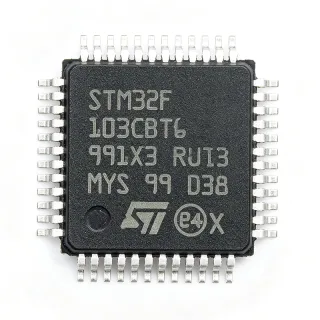
PIC16C58B-40/P - 8-bit 40MHz 3KB OTP MCU 18-PDIP | Microchip
MPN: PIC16C58B-40/P ✓ Active| Qty | Unit Price | Extended |
|---|---|---|
| 1 | $2.161 | $2.16 |
| 10 | $1.95 | $19.50 |
| 100 | $1.72 | $172.00 |
| 500 | $1.5 | $750.00 |
| 1,000 | $1.35 | $1,350.00 |
PIC16C58B-40/P Overview
A microcontroller (MCU) is a single-chip computer that integrates a CPU, memory (program + RAM), and peripherals onto one silicon die, intended for embedded control tasks. Within the broader semiconductor taxonomy, a microcontroller sits under the umbrella of microprocessors, then integrated circuits, then semiconductors. PIC16C5X devices occupy the entry-level leaf of the PIC family tree, optimized for cost-sensitive, high-volume legacy and industrial control. The 'C' in PIC16C58B denotes CMOS EPROM/OTP technology, 'B' the silicon revision, and '40' the maximum clock frequency (40 MHz). The trailing '/P' indicates the plastic PDIP package.
Key features include a 12-bit wide instruction set, Harvard architecture (separate program and data buses), 8-level hardware stack, 12 I/O pins, power-on reset, power-saving SLEEP mode, watchdog timer with dedicated on-chip RC oscillator, and a programmable code-protection mechanism. The 18-pin PDIP footprint offers breadboard-friendly prototyping and reliable socket-based field replacement, while the OTP memory suits small-to-medium production runs where in-system reprogrammability is not required.
Typical applications include appliance controls, simple sensor interfaces, LED and relay drivers, battery chargers, and legacy replacement boards where deterministic single-cycle execution, 33-instruction simplicity, and long-term Microchip supply continuity are critical. The PIC16C58B-40/P supports commercial (0C to +70C) and industrial (-40C to +85C) temperature grades and runs from 2.5 V to 5.5 V across the family.
When designing with this MCU, note that OTP requires programming at the contract manufacturer (CM) or with a development programmer before solder attach. Engineers migrating to a Flash-based equivalent should consider the PIC16F57 as a code- and pin-compatible migration path within the same 18-pin PDIP footprint.
Drop-in alternatives for PIC16C58B-40/P — same package, pin-to-pin compatible. Different-package parts requiring PCB rework are excluded.
Variants in this series
Same-series models that are drop-in compatible with PIC16C58B-40/P (same form factor and footprint) — differing in Watchdog Timer, RoHS Status, Core Architecture, Maximum Clock Frequency, Package.
Quick Comparison Tool — Select alternative parts for side-by-side comparison:
PIC16C58B-20/P
✅ Drop-In✓ In Stock
$1.55 / Unit
View Datasheet →PIC16C58B-20I/P
✅ Drop-In✓ In Stock
$1.55 / Unit
View Datasheet →PIC16C58B-04/P
✅ Drop-In✓ In Stock
$2.55 / Unit
View Datasheet →PIC16C58B-04I/P
✅ Drop-In✓ In Stock
$1.88 / Unit
View Datasheet →PIC16F57-I/P
✅ Drop-In📋 Reference alternative (not in catalog)
PIC16C58B-40/P Maximum Ratings & Electrical Characteristics
| Core Architecture | 8-bit RISC (PIC) |
| Instruction Set | 33 single-word/single-cycle instructions |
| Maximum Clock Frequency | 40 MHz |
| Program Memory Type | OTP (One-Time Programmable), CMOS EPROM-based |
| Program Memory Size | 3 KB (2K x 12) |
| RAM | 73 bytes |
| Data EEPROM | None |
| I/O Pins | 12 |
| Hardware Stack | 8 levels |
| Instruction Cycle | 100 ns at 40 MHz (4 clocks per instruction cycle) |
| Supply Voltage (VDD) | 2.5 V to 5.5 V (family-wide) |
| Operating Temperature Range | 0C to +70C (commercial) |
| Package / Case | 18-DIP (0.300 inch, 7.62 mm), Through-Hole |
| Mounting Type | Through-Hole |
| Watchdog Timer | Yes (with dedicated on-chip RC oscillator) |
| Power-on Reset | Yes |
| SLEEP / Power-Saving Mode | Yes |
| Code Protection | Programmable |
PIC16C58B-40/P Pin Configuration
| Pin 1 | RA2 — Bidirectional I/O pin, PORTA bit 2 |
| Pin 2 | RA3 — Bidirectional I/O pin, PORTA bit 3 |
| Pin 3 | RTCC — Timer0 clock input (also general-purpose I/O) |
| Pin 4 | MCLR — Master Clear reset input, active low |
| Pin 5 | VSS — Ground reference |
| Pin 6 | RB0 — Bidirectional I/O pin, PORTB bit 0 |
| Pin 7 | RB1 — Bidirectional I/O pin, PORTB bit 1 |
| Pin 8 | RB2 — Bidirectional I/O pin, PORTB bit 2 |
| Pin 9 | RB3 — Bidirectional I/O pin, PORTB bit 3 |
| Pin 10 | RB4 — Bidirectional I/O pin, PORTB bit 4 |
| Pin 11 | RB5 — Bidirectional I/O pin, PORTB bit 5 |
| Pin 12 | RB6 — Bidirectional I/O pin, PORTB bit 6 |
| Pin 13 | RB7 — Bidirectional I/O pin, PORTB bit 7 |
| Pin 14 | VDD — Positive supply voltage (+2.5 V to +5.5 V) |
| Pin 15 | OSC2 — Oscillator crystal/clock output |
| Pin 16 | OSC1 — Oscillator crystal/clock input |
| Pin 17 | RA0 — Bidirectional I/O pin, PORTA bit 0 |
| Pin 18 | RA1 — Bidirectional I/O pin, PORTB bit 1 |
Typical Applications
PIC16C58B-40/P is suitable for 6 applications: Appliance Control Boards, Battery Charger Controllers, LED Lighting Controllers, Industrial Sensor Interfaces, Automotive Body Electronics (Legacy), Legacy Board Replacement / Form-Fit-Function.
Appliance Control Boards
The PIC16C58B-40/P fits appliance control boards because its 33-instruction RISC core executes deterministic single-cycle instructions at 100 ns, ensuring predictable response times for relay and triac switching. The 12 I/O pins drive 7-segment displays, keypads, and indicator LEDs without external logic, and the on-chip watchdog timer with dedicated RC oscillator protects against firmware lockup in unattended operation. The 40 MHz headroom lets the MCU multiplex displays and run a soft-PWM motor control loop in the same scan cycle. The OTP memory prevents firmware extraction in cost-sensitive consumer markets where reverse engineering is a concern.
Recommended
Battery Charger Controllers
For sealed lead-acid and NiCd battery charger designs, the PIC16C58B-40/P delivers 40 MIPS of deterministic compute for voltage/current loop regulation while the OTP memory locks the firmware to prevent tampering with the charge profile. The 2K x 12 instruction word is sufficient for state-machine chargers with CC/CV/timer logic, and the 12 I/O pins accommodate ADC-free comparator-based sensing plus relay and LED outputs. The 8-level hardware stack handles nested interrupt service for safety shutdown, and the wide 2.5 V to 5.5 V supply range supports both 3-cell and 6-cell battery packs with the same firmware.
Recommended
LED Lighting Controllers
Architectural and decorative LED controllers benefit from the PIC16C58B-40/P's 40 MHz compute, which executes 8-channel software PWM at refresh rates above 100 Hz with full flicker-free color mixing. The 12 I/O pins drive Charlieplexed or matrixed LED arrays up to 96 diodes without external drivers, and the SLEEP mode cuts quiescent current below 1 uA for battery-backed accent lighting. The OTP memory secures DMX or proprietary lighting protocols from copying, and the small 18-pin PDIP footprint fits inside standard junction boxes. The watchdog timer auto-recovers from brownouts on long cable runs in permanent installations.
Recommended
Industrial Sensor Interfaces
The PIC16C58B-40/P serves as a smart sensor front-end for industrial 4-20 mA loops, providing RTCC-based pulse counting, debounced digital input conditioning, and HART-like Manchester encoding on a single 5 V supply. Its 33-instruction simplicity enables compact, audit-friendly firmware for safety-critical monitoring, and the 8-level hardware stack supports nested interrupt handlers for time-stamping events. The OTP memory suits hazardous-location certifications where firmware must be locked. Operating at 40 MHz, the MCU can run a digital filter and linearization algorithm on a thermocouple or load cell signal while servicing the 4-20 mA output DAC.
Recommended
Automotive Body Electronics (Legacy)
Although not AEC-Q100 qualified, the PIC16C58B-40/P has historically powered non-safety automotive body modules such as interior lighting controllers, mirror adjusters, and accessory timers in pre-2005 vehicle platforms. Its 40 MHz execution and OTP memory suit the deterministic, locked-firmware requirements of these modules. Designers migrating to newer platforms should select AEC-Q100-qualified PIC microcontrollers from the PIC16F1xxx family. The 18-pin PDIP footprint supports through-hole field-replacement modules in dealer service environments. SLEEP mode drops quiescent current below 1 uA to preserve battery during long vehicle storage.
Recommended
Legacy Board Replacement / Form-Fit-Function
The PIC16C58B-40/P is the canonical drop-in for maintaining legacy 1990s-era embedded controllers in industrial PLCs, telecom line cards, test fixtures, and instrumentation that were originally designed around the PIC16C5X family. Its 18-pin PDIP footprint matches the original socket exactly, and its 33-instruction RISC core runs the original assembly firmware without recompilation. The 40 MHz grade provides up to 5x compute headroom over the 04 grade that shipped on some legacy boards, allowing the same hardware to support firmware features added over decades. The OTP memory preserves bit-for-bit the original firmware behavior required for regulatory re-certification.
Recommended
Recommended Products Summary
Engineering reference data for PIC16C58B-40/P — comparison, design guidance, and compliance information.
Selection Guide
Comparison with Alternatives
| Parameter | This Product | PIC16C58B-20/P | PIC16C58B-20I/P | PIC16C58B-04/P | PIC16F57-I/P |
|---|---|---|---|---|---|
| Brand | Microchip Technology | Microchip Technology | Microchip Technology | Microchip Technology | Microchip Technology |
| Package | 18-DIP (0.300 inch) | 18-DIP - same | 18-DIP - same | 18-DIP - same | 18-DIP - same |
| Maximum Clock Frequency | 40 MHz | 20 MHz | 20 MHz | 4 MHz | 20 MHz |
| Program Memory Type | OTP (3 KB / 2K x 12) | OTP (3 KB / 2K x 12) | OTP (3 KB / 2K x 12) | OTP (3 KB / 2K x 12) | Flash (3 KB / 2K x 12) - reprogrammable |
| RAM | 73 bytes | 73 bytes | 73 bytes | 73 bytes | 73 bytes |
| Operating Temperature Range | 0C to +70C (commercial) | 0C to +70C (commercial) | -40C to +85C (industrial) | 0C to +70C (commercial) | -40C to +85C (industrial) |
| Reprogrammability | No (OTP, one-time write) | No (OTP) | No (OTP) | No (OTP) | Yes (Flash, 100k erase cycles) |
| Supply Voltage | 2.5 V to 5.5 V | 2.5 V to 5.5 V | 2.5 V to 5.5 V | 2.5 V to 5.5 V | 2.0 V to 5.5 V |
Key Differentiators
- Highest clock grade in the PIC16C58B family (vs PIC16C58B-20/P)
- OTP memory provides hardware-level firmware lock (vs PIC16F57-I/P)
- Industrial temperature variant available in same family (vs PIC16C58B-04/P)
Design Notes
The PIC16C58B-40/P uses One-Time Programmable (OTP) memory - firmware must be fully validated before programming because there is no second chance. Plan a parallel engineering build using the Flash-based PIC16F57-I/P in the same 18-pin PDIP socket for firmware development; only commit the locked OTP image to the PIC16C58B-40/P at the production programming step. Microchip recommends verifying the device ID and checksum on every programmed unit, and using the code-protection bit once the firmware is finalized to prevent bit-level extraction.
Place a 100 nF decoupling capacitor as close as possible to the VDD pin (pin 14), with the ground lead short to the VSS pin (pin 5). Use a 10 to 100 uF bulk capacitor on the same VDD rail. For crystal oscillator operation, keep the crystal and load capacitors close to pins 15 (OSC2) and 16 (OSC1); route oscillator traces over a continuous ground plane and away from switching signals. The MCLR reset pin (pin 4) should be pulled up to VDD through a 10 kohm resistor with a 100 nF cap to VSS to filter noise; do not leave MCLR floating.
The PIC16C5X architecture has no interrupts - all event handling must be polled. This simplifies timing analysis but requires careful loop-budget planning; at 40 MHz the instruction cycle is 100 ns, so a polled 1 ms task consumes 10,000 cycles. The 8-level hardware stack means subroutines cannot nest more than 8 deep; deeply nested call chains must be inlined or refactored. The watchdog timer has its own dedicated on-chip RC oscillator, so it continues to count even when the main oscillator is stopped in SLEEP mode - this is intentional but must be accounted for in low-power designs.
Compliance Information
RoHS and lead-free status of the PIC16C58B-40/P PDIP package not stated explicitly in the verified web data; request material declaration from Microchipdirect before EU sale. Not AEC-Q100 qualified - choose PIC16F628A-I/P or PIC16F1823-I/P for automotive.