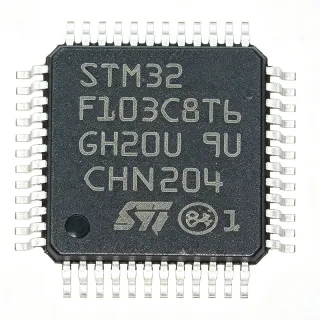
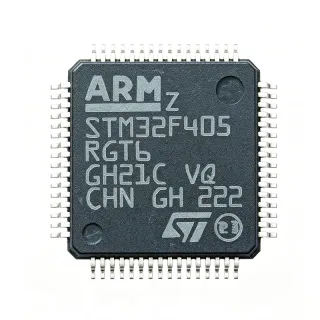
PIC16C58BT-20E/SS - 8-bit 20MHz 3KB OTP MCU | Microchip SSOP-20
MPN: PIC16C58BT-20E/SS ✓ Active| Qty | Unit Price | Extended |
|---|---|---|
| 1 | $3.85 | $3.85 |
| 10 | $3.45 | $34.50 |
| 100 | $3.02 | $302.00 |
| 500 | $2.68 | $1,340.00 |
| 1,000 | $2.35 | $2,350.00 |
PIC16C58BT-20E/SS Overview
An 8-bit microcontroller (MCU) is a single-chip computer that integrates a CPU, RAM, non-volatile program memory, and peripherals. PIC16C5X devices belong to the PIC microcontroller family (Peripheral Interface Controller), classified as RISC microcontrollers -> 8-bit MCU -> microcontroller -> embedded computing -> semiconductor. The PIC16C5X family uses a RISC architecture with 33 single-word/single-cycle instructions, achieving roughly 2:1 code compression versus competitive 8-bit MCUs in its class.
Key features include a 12-bit instruction word, 8-level hardware stack, 4 oscillator selections (RC, XT, HS, LP), 12 I/O pins, a watchdog timer with on-chip RC oscillator, and a programmable code protection mechanism. The OTP program memory is well suited to low-volume production and prototype runs that need to mimic mask-ROM cost structure without NRE charges.
The PIC16C58BT employs a fully static CMOS design with low power consumption suitable for battery-powered or sleep-dominated applications. The 20 MHz clock rate delivers 5 MIPS throughput (1 instruction per cycle), more than adequate for control loops, simple communication, sensor sampling, and user-interface glue logic. The architecture separates program and data buses (Harvard), letting the CPU fetch instruction and operand in the same cycle.
Typical applications include appliance control, smart sensor fans, IoT edge nodes, automotive body electronics, industrial control, white-goods user interfaces, and consumer electronics. Designers select this part when cost is paramount and reprogrammability in-circuit is not required.
When designing with this part, account for OTP (one-time-programmable) memory: firmware must be fully validated before commit. The 'E' suffix indicates the extended industrial temperature range (-40C to +125C), making it appropriate for harsh-environment deployments.
This page synthesizes distributor pricing, drop-in alternatives, and design guidance compiled from the Microchip PIC16C58BT datasheet and authorized distributor listings.
Drop-in alternatives for PIC16C58BT-20E/SS — same package, pin-to-pin compatible. Different-package parts requiring PCB rework are excluded.
Variants in this series
Same-series models that are drop-in compatible with PIC16C58BT-20E/SS (same form factor and footprint) — differing in Package, Mounting Type, Core Architecture, Instruction Set, Program Memory Type.
Quick Comparison Tool — Select alternative parts for side-by-side comparison:
PIC16C58B-20E/SS
✅ Drop-In✓ In Stock
$2.78 / Unit
View Datasheet →PIC16C58BT-20/SS
✅ Drop-In✓ In Stock
$1.39 / Unit
View Datasheet →PIC16C58BT-04/SS
✅ Drop-In✓ In Stock
$1.62 / Unit
View Datasheet →PIC16C58B-20I/SS
✅ Drop-In✓ In Stock
$1.74 / Unit
View Datasheet →PIC16C58B-20E/SO
✅ Drop-In✓ In Stock
$1.85 / Unit
View Datasheet →PIC16C58BT-20E/SS Maximum Ratings & Electrical Characteristics
| Core Architecture | 8-bit PIC RISC |
| Core Clock Speed | 20 MHz |
| Instruction Set | 33 single-word/single-cycle instructions |
| Program Memory | 3 KB (2K x 12) OTP EPROM |
| RAM | 73 x 8 bytes |
| Operating Voltage | 3.0 V to 5.5 V |
| I/O Pins | 12 |
| Hardware Stack | 8 levels |
| Instruction Width | 12-bit |
| Throughput | 5 MIPS |
| Oscillator Options | RC, XT, HS, LP (4 modes) |
| Watchdog Timer | Yes, with on-chip RC oscillator |
| Operating Temperature | -40C to +125C (Extended, 'E' suffix) |
| Package | 20-SSOP (0.209", 5.30 mm width) |
| Mounting Type | Surface Mount |
| Code Protection | Programmable |
PIC16C58BT-20E/SS Pin Configuration
| Pin 1 | RA2 — Bidirectional I/O port A bit 2 |
| Pin 2 | RA3 — Bidirectional I/O port A bit 3 |
| Pin 3 | RA4/T0CKI — Bidirectional I/O port A bit 4 / Timer0 clock input |
| Pin 4 | MCLR/VPP — Master Clear (reset) input / Programming voltage |
| Pin 5 | VSS — Ground reference |
| Pin 6 | RB0/INT — Bidirectional I/O port B bit 0 / External interrupt |
| Pin 7 | RB1 — Bidirectional I/O port B bit 1 |
| Pin 8 | RB2 — Bidirectional I/O port B bit 2 |
| Pin 9 | RB3 — Bidirectional I/O port B bit 3 |
| Pin 10 | RB4 — Bidirectional I/O port B bit 4 |
| Pin 11 | RB5 — Bidirectional I/O port B bit 5 |
| Pin 12 | RB6 — Bidirectional I/O port B bit 6 |
| Pin 13 | RB7 — Bidirectional I/O port B bit 7 |
| Pin 14 | VSS — Ground reference (secondary) |
| Pin 15 | OSC1/CLKIN — Oscillator crystal input / External clock input |
| Pin 16 | OSC2/CLKOUT — Oscillator crystal output / Clock output (RC mode) |
| Pin 17 | RC0 — Bidirectional I/O port C bit 0 |
| Pin 18 | RC1 — Bidirectional I/O port C bit 1 |
| Pin 19 | RC2 — Bidirectional I/O port C bit 2 |
| Pin 20 | RC3 — Bidirectional I/O port C bit 3 |
Typical Applications
PIC16C58BT-20E/SS is suitable for 7 applications: Appliance Control, Automotive Body Electronics, Industrial Control and Sensor Signal Conditioning, White-Goods User Interface, Smart Sensor Fan Controller, Consumer Electronics Remote Controls, IoT Edge Sensor Nodes (Non-Connected).
Appliance Control
The PIC16C58BT-20E/SS is a strong fit for appliance control boards (washing machines, dishwashers, microwave ovens) where 12 I/O pins and 5 MIPS throughput easily drive keypads, relay drivers, seven-segment displays, and triac-based load control. Its 3 KB OTP program memory stores the entire state-machine firmware with predictable fixed code, and the extended -40C to +125C temperature grade handles the heat of under-cabinet or motor-adjacent PCB placement. The 20 MHz clock lets designers implement software debouncing, PWM dimming, and serial communication to companion sensors without firmware stalls. Per the Microchip PIC16C5X reference designs, the same die has shipped in millions of appliance controllers worldwide, giving strong evidence of long-term reliability and low BOM cost.
Recommended
Automotive Body Electronics
Body electronics modules (window lift controllers, seat controllers, mirror adjusters, lighting timers) benefit from the PIC16C58BT-20E/SS's extended -40C to +125C temperature range and 5 V supply tolerance that matches 12 V battery rails after regulation. The OTP memory locks firmware against field code extraction, deterring aftermarket cloning. With 12 GPIO and 5 MIPS, the MCU can drive MOSFET half-bridges, read Hall-effect sensors, and run LIN or simple UART communication to a body controller. Microchip's automotive-grade PIC16 family shares tooling and programming interfaces with this part, easing engineering reuse across vehicle platforms. Designers targeting AEC-Q100 should evaluate PIC16F variants instead, since this part is not explicitly AEC-Q100 qualified.
Recommended
Industrial Control and Sensor Signal Conditioning
For industrial control panels and sensor-signal-conditioning nodes, the PIC16C58BT-20E/SS delivers deterministic RISC execution with 5 MIPS throughput, well-suited to PID loops running at 1 kHz update rates. The on-chip watchdog timer with dedicated RC clock catches firmware lockups even if the main oscillator is disturbed by EMI, a common requirement in factory-floor deployments. The SSOP-20 package (5.30 mm body width) fits compact DIN-rail modules where PCB real estate is constrained. Per Microchip application notes, the PIC16C5X series is widely used for thermocouple cold-junction compensation, 4-20 mA loop read-back, and discrete logic replacement on legacy industrial controllers.
Recommended
White-Goods User Interface
User-interface boards in refrigerators, ovens, and washing machines typically need only 8-16 GPIO to scan keypads and drive displays. The PIC16C58BT-20E/SS provides 12 GPIO plus 5 MIPS throughput, enough to multiplex 4-digit seven-segment or 16-character LCD interfaces without external driver ICs. OTP memory locks the user-menu firmware and discourages unauthorized UI customization. The extended temperature grade tolerates steam-room adjacent placements and outdoor-vented cabinets. Designers should budget the 3 KB OTP for menu structures, beep libraries, and fault-history logs; Microchip's MPLAB XC8 compiler supports the PIC16C5X instruction set with full optimization.
Recommended
Smart Sensor Fan Controller
Brushless DC (BLDC) and brushed-DC fan controllers benefit from the PIC16C58BT-20E/SS's combination of 5 MIPS throughput, 12 GPIO, and hardware flexibility. The MCU can read tachometer feedback, drive PWM into a gate driver, and run stall-detection algorithms at 100 Hz loop rates without saturating. The extended temperature grade is essential for fan-embedded electronics that sit in 80C+ airflow paths. OTP memory locks the fan calibration tables, preventing aftermarket detuning. Per Microchip application note AN857, the PIC16C5X family has been used in variable-speed ceiling fans, server fans, and HVAC blowers where cost dominates feature differentiation.
Recommended
Consumer Electronics Remote Controls
Infrared and RF remote-control transmitters for TVs, set-top boxes, audio equipment, and toys are ideal for the PIC16C58BT-20E/SS due to its ultra-low power consumption in sleep mode and small SSOP-20 footprint. With 3 KB OTP, the firmware can store complex button-mapping tables and protocol stacks (NEC, RC5, SIRC). The 5 MIPS throughput easily generates 38 kHz carrier modulation with software PWM, eliminating the need for an external timer IC. The PIC16C5X instruction set is well-documented and stable, allowing long-life-cycle remote designs to ship for a decade without firmware churn.
Recommended
IoT Edge Sensor Nodes (Non-Connected)
Pre-wireless edge sensor nodes for thermostats, soil-moisture probes, and battery-powered HVAC accessories benefit from the PIC16C58BT-20E/SS's low power consumption, 3.0-5.5 V supply range, and extended temperature tolerance. The 12 GPIO can read multiple analog sensors via external ADC, drive a low-power RF module via UART/SPI, and blink status LEDs without external glue logic. OTP memory locks calibration coefficients, preventing accidental over-the-air tampering in field deployments. The SSOP-20 footprint allows compact wearable or wall-mounted form factors where PCB area is at a premium.
Recommended
Recommended Products Summary
Engineering reference data for PIC16C58BT-20E/SS — comparison, design guidance, and compliance information.
Selection Guide
Comparison with Alternatives
| Parameter | This Product | PIC16C58B-20E/SS | PIC16C58BT-20/SS | PIC16C58BT-04/SS | PIC16C58B-20I/SS | PIC16C58B-20E/SO |
|---|---|---|---|---|---|---|
| Package | 20-SSOP | 20-SSOP - same | 20-SSOP - same | 20-SSOP - same | 20-SSOP - same | 20-SOIC - similar body width |
| Brand | Microchip Technology | Microchip Technology - same | Microchip Technology - same | Microchip Technology - same | Microchip Technology - same | Microchip Technology - same |
| Core Clock Speed | 20 MHz | 20 MHz | 20 MHz | 4 MHz | 20 MHz | 20 MHz |
| Program Memory | 3 KB OTP | 3 KB OTP | 3 KB OTP | 3 KB OTP | 3 KB OTP | 3 KB OTP |
| RAM | 73 bytes | 73 bytes | 73 bytes | 73 bytes | 73 bytes | 73 bytes |
| Operating Temperature | -40C to +125C (Extended) | -40C to +125C (Extended) | -40C to +85C (Industrial) | -40C to +85C (Industrial) | -40C to +85C (Industrial) | -40C to +125C (Extended) |
| I/O Pins | 12 | 12 | 12 | 12 | 12 | 12 |
| Packaging Format | Tape & Reel | Tube | Tape & Reel | Tape & Reel | Tube | Tube |
| Supply Voltage | 3.0 V to 5.5 V | 3.0 V to 5.5 V | 3.0 V to 5.5 V | 3.0 V to 5.5 V | 3.0 V to 5.5 V | 3.0 V to 5.5 V |
Key Differentiators
- Extended industrial temperature grade on a same-die alternative (vs PIC16C58BT-20/SS)
- Highest-speed-by-design accessibility in the same SSOP-20 footprint (vs PIC16C58BT-04/SS)
- Tape-and-reel factory pick compatible with the same die as the tube variant (vs PIC16C58B-20E/SS)
Design Notes
PIC16C58BT uses One-Time-Programmable (OTP) EPROM, not flash. Validate firmware exhaustively on a windowed or simulator-based part (PIC16C58B JW or PIC16C58B /04 with EPROM emulator) before committing to OTP production units. Once programmed, OTP cannot be erased - any silicon bug becomes a board-swap recall. Budget at least two prototype spins using reprogrammable equivalents to flush out bugs.
Place the MCLR pull-up resistor (typically 10-47 kohm) within 5 mm of the MCLR/VPP pin and keep its trace short and direct. Add a 100 nF decoupling capacitor on VDD within 2-3 mm of the VDD pin. For RC oscillator mode, keep the RC components close to OSC1; for crystal/ceramic resonator modes, keep the load capacitors within 5 mm of OSC1 and OSC2. Avoid routing high-current switching traces (relay coils, triac gates) under or near the clock pins to prevent oscillator jitter.
Estimated: at 20 MHz and 5 V supply with all GPIO toggling, the PIC16C58BT-20E/SS draws approximately 10 mA active and 1 uA sleep. In SSOP-20 with theta_JA of approximately 90 C/W, this yields a 0.9 C junction rise over ambient in active mode - thermal management is not a concern. The extended -40C to +125C operating range reflects silicon capability, not a thermal dissipation limit. Verify the ambient temperature inside any sealed enclosure (e.g., behind a washing-machine control panel) does not exceed 85 C without additional cooling.
For sleep-mode battery-powered designs, leverage the PIC16C58B's 1 uA typical sleep current (watchdog disabled). To wake from sleep, use the MCLR reset, watchdog timer overflow, or external interrupt on RB0/INT. Disable the watchdog in software (WDTE configuration bit cleared) for minimum sleep current. If a crystal oscillator is used, allow adequate startup delay (OST) before executing time-critical code; the PIC16C5X provides 18 ms OST after wake from sleep with crystal mode.
PIC16C5X devices do not include a dedicated ICSP programming pinout on the SSOP-20 variant in the same way newer PIC16F1xxx parts do - programming uses the high-voltage VPP on MCLR plus clock/data on RB6/RB7 (or alternate pins). When laying out the PCB, ensure RB6 and RB7 are accessible for in-circuit programming if you need post-assembly firmware update capability on a development run. Mark these as test points on the silkscreen for probe access during bring-up.
Compliance Information
RoHS and REACH compliance status not confirmed in provided data; verify with Microchip product compliance documentation. AEC-Q100 not qualified - this part targets industrial and consumer applications, not automotive safety-critical deployments. Lead-free per Microchip's standard surface-mount packaging convention.