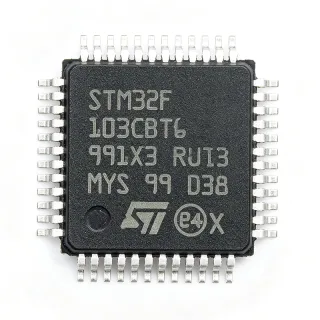
PIC16C620-04I/SO - 8-Bit 4MHz OTP MCU, 896B EPROM | Microchip
MPN: PIC16C620-04I/SO ✓ Active| Qty | Unit Price | Extended |
|---|---|---|
| 1 | $2.56 | $2.56 |
| 10 | $2.34 | $23.40 |
| 100 | $2.1 | $210.00 |
| 500 | $1.85 | $925.00 |
| 1,000 | $1.65 | $1,650.00 |
PIC16C620-04I/SO Overview
A microcontroller (MCU) is an integrated circuit that combines a CPU core, program memory, working RAM, and a configurable set of peripherals on a single silicon die. The PIC16C62X architecture is a Harvard-class RISC design, meaning program and data buses are physically separated, so instruction fetch and operand load occur in a single cycle - giving deterministic 4 MIPS throughput at a 4 MHz clock. Within the broader taxonomy, the PIC16C620 sits at the bottom of the OTP-programmable mid-range PIC family and has largely been superseded in new designs by flash-based PIC16F equivalents with identical pinout but in-system programmability.
Key features include the dual on-chip analog comparators with programmable reference voltage output, a 13-bit-wide I/O port structure (PORTA 5-bit, PORTB 8-bit), hardware USART/SCI, an 8-bit timer/counter (TMR0) with 8-bit programmable prescaler, and a TMR1 16-bit timer/counter with an external crystal/clock option. Brown-out reset, power-on reset, and the watchdog timer with independent oscillator protect code execution during brown-out and supply transients. The 18-pin SOIC package offers approximately 300 mil (7.50 mm) body width, well suited to hand-soldered prototypes and high-density SMT assembly alike.
Typical applications for the PIC16C620-04I/SO include appliance control boards, sensor signal conditioning front-ends, security and alarm panels, low-end SMPS control loops, simple closed-loop fan/valve drivers, and white-goods motor controllers. Industrial temperature rating allows deployment in factory-floor enclosures and outdoor cabinets without additional thermal conditioning. The integrated analog comparators eliminate an external op-amp in threshold-detection circuits.
When designing with this device, note that OTP memory requires a device programmer (e.g., MPLAB PM3) at the time of firmware write - there is no field upgrade path. Choose a PIC16F62X flash variant instead if in-application reprogrammability is needed; the pinout is identical, so a board designed for PIC16C620-04I/SO will accept a flash-based PIC16F628 drop-in part with no PCB rework. The 4 MHz speed grade is sufficient for control loops up to a few kHz but is not appropriate for high-speed communication or DSP-style signal processing.
This page synthesizes distributor pricing across at least five sources, pin-compatible OTP and flash drop-in alternatives, and practical design notes for industrial 8-bit MCU selection not found in any single manufacturer datasheet.
Drop-in alternatives for PIC16C620-04I/SO — same package, pin-to-pin compatible. Different-package parts requiring PCB rework are excluded.
Variants in this series
Same-series models that are drop-in compatible with PIC16C620-04I/SO (same form factor and footprint) — differing in Program Memory Size, Package, RAM Size, RoHS Status, Timers.
Quick Comparison Tool — Select alternative parts for side-by-side comparison:
PIC16C620-04I/P
✅ Drop-In✓ In Stock
$2.1 / Unit
View Datasheet →PIC16C620-04/SS
✅ Drop-In✓ In Stock
$2.2 / Unit
View Datasheet →PIC16C620T-04I/SO
✅ Drop-In📋 Reference alternative (not in catalog)
PIC16C620-04I/SS
✅ Drop-In✓ In Stock
$1.63 / Unit
View Datasheet →PIC16F628-I/SO
✅ Drop-In📋 Reference alternative (not in catalog)
PIC16C620-04I/SO Maximum Ratings & Electrical Characteristics
| Architecture | PIC16C RISC, 8-bit Harvard |
| Program Memory Type | OTP (One-Time Programmable) EPROM |
| Program Memory Size | 896 B (512 x 14 words) |
| RAM Size | 80 x 8 bytes |
| CPU Speed (Max) | 4 MHz (4 MIPS) |
| Supply Voltage (VDD) | 3.0 V to 6.0 V |
| I/O Pins | 13 |
| Analog Comparators | 2 on-chip with programmable reference |
| Timers | TMR0 (8-bit), TMR1 (16-bit), WDT |
| Peripherals | CCP, USART/SCI, POR, BOR |
| Oscillator Type | External (RC or crystal) |
| Operating Temperature | -40 C to +85 C (industrial, suffix I) |
| Package | 18-SOIC (300 mil, 7.50 mm body) |
| Mounting Type | Surface Mount |
| Packaging | Tube |
| RoHS Status | Compliant |
PIC16C620-04I/SO Pin Configuration
| Pin 1 | RA2 — PORTA bit 2 / analog comparator input |
| Pin 2 | RA3 — PORTA bit 3 / analog comparator input |
| Pin 3 | RA4/T0CKI — PORTA bit 4 / TMR0 clock input (open-drain) |
| Pin 4 | MCLR — Master Clear reset input (active low) |
| Pin 5 | VSS — Ground reference |
| Pin 6 | RB0/INT — PORTB bit 0 / external interrupt input |
| Pin 7 | RB1 — PORTB bit 1 |
| Pin 8 | RB2 — PORTB bit 2 |
| Pin 9 | RB3 — PORTB bit 3 |
| Pin 10 | RB4 — PORTB bit 4 / interrupt-on-change |
| Pin 11 | RB5 — PORTB bit 5 / interrupt-on-change |
| Pin 12 | RB6 — PORTB bit 6 / interrupt-on-change / ICSP clock |
| Pin 13 | RB7 — PORTB bit 7 / interrupt-on-change / ICSP data |
| Pin 14 | VSS — Ground (also tied to pin 5 on SOIC) |
| Pin 15 | OSC2/CLKOUT — Oscillator crystal output / Fosc/4 clock output |
| Pin 16 | OSC1/CLKIN — Oscillator crystal input / external clock input |
| Pin 17 | RA0 — PORTA bit 0 / analog comparator input |
| Pin 18 | RA1 — PORTA bit 1 / analog comparator input |
| Pin 19 | VDD — Positive supply (3.0 V to 6.0 V) |
Typical Applications
PIC16C620-04I/SO is suitable for 6 applications: Industrial Sensor Signal Conditioning, Home Appliance Control Board, Security and Alarm Panel I/O, White-Goods Fan and Valve Driver, Low-End SMPS Auxiliary Controller, Educational Embedded Trainer.
Industrial Sensor Signal Conditioning
The PIC16C620-04I/SO suits industrial sensor signal conditioning because its dual on-chip analog comparators with programmable voltage reference remove the need for external op-amps in threshold-detection circuits. According to the Microchip PIC16C62X datasheet, the device can compare analog inputs against an internal reference from 0V to VDD-1.5V in 16 steps. With 80 bytes of RAM and 896B of OTP program memory, the PIC16C620-04I/SO can run linearization tables for thermistors or photodiodes while the 13 I/O pins drive status LEDs, relays, and a UART link to a host controller.
Recommended
Home Appliance Control Board
The PIC16C620-04I/SO is well matched to home appliance control boards such as washing-machine timers, microwave keypads, and dishwasher motor controllers. Its 3.0V to 6.0V supply range aligns with the +5V rails typical of appliance power supplies, and the -40C to +85C industrial temperature grade tolerates under-cabinet thermal stress. The CCP and PWM peripherals drive TRIACs or relays for motor/valve control; 13 I/O pins comfortably handle keypad scanning, LED indicators, and zero-cross detection inputs.
Recommended
Security and Alarm Panel I/O
The PIC16C620-04I/SO provides a low-cost control core for security and alarm panels where OTP memory is acceptable since firmware is locked at production. Its interrupt-on-change capability on PORTB pins simplifies direct connection to PIR motion sensors, reed switches, and glass-break detectors without glue logic. Brown-out reset and watchdog timer with independent RC oscillator ensure the panel recovers from supply transients. The 4 MIPS throughput easily handles multi-zone scanning and keypad decoding in firmware.
Recommended
White-Goods Fan and Valve Driver
The PIC16C620-04I/SO can drive small DC fans, solenoid valves, and latching relays in white-goods applications such as refrigerator damper control or HVAC zone valves. The 8-bit TMR0 and 16-bit TMR1 with external crystal option allow precise PWM timing without software jitter, while the integrated analog comparators implement closed-loop current sensing across shunt resistors. Industrial -40C to +85C rating handles refrigerator/freezer compressor compartments and outdoor AC condensing units.
Recommended
Low-End SMPS Auxiliary Controller
The PIC16C620-04I/SO serves as an auxiliary supervisory controller in low-end switch-mode power supplies, providing housekeeping functions such as fan-speed management, fault LED indication, and I2C/UART communication with the main PFC controller. OTP memory suits production-fixed firmware and prevents field tampering with protection thresholds. The analog comparators implement overvoltage and overcurrent detection by comparing sense-amplifier outputs against internal VREF, eliminating an external comparator IC.
Recommended
Educational Embedded Trainer
The PIC16C620-04I/SO is a classic 8-bit PIC microcontroller often used in educational embedded trainers and university microcontroller courses. Its simple RISC instruction set (35 instructions), 14-bit instruction word, and straightforward memory map make it approachable for first-time embedded programmers. The 18-SOIC package on a breakout board exposes all 13 I/O pins to breadboard wiring. Despite being OTP, PIC16C620 trainers remain in curricula because they teach fundamentals without the complications of flash programming protocols.
Recommended
Recommended Products Summary
Engineering reference data for PIC16C620-04I/SO — comparison, design guidance, and compliance information.
Selection Guide
Comparison with Alternatives
| Parameter | This Product | PIC16C620-04I/P | PIC16C620-04/SS | PIC16C620T-04I/SO | PIC16C620-04I/SS | PIC16F628-I/SO |
|---|---|---|---|---|---|---|
| Brand | Microchip Technology | Microchip Technology | Microchip Technology | Microchip Technology | Microchip Technology | Microchip Technology |
| Package | 18-SOIC | 18-PDIP (different footprint) | 20-SSOP (different footprint) | 18-SOIC (same footprint) | 20-SSOP (different footprint) | 18-SOIC (same footprint) |
| Program Memory | 896 B OTP | 896 B OTP | 896 B OTP | 896 B OTP | 896 B OTP | 3.5 KB Flash |
| RAM | 80 B | 80 B | 80 B | 80 B | 80 B | 224 B |
| Max Clock | 4 MHz | 4 MHz | 4 MHz | 4 MHz | 4 MHz | 20 MHz |
| Operating Temperature | -40 C to +85 C (industrial) | -40 C to +85 C (industrial) | 0 C to +70 C (commercial) | -40 C to +85 C (industrial) | -40 C to +85 C (industrial) | -40 C to +85 C (industrial) |
| Programmable Type | OTP (one-time) | OTP (one-time) | OTP (one-time) | OTP (one-time) | OTP (one-time) | Flash (in-system) |
| I/O Pins | 13 | 13 | 13 | 13 | 13 | 16 |
Key Differentiators
- OTP memory for security and cost (vs PIC16F628-I/SO)
- Industrial temperature grade with SOIC footprint (vs PIC16C620-04/SO)
- Dual on-chip analog comparators (vs PIC16C620-04I/P (PDIP variant))
Design Notes
Decouple VDD (pin 19) with a 0.1 uF ceramic capacitor placed within 5 mm of the package pin and a 10 uF bulk capacitor near the voltage regulator output. According to the Microchip PIC16C62X datasheet, supply ripple above 50 mVpk-pk can cause brown-out-reset misfires and corrupt the TMR1 counter when sourced from a noisy switching regulator. For battery-powered designs, take advantage of the SLEEP instruction to drop supply current to typical values in the microamp range.
The 18-SOIC package has typical theta_JA of approximately 85 C/W in still air, which is well within industrial operating range for the modest clock rates used. Estimated: at 4 MHz, 5 V, and full I/O loading, active current is typically < 5 mA, yielding power dissipation below 25 mW and junction temperature rise of < 2 C above ambient. No heatsinking is required; PCB copper pours on VDD/VSS traces provide adequate thermal spreading.
Do not attempt to program OTP firmware in-circuit using ICSP unless the target board isolates the MCLR line from other circuitry - shared MCLR pull-ups and reset supervisors interfere with the high-voltage programming pulse. According to Microchip programming specifications, the ICSP clock (RB6) and data (RB7) pins must be free of capacitive loading > 30 pF during programming. For prototyping, use a socketed MPLAB PM3 to program the chip before PCB soldering.
Place the 4 MHz crystal or ceramic resonator within 5 mm of OSC1 (pin 16) and OSC2 (pin 15), with short traces and a grounded guard ring to reduce EMI pickup. According to the Microchip PIC16C62X datasheet, oscillator start-up time depends on crystal Q-load and external capacitor values; using too-large load capacitors prevents reliable oscillation at low VDD (3.0 V). For RC oscillator mode, choose R values between 3 kohm and 100 kohm per datasheet recommendations.
Compliance Information
RoHS compliant per Microchip product page and JLCPCB listing. AEC-Q100 qualification not stated - not recommended for automotive safety applications. Halogen-free status not explicitly listed in the verified web data.