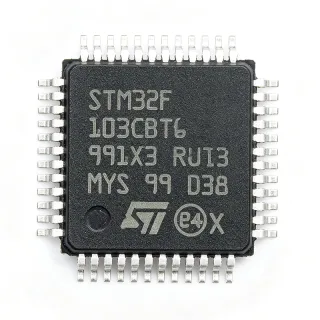
PIC16C621A-40/P - 8-bit OTP MCU, 1.75KB, 40MHz | Microchip
MPN: PIC16C621A-40/P ✓ Active| Qty | Unit Price | Extended |
|---|---|---|
| 1 | $0.7517 | $0.75 |
| 10 | $0.68 | $6.80 |
| 100 | $0.62 | $62.00 |
| 500 | $0.55 | $275.00 |
| 1,000 | $0.49 | $490.00 |
PIC16C621A-40/P Overview
A microcontroller (MCU) is a single-chip computer that integrates a CPU core, program memory (ROM/Flash/OTP), working RAM, and programmable I/O peripherals on one die. OTP (One-Time Programmable) MCUs use EPROM cells that can be programmed exactly once and cannot be erased, which lowers die cost versus Flash parts but rules out field firmware updates. PIC MCUs employ a Harvard RISC architecture with separate program and data buses, allowing most instructions to execute in a single instruction cycle — which is the architectural source of the PIC16C621A's 100 ns execution time at 40 MHz.
Key features include 1.75KB (typically 2K x 14 bit) of OTP program memory, 96 bytes of RAM, two 8-bit timers (Timer0, Timer2) plus one 16-bit timer (Timer1), an analog comparator module, and a 13-bit-wide I/O port. The 40 speed grade corresponds to a 40 MHz maximum oscillator frequency. The 18-pin PDIP package is a through-hole format preferred for prototyping, hobby projects, and legacy industrial controls where socketed replacement is desirable.
The PIC16C621A uses a 14-bit instruction word and an 8-bit data path. Code protection is selectable via configuration bits, which fuse specific EPROM cells at programming time. The device includes a power-on reset (POR), brown-out detect (BOD), watchdog timer (WDT), and an in-circuit serial programming (ICSP) interface exposed on dedicated pins.
Typical applications include appliance control, simple sensor signal conditioning with analog comparator, motor-driver logic interfaces, low-cost industrial timer/counter modules, and replacement of legacy 18-pin PIC16C5X designs. The PDIP package is also widely used in educational lab kits and DIY hobby electronics where hand-soldering and breadboard compatibility matter more than SMT density.
When designing with this part, note that OTP memory means firmware must be validated before programming — there is no second chance. Decoupling (100 nF ceramic at VDD) and a stable clock source (crystal, resonator, or external clock) are required. Code-protect fuses should be enabled for production units to prevent firmware readout.
This page synthesizes verified distributor pricing, drop-in alternatives from the same PIC16C6XX family, and practical design notes not consolidated in the manufacturer datasheet alone.
Drop-in alternatives for PIC16C621A-40/P — same package, pin-to-pin compatible. Different-package parts requiring PCB rework are excluded.
Variants in this series
Same-series models that are drop-in compatible with PIC16C621A-40/P (same form factor and footprint) — differing in Package, Mounting Type, ADC, Instruction Set, Product Type.
Quick Comparison Tool — Select alternative parts for side-by-side comparison:
PIC16C621A-20/P
✅ Drop-In ⚠️ 参数待验证📋 Reference alternative (not in catalog)
PIC16C621A-04/P
✅ Drop-In ⚠️ 参数待验证📋 Reference alternative (not in catalog)
PIC16C621A-04I/P
✅ Drop-In✓ In Stock
$1.5 / Unit
View Datasheet →PIC16C620A-40/P
✅ Drop-In ⚠️ 参数待验证📋 Reference alternative (not in catalog)
PIC16F628A-20/P
✅ Drop-In ⚠️ 参数待验证📋 Reference alternative (not in catalog)
PIC16C621A-40/P Maximum Ratings & Electrical Characteristics
| Product Type | 8-bit Microcontroller (MCU) |
| Architecture | PIC16 (Harvard RISC, 14-bit instruction word) |
| Program Memory | 1.75 KB (2K x 14 bit) OTP EPROM |
| RAM | 96 bytes |
| I/O Pins | 13 |
| Instruction Set | 35 single-word instructions |
| Instruction Execution | 100 ns (at 40 MHz) |
| Speed Grade | 40 MHz maximum clock input |
| Operating Voltage | 2.5 V to 5.5 V |
| Timers | Timer0 (8-bit), Timer1 (16-bit), Timer2 (8-bit) |
| Analog Comparators | Yes (on-chip, programmable) |
| ADC | None (digital only; analog via comparator) |
| Watchdog Timer (WDT) | Yes (software-enabled) |
| Brown-out Detect (BOD) | Yes |
| Power-on Reset (POR) | Yes |
| In-Circuit Serial Programming (ICSP) | Yes |
| Package | 18-pin PDIP (Through-Hole) |
| Mounting Type | Through-Hole (DIP) |
| RoHS Status | Compliant |
PIC16C621A-40/P Pin Configuration
| Pin 1 | MCLR/VPP — Master Clear (reset) input / programming voltage |
| Pin 2 | RA0/AN0 — Port A bit 0 / analog comparator input 0 |
| Pin 3 | RA1/AN1 — Port A bit 1 / analog comparator input 1 |
| Pin 4 | RA2/AN2 — Port A bit 2 / analog comparator input 2 |
| Pin 5 | RA3/AN3 — Port A bit 3 / analog comparator input 3 |
| Pin 6 | RA4/T0CKI — Port A bit 4 / Timer0 clock input |
| Pin 7 | RA5 — Port A bit 5 |
| Pin 8 | VSS — Ground reference |
| Pin 9 | OSC1/CLKIN — Oscillator crystal input / external clock in |
| Pin 10 | OSC2/CLKOUT — Oscillator crystal output / clock out |
| Pin 11 | RC0 — Port C bit 0 |
| Pin 12 | RC1 — Port C bit 1 |
| Pin 13 | RC2 — Port C bit 2 |
| Pin 14 | RC3 — Port C bit 3 |
| Pin 15 | RC4 — Port C bit 4 |
| Pin 16 | RC5 — Port C bit 5 |
| Pin 17 | RB6 — Port B bit 6 |
| Pin 18 | RB7 — Port B bit 7 |
Typical Applications
PIC16C621A-40/P is suitable for 6 applications: Appliance Control (Washing Machines, Microwaves), Analog Sensor Threshold Detection (Comparator Module), Motor Driver Logic Interface (Stepper, DC, BLDC Commutation), Industrial Timer and Counter Modules, Hobby Electronics and Educational Lab Kits, Legacy 18-Pin PIC16C5X Replacement Designs.
Appliance Control (Washing Machines, Microwaves)
The PIC16C621A-40/P is widely deployed in legacy white-goods and small-appliance controllers where cost is paramount and firmware is finalized before manufacturing. Its 1.75 KB OTP program memory holds typical keypad-scan, relay-drive, and buzzer-control state machines with margin to spare. The 40 MHz instruction rate allows 100 ns loop execution, enabling tight timing for triac zero-crossing detection on heater and motor loads. With 13 I/O pins, the device can directly drive 7-segment displays, multiplexed keypad matrices, status LEDs, and several relay coils without external glue logic. The 18-pin PDIP package supports through-hole PCB designs favored in low-volume appliance manufacturing, and the integrated brown-out detector prevents corrupted EEPROM variable retention during supply brown-outs common in motor-start transients.
Recommended
Analog Sensor Threshold Detection (Comparator Module)
The PIC16C621A's on-chip analog comparator makes it a strong fit for low-cost sensor threshold detectors where the PIC16C620A cannot be used. The comparator can be configured with two external pins as inputs and routed to an internal reference, allowing battery-cell voltage monitoring, photocell light-level detection, and thermistor temperature-trip sensing without any external op-amp. The 40 MHz instruction cycle lets the firmware poll the comparator output at > 1 MHz, supporting real-time hysteresis and de-bounce algorithms for noisy industrial sensors. With 1.75 KB of OTP, the device fits substantial calibration and trip-curve table lookup routines. The 18-pin PDIP footprint is friendly to hand-soldered prototype sensor boards used in HVAC duct-mounted detectors and standalone thermostat retrofits in legacy equipment.
Recommended
Motor Driver Logic Interface (Stepper, DC, BLDC Commutation)
The PIC16C621A-40/P serves as a low-cost logic interface between operator controls and discrete motor-driver ICs in stepper, brushed DC, and sensorless BLDC applications. The 100 ns instruction execution allows precise commutation timing at high RPM, while the three on-chip timers (Timer0, Timer1 16-bit, Timer2) provide the PWM, period, and capture functions needed for velocity feedback loops. The 13 I/O pins can directly drive H-bridge enable lines, direction inputs, and fault-flag monitoring without a logic-translator stage. Its 2.5 V–5.5 V operating range lets it share a supply with 5 V gate drivers as well as 3.3 V logic-level FPGAs. The 18-pin PDIP package and OTP memory remain preferred for motor-control modules produced in modest annual volumes where firmware is stable.
Recommended
Industrial Timer and Counter Modules
Industrial control panels and process automation systems have used the PIC16C621A-40/P for decades as a configurable timer/counter core. The 16-bit Timer1 module supports external event counting up to the 40 MHz instruction rate, enabling precise production-line pulse counting and batch-quantity tracking. The watchdog timer provides autonomous lock-up recovery required in unattended machinery. The brown-out detector ensures clean restart after supply disturbances on factory power rails. With 96 bytes of RAM, the device can hold substantial run-time statistics. The 18-pin PDIP package allows socketed field replacement of failed modules, which minimizes production-line downtime in legacy plants where the controller was designed around this exact MCU 10–20 years ago.
Recommended
Hobby Electronics and Educational Lab Kits
The PIC16C621A-40/P in 18-pin PDIP remains a staple in university microcontroller courses, hobby electronics kits, and DIY maker projects. The through-hole leads fit standard 0.1-inch-pitch breadboards and IC sockets, eliminating soldering for rapid prototype iteration. The PIC instruction set is just 35 single-word instructions, which keeps the learning curve gentle for first-time embedded programmers. The 40 MHz speed grade lets students experiment with high-rate sampling and bit-banged protocols. The on-chip comparator introduces basic mixed-signal concepts without ADC overhead. Since OTP memory forces careful firmware validation, students learn professional firmware-development discipline. The PIC16C621A-04/P (4 MHz, lower cost) is often the educational variant of choice when timing requirements are modest.
Recommended
Legacy 18-Pin PIC16C5X Replacement Designs
The PIC16C621A-40/P is a popular upgrade target for legacy designs originally built around the PIC16C5X 18-pin baseline family. The PIC16C62X core adds interrupts (which the PIC16C5X lacks), more I/O, larger RAM (96 bytes vs 24–73 bytes), and the on-chip analog comparator, all while retaining the same 18-pin PDIP footprint for drop-in compatibility. Many legacy industrial and consumer products have been re-engineered around this exact part over the past 15 years. With up to 40 MHz instruction execution, performance headroom is rarely a constraint. The watchdog timer and brown-out reset, both optional on the PIC16C5X, are integrated, improving reliability over the older baseline designs. The OTP memory and 18-pin PDIP keep per-unit cost low for sustained-production items.
Recommended
Recommended Products Summary
Engineering reference data for PIC16C621A-40/P — comparison, design guidance, and compliance information.
Selection Guide
Comparison with Alternatives
| Parameter | This Product | PIC16C621A-20/P | PIC16C620A-40/P | PIC16F628A-20/P |
|---|---|---|---|---|
| Brand | Microchip Technology | Microchip Technology | Microchip Technology | Microchip Technology |
| Package | 18-pin PDIP | 18-pin PDIP - same | 18-pin PDIP - same | 18-pin PDIP - same |
| Maximum Clock Frequency | 40 MHz | 20 MHz (-50%) | 40 MHz | 20 MHz (-50%) |
| Program Memory Type | 1.75 KB OTP EPROM | 1.75 KB OTP EPROM | 1.75 KB OTP EPROM | Flash (re-programmable) |
| RAM | 96 bytes | 96 bytes | 96 bytes | 224 bytes |
| I/O Pins | 13 | 13 | 13 | 16 |
| Analog Comparator | Yes (on-chip) | Yes | No | Yes + 2 additional comparators |
| Instruction Execution Time | 100 ns at 40 MHz | 200 ns at 20 MHz | 100 ns at 40 MHz | 200 ns at 20 MHz |
Key Differentiators
- On-chip analog comparator module (vs PIC16C620A-40/P)
- Highest speed grade in the family (vs PIC16C621A-20/P)
- OTP cost advantage vs Flash (vs PIC16F628A-20/P)
Design Notes
OTP program memory can only be programmed once — there is no second chance. Validate the firmware on a windowed or Flash equivalent (PIC16F628A) prototype before committing to OTP production. A failed programming batch or late firmware bug forces a full re-spin of parts, costing the entire OTP inventory. Always keep a debugged Flash version as a golden reference.
Place a 100 nF ceramic decoupling capacitor as close as possible to the VDD pin (pin 14 reference; see datasheet). The PIC16C621A's internal core switching at 40 MHz creates brief current spikes; without local decoupling these can couple into the analog comparator inputs and cause false triggers. For sensor applications, add a 10 uF bulk capacitor near the supply pins.
The MCLR/VPP pin (pin 1) is sensitive to noise; long PCB traces to a manual reset pushbutton can pick up EMI that triggers spurious resets. Add a 10–47 kΩ pull-up to VDD and a 100 nF capacitor to ground on MCLR to filter noise. For ICSP programming, the same pin carries VPP (~13 V) — ensure the capacitor does not slow programming pulses excessively.
The PIC16C621A's brown-out detect (BOD) trip voltage must be configured via configuration fuses to match the supply rail. For 5 V systems use a BOD threshold of 4.0 V; for 3.3 V systems use 2.5 V. Enabling BOD below the supply minimum prevents corrupted EEPROM variable retention during brown-out events, which is critical for appliance and industrial control designs.
Compliance Information
RoHS compliant per Microchip product page. OTP technology; no automotive AEC-Q100 variant exists in this exact family.