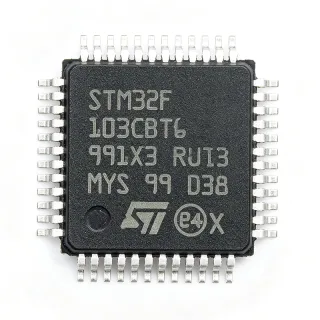
PIC16C622-04E/SS - 4MHz 8-bit CMOS EPROM MCU, 20-SSOP | Microchip
MPN: PIC16C622-04E/SS ✗ End of Life| Qty | Unit Price | Extended |
|---|---|---|
| 1 | $2.28 | $2.28 |
| 10 | $2.05 | $20.50 |
| 100 | $1.83 | $183.00 |
| 500 | $1.6 | $800.00 |
| 1,000 | $1.4 | $1,400.00 |
PIC16C622-04E/SS Overview
An 8-bit CMOS microcontroller (MCU) is a single-chip computer that integrates a CPU, RAM, program memory, and peripheral I/O into one package. The PIC16C family uses a RISC-based Harvard architecture with a 14-bit instruction word, providing deterministic instruction timing of one instruction per clock cycle (except branches). EPROM-based variants such as the PIC16C622 support one-time or windowed reprogrammability, making them well suited for low-volume and prototyping applications where Flash re-programmability is unnecessary.
Key features include fully static design (allowing clock stopping), 15 µA typical supply current at 5 V / 4 MHz, and 1 µA typical at 3 V / 32 kHz. The device also supports power-saving SLEEP mode, a watchdog timer, and a programmable code-protection feature on program memory. Its compact 20-pin SSOP footprint is pin-compatible with several siblings in the PIC16C62x family, simplifying board layout reuse across speed grades and temperature ranges.
The PIC16C622-04E/SS is widely deployed in legacy industrial controllers, appliance controls, automotive body modules, and instrumentation front-ends that benefit from its mature PIC instruction set and broad third-party toolchain support. The EPROM cell technology and 4 MHz instruction throughput are adequate for control-loop and interface-bridging tasks rather than compute-intensive signal processing.
When designing with this part, place a 0.1 µF decoupling capacitor close to the VDD pin and follow Microchip's recommended oscillator layout to minimize EMI. Engineers should also confirm code-protection programming settings before volume production, as the EPROM window cannot be un-protected after sealing.
This page synthesizes distributor pricing, drop-in PIC16C6xx alternatives, and practical design notes not found in the standalone manufacturer datasheet.
Drop-in alternatives for PIC16C622-04E/SS — same package, pin-to-pin compatible. Different-package parts requiring PCB rework are excluded.
Variants in this series
Same-series models that are drop-in compatible with PIC16C622-04E/SS (same form factor and footprint) — differing in Core Architecture, Package, Program Memory Size, Program Memory Type, RoHS Status.
Quick Comparison Tool — Select alternative parts for side-by-side comparison:
PIC16C622-04/SS
✅ Drop-In✓ In Stock
$1.18 / Unit
View Datasheet →PIC16C622-04I/SS
✅ Drop-In📋 Reference alternative (not in catalog)
PIC16C621-04/SS
✅ Drop-In📋 Reference alternative (not in catalog)
PIC16C620-04/SS
✅ Drop-In✓ In Stock
$2.2 / Unit
View Datasheet →PIC16C621A-20E/SS
✅ Drop-In✓ In Stock
$4.12 / Unit
View Datasheet →PIC16C621-20E/SS
✅ Drop-In✓ In Stock
$2.45 / Unit
View Datasheet →PIC16C622-04E/SS Maximum Ratings & Electrical Characteristics
| Family | PIC16C6xx |
| Core Architecture | 8-bit RISC (Harvard) |
| Instruction Word | 14-bit |
| Program Memory Type | EPROM (OTP/windowed) |
| Program Memory Size | 3.5 KB (2K x 14) |
| RAM Size | 128 bytes |
| Number of I/O Pins | 13 |
| CPU Speed (Max) | 4 MHz |
| Operating Voltage Range | 3.0 V to 6.0 V |
| Supply Current (Typ @ 5 V, 4 MHz) | 15 µA |
| Supply Current (Typ @ 3 V, 32 kHz) | 1 µA |
| Oscillator Type | External |
| Package | 20-SSOP (0.209 in / 5.30 mm width) |
| Operating Temperature Range | -40 °C to +125 °C (Extended) |
| Mounting Type | Surface Mount |
| Packaging | Tube |
PIC16C622-04E/SS Pin Configuration
| Pin 1 | RA2 — Bidirectional I/O port A bit 2 |
| Pin 2 | RA3 — Bidirectional I/O port A bit 3 |
| Pin 3 | RA4 — Bidirectional I/O port A bit 4 (open-drain option) |
| Pin 4 | MCLR/VPP — Master Clear (reset) input / programming voltage |
| Pin 5 | VSS — Ground reference |
| Pin 6 | RB0/INT — Bidirectional I/O port B bit 0 / external interrupt |
| Pin 7 | RB1 — Bidirectional I/O port B bit 1 |
| Pin 8 | RB2 — Bidirectional I/O port B bit 2 |
| Pin 9 | RB3 — Bidirectional I/O port B bit 3 |
| Pin 10 | RB4 — Bidirectional I/O port B bit 4 |
| Pin 11 | RB5 — Bidirectional I/O port B bit 5 |
| Pin 12 | RB6 — Bidirectional I/O port B bit 6 |
| Pin 13 | RB7 — Bidirectional I/O port B bit 7 |
| Pin 14 | VDD — Positive supply voltage |
| Pin 15 | OSC2/CLKOUT — Oscillator crystal output / clock out |
| Pin 16 | OSC1/CLKIN — Oscillator crystal input / external clock in |
| Pin 17 | RA0 — Bidirectional I/O port A bit 0 |
| Pin 18 | RA1 — Bidirectional I/O port A bit 1 |
| Pin 19 | RA5 — Bidirectional I/O port A bit 5 |
| Pin 20 | RA7 — Bidirectional I/O port A bit 7 |
Typical Applications
PIC16C622-04E/SS is suitable for 6 applications: Industrial Appliance Control, Automotive Body Electronics (Legacy), Remote Sensor Front-Ends, Smart Meter and Utility Modules, User-Interface and Keypad Controllers, Test and Measurement Front-Ends.
Industrial Appliance Control
The PIC16C622-04E/SS is well suited to industrial appliance controllers such as washing-machine front-panels, dishwasher timers, and HVAC thermostats. Its 4 MHz MIPS throughput is adequate for relay and triac sequencing, while the 13 digital I/O pins comfortably drive 7-segment displays, keypads, and indicator LEDs. The Extended -40 to +125 °C temperature grade survives under-cabinet thermal stress, and the 3.0-6.0 V supply range tolerates rectified mains-rail voltages after bulk regulation. EPROM program memory also provides excellent resistance to soft-errors in high-EMI motor environments, an important consideration when triac zero-cross circuits are nearby.
Recommended
Automotive Body Electronics (Legacy)
Legacy automotive body-control modules - including central-locking, mirror-adjustment, and seat-controller ECUs - often rely on the PIC16C622-04E/SS for its proven reliability and Extended temperature range. The 4 MHz CPU easily handles LIN-style slave protocols, PWM-driven mirror motors, and switch-matrix scanning, while the 20-SSOP footprint fits the small PCB area behind door trim panels. Engineers should note that AEC-Q100 qualification is not held by this part, so it is typically used in modules qualified at the system level. For new automotive platforms, Microchip recommends migrating to AEC-Q100-qualified PIC16F or PIC18F devices with the same SSOP-20 footprint.
Recommended
Remote Sensor Front-Ends
The PIC16C622-04E/SS fits remote sensor-interface nodes that read a small number of analog or digital sensors and forward data over UART or SPI to a host controller. The PIC16C622's internal comparator and voltage reference simplify threshold-detection circuits for battery-voltage monitoring and overtemperature alarms. Operating at 15 µA typical at 4 MHz/5 V, the device stays comfortably within the power budget of solar- or battery-powered wireless nodes. Its EPROM cell and 20-SSOP package also tolerate conformal coating and potting compounds used in outdoor sensor enclosures.
Recommended
Smart Meter and Utility Modules
Smart electricity, water, and gas-meter sub-assemblies have used the PIC16C622-04E/SS for tariff display drivers, button-input scanning, and low-speed optical-port communication. The 13 I/O pins multiplex segmented-LCD or LED display rows, optical UART pins, and tamper-detection switches, while the 128-byte RAM buffers calibration constants and recent-meter-read snapshots. The 3.0-6.0 V supply range is compatible with single-cell lithium-thionyl-chloride battery chemistries common in utility meters, and EPROM program memory ensures that firmware cannot be altered after meter sealing.
Recommended
User-Interface and Keypad Controllers
Elevator panels, security keypads, and access-control readers rely on the PIC16C622-04E/SS for matrix keypad scanning, LED or 7-segment display refresh, and buzzer or relay actuation. The PIC's deterministic instruction timing simplifies debounce and multiplex routines, eliminating the jitter visible with timer-heavy architectures. The 13 I/O pins easily handle a 4x4 keypad (8 lines) plus a few status LEDs and a relay driver. Because the part is fully static, the firmware can halt the oscillator during long idle periods, drawing only microamp-level standby current to preserve battery life in wireless access-control fobs.
Recommended
Test and Measurement Front-Ends
Bench-top test instruments, hand-held multimeters, and laboratory data-loggers often use the PIC16C622-04E/SS to perform range-selection switching, ADC handshaking, and LCD display driving. The PIC16C622's internal comparator is useful for autoranging threshold detection on the analog front-end, and the 4 MHz CPU keeps up with continuous ADC sampling rates up to a few kilosamples per second. The Extended temperature rating protects the part when the instrument is used in non-climate-controlled field environments, and the EPROM cell ensures calibration firmware cannot be accidentally erased by the user.
Recommended
Recommended Products Summary
Engineering reference data for PIC16C622-04E/SS — comparison, design guidance, and compliance information.
Selection Guide
Comparison with Alternatives
| Parameter | This Product | PIC16C622-04/SS | PIC16C622-04I/SS | PIC16C621-04/SS | PIC16C620-04/SS | PIC16C621A-20E/SS | PIC16C621-20E/SS |
|---|---|---|---|---|---|---|---|
| Package | 20-SSOP | 20-SSOP - same | 20-SSOP - same | 20-SSOP - same | 20-SSOP - same | 20-SSOP - same | 20-SSOP - same |
| Brand | Microchip Technology | Microchip Technology | Microchip Technology | Microchip Technology | Microchip Technology | Microchip Technology | Microchip Technology |
| Program Memory | 3.5 KB EPROM (2K x 14) | 3.5 KB EPROM | 3.5 KB EPROM | 3.5 KB EPROM | 512 x 14 EPROM (lower) | 3.5 KB EPROM | 3.5 KB EPROM |
| RAM Size | 128 bytes | 128 bytes | 128 bytes | 128 bytes | 128 bytes | 128 bytes | 128 bytes |
| CPU Speed (Max) | 4 MHz | 4 MHz | 4 MHz | 4 MHz | 4 MHz | 20 MHz (faster) | 20 MHz (faster) |
| Temperature Grade | Extended (-40 to +125 °C) | Commercial (0 to +70 °C) | Industrial (-40 to +85 °C) | Commercial (0 to +70 °C) | Commercial (0 to +70 °C) | Extended (-40 to +125 °C) | Extended (-40 to +125 °C) |
| Number of I/O | 13 | 13 | 13 | 13 | 13 | 13 | 13 |
| Internal Voltage Reference | Yes | Yes | Yes | No (omitted) | Yes | No (omitted) | No (omitted) |
Key Differentiators
- Extended temperature range (-40 to +125 °C) versus the commercial PIC16C622-04/SS counterpart (vs PIC16C622-04/SS)
- Internal band-gap voltage reference for on-chip comparator threshold generation (vs PIC16C621-04/SS)
- Mature EPROM technology with 3.5 KB program memory and 128 bytes RAM, fully static design (vs PIC16C620-04/SS)
Design Notes
Place a 0.1 µF ceramic decoupling capacitor within 5 mm of the VDD pin (pin 14) and a bulk capacitor (e.g., 10 µF tantalum or ceramic) near the IC supply entry. The PIC16C622-04E/SS draws 15 µA typical at 5 V/4 MHz, but brief inrush spikes during oscillator startup can reach several milliamps - the local bulk capacitor prevents VDD sag that would otherwise reset the device via brown-out. Tie the MCLR pin (pin 4) to VDD through a 10 kΩ resistor and add a 100 nF cap to ground for noise-immune reset behavior in industrial control panels.
The PIC16C622-04E/SS relies on an external clock source fed into OSC1/CLKIN (pin 16) or a crystal across OSC1/OSC2 (pints 15-16). Choose a crystal with low equivalent series resistance (ESR < 50 Ω) and add 15-22 pF load capacitors on each oscillator pin to ground to maintain stable oscillation across the -40 to +125 °C operating range. Routing the crystal traces short and symmetric, and guarding them with a ground ring, prevents EMI pickup that can degrade UART timing in noisy motor-control environments.
Do not assume that EPROM code protection can be reversed - once the code-protection fuse is programmed and the device is sealed (no window), the program memory cannot be read or rewritten. For prototype and pre-production units, order the JW (windowed) ceramic package variant or use a Flash-based PIC16F equivalent for in-circuit reprogrammability. Also note that the PIC16C622's internal voltage reference differs from the PIC16C621's - if your firmware depends on the band-gap reference, do not silently swap to PIC16C621 without re-tuning the comparator thresholds.
The 20-SSOP package has a 0.65 mm lead pitch, so PCB layout should use 0.30-0.40 mm wide traces between pads and a single ground pour on the top layer under the IC body. Keep digital switching traces (RB ports driving LEDs or relays) away from the analog-sensitive RA0/RA1 pins used for comparator inputs, since the PIC16C622 shares a single VDD/VSS and cannot isolate digital noise from analog references. A ferrite bead on VDD plus the local 0.1 µF cap is often necessary to keep ADC and comparator measurements stable in motor-control and HVAC designs.
Compliance Information
RoHS, lead-free, and halogen-free status were not directly stated in the verified web data; PIC16C EPROM parts from Microchip historically predate many of these compliance programs. AEC-Q100 qualification is not held by this part - Microchip recommends PIC16F or PIC18F AEC-Q100-qualified parts for new automotive designs.