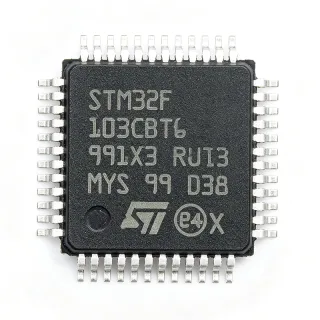
PIC16C62B-20I/ML - 8-Bit 20MHz 3.5KB OTP MCU 28-QFN | Microchip
MPN: PIC16C62B-20I/ML ✗ End of Life| Qty | Unit Price | Extended |
|---|---|---|
| 1 | $6.92 | $6.92 |
| 10 | $6.18 | $61.80 |
| 100 | $5.34 | $534.00 |
| 500 | $4.72 | $2,360.00 |
| 1,000 | $4.21 | $4,210.00 |
PIC16C62B-20I/ML Overview
An 8-bit microcontroller (MCU) is a single-chip computer built around an 8-bit data bus, integrating a CPU, program memory (ROM/OTP/Flash), data RAM, and programmable I/O peripherals on one die. Within the product hierarchy, the PIC16C62B belongs to the microcontroller (MCU) category -> 8-bit MCU -> CMOS MCU -> OTP (One-Time Programmable) MCU -> embedded control IC -> semiconductor. The PIC architecture uses a RISC instruction set with a 14-bit instruction word, allowing most instructions to execute in a single instruction cycle, which gives it deterministic timing and predictable interrupt latency compared with CISC 8-bit alternatives.
Key features of the PIC16C62B-20I/ML include: 22 digital I/O pins, an external oscillator interface, 20MHz maximum clock, 3.5KB OTP program memory for code storage, 128 bytes of RAM for variables and stack operations, and a Synchronous Serial Port (SSP) module for SPI/I2C communication. The 28-QFN package integrates an exposed thermal pad that improves heat dissipation and reduces PCB footprint, enabling high-density designs. The -40C to +85C industrial temperature range supports deployment in harsh environments without additional thermal management.
Architecturally, the PIC16C62B uses a Harvard architecture with separate program and data buses, allowing simultaneous instruction fetch and data access. Its OTP (One-Time Programmable) program memory uses EPROM cells that can be programmed once and retain data for decades, suited to high-volume production where firmware is finalized before manufacture. The brown-out detect (BOD), watchdog timer (WDT), and power-on reset (POR) circuits improve system reliability in noisy industrial environments.
Typical applications include industrial automation controllers, consumer appliance controls, automotive body electronics, HVAC thermostat logic, and low-cost sensor interface modules. Its small QFN footprint and integrated peripherals also make it suitable for compact handheld instruments and battery-powered telemetry devices.
When designing with this part, note that OTP memory cannot be re-programmed in the field - prototype with the windowed (JW) or Flash-based PIC16F equivalent and migrate to the PIC16C62B-20I/ML only after firmware is finalized. The Synchronous Serial Port module has documented anomalies (per Microchip silicon errata) that may affect SPI master-mode timing in some revision lots - review the device errata document before finalizing firmware timing.
This page consolidates distributor pricing, drop-in alternatives, and design considerations not duplicated in the manufacturer datasheet, providing engineers with an independent information source for PIC16C62B-20I/ML sourcing decisions.
Drop-in alternatives for PIC16C62B-20I/ML — same package, pin-to-pin compatible. Different-package parts requiring PCB rework are excluded.
Variants in this series
Same-series models that are drop-in compatible with PIC16C62B-20I/ML (same form factor and footprint) — differing in Package, Program Memory Size, Core Architecture, Program Memory Type, RoHS Status.
Quick Comparison Tool — Select alternative parts for side-by-side comparison:
PIC16C62B-04I/SS
✅ Drop-In ⚠️ 参数待验证✓ In Stock
$5.4 / Unit
View Datasheet →PIC16C62B-20E/SP
✅ Drop-In ⚠️ 参数待验证✓ In Stock
$5.85 / Unit
View Datasheet →PIC16F627A-I/ML
✅ Drop-In📋 Reference alternative (not in catalog)
PIC16F88-I/ML
✅ Drop-In ⚠️ 参数待验证📋 Reference alternative (not in catalog)
ATMEGA325-16MI
✅ Drop-In ⚠️ 参数待验证✓ In Stock
$3.05 / Unit
View Datasheet →PIC16C62B-20I/ML Maximum Ratings & Electrical Characteristics
| Product Type | 8-bit CMOS OTP Microcontroller |
| Family | PIC16C6x Mid-Range |
| Program Memory Size | 3.5 KB (2K x 14) OTP/EPROM |
| RAM Size | 128 bytes |
| EEPROM Size | None |
| CPU Core | PIC16 (14-bit instruction word, Harvard) |
| Maximum Clock Frequency | 20 MHz |
| Instruction Cycle Time | 200 ns at 20 MHz (4 clocks per instruction) |
| Number of I/O Pins | 22 |
| Package | 28-QFN (ML) with exposed thermal pad |
| Mounting Type | Surface Mount |
| Oscillator Type | External (crystal/RC) |
| Peripherals | SSP (SPI/I2C), 8-bit Timer, WDT, POR, BOD |
| Operating Voltage | 3.0 V to 5.5 V |
| Operating Temperature Range | -40 C to +85 C (Industrial) |
PIC16C62B-20I/ML Pin Configuration
| Pin 1 | RA2/AN2 — GPIO Port A bit 2 / Analog input 2 |
| Pin 2 | RA3/AN3 — GPIO Port A bit 3 / Analog input 3 |
| Pin 3 | RA4/T0CKI — GPIO Port A bit 4 / Timer0 clock input |
| Pin 4 | RA5/SS/AN4 — GPIO Port A bit 5 / SSP slave select / Analog input 4 |
| Pin 5 | VSS — Ground reference |
| Pin 6 | OSC1/CLKIN — External oscillator input / external clock in |
| Pin 7 | OSC2/CLKOUT — External oscillator output / clock out |
| Pin 8 | RC0 — GPIO Port C bit 0 |
| Pin 9 | RC1 — GPIO Port C bit 1 |
| Pin 10 | RC2 — GPIO Port C bit 2 |
| Pin 11 | RC3 — GPIO Port C bit 3 |
| Pin 12 | RC4 — GPIO Port C bit 4 |
| Pin 13 | RC5 — GPIO Port C bit 5 |
| Pin 14 | RC6 — GPIO Port C bit 6 |
| Pin 15 | RC7 — GPIO Port C bit 7 |
| Pin 16 | VSS — Ground (additional VSS pin) |
| Pin 17 | VDD — Positive supply voltage |
| Pin 18 | RB0/INT — GPIO Port B bit 0 / external interrupt |
| Pin 19 | RB1 — GPIO Port B bit 1 |
| Pin 20 | RB2 — GPIO Port B bit 2 |
| Pin 21 | RB3 — GPIO Port B bit 3 |
| Pin 22 | RB4 — GPIO Port B bit 4 |
| Pin 23 | RB5 — GPIO Port B bit 5 |
| Pin 24 | RB6 — GPIO Port B bit 6 |
| Pin 25 | RB7 — GPIO Port B bit 7 |
| Pin 26 | RA0/AN0 — GPIO Port A bit 0 / Analog input 0 |
| Pin 27 | RA1/AN1 — GPIO Port A bit 1 / Analog input 1 |
| Pin 28 | MCLR/VPP — Master clear reset / programming voltage |
| Pin EP | EPAD (VSS) — Exposed thermal pad - tie to PCB ground pour |
Typical Applications
PIC16C62B-20I/ML is suitable for 6 applications: Industrial Automation Controllers, Consumer Appliance Control, HVAC Thermostat Logic Controllers, Low-Cost Sensor Interface Modules, Automotive Body Electronics (Non-Safety), Compact Handheld Instruments.
Industrial Automation Controllers
The PIC16C62B-20I/ML suits industrial automation controllers thanks to its -40C to +85C industrial temperature range, 22 digital I/O lines, and brown-out detect / watchdog timer that improve reliability in electrically noisy factory environments. Its 3.5KB OTP program memory is enough for state-machine control of motors, conveyors, sensors, and relay sequencing. Engineers typically pair the MCU with opto-isolated input/output modules for 24V industrial logic, and the 20MHz clock rate gives a 200ns instruction cycle - fast enough for PID control loops at typical industrial update rates of 1-10 kHz. Replacement candidates: PIC16F627A-I/ML for in-field reprogrammability during commissioning.
Recommended
Consumer Appliance Control
The PIC16C62B-20I/ML is a strong fit for consumer appliance control boards (washing machines, dishwashers, microwave ovens, HVAC controls) where the OTP program memory holds finalized firmware in high-volume production. The 28-QFN (ML) package enables very compact board layouts required behind appliance control panels, and the exposed thermal pad dissipates heat from the MCU's switching transients. The Synchronous Serial Port module allows connection to LED driver ICs or character LCD displays via SPI. The industrial temperature rating tolerates appliance interior temperatures, and the OTP memory prevents accidental firmware overwrite during field service.
Recommended
HVAC Thermostat Logic Controllers
The PIC16C62B-20I/ML works well in HVAC thermostat controllers, reading temperature sensors via the SSP (I2C), driving TRIACs for heating/cooling stage control, and implementing hysteresis and safety timer logic in firmware. The 22 GPIO pins support multiple temperature setpoints, fan relays, and LED status indicators. The 20MHz clock executes multi-zone scheduling algorithms with adequate margin, while the -40C to +85C industrial range handles attic-mount and basement-mount locations. OTP memory protects against user tampering with the calibrated control parameters.
Recommended
Low-Cost Sensor Interface Modules
Sensor interface modules benefit from the PIC16C62B-20I/ML's low unit cost, 22 GPIOs, and SSP module that can act as I2C master for multi-sensor polling. The MCU reads sensor data, applies calibration coefficients, and outputs the result via SPI/UART to a host processor. The 28-QFN footprint keeps the module under 10x10 mm. For battery-powered sensor transmitters, the 3.0V minimum supply supports 2xAA alkaline cells with a boost regulator, although PIC16C62B lacks low-power sleep modes - consider the PIC16F88 for sleep-mode designs.
Recommended
Automotive Body Electronics (Non-Safety)
For non-safety automotive body electronics such as interior lighting controllers, seat-position memory modules, mirror-adjust controllers, and HVAC blend-door actuators, the PIC16C62B-20I/ML provides sufficient compute, GPIO count, and timing margin. The 20MHz instruction throughput handles PWM generation for brushed DC motor control via GPIOs and timer interrupts. Note that the -40C to +85C industrial range is acceptable for cabin electronics but insufficient for under-hood applications; AEC-Q100 qualification is not available for PIC16C62B - choose AEC-Q100 parts like PIC16F1936-E/ML for safety-relevant designs.
Recommended
Compact Handheld Instruments
Handheld measurement instruments such as digital calipers, multimeters, tachometers, and laser distance meters use the PIC16C62B-20I/ML to drive LCD segments, read rotary encoders, and process measurement results. The small 28-QFN (6x6 mm) package fits inside the limited PCB area of a handheld enclosure, and the exposed thermal pad provides mechanical rigidity for drop tests. The 20MHz clock delivers fast math routines for distance or temperature calculations. The OTP memory locks the factory calibration, preventing user field recalibration that could compromise measurement accuracy.
Recommended
Recommended Products Summary
Engineering reference data for PIC16C62B-20I/ML — comparison, design guidance, and compliance information.
Selection Guide
Comparison with Alternatives
| Parameter | This Product | PIC16C62B-04I/SS | PIC16C62B-20E/SP | PIC16F627A-I/ML | PIC16F88-I/ML | ATmega325-16MI |
|---|---|---|---|---|---|---|
| Brand | Microchip Technology | Microchip Technology | Microchip Technology | Microchip Technology | Microchip Technology | Microchip Technology |
| Package | 28-QFN (ML) | 28-QFN equivalent (ML) | 28-PDIP (SP) | 28-QFN (ML) - same | 28-QFN (ML) - same | 28-QFN (ML-equivalent) |
| Program Memory | 3.5 KB OTP | 3.5 KB OTP | 3.5 KB OTP | 1.75 KB Flash | 7 KB Flash | 32 KB Flash |
| RAM | 128 bytes | 128 bytes | 128 bytes | 224 bytes | 368 bytes | 2 KB |
| Max Clock | 20 MHz | 4 MHz | 20 MHz | 20 MHz | 20 MHz | 16 MHz |
| Program Memory Type | OTP/EPROM (one-time) | OTP/EPROM | OTP/EPROM | Flash (reprogrammable) | Flash (reprogrammable) | Flash (reprogrammable) |
| I/O Pins | 22 | 22 | 22 | 16-22 (family variant) | 16-22 | 54 |
| Operating Temperature | -40 C to +85 C | -40 C to +85 C | -40 C to +125 C (extended) | -40 C to +85 C | -40 C to +85 C | -40 C to +85 C |
| Lifecycle | Obsolete / NRND | Obsolete / NRND | Obsolete / NRND | Active | Active | Active |
Key Differentiators
- Higher 20 MHz clock speed vs 04 speed grade (vs PIC16C62B-04I/SS)
- Industrial temperature range matches typical factory environments (vs PIC16F627A-I/ML)
- QFN package saves PCB area vs PDIP (vs PIC16C62B-20E/SP)
Design Notes
OTP program memory cannot be re-programmed once the device is programmed and the UV-transparent window (if present) is sealed. Finalize firmware on a JW (windowed) or Flash-equivalent (PIC16F627A) part first, then commit production firmware to the PIC16C62B-20I/ML OTP part. Budget the OTP programming time at production: typical MCHP programmers take 1-2 seconds per device at 5V VPP. Ensure MCLR/VPP is correctly driven during programming per Microchip programming specification document DS30228.
The 28-QFN exposed thermal pad (EPAD) MUST be soldered to a PCB copper pour tied to VSS (ground) for both thermal dissipation and mechanical reliability. Use at least 4 thermal vias (0.3mm drill, 0.5mm pitch) in the EPAD land pattern. Keep high-current switching traces away from the OSC1/OSC2 oscillator pins to avoid clock jitter. Place a 0.1uF ceramic decoupling capacitor within 3mm of the VDD pin and a 10uF bulk capacitor near the MCU supply input.
The PIC16C62B SSP module has documented silicon errata affecting SPI master-mode timing in some revision lots. Per Microchip PIC16C6x errata documents, certain OSC configurations and SPI clock divisor combinations may produce non-compliant tV (output valid) timing on SDO. Verify SPI timing against the datasheet electricals with an oscilloscope during prototype validation, especially when the MCU interfaces with SD cards, EEPROMs, or display drivers. Avoid the affected OSC modes or use I2C mode if design flexibility allows.
Compliance Information
RoHS, REACH, lead-free, and halogen-free compliance status was not provided in the verified distributor data and is marked unknown in this page. Engineers should request the lot-specific Certificate of Conformance (CoC) from the supplier before using in RoHS-restricted or automotive applications. AEC-Q100 is not qualified; the industrial -40C to +85C rating does not satisfy automotive under-hood requirements.