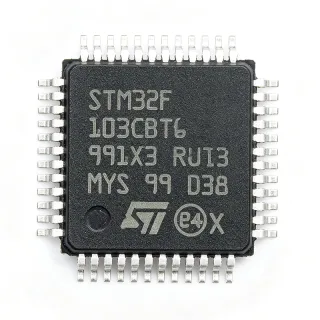
PIC16C63AT-04I/SO - 8-Bit OTP MCU 7KB 4MHz SOIC-28 | Microchip
MPN: PIC16C63AT-04I/SO ✓ Active| Qty | Unit Price | Extended |
|---|---|---|
| 1 | $9.15 | $9.15 |
| 10 | $8.42 | $84.20 |
| 100 | $7.65 | $765.00 |
| 500 | $6.88 | $3,440.00 |
| 1,000 | $6.2 | $6,200.00 |
PIC16C63AT-04I/SO Overview
An 8-bit microcontroller (MCU) is a single-chip computer containing a CPU, program memory, data RAM, I/O peripherals, and timers on one silicon die. The PIC16CXX mid-range family is the workhorse tier of Microchip's PIC architecture - it occupies the middle of the company's product pyramid: `PIC16CXX mid-range > PIC 8-bit > PICmicro > PIC16C > PIC family > microcontroller > embedded processor > semiconductor`. Mid-range parts strike a balance between code density, peripheral richness, and cost, which is why they have been embedded into billions of industrial, automotive, and consumer designs over three decades.
Key differentiating features include the OTP program memory for low per-unit cost in mature production runs, a wide 4 V to 5.5 V supply range, and a 10 MHz maximum clock speed option available on the 10/20 MHz siblings. The PIC16C63AT-04I/SO variant adds the -04 speed grade (4 MHz) and the -I industrial temperature range (-40C to +85C) over the standard commercial part, all within the same 28-pin SOIC footprint. The device also supports in-circuit serial programming (ICSP) via the RB6/RB7 pins, allowing firmware updates after PCB assembly.
Typical applications include industrial control, sensor signal conditioning, low-cost consumer appliances, automotive body controllers (pre-CAN era), and standalone serial peripherals. The OTP memory makes it especially well suited to high-volume mature products where firmware is locked and per-unit cost dominates BOM.
When designing with this part, plan around the OTP constraint: once programmed the memory cannot be erased. Engineers should prototype with the pin-compatible PIC16F63 (Flash) variant and migrate to PIC16C63A for production. Always reserve the ICSP pins for in-system programming access.
This page consolidates distributor pricing, drop-in alternatives (siblings and Flash-based equivalents), and practical design notes that are not aggregated on any single manufacturer or distributor page.
Drop-in alternatives for PIC16C63AT-04I/SO — same package, pin-to-pin compatible. Different-package parts requiring PCB rework are excluded.
Variants in this series
Same-series models that are drop-in compatible with PIC16C63AT-04I/SO (same form factor and footprint) — differing in Core Architecture, Operating Temperature, Package.
Quick Comparison Tool — Select alternative parts for side-by-side comparison:
PIC16C63A-04I/SO
✅ Drop-In📋 Reference alternative (not in catalog)
PIC16C63AT-04E/SO
✅ Drop-In✓ In Stock
$4.05 / Unit
View Datasheet →PIC16F63-I/SO
✅ Drop-In📋 Reference alternative (not in catalog)
PIC16C63-04I/SO
✅ Drop-In📋 Reference alternative (not in catalog)
PIC16C63AT-04I/SO Maximum Ratings & Electrical Characteristics
| Core Architecture | PIC16CXX mid-range 8-bit RISC (Harvard) |
| Program Memory Type | OTP (One-Time Programmable) EPROM |
| Program Memory Size | 7 KB (4K x 14 words) |
| RAM | 192 bytes |
| EEPROM | None (OTP part) |
| Maximum Clock Speed | 4 MHz (this -04 grade); 10/20 MHz on other grades |
| Instruction Cycle | 4 x oscillator period (200 ns at 20 MHz) |
| Instruction Set | 35 single-word instructions |
| I/O Pins | 22 |
| Supply Voltage | 4.0 V to 5.5 V |
| Operating Temperature | -40C to +85C (industrial, -I suffix) |
| Package | 28-pin SOIC (SO), 7.50 mm wide body |
| Mounting Type | Surface Mount |
| MSL Level | 1 (unlimited floor life at <30C/85% RH) |
| Peripherals | USART, SSP (SPI/I2C), 2x Capture/Compare/PWM, 8-bit ADC, 2x 8-bit timers, 1x 16-bit timer |
| Watchdog Timer | Yes (WDT with on-chip RC oscillator) |
| ICSP | Yes (RB6/ICSPCLK, RB7/ICSPDAT) |
PIC16C63AT-04I/SO Pin Configuration
| Pin 1 | MCLR/VPP — Master clear reset (active low) / ICSP programming voltage input |
| Pin 2 | RA0/AN0 — PORTA bit 0 / Analog input 0 |
| Pin 3 | RA1/AN1 — PORTA bit 1 / Analog input 1 |
| Pin 4 | RA2/AN2 — PORTA bit 2 / Analog input 2 |
| Pin 5 | RA3/AN3/VREF- — PORTA bit 3 / Analog input 3 / ADC VREF- |
| Pin 6 | RA4/T0CKI — PORTA bit 4 / Timer0 clock input |
| Pin 7 | RA5/AN4/SS/VREF+ — PORTA bit 5 / Analog input 4 / SSP slave select / ADC VREF+ |
| Pin 8 | OSC2/CLKOUT — Oscillator output / clock out (crystal mode) or Fosc/4 (RC mode) |
| Pin 9 | OSC1/CLKIN — Oscillator input / external clock input |
| Pin 10 | RC0/T1OSO/T1CKI — PORTC bit 0 / Timer1 oscillator output / Timer1 clock input |
| Pin 11 | RC1/T1OSI/CCP2 — PORTC bit 1 / Timer1 oscillator input / CCP2 I/O |
| Pin 12 | RC2/CCP1 — PORTC bit 2 / CCP1 I/O |
| Pin 13 | RC3/SCK/SCL — PORTC bit 3 / SSP SPI clock / I2C clock |
| Pin 14 | RC4/SDI/SDA — PORTC bit 4 / SSP SPI data in / I2C data |
| Pin 15 | RC5/SDO — PORTC bit 5 / SSP SPI data out |
| Pin 16 | RC6/TX/CK — PORTC bit 6 / USART TX / USART synchronous clock |
| Pin 17 | RC7/RX/DT — PORTC bit 7 / USART RX / USART synchronous data |
| Pin 18 | RB0/INT — PORTB bit 0 / external interrupt |
| Pin 19 | RB1 — PORTB bit 1 |
| Pin 20 | RB2 — PORTB bit 2 |
| Pin 21 | RB3 — PORTB bit 3 |
| Pin 22 | RB4 — PORTB bit 4 |
| Pin 23 | RB5 — PORTB bit 5 |
| Pin 24 | RB6/ICSPCLK — PORTB bit 6 / ICSP clock |
| Pin 25 | RB7/ICSPDAT — PORTB bit 7 / ICSP data |
| Pin 26 | VSS — Ground reference (pair with pin 25 connection on PCB) |
| Pin 27 | VDD — Positive supply 4.0 V to 5.5 V |
| Pin 28 | VSS — Ground reference |
Typical Applications
PIC16C63AT-04I/SO is suitable for 6 applications: Industrial Sensor Signal Conditioning, Low-Cost Consumer Appliance Control, Automotive Body Electronics (Pre-CAN), Standalone Serial-Peripheral Bridge, Educational Microcontroller Trainer Board, Battery-Operated Remote Control / IR Transmitter.
Industrial Sensor Signal Conditioning
The PIC16C63AT-04I/SO suits sensor front-end boards needing 22 digital I/O for switch scanning, relay drivers, and indicator LEDs. Its 4 MIPS throughput at 4 MHz is enough to debounce inputs, run a small lookup-table linearization in firmware, and drive a 7-segment display via PORTC. The industrial -40C to +85C rating covers most factory-floor environments, and the OTP cost advantage lets the BOM stay under USD 10 even at low volumes.
Recommended
Low-Cost Consumer Appliance Control
White-goods controllers (microwave keypads, washing-machine user interfaces, coffee-machine pumps) rely on the PIC16C63AT-04I/SO for its tiny BOM, single 5 V supply, and proven OTP reliability in fielded units. The integrated USART drives the user-interface serial display, the CCP modules generate triac-firing pulses for heater control, and the 192-byte RAM is sufficient for menu state machines. The part has shipped in tens of millions of small appliances since its release.
Recommended
Automotive Body Electronics (Pre-CAN)
Pre-CAN-era body controllers (window lift, seat memory, mirror adjust, lighting) were built around the PIC16C63AT-04I/SO because it offers 22 robust I/O, ICSP for end-of-line programming, and 5 V noise tolerance. The -I industrial temperature range covers most cabin environments; for under-hood duty the -E extended grade is preferred. The PIC16C63A is widely second-sourced in automotive aftermarket modules.
Recommended
Standalone Serial-Peripheral Bridge
Engineers repurpose the PIC16C63AT-04I/SO as a UART-to-GPIO or UART-to-PWM bridge when a larger MCU is overkill. The USART talks to a host processor while the SSP (SPI/I2C) talks to a sensor; firmware on the PIC does format conversion in 7 KB of code. OTP makes the bridge a locked, royalty-free implementation that competitors cannot reverse-engineer in volume production.
Recommended
Educational Microcontroller Trainer Board
University embedded-systems labs still deploy the PIC16C63AT-04I/SO on trainer boards because the 35-instruction RISC ISA is teachable in one lecture, the ICSP interface works on a breadboard with a PICkit-2, and the SOIC-28 package fits standard 0.1-inch headers via SOIC-to-DIP adapters. OTP adds the pedagogical lesson of mask-set economics versus Flash reprogrammability.
Recommended
Battery-Operated Remote Control / IR Transmitter
The PIC16C63AT-04I/SO Sleep mode draws microamps and wakes on interrupt, making it a fit for handheld IR/RF remote controls where battery life dominates BOM. The CCP module generates the 38 kHz carrier, the USART orbit-samples the button matrix, and the 192-byte RAM holds the learned-code table. OTP locks the protocol to prevent third-party cloning.
Recommended
Recommended Products Summary
Engineering reference data for PIC16C63AT-04I/SO — comparison, design guidance, and compliance information.
Selection Guide
Comparison with Alternatives
| Parameter | This Product | PIC16C63A-04I/SO | PIC16C63AT-04E/SO | PIC16F63-I/SO | PIC16C63-04I/SO |
|---|---|---|---|---|---|
| Package | SOIC-28 | SOIC-28 - same | SOIC-28 - same | SOIC-28 - same | SOIC-28 - same |
| Brand | Microchip Technology | Microchip Technology | Microchip Technology | Microchip Technology | Microchip Technology |
| Program Memory | 7 KB OTP | 7 KB OTP | 7 KB OTP | 4 KB Flash | 7 KB OTP |
| Max Clock Speed | 4 MHz | 4 MHz | 4 MHz | 20 MHz | 4 MHz |
| Operating Temperature | -40C to +85C (industrial) | -40C to +85C | -40C to +125C (extended) | -40C to +85C | -40C to +85C |
| Memory Type | OTP EPROM | OTP EPROM | OTP EPROM | Flash (reprogrammable) | OTP EPROM |
| RAM | 192 bytes | 192 bytes | 192 bytes | 192 bytes | 192 bytes |
| I/O Pins | 22 | 22 | 22 | 22 | 22 |
| Pin-to-Pin Compatible | Yes | Yes (identical die) | Yes (temp grade only) | Yes (Flash sibling) | Yes (earlier die rev) |
Key Differentiators
- Pin-compatible Flash successor (vs PIC16F63-I/SO)
- Industrial temperature range as standard (vs PIC16C63A-04I/SO (no -E grade))
- Wide 5 V supply tolerance with on-chip BOR (vs PIC16C63-04I/SO (earlier rev))
Design Notes
The OTP program memory cannot be erased or rewritten. Once programmed, a programming fault is permanent - any bit-cell failure locks the part. For firmware development, prototype with the Flash-based PIC16F63-I/SO which is pin-compatible and supports thousands of erase/write cycles. Reserve the ICSP pins (RB6/ICSPCLK, RB7/ICSPDAT) on the PCB layout even if not used in production, in case field firmware updates are needed.
Estimated: at 4 MHz active current is approximately 2 mA + I/O drive current. VDD rise time on power-up must meet the BOR (brown-out reset) spec; a slow rise can leave the part in undefined state. Add a 100 nF decoupling capacitor between VDD (pin 20) and VSS (pin 19) placed within 5 mm of the IC pins, plus a 10 uF bulk capacitor at the regulator. Place a 10 kohm pull-up on MCLR (pin 1) per Microchip recommendation.
Crystal/oscillator traces from OSC1 (pin 9) and OSC2 (pin 8) should be kept short and surrounded by a ground guard ring to avoid coupling noise into the internal clock. For high-noise environments use a 4-pin crystal with the case grounded. The ICSP clock and data pins (RB6, RB7) need series resistors of 10-100 ohm if long PCB traces run to the programming header, to limit ringing.
The PIC16C63A USART baud-rate generator at 4 MHz oscillator yields exactly 9600 baud with BRGH=1 and SPBRG=25 (error 0.16%) - useful when no crystal is fitted. For SSI/SPI bus runs over 50 mm, place a 10-100 ohm series damping resistor at the driver pin and keep clock and data traces length-matched. The 5 V logic levels are TTL-compatible but not directly LVCMOS - verify level translation to 3.3 V peripherals.
At maximum 4 MHz clock the active supply current is ~2 mA plus I/O drive; total power dissipation is well below 100 mW so no heatsink or thermal copper pour is required. However, the industrial -40C to +85C temperature rating assumes the SOIC-28 thermal pad (none on this part) and standard JEDEC EIA/JESD51 test board. Outputs sourcing >20 mA per pin should be limited to 4 pins simultaneously per the absolute-maximum DC current spec to stay safe.
Compliance Information
RoHS and REACH status vary by production lot - Microchip ships both Pb-free matte-tin finish and legacy SnPb finish parts; declare by lot in production builds. AEC-Q100 is not_applicable for this industrial-grade part; Microchip does not market PIC16CXX for automotive safety-critical use. Lead-free matte-tin finish is the current standard production finish per Microchip product declaration.