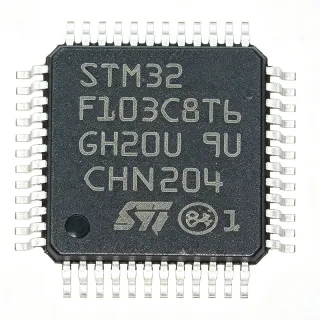
PIC16C642-20E/SO - 8-bit OTP MCU, 7KB, 22 I/O, 28-SOIC | Microchip
MPN: PIC16C642-20E/SO ✓ Active| Qty | Unit Price | Extended |
|---|---|---|
| 1 | $8.1 | $8.10 |
| 10 | $7.3 | $73.00 |
| 100 | $6.55 | $655.00 |
| 500 | $5.85 | $2,925.00 |
| 1,000 | $5.2 | $5,200.00 |
PIC16C642-20E/SO Overview
A PIC microcontroller (Peripheral Interface Controller) is a Harvard-architecture RISC microprocessor family originally developed by Microchip Technology. PIC microcontrollers combine a small instruction set (RISC) with separate program and data buses, allowing single-cycle instruction execution under typical conditions. They sit within the broader taxonomy: microcontroller -> embedded processor -> microprocessor -> semiconductor IC. The PIC16C sub-family adds one-time-programmable EPROM program memory, making these parts suitable for low-volume production and legacy designs where in-system reprogramming is not required.
Key features of the PIC16C642 include the 8-bit timer/counter with prescaler, capture/compare/PWM module, 8-channel 8-bit ADC (multiplexed), synchronous serial port (SSP) supporting SPI and I2C, and a USART for asynchronous serial communication. The device also provides a watchdog timer with its own on-chip RC oscillator for reliable recovery, power-on reset, and a programmable code-protection scheme to safeguard firmware IP.
The PIC16C642 uses a 14-bit instruction word with a Harvard memory layout, which is why the program memory is referenced as 7KB (4K x 14). This wider instruction word provides richer addressing and branch capability compared to 12-bit PIC cores, while keeping code density high. Internal peripheral features are mapped to a bank of special-function registers, and the device operates from a single 5V supply typical of industrial and automotive embedded systems.
Typical applications for the PIC16C642-20E/SO include automotive body and chassis controllers, industrial sensor interfaces, simple motor control loops, and appliance user-interface boards. The extended temperature grade and OTP program memory make it a strong fit for production runs where firmware is finalized and a cost-optimized non-reprogrammable solution is preferred.
When designing with this part, plan oscillator and I/O pin assignments early because OTP cannot be changed after programming. Use MPLAB IDE with Hi-Tech PICC or MPLAB XC8 compilers to generate the .HEX image, then program the device using Microchip's PM3 programmer or a compatible gang programmer.
This page synthesizes distributor pricing, drop-in alternatives from the same PIC16C and PIC16F families, and practical design notes not found in the manufacturer datasheet alone, helping engineers compare the part against both pin-compatible OTP and Flash siblings.
Drop-in alternatives for PIC16C642-20E/SO — same package, pin-to-pin compatible. Different-package parts requiring PCB rework are excluded.
Variants in this series
Same-series models that are drop-in compatible with PIC16C642-20E/SO (same form factor and footprint) — differing in Package, Program Memory Size, Operating Temperature Range, Timers, Mounting Type.
Quick Comparison Tool — Select alternative parts for side-by-side comparison:
PIC16C642-04E/SO
✅ Drop-In ⚠️ 参数待验证✓ In Stock
$3.62 / Unit
View Datasheet →PIC16C642-20I/SO
✅ Drop-In ⚠️ 参数待验证✓ In Stock
$2.3 / Unit
View Datasheet →PIC16C642-04E/SP
✅ Drop-In ⚠️ 参数待验证✓ In Stock
$5.65 / Unit
View Datasheet →PIC16C642-20/SO
✅ Drop-In ⚠️ 参数待验证✓ In Stock
$4.85 / Unit
View Datasheet →PIC16C642T-20E/SO
✅ Drop-In ⚠️ 参数待验证✓ In Stock
$3.75 / Unit
View Datasheet →PIC16F630-I/SL
✅ Drop-In📋 Reference alternative (not in catalog)
PIC16C642-20E/SO Maximum Ratings & Electrical Characteristics
| Manufacturer | Microchip Technology |
| Series | PIC 16C |
| Core Processor | PIC |
| Core Size | 8-bit |
| Program Memory Size | 7KB (4K x 14) |
| Program Memory Type | OTP (One-Time Programmable) |
| RAM Size | 176 x 8 bytes |
| Number of I/O Pins | 22 |
| Maximum Clock Frequency | 20 MHz |
| Instruction Execution Time | 200 ns |
| Number of Instructions | 35 single-word |
| Supply Voltage | 5 V (typical) |
| Package / Case | 28-SOIC (0.295 inch, 7.50 mm width) |
| Mounting Type | Surface Mount |
| Operating Temperature Grade | Automotive (-40C to +125C) |
PIC16C642-20E/SO Pin Configuration
| Pin 1 | RA2/AN2/VREF- — I/O port A bit 2, analog input, or ADC reference negative |
| Pin 2 | RA3/AN3/VREF+ — I/O port A bit 3, analog input, or ADC reference positive |
| Pin 3 | RA4/T0CKI — I/O port A bit 4, or Timer 0 clock input |
| Pin 4 | RA5/SS/AN4 — I/O port A bit 5, SPI slave select, or analog input 4 |
| Pin 5 | RA6/OSC2/CLKO — I/O port A bit 6, or oscillator crystal/clock output |
| Pin 6 | RA7/OSC1/CLKI — I/O port A bit 7, or oscillator crystal/clock input |
| Pin 7 | VSS — Ground reference |
| Pin 8 | VDD — Positive supply voltage (+5V) |
| Pin 9 | RB0/INT — I/O port B bit 0, or external interrupt input |
| Pin 10 | RB1 — I/O port B bit 1 |
| Pin 11 | RB2 — I/O port B bit 2 |
| Pin 12 | RB3 — I/O port B bit 3 |
| Pin 13 | RB4 — I/O port B bit 4 |
| Pin 14 | RB5 — I/O port B bit 5 |
| Pin 15 | RB6 — I/O port B bit 6 |
| Pin 16 | RB7 — I/O port B bit 7 |
| Pin 17 | MCLR/VPP — Master clear reset input or programming voltage input |
| Pin 18 | RC0/T1OSO/T1CKI — I/O port C bit 0, Timer 1 oscillator output or clock input |
| Pin 19 | RC1/T1OSI/CCP2 — I/O port C bit 1, Timer 1 oscillator input, or CCP2 module |
| Pin 20 | RC2/CCP1 — I/O port C bit 2, or Capture/Compare/PWM 1 |
| Pin 21 | RC3/SCK/SCL — I/O port C bit 3, SPI clock, or I2C clock |
| Pin 22 | RC4/SDI/SDA — I/O port C bit 4, SPI data in, or I2C data |
| Pin 23 | RC5/SDO — I/O port C bit 5, or SPI data out |
| Pin 24 | RC6/TX/CK — I/O port C bit 6, USART transmit, or clock |
| Pin 25 | RC7/RX/DT — I/O port C bit 7, USART receive, or data |
| Pin 26 | VSS — Ground reference |
| Pin 27 | VDD — Positive supply voltage (+5V) |
| Pin 28 | NC — Not connected (per datasheet) |
Typical Applications
PIC16C642-20E/SO is suitable for 7 applications: Automotive Body Control Modules, Industrial Sensor Interface Boards, Appliance User-Interface Controllers, Simple Closed-Loop Motor Control, Standalone Security and Access Panels, Cost-Optimized Legacy Embedded Replacements, Smart Home Sensor Hubs.
Automotive Body Control Modules
The PIC16C642-20E/SO is well suited for automotive body and chassis ECUs thanks to its -40C to +125C operating range, 5 MIPS instruction throughput at 20 MHz, and 22 I/O pins for switch scanning, lamp drivers, and relay control. The 7KB OTP memory holds body controller firmware for door locks, window lifters, and mirror positioning. Compared with Flash parts, OTP delivers lower per-unit cost in high-volume runs and reduces the risk of unauthorized firmware modification in deployed ECUs, which is critical for automotive functional safety. Brown-out reset and watchdog timer add fault recovery for under-voltage cranking events.
Recommended
Industrial Sensor Interface Boards
Industrial sensor signal-conditioning and limit-detection boards benefit from the PIC16C642-20E/SO's two on-chip analog comparators, 8-channel 8-bit ADC, and 22 digital I/O. The 200 ns instruction execution enables fast scanning of multiple sensor inputs with deterministic response times for threshold or alarm logic. With 176 bytes of RAM and 7KB OTP code space, the device can host PID or hysteresis control loops for temperature, pressure, or flow sensors. The extended -40C to +125C rating supports deployment near motors and process equipment without additional thermal conditioning.
Recommended
Appliance User-Interface Controllers
Washing machines, dishwashers, and microwave ovens use the PIC16C642-20E/SO as a user-interface controller for keypad scanning, LED or LCD drive, and buzzer control. The 22 I/O pins handle up to a 4x5 keypad matrix plus indicator LEDs without external I/O expanders. The 200 ns instruction execution supports anti-bounce debounce routines and smooth knob quadrature decoding. OTP memory keeps firmware locked against field tampering or aftermarket modification, while the 5 MIPS performance comfortably handles both UI refresh and serial communication with the main appliance controller.
Recommended
Simple Closed-Loop Motor Control
The PIC16C642-20E/SO can drive small brushless DC or stepper motor control loops using its PWM module and analog comparators for back-EMF sensing. The 20 MHz clock supports a 5 MIPS loop rate, sufficient for low-RPM commutation and current limiting. With 22 I/O the device can drive half-bridges directly through external gate drivers, monitor over-current via comparators, and sequence startup safely. The OTP memory holds the motor control algorithm and protects IP from cloning by aftermarket competitors.
Recommended
Standalone Security and Access Panels
Door access panels, alarm keypads, and RFID readers use the PIC16C642-20E/SO for keypad decoding, relay control of door strikes, and serial uplink to a central panel. The OTP memory prevents firmware extraction and code modification by attackers, which is critical for security hardware. The 35-instruction RISC core supports efficient look-up-table-based keypad decryption and time-of-day logic with the on-chip timer. The automotive temperature rating ensures operation in outdoor enclosures.
Recommended
Cost-Optimized Legacy Embedded Replacements
Legacy PIC16C-based designs in discontinued products can be sustained with the PIC16C642-20E/SO as a long-life OTP replacement that matches the original 28-pin SOIC footprint. Designers avoid re-routing the PCB and re-validating analog front ends. The 20 MHz performance and 7KB OTP accommodate the legacy firmware without code changes, and the automotive temperature grade allows the same part to serve both consumer and industrial SKUs, simplifying BOM management.
Recommended
Smart Home Sensor Hubs
The PIC16C642-20E/SO is suitable as a secondary microcontroller in smart-home sensor hubs that aggregate temperature, humidity, and occupancy data for transmission to a primary Wi-Fi or Zigbee host. With 22 I/O the device can scan multiple analog and digital sensor inputs simultaneously while driving status LEDs. The extended temperature grade supports attic, garage, and outdoor sensor deployments. OTP memory prevents over-the-air firmware tampering, complementing secure boot on the primary host MCU.
Recommended
Recommended Products Summary
Engineering reference data for PIC16C642-20E/SO — comparison, design guidance, and compliance information.
Selection Guide
Comparison with Alternatives
| Parameter | This Product | PIC16C642-04E/SO | PIC16C642-20I/SO | PIC16C642-20/SO | PIC16C642T-20E/SO | PIC16F630-I/SL |
|---|---|---|---|---|---|---|
| Brand | Microchip Technology | Microchip Technology | Microchip Technology | Microchip Technology | Microchip Technology | Microchip Technology |
| Package | 28-SOIC | 28-SOIC - same | 28-SOIC - same | 28-SOIC - same | 28-SOIC - same | 14-SOIC - smaller |
| Program Memory | 7KB OTP | 7KB OTP | 7KB OTP | 7KB OTP | 7KB OTP | 1KB Flash |
| Maximum Clock | 20 MHz | 4 MHz | 20 MHz | 20 MHz | 20 MHz | 20 MHz |
| Temperature Grade | Automotive (-40C to +125C) | Automotive (-40C to +125C) | Industrial (-40C to +85C) | Commercial (0C to +70C) | Automotive (-40C to +125C) | Industrial (-40C to +85C) |
| RAM Size | 176 bytes | 176 bytes | 176 bytes | 176 bytes | 176 bytes | 64 bytes |
| I/O Pins | 22 | 22 | 22 | 22 | 22 | 12 |
| Program Memory Type | OTP | OTP | OTP | OTP | OTP | Flash |
Key Differentiators
- Extended automotive temperature grade in a 28-SOIC footprint (vs PIC16C642-20/SO)
- Larger 7KB OTP and 22 I/O vs Flash-based PIC16F630-I/SL (vs PIC16F630-I/SL)
- 20 MHz speed grade (5 MIPS) for time-critical loops (vs PIC16C642-04E/SO)
- Automotive temp grade at 20 MHz with 7KB OTP in 28-SOIC (vs PIC16F636-I/SL)
Design Notes
OTP program memory cannot be re-programmed. Plan firmware and verification thoroughly using a Flash-based sibling such as PIC16F636-I/SL on a development board before committing to OTP production programming. Once the part is OTP-programmed, any bug is a scrap event, so use the PM3 programmer with verification enabled to catch bad programming cycles. Always enable code protection fuses only after final firmware validation.
Place a 100 nF decoupling capacitor as close as possible to each VDD pin (pins 8 and 27) and a bulk 10 uF tantalum or ceramic on the board-level VDD rail. For SOIC packages, route VDD and VSS on adjacent layers with vias stitching them near the IC to minimize ground bounce on the 20 MHz oscillator transitions. Keep the oscillator traces (OSC1/OSC2, pins 6/5) short and surrounded by a ground guard ring to avoid injection of switching noise into the clock.
The PIC16C642-20E/SO has limited drive strength on each I/O (typically 25 mA source/sink) and shares VDD/VSS across the chip. When driving relays or high-current loads, use a buffer transistor (e.g., 2N2222) or driver IC rather than the MCU pin directly. For analog inputs, the ADC reference (VREF+/VREF-, pins 2/3) must be decoupled with 100 nF + 10 uF and have low-impedance traces; reference noise directly degrades ADC accuracy on the 8-bit conversion.
At 20 MHz clock the PIC16C642-20E/SO consumes approximately 10-15 mA active current from 5V, dissipating under 100 mW even at 100% CPU load. The 28-SOIC package's theta_JA of approximately 80 C/W yields a junction temperature rise of <10 C above ambient, so no heatsinking is required. However, the automotive -40C to +125C temperature grade is a silicon-level spec and does not require any external thermal management within typical use cases.
Compliance Information
RoHS/REACH/AEC-Q100 compliance status was not provided in the verified web data and must be confirmed with Microchip's product compliance documentation before production use. The 'E' temperature suffix indicates extended automotive qualification but does not necessarily imply AEC-Q100 certification.