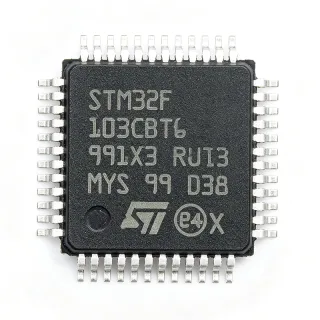
PIC16C64A-04/L - 8-bit OTP MCU, 4MHz, 3.5KB | Microchip
MPN: PIC16C64A-04/L ✓ Active| Qty | Unit Price | Extended |
|---|---|---|
| 1 | $11.2 | $11.20 |
| 10 | $9.85 | $98.50 |
| 100 | $8.45 | $845.00 |
| 500 | $7.1 | $3,550.00 |
| 1,000 | $6.2 | $6,200.00 |
PIC16C64A-04/L Overview
Background: An 8-bit microcontroller (MCU) is a single-chip computer integrating a CPU, memory (ROM/RAM), and programmable I/O peripherals. Within the MCU taxonomy, the PIC16C64A belongs to the PIC16C family, which in turn falls under the broader category of microcontrollers -> embedded processors -> integrated circuits. The PIC architecture uses a Harvard-design RISC CPU with 35 single-word instructions, making it well suited for cost-sensitive, deterministic real-time control. The OTP suffix means the program memory can be written once (mask ROM-like behavior at low NRE cost), making PIC16C64A variants appropriate for medium-volume production.
Key features include a high-performance RISC CPU executing most instructions in a single clock cycle, 4MHz operation at 4V-5.5V supply, 33 I/O pins supporting digital I/O, two 8-bit timers and one 16-bit timer/counter, a USART serial port, and low-power operation (less than 2mA typical at 5V/4MHz, with sleep-mode currents under 1uA typical). The device offers multiple interrupt sources and a hardware watchdog timer.
Architecturally, the PIC16C64A-04/L uses a Harvard memory structure with separate program and data buses, enabling simultaneous instruction fetch and operand access. Its RISC engine performs most instructions in one instruction cycle (4 oscillator clocks), giving a 4MHz oscillator a 1 MIPS instruction throughput. The wide operating voltage (2.5V-6.0V range across the family) and integrated peripherals (USART, timers, watchdog, capture/compare/PWM) eliminate external glue logic in typical embedded designs.
Typical applications include industrial process control, motor control front-ends, automotive body electronics, sensor signal conditioning, keypad/display interfaces, embedded serial-communication nodes, and legacy replacement of older 8051 or HC11 designs where software IP exists for PIC assembly. The windowed ceramic L-package also serves engineering development and prototype builds.
Design consideration: When migrating from PIC16C64A-04/L to a flash-memory equivalent (PIC16F877A or PIC16F877), note the pinout is largely compatible but the program memory technology differs. Designers should plan for ICP/ICD programming headers and decoupling (100nF + 10uF) close to VDD/VSS pins to support the 33 simultaneously-switching I/Os.
This page synthesizes distributor pricing, OTP vs flash alternatives, and practical design notes beyond what the manufacturer datasheet alone provides.
Drop-in alternatives for PIC16C64A-04/L — same package, pin-to-pin compatible. Different-package parts requiring PCB rework are excluded.
Variants in this series
Same-series models that are drop-in compatible with PIC16C64A-04/L (same form factor and footprint) — differing in Mounting Type, Program Memory Type, Package, Program Memory Size, RAM Size.
Quick Comparison Tool — Select alternative parts for side-by-side comparison:
PIC16C65B-04/L
✅ Drop-In📋 Reference alternative (not in catalog)
PIC16C66-04/L
✅ Drop-In📋 Reference alternative (not in catalog)
PIC16F877A-04/L
✅ Drop-In📋 Reference alternative (not in catalog)
PIC16C64A-04I/L
✅ Drop-In ⚠️ 参数待验证✓ In Stock
$4.5 / Unit
View Datasheet →PIC16C64A-10/L
✅ Drop-In ⚠️ 参数待验证✓ In Stock
$5.5 / Unit
View Datasheet →PIC16C64B-04/L
✅ Drop-In📋 Reference alternative (not in catalog)
PIC16C64A-04/L Maximum Ratings & Electrical Characteristics
| Product Family | PIC16C 8-bit Microcontroller |
| Core | 8-bit RISC |
| Maximum Clock Speed | 4 MHz |
| Program Memory Type | OTP (One-Time Programmable) |
| Program Memory Size | 3.5 KB (2K x 14) |
| RAM Size | 128 bytes |
| Number of I/O Pins | 33 |
| Data EEPROM | Not present (OTP family) |
| Supply Voltage (Vdd) | 4.0 V to 5.5 V |
| Package | 44-pin PLCC (Leaded Chip Carrier, windowed ceramic) |
| Mounting Type | Surface Mount |
| Number of Instructions | 35 |
| Instruction Cycle | Single cycle (except program branches, 2 cycles) |
| Watchdog Timer | Yes (hardware) |
PIC16C64A-04/L Pin Configuration
| Pin 1 | MCLR/VPP — Master Clear (Reset) input / programming voltage |
| Pin 2 | RA0 — PORTA bit 0 (digital I/O) |
| Pin 3 | RA1 — PORTA bit 1 (digital I/O) |
| Pin 4 | RA2 — PORTA bit 2 (digital I/O) |
| Pin 5 | RA3 — PORTA bit 3 (digital I/O) |
| Pin 6 | RA4 — PORTA bit 4 (digital I/O, open-drain) |
| Pin 7 | RA5 — PORTA bit 5 (digital I/O) |
| Pin 8 | VSS — Ground |
| Pin 9 | OSC1/CLKIN — Oscillator input / external clock |
| Pin 10 | OSC2/CLKOUT — Oscillator output |
| Pin 11 | RC0 — PORTC bit 0 (digital I/O) |
| Pin 12 | RC1 — PORTC bit 1 (digital I/O) |
| Pin 13 | RC2 — PORTC bit 2 (digital I/O) |
| Pin 14 | RC3 — PORTC bit 3 (digital I/O) |
| Pin 15 | RC4 — PORTC bit 4 (digital I/O) |
| Pin 16 | RC5 — PORTC bit 5 (digital I/O) |
| Pin 17 | RC6 — PORTC bit 6 (digital I/O / TX) |
| Pin 18 | RC7 — PORTC bit 7 (digital I/O / RX) |
| Pin 19 | VSS — Ground |
| Pin 20 | VDD — Positive supply (5V nominal) |
| Pin 21 | RB0/INT — PORTB bit 0 / external interrupt |
| Pin 22 | RB1 — PORTB bit 1 (digital I/O) |
| Pin 23 | RB2 — PORTB bit 2 (digital I/O) |
| Pin 24 | RB3 — PORTB bit 3 (digital I/O / PG) |
| Pin 25 | RB4 — PORTB bit 4 (digital I/O) |
| Pin 26 | RB5 — PORTB bit 5 (digital I/O) |
| Pin 27 | RB6 — PORTB bit 6 (digital I/O / PGC) |
| Pin 28 | RB7 — PORTB bit 7 (digital I/O / PGD) |
| Pin 29 | VSS — Ground |
| Pin 30 | VDD — Positive supply (5V nominal) |
| Pin 31 | RD0 — PORTD bit 0 (digital I/O) |
| Pin 32 | RD1 — PORTD bit 1 (digital I/O) |
| Pin 33 | RD2 — PORTD bit 2 (digital I/O) |
| Pin 34 | RD3 — PORTD bit 3 (digital I/O) |
| Pin 35 | RD4 — PORTD bit 4 (digital I/O) |
| Pin 36 | RD5 — PORTD bit 5 (digital I/O) |
| Pin 37 | RD6 — PORTD bit 6 (digital I/O) |
| Pin 38 | RD7 — PORTD bit 7 (digital I/O) |
| Pin 39 | RE0 — PORTE bit 0 (digital I/O / RD) |
| Pin 40 | RE1 — PORTE bit 1 (digital I/O / WR) |
| Pin 41 | RE2 — PORTE bit 2 (digital I/O / CS) |
| Pin 42 | VSS — Ground |
| Pin 43 | VDD — Positive supply (5V nominal) |
| Pin 44 | NC — Not connected (per datasheet PLCC-44 layout) |
Typical Applications
PIC16C64A-04/L is suitable for 6 applications: Industrial Process Control Front-Ends, Motor Control PWM Drive Modules, Embedded Serial Communication Nodes, Automotive Body Electronics Modules, Keypad and Display Interface Boards, Legacy Industrial Replacement and Migration.
Industrial Process Control Front-Ends
The PIC16C64A-04/L's 33 I/O pins and deterministic RISC core fit industrial control front-ends. With 4MHz / 1 MIPS throughput, the MCU reads 4-20mA sensor signals via ADC-free external signal conditioning, drives 7-segment displays, and executes PID loops at deterministic cycle times. The wide 4V-5.5V supply tolerates industrial 5V rail tolerance (+/-10%), and the watchdog timer plus POR/BOR circuitry improve field reliability. The PLCC-44 ceramic L package suits panel-mount modules where thermal cycling is moderate.
Recommended
Motor Control PWM Drive Modules
The PIC16C64A-04/L drives brushed DC and stepper motor control modules using its Capture/Compare/PWM (CCP) peripheral and 16-bit timer. With a 4MHz clock, the PWM module produces 8-bit resolution at modest switching frequencies, sufficient for sub-1kW DC motor speed control in industrial automation. The 33 I/O pins handle quadrature encoder inputs, direction outputs, brake logic, and fault indicators. Note that real-time motor control at higher PWM frequencies benefits from upgrading to the PIC16F877A-20 (20MHz).
Recommended
Embedded Serial Communication Nodes
The PIC16C64A-04/L serves as a serial protocol bridge node in multi-drop RS-485 or RS-232 networks, leveraging its integrated USART peripheral. The 4MHz instruction rate sustains 9600 baud software-UART on additional pins for multi-port bridging. Industrial-grade operating voltage tolerance and the hardware watchdog timer support unattended remote installations. The 128 bytes RAM handle small receive buffers, while the 3.5KB OTP stores protocol stacks for Modbus RTU or proprietary packet formats.
Recommended
Automotive Body Electronics Modules
The PIC16C64A-04/L fits body-electronics modules (window lift, mirror control, lighting nodes) in automotive applications where its industrial temperature grade and 5V supply tolerance handle 12V-battery transients with external clamping. The 33 I/O drive small MOSFET switches for relays and lamps, and the hardware watchdog detects firmware lockup. New automotive designs should consider AEC-Q100 qualified PIC18 or dsPIC33 families; the OTP PIC16C64A-04/L is reserved for legacy automotive platforms.
Recommended
Keypad and Display Interface Boards
The PIC16C64A-04/L scans 4x4 or 8x4 keypad matrices and drives multiplexed LED or LCD displays through its 33 I/O pins. With 4MHz / 1 MIPS, the MCU executes software-debounced key scan loops at sub-10ms response times and refreshes 7-segment displays without flicker. The wide supply range (4V-5.5V) accepts unregulated wall-adapter power, and the windowed ceramic L package supports engineering prototyping where firmware can be erased and re-programmed repeatedly.
Recommended
Legacy Industrial Replacement and Migration
The PIC16C64A-04/L is widely used to maintain legacy industrial equipment originally designed around the PIC16C6X family. Engineers use the windowed ceramic L package to erase and re-program units during field service. For ongoing production, Microchip recommends migrating to PIC16F877A-04/L (flash, same PLCC-44 pinout) for field reprogrammability and supply chain continuity. Existing PIC assembly source code ports with minimal changes due to PIC16C6X code compatibility.
Recommended
Recommended Products Summary
Engineering reference data for PIC16C64A-04/L — comparison, design guidance, and compliance information.
Selection Guide
Comparison with Alternatives
| Parameter | This Product | PIC16C65B-04/L | PIC16F877A-04/L | PIC16C66-04/L |
|---|---|---|---|---|
| Brand | Microchip Technology | Microchip Technology | Microchip Technology | Microchip Technology |
| Package | 44-pin PLCC (windowed ceramic) | 44-pin PLCC - same | 44-pin PLCC - same | 44-pin PLCC - same |
| Maximum Clock Speed | 4 MHz | 4 MHz | 4 MHz | 4 MHz |
| Program Memory Size | 3.5 KB OTP | 7 KB OTP | 14 KB Flash | 8 KB OTP |
| RAM Size | 128 bytes | 192 bytes | 368 bytes | 256 bytes |
| EEPROM | None | None | 256 bytes | None |
| Memory Technology | OTP EPROM | OTP EPROM | Flash | OTP EPROM |
| Number of I/O Pins | 33 | 33 | 33 | 33 |
| Supply Voltage | 4.0 V to 5.5 V | 4.0 V to 5.5 V | 2.0 V to 5.5 V (wider range) | 4.0 V to 5.5 V |
Key Differentiators
- Drop-in flash-based successor with field reprogrammability (vs PIC16C65B-04/L)
- Widest program memory in the PIC16C6X family (vs PIC16C66-04/L)
- Windowed ceramic L package enables engineering prototyping (vs PIC16C64A-04I/P (40-PDIP))
Design Notes
Decoupling: Place a 100 nF ceramic capacitor within 5 mm of each VDD/VSS pin pair on the PLCC-44. Add a bulk 10-47 uF tantalum or aluminum electrolytic on the 5V rail. With 33 simultaneously-switching I/O pins, transient current demand peaks can reach 100 mA under worst-case load - adequate bulk capacitance prevents VDD droop that can cause POR resets. Estimated: peak transient I/O current approximately 33 pins x 25 mA sink = 825 mA theoretical max, but typical applications see 50-200 mA peaks.
Place the 4 MHz ceramic resonator or crystal as close as possible to OSC1 (pin 9) and OSC2 (pin 10), with load capacitors (typically 15-33 pF) returning to VSS. Keep the MCLR/VPP pin (pin 1) decoupled with a 10-100 nF capacitor to VSS to prevent spurious resets from noise. Route high-current I/O traces away from the oscillator circuit to avoid injected noise that can shift the clock frequency and timing accuracy.
OTP programming warning: The PIC16C64A-04/L uses One-Time Programmable EPROM that cannot be erased in-circuit. A programming error requires discarding the IC. Maintain at least 5% programming margin in production schedules. For prototypes, use the windowed ceramic L package which can be erased via UV light. Configuration word (oscillator, watchdog, code-protect) must be set correctly - an incorrect WDT setting can cause spurious resets that lock the device into a brown-out loop.
Compliance Information
Windowed ceramic L package historically uses lead-bearing ceramic (Pb in glass seal). RoHS compliance status not explicitly stated in the verified web data for this specific windowed L variant. Industrial-grade part; not AEC-Q100 qualified.