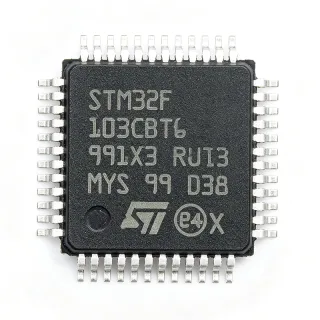
PIC16C65B-04/PQ - 8-Bit 4MHz 7KB OTP MCU 44-MQFP | Microchip
MPN: PIC16C65B-04/PQ ✓ Active| Qty | Unit Price | Extended |
|---|---|---|
| 1 | $16.5 | $16.50 |
| 10 | $14.85 | $148.50 |
| 100 | $13.2 | $1,320.00 |
| 500 | $11.55 | $5,775.00 |
| 1,000 | $10.25 | $10,250.00 |
PIC16C65B-04/PQ Overview
An 8-bit microcontroller (MCU) is a microprocessor integrated with program memory, data RAM, and peripheral blocks on a single die. PIC16C-series MCUs use a Harvard RISC architecture that separates program and data buses, allowing instruction fetch and data access in the same clock cycle. This family sits within Microchip's mid-range PIC family, which historically targets cost-sensitive embedded control applications. The OTP variant is programmed once at production or during board bring-up and is not erasable, distinguishing it from Flash (PIC16F) and windowed EPROM (PIC16C/JW) variants.
Key features of the PIC16C65B-04/PQ include a fully static design (allowing DC to maximum clock), wide operating voltage up to 6.0 V, low power consumption of 5 mA typical at 5 V/4 MHz and 1 uA typical at 3 V/32 kHz, and a peripheral set including Capture/Compare/PWM (CCP), USART, and an 8-bit ADC. The 33 I/O lines support direct interfacing to LEDs, relays, and digital sensors, while on-chip peripherals minimize external component count.
The PIC16C65B-04/PQ is built on Microchip's EPROM/ROM CMOS process and uses a 14-bit instruction word. With 4 MHz CPU clock, instruction throughput is effectively 1 MIPS, sufficient for slow control loops, simple user interfaces, and protocol bridging. The 44-MQFP package (10x10 mm body) provides gull-wing leads suitable for standard SMT assembly lines and offers pin compatibility with the broader PIC16C63A/65B/73B/74B family.
Typical applications include industrial control panels, motor drive signal conditioning, automotive body electronics, HVAC thermostat controllers, security keypad interfaces, and consumer appliance control boards. The 33 I/O count and on-chip peripherals enable direct replacement of discrete logic with a programmable solution, while OTP memory supports low-cost high-volume production where firmware is fixed.
When designing with this device, ensure the MCLR reset circuit uses the proper pull-up network and that the oscillator configuration (HS or XT) matches the crystal selection. OTP parts require programming during board production, so plan for MPLAB PM3 or equivalent programmer integration into the manufacturing flow.
This page synthesizes distributor pricing, drop-in alternatives, and practical design notes not found in the manufacturer datasheet alone, providing engineers and procurement teams with consolidated decision-support information.
Drop-in alternatives for PIC16C65B-04/PQ — same package, pin-to-pin compatible. Different-package parts requiring PCB rework are excluded.
Variants in this series
Same-series models that are drop-in compatible with PIC16C65B-04/PQ (same form factor and footprint) — differing in Timers, Package, Program Memory Size, Core Architecture, Mounting Type.
Quick Comparison Tool — Select alternative parts for side-by-side comparison:
PIC16C65B-04I/PQ
✅ Drop-In✓ In Stock
$5.45 / Unit
View Datasheet →PIC16C65B-04E/PQ
✅ Drop-In✓ In Stock
$11.1 / Unit
View Datasheet →PIC16C65BT-04E/PQ
✅ Drop-In📋 Reference alternative (not in catalog)
PIC16C65A-20/PQ
✅ Drop-In ⚠️ 参数待验证📋 Reference alternative (not in catalog)
PIC16C65AT-04I/PT
✅ Drop-In ⚠️ 参数待验证✓ In Stock
$4.5 / Unit
View Datasheet →PIC16C65B-04/PQ Maximum Ratings & Electrical Characteristics
| Program Memory Size | 7 KB (4K x 14) |
| Program Memory Type | OTP (One-Time-Programmable) |
| RAM Size | 192 bytes |
| CPU Architecture | 8-bit PIC16C mid-range RISC |
| Maximum Clock Frequency | 4 MHz |
| Instruction Word Size | 14-bit |
| Instruction Set | 35 single-word instructions |
| Supply Voltage Range | 4.0 V to 5.5 V (extended range up to 6.0 V) |
| I/O Pins | 33 |
| ADC | 8-bit, multi-channel |
| USART | Yes (1x) |
| CCP Modules | Capture/Compare/PWM |
| Timers | Timer0, Timer1, Timer2 |
| Operating Temperature | -40C to +85C (Industrial) |
| Package Type | 44-MQFP (Metric Quad Flat Pack, 10x10 mm) |
| Mounting Type | Surface Mount |
| RoHS Status | Non-RoHS (OTP windowed/legacy) |
| Lead-Free | No (contains lead, ceramic windowed variants available) |
PIC16C65B-04/PQ Pin Configuration
| Pin 1 | OSC1/CLKI — Oscillator input or external clock input |
| Pin 2 | OSC2/CLKO — Oscillator output or clock output |
| Pin 3 | MCLR — Master Clear reset input (active low) |
| Pin 4 | RA0/AN0 — PORTA bit 0 / Analog input 0 |
| Pin 5 | RA1/AN1 — PORTA bit 1 / Analog input 1 |
| Pin 6 | RA2/AN2 — PORTA bit 2 / Analog input 2 |
| Pin 7 | RA3/AN3/VREF — PORTA bit 3 / Analog input 3 / Voltage reference |
| Pin 8 | RA4/T0CKI — PORTA bit 4 / Timer0 clock input |
| Pin 9 | RA5/AN4/SS — PORTA bit 5 / Analog input 4 / SPI slave select |
| Pin 10 | VSS — Ground |
| Pin 11 | VDD — Positive supply voltage |
| Pin 12 | RB0/INT — PORTB bit 0 / External interrupt |
| Pin 13 | RB1 — PORTB bit 1 |
| Pin 14 | RB2 — PORTB bit 2 |
| Pin 15 | RB3 — PORTB bit 3 |
| Pin 16 | RB4 — PORTB bit 4 |
| Pin 17 | RB5 — PORTB bit 5 |
| Pin 18 | RB6/PGC — PORTB bit 6 / ICSP clock |
| Pin 19 | RB7/PGD — PORTB bit 7 / ICSP data |
| Pin 20 | VSS — Ground |
| Pin 21 | VDD — Positive supply voltage |
| Pin 22 | RC0/T1OSO/T1CKI — PORTC bit 0 / Timer1 oscillator output / clock input |
| Pin 23 | RC1/T1OSI/CCP2 — PORTC bit 1 / Timer1 oscillator input / CCP2 |
| Pin 24 | RC2/CCP1 — PORTC bit 2 / CCP1 PWM output |
| Pin 25 | RC3/SCK/SCL — PORTC bit 3 / SPI clock / I2C clock |
| Pin 26 | RC4/SDI/SDA — PORTC bit 4 / SPI data in / I2C data |
| Pin 27 | RC5/SDO — PORTC bit 5 / SPI data out |
| Pin 28 | RC6/TX/CK — PORTC bit 6 / USART TX / clock |
| Pin 29 | RC7/RX/DT — PORTC bit 7 / USART RX / data |
| Pin 30 | VSS — Ground |
| Pin 31 | VDD — Positive supply voltage |
| Pin 32 | RD0 — PORTD bit 0 |
| Pin 33 | RD1 — PORTD bit 1 |
| Pin 34 | RD2 — PORTD bit 2 |
| Pin 35 | RD3 — PORTD bit 3 |
| Pin 36 | RD4 — PORTD bit 4 |
| Pin 37 | RD5 — PORTD bit 5 |
| Pin 38 | RD6 — PORTD bit 6 |
| Pin 39 | RD7 — PORTD bit 7 |
| Pin 40 | VSS — Ground |
| Pin 41 | VDD — Positive supply voltage |
| Pin 42 | RE0/RD — PORTE bit 0 / Parallel slave port read |
| Pin 43 | RE1/WR — PORTE bit 1 / Parallel slave port write |
| Pin 44 | RE2/CS — PORTE bit 2 / Parallel slave port chip select |
Typical Applications
PIC16C65B-04/PQ is suitable for 6 applications: Industrial Control Panel, HVAC Thermostat Controller, Security Keypad Interface, Consumer Appliance Control Board, Automotive Body Electronics, Motor Drive Signal Conditioning.
Industrial Control Panel
The PIC16C65B-04/PQ's 33 I/O pins and integrated peripherals make it well-suited for industrial control panel applications including button matrix scanning, LED/relay driving, and Modbus RTU communication via the on-chip USART. Its 4 MHz CPU delivers sufficient throughput for slow control loops (typically 10-100 Hz) while the OTP memory and 44-MQFP package support high-volume SMT production. Industrial designers value the wide 4-5.5V supply range that tolerates 24V-derived rails with simple regulation, and the 7KB program memory accommodates complex state machines for pump, valve, and conveyor control logic. The PIC16C65B-04/PQ consumes only 5 mA typical at full clock, allowing fanless panel designs in sealed enclosures.
Recommended
HVAC Thermostat Controller
The PIC16C65B-04/PQ is widely deployed in HVAC thermostat controllers where its 8-bit ADC reads temperature sensors (NTC thermistors or analog ICs), CCP modules drive TRIAC phase-control circuits, and 33 I/O lines interface to LCD displays, keypads, and relay drivers. The 192-byte RAM is sufficient for thermostat state variables (setpoint, hysteresis, mode flags), while 7KB OTP holds scheduling firmware. The industrial temperature variant (-40C to +85C) handles rooftop and basement installations. Low-power modes enable battery-backed thermostat designs; the device draws only 1 uA typical at 32 kHz in sleep mode, extending backup battery life to multi-year durations.
Recommended
Security Keypad Interface
Security alarm keypads use the PIC16C65B-04/PQ to scan 4x4 button matrices, drive LED status indicators, communicate with central alarm panels via USART, and manage piezo buzzer tones through PWM. The 33 I/O lines easily accommodate matrix scanning with diodes, status LEDs (zone, armed, bypass), and dedicated inputs (panic, fire, medical). OTP memory prevents firmware reverse-engineering, enhancing security product IP protection. The 44-MQFP package enables slimline keypad enclosures with surface-mount assembly for volume production. The MCU's RISC architecture delivers deterministic scan timing critical for debounce algorithms and tamper detection response.
Recommended
Consumer Appliance Control Board
Washing machines, dishwashers, and microwave ovens use the PIC16C65B-04/PQ to coordinate motor control (via CCP/PWM), user interface scanning, sensor monitoring, and timer functions. The 4 MHz clock and 14-bit instruction set provide enough MIPS for motor PID loops, while 7KB OTP holds complete appliance firmware including safety checks and diagnostic routines. The integrated USART enables service technician diagnostics through serial interfaces. OTP memory ensures firmware stability for the appliance's 10-15 year service life. The 44-MQFP package is compatible with automated SMT lines used in high-volume white goods manufacturing.
Recommended
Automotive Body Electronics
Body control modules in automotive applications leverage the PIC16C65B-04/PQ (extended grade variant) for window lift control, mirror adjustment, interior lighting, and auxiliary accessory management. The extended temperature grade operates reliably from -40C to +125C under-hood and dashboard environments. The 33 I/O lines interface to body wiring harness connectors, while PWM drives LED dimming and motor speed control. OTP memory provides cost-effective firmware storage for high-volume automotive production. The wide 4-5.5V supply tolerance handles 12V battery transients through external regulation. Note: AEC-Q100 qualification should be verified with the specific automotive part number ordering code.
Recommended
Motor Drive Signal Conditioning
Brush DC motor and small stepper motor controllers use the PIC16C65B-04/PQ's CCP modules for PWM generation, ADC for current sensing via shunt resistors, and digital I/O for direction and enable control. The 4 MHz CPU clock supports PWM frequencies up to 20 kHz (above audible range) with 8-bit duty resolution. The 33 I/O lines accommodate multi-axis motion control or H-bridge direction logic. OTP memory locks in calibration data and motor profiles at production programming. The integrated peripherals reduce external component count, enabling compact motor controller PCBs for robotics, CNC accessories, and 3D printer extruders in legacy designs.
Recommended
Recommended Products Summary
Engineering reference data for PIC16C65B-04/PQ — comparison, design guidance, and compliance information.
Selection Guide
Comparison with Alternatives
| Parameter | This Product | PIC16C65B-04I/PQ | PIC16C65B-04E/PQ | PIC16C65BT-04E/PQ | PIC16C65A-20/PQ |
|---|---|---|---|---|---|
| Brand | Microchip Technology | Microchip Technology | Microchip Technology | Microchip Technology | Microchip Technology |
| Package | 44-MQFP (10x10) | 44-MQFP (10x10) - same | 44-MQFP (10x10) - same | 44-MQFP (10x10) - same | 44-MQFP (10x10) - same |
| Program Memory | 7 KB OTP | 7 KB OTP | 7 KB OTP | 7 KB OTP | 7 KB OTP |
| Max Clock Frequency | 4 MHz | 4 MHz | 4 MHz | 4 MHz | 20 MHz |
| RAM | 192 bytes | 192 bytes | 192 bytes | 192 bytes | 192 bytes |
| I/O Pins | 33 | 33 | 33 | 33 | 33 |
| Temperature Grade | Commercial (0C to +70C) | Industrial (-40C to +85C) | Extended/Automotive | Extended/Automotive (tape and reel) | Commercial |
| Memory Type | OTP | OTP | OTP | OTP | OTP |
Key Differentiators
- Wide 4.0-5.5V supply range with extended 6.0V tolerance (vs PIC16C65A-20/PQ)
- Industrial temperature grade (-40C to +85C) option available (vs PIC16C65B-04E/PQ)
- Cost-effective OTP memory for high-volume production (vs Flash-based PIC16F877A-I/PQ)
Design Notes
The PIC16C65B-04/PQ operates from 4.0 V to 5.5 V with extended operation up to 6.0 V. Place 100 nF decoupling capacitors as close as possible to each VDD/VSS pair (the 44-MQFP package has 4 VDD pins and 4 VSS pins distributed around the package). Use bulk 10 uF tantalum or ceramic on the main supply rail. For battery-backed applications, leverage the device's low-power sleep mode drawing approximately 1 uA typical at 3 V/32 kHz to extend backup battery life.
The 44-MQFP package (10x10 mm body, 0.8 mm lead pitch) requires careful PCB land pattern design per IPC-7351. Use solder mask defined (SMD) pads for better tombstoning control on small-outline gull-wing leads. Keep the MCLR pull-up resistor (typically 10 kohm) close to the pin, and add the optional MCLR decoupling capacitor (typically 0.1 uF) only if the application requires enhanced ESD protection. Route the ICSP clock (PGC/RB6) and data (PGD/RB7) lines away from high-frequency switching signals to prevent programming interference.
OTP (One-Time-Programmable) memory cannot be erased once programmed - verify firmware thoroughly using windowed/UV-erasable PIC16C65B/JW or Flash PIC16F877A prototypes before committing to OTP production parts. Configure the oscillator mode (HS for >4 MHz, XT for <=4 MHz, LP for 32 kHz) in the configuration word to match the crystal; mismatched modes cause unreliable startup or overdrive the crystal. Ensure unused I/O pins are configured as outputs (not inputs) to avoid floating-input current consumption of approximately 100-500 uA per pin.
Place the crystal oscillator (or ceramic resonator) within 10 mm of the OSC1/OSC2 pins to minimize parasitic capacitance and ensure stable oscillation. Keep oscillator traces short and surrounded by ground pour to reduce EMI susceptibility. For ADC accuracy, separate the analog AVdd/AVss supply pin pair from digital VDD/VSS pins, and add a ferrite bead or inductor between digital and analog supplies to prevent digital switching noise from corrupting ADC measurements.
Compliance Information
Legacy OTP windowed ceramic variant; not RoHS compliant due to lead content. For RoHS-compliant modern alternatives, consider PIC16F877A-I/PQ (Flash, lead-free, RoHS compliant). AEC-Q100 not qualified for standard -04/PQ variant; the -04E/PQ automotive temperature grade variant may require additional qualification review.