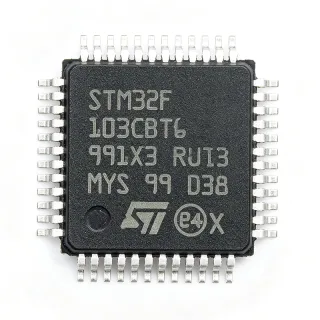
PIC16C66-20I/SP - 8-Bit 20MHz OTP MCU, 14KB, 28-SPDIP | Microchip
MPN: PIC16C66-20I/SP ✓ Active| Qty | Unit Price | Extended |
|---|---|---|
| 1 | $8.96 | $8.96 |
| 10 | $8.42 | $84.20 |
| 100 | $7.65 | $765.00 |
| 500 | $6.95 | $3,475.00 |
| 1,000 | $6.3 | $6,300.00 |
PIC16C66-20I/SP Overview
An 8-bit OTP microcontroller is a single-chip computer that integrates a CPU, non-volatile program memory (programmable once), data memory, and peripherals on one die; it sits within the broader hierarchy of microcontrollers -> embedded processors -> semiconductors. The PIC16C6x family targets cost-sensitive, deterministic real-time control applications where the simplicity of a RISC instruction set, predictable interrupt latency, and proven long-term supply continuity outweigh the need for in-system reprogrammability. OTP parts are typically chosen for volume production where code is finalized and field updates are not expected.
Key differentiating features include the 35-instruction RISC core (every instruction executes in a single cycle except program branches, which take two cycles), a Harvard architecture with separate program and data buses, and an operating speed range that scales linearly with the external oscillator from DC up to 20 MHz. The device supports fully static operation, allowing the clock to be stopped for ultra-low standby power consumption. The 22 I/O pins each feature independent direction control, with several pins multiplexed to the synchronous serial port (SSP), USART, and capture/compare/PWM (CCP) peripherals. Brown-out Reset and Power-on Reset provide robust supply-voltage supervision, while the Watchdog Timer guards against code lockups in unattended deployments.
Typical applications span legacy industrial automation, HVAC control boards, automotive body controllers, instrumentation front-ends, and consumer appliance controllers. The wide 4V-6V supply tolerance allows the device to operate directly from unregulated 5V rails commonly found in industrial cabinets and 12V/24V systems with simple linear regulation. The combination of OTP memory and -I industrial temperature grade makes the PIC16C66-20I/SP especially attractive for high-reliability, low-cost, fixed-code deployments.
When designing with this part, allocate the 28-SPDIP footprint carefully because the through-hole pin pitch of 2.54 mm and 7.62 mm row spacing consume significant PCB real estate versus SOIC or QFP alternatives. Confirm oscillator type (XT, HS, RC, LP) and external component values against the datasheet's oscillator configuration section, because the 20 MHz maximum rating requires HS-mode crystal selection. Designers transitioning from PIC16C66 to PIC16F877 or other flash-based siblings should review the pin and code compatibility chart before committing to a footprint swap.
This page consolidates distributor pricing, drop-in PIC16C6x alternatives, and practical design notes that go beyond the manufacturer datasheet, giving engineers a single source for sourcing, comparison, and second-source decisions on long-lifecycle PIC16C66 designs.
Drop-in alternatives for PIC16C66-20I/SP — same package, pin-to-pin compatible. Different-package parts requiring PCB rework are excluded.
Variants in this series
Same-series models that are drop-in compatible with PIC16C66-20I/SP (same form factor and footprint) — differing in Package, ADC, Mounting Type, Program Memory Type, Program Memory Size.
Quick Comparison Tool — Select alternative parts for side-by-side comparison:
PIC16C66-20/SP
✅ Drop-In✓ In Stock
$4.61 / Unit
View Datasheet →PIC16C65B-20I/P
✅ Drop-In✓ In Stock
$5.42 / Unit
View Datasheet →PIC16C63A-20I/SP
✅ Drop-In✓ In Stock
$5.38 / Unit
View Datasheet →PIC16C66-20I/SO
✅ Drop-In✓ In Stock
$6.42 / Unit
View Datasheet →PIC16C66-04I/SP
✅ Drop-In📋 Reference alternative (not in catalog)
PIC16C662-04I/P
✅ Drop-In✓ In Stock
$5.07 / Unit
View Datasheet →PIC16C66-20I/SP Maximum Ratings & Electrical Characteristics
| Core | PIC16C 8-bit RISC |
| Instruction Set | 35 single-word instructions |
| Program Memory Type | OTP (One-Time Programmable) EPROM |
| Program Memory Size | 14 KB (8K x 14) |
| RAM | 368 bytes |
| Data EEPROM | Not present |
| Maximum CPU Speed | 20 MHz |
| Supply Voltage (Vcc) | 4.0 V to 6.0 V |
| I/O Pins | 22 |
| Peripherals | Brown-out Detect/Reset, POR, PWM, WDT |
| Connectivity | I2C, SPI, UART/USART |
| Package | 28-SPDIP (Skinny Plastic DIP), 0.300 in (7.62 mm) |
| Operating Temperature | -40 C to +85 C (Industrial, -I suffix) |
| Mounting Type | Through-Hole |
| Lead-Free / RoHS | Compliant (Pb-free terminal finish) |
| Architecture | Harvard, fully static |
PIC16C66-20I/SP Pin Configuration
| Pin 1 | MCLR/VPP — Master Clear (Reset) input / Programming voltage |
| Pin 2 | RA0/AN0 — Digital I/O / Analog input 0 |
| Pin 3 | RA1/AN1 — Digital I/O / Analog input 1 |
| Pin 4 | RA2/AN2 — Digital I/O / Analog input 2 |
| Pin 5 | RA3/AN3/VREF — Digital I/O / Analog input 3 / Voltage reference |
| Pin 6 | RA4/T0CKI — Digital I/O / Timer0 clock input |
| Pin 7 | RA5/SS/AN4 — Digital I/O / SPI slave select / Analog input 4 |
| Pin 8 | OSC1/CLKIN — Oscillator crystal input / external clock input |
| Pin 9 | OSC2/CLKOUT — Oscillator crystal output / clock output |
| Pin 10 | RC0/T1OSO/T1CKI — Digital I/O / Timer1 oscillator output / Timer1 clock input |
| Pin 11 | RC1/T1OSI/CCP2 — Digital I/O / Timer1 oscillator input / Capture-Compare-PWM2 |
| Pin 12 | RC2/CCP1 — Digital I/O / Capture-Compare-PWM1 |
| Pin 13 | RC3/SCK/SCL — Digital I/O / SPI clock / I2C clock |
| Pin 14 | RC4/SDI/SDA — Digital I/O / SPI data in / I2C data |
| Pin 15 | RC5/SDO — Digital I/O / SPI data out |
| Pin 16 | RC6/TX/CK — Digital I/O / USART TX / USART clock |
| Pin 17 | RC7/RX/DT — Digital I/O / USART RX / USART data |
| Pin 18 | VSS — Ground reference |
| Pin 19 | VDD — Positive supply voltage (4V-6V) |
| Pin 20 | RB0/INT — Digital I/O / External interrupt |
| Pin 21 | RB1 — Digital I/O |
| Pin 22 | RB2 — Digital I/O |
| Pin 23 | RB3/PGM — Digital I/O / Low-voltage programming input |
| Pin 24 | RB4 — Digital I/O |
| Pin 25 | RB5 — Digital I/O |
| Pin 26 | RB6/PGC — Digital I/O / ICSP clock |
| Pin 27 | RB7/PGD — Digital I/O / ICSP data |
| Pin 28 | VSS — Ground reference |
Typical Applications
PIC16C66-20I/SP is suitable for 6 applications: Industrial Automation Controllers, HVAC Control Boards, Automotive Body Controllers, Instrumentation Front-Ends, Consumer Appliance Controllers, Legacy Embedded Systems Maintenance.
Industrial Automation Controllers
The PIC16C66-20I/SP fits industrial automation controllers because its -40C to +85C industrial temperature range, 4V-6V supply tolerance, and 22 I/O pins accommodate noisy factory-floor environments and 5V PLC backplanes. The 14 KB OTP program memory holds substantial ladder-logic-equivalent state machines, PWM outputs drive motor speed references, and the USART links to HMI panels or supervisory controllers. With 5 MIPS throughput at 20 MHz, the deterministic RISC core guarantees predictable response times for time-critical interlocks, while Brown-out Reset and Power-on Reset harden supply-ride-through during heavy inrush events.
Recommended
HVAC Control Boards
The PIC16C66-20I/SP is well-suited to HVAC control boards where its 22 I/O lines scan multiple temperature sensors, drive triac-fired fan and compressor stages via PWM, and communicate with the indoor thermostat bus over USART. The 4V-6V supply accepts unregulated 24VAC-derived DC rails, and the wide industrial temperature rating tolerates attic and rooftop enclosures. The 14 KB OTP code space comfortably fits the multi-state compressor sequencing logic plus fault-diagnostic routines, while the integrated Watchdog Timer prevents code lockups during brown-outs.
Recommended
Automotive Body Controllers
The PIC16C66-20I/SP serves automotive body controllers for door-lock, lighting, and wiper modules where its industrial temperature rating plus robust peripheral set and OTP memory fit fixed-function body-electronics modules. The 22 I/O pins multiplex with LIN/USART for body-network communication, PWM drives lamp-dimming FETs, and the Brown-out Reset handles crank-dip transients on the 12V bus regulated to 5V. The OTP code protects against unauthorized firmware readout, an advantage in cost-sensitive aftermarket and OEM body-control designs.
Recommended
Instrumentation Front-Ends
The PIC16C66-20I/SP fits instrumentation front-ends such as digital panel meters, sensor signal conditioners, and laboratory data-loggers because its 20 MHz CPU delivers the throughput needed to handle interrupt-driven ADC sampling, USART telemetry, and real-time display-refresh tasks. The 368 bytes of RAM support circular sample buffers, while the 14 KB OTP holds calibration tables and menu logic. Wide 4V-6V supply and industrial temperature make the part tolerant of fluctuating bench supplies and harsh equipment-room conditions.
Recommended
Consumer Appliance Controllers
The PIC16C66-20I/SP is appropriate for consumer appliance controllers in washing machines, dishwashers, and microwave ovens, where its 22 I/O pins interface to keypads, seven-segment displays, triac-driven heater banks, and brushless-DC motors via PWM. The OTP memory locks in final production firmware to prevent unauthorized code changes, and the 4V-6V supply range accepts rectified mains-derived 5V rails. Industrial-grade -40C to +85C operation tolerates the high ambient temperatures inside appliance cabinets near heating elements.
Recommended
Legacy Embedded Systems Maintenance
The PIC16C66-20I/SP remains the right choice for maintaining legacy embedded systems installed in industrial machinery, medical instrumentation, and aerospace ground-support equipment where original-design OTP firmware must continue running for decades. Its ACTIVE lifecycle status from Microchip, second-source Microchip PIC16C6x family members, and 28-SPDIP through-hole footprint ease both PCB repair and factory-scale replacements. Designers reading the PIC16C66-20I/SP into new long-lifecycle designs gain a migration path to flash-based PIC16F1x or PIC18F siblings when field updates become mandatory.
Recommended
Recommended Products Summary
Engineering reference data for PIC16C66-20I/SP — comparison, design guidance, and compliance information.
Selection Guide
Comparison with Alternatives
| Parameter | This Product | PIC16C66-20/SP | PIC16C65B-20I/P | PIC16C63A-20I/SP | PIC16C66-20I/SO | PIC16C66-04I/SP |
|---|---|---|---|---|---|---|
| Brand | Microchip Technology | Microchip Technology | Microchip Technology | Microchip Technology | Microchip Technology | Microchip Technology |
| Package | 28-SPDIP (through-hole) | 28-SPDIP (through-hole) - same | 28-PDIP (through-hole) - same | 28-SPDIP (through-hole) - same | 28-SOIC (surface-mount) - different footprint | 28-SPDIP (through-hole) - same |
| Program Memory | 14 KB OTP | 14 KB OTP | 7 KB OTP | 4 KB OTP | 14 KB OTP | 14 KB OTP |
| Maximum Clock | 20 MHz | 20 MHz | 20 MHz | 20 MHz | 20 MHz | 4 MHz |
| Operating Temperature | -40C to +85C (Industrial) | 0C to +70C (Commercial) | -40C to +85C (Industrial) | -40C to +85C (Industrial) | -40C to +85C (Industrial) | -40C to +85C (Industrial) |
| Supply Voltage | 4.0 V to 6.0 V | 4.0 V to 6.0 V | 4.0 V to 6.0 V | 4.0 V to 6.0 V | 4.0 V to 6.0 V | 4.0 V to 6.0 V |
| I/O Pins | 22 | 22 | 22 | 22 | 22 | 22 |
| Lifecycle Status | Active | Active | Active | Active | Active | Active |
Key Differentiators
- 14 KB OTP program memory - twice that of PIC16C65B (vs PIC16C65B-20I/P)
- Industrial -40C to +85C temperature grade (vs PIC16C66-20/SP)
- 20 MHz CPU throughput for deterministic real-time control (vs PIC16C66-04I/SP)
Design Notes
The PIC16C66-20I/SP operates from 4.0 V to 6.0 V on VDD (pin 19) with VSS on pins 18 and 28. Place a 100 nF decoupling capacitor as close as possible to the VDD pin to suppress high-frequency switching noise, and add a bulk 10 uF tantalum or aluminum-electrolytic capacitor on the same rail. The internal Brown-out Reset and Power-on Reset blocks ride through supply transients, but adding an external reset supervisor (e.g., MCP100 or MCP809) is recommended when the input supply comes from long cables or noisy industrial environments.
To reach the 20 MHz maximum CPU clock rating of the PIC16C66-20I/SP, configure the oscillator mode as HS in the configuration word and select an HS-mode crystal with the appropriate load capacitance specified by the crystal vendor. Avoid XT mode above 4 MHz because XT-mode gain cannot sustain reliable oscillation at 20 MHz. For lower-frequency designs where 4 MHz is sufficient, the PIC16C66-04I/SP can be used with a lower-cost XT crystal.
Lay out the 28-SPDIP footprint on a 2.54 mm (0.100 in) grid with 7.62 mm (0.300 in) row spacing, and route decoupling and crystal traces before any other signal traces. Keep the MCLR/VPP trace short and isolated from high-current switching nodes; add a 10 kohm pull-up to VDD on MCLR for normal operation. Route analog inputs (RA0-RA5) away from PWM and USART traces to minimize crosstalk, and place the crystal within 5 mm of the OSC1/OSC2 pins with symmetric ground-plane cutouts.
Do not assume the PIC16C66-20I/SP is in-system programmable like flash-based PIC16F parts; OTP memory can be programmed only once via high-voltage VPP on MCLR. Engineers migrating from PIC16F877 code must rewrite OTP programming into the production flow using a high-voltage programmer such as the MPLAB PM3. The internal EEPROM is not present on the PIC16C66, so persistent storage of calibration constants must use external EEPROM or be hard-coded into OTP at production time.
Compliance Information
RoHS compliant per Microchip product documentation and DigiKey compliance attributes. The -I industrial temperature suffix denotes -40C to +85C operation, but AEC-Q100 automotive qualification is not specified by Microchip for the PIC16C66 family; for AEC-Q100-qualified alternatives, use PIC16F1x or PIC18F Q1 variants. Lead-free terminal finish is standard.