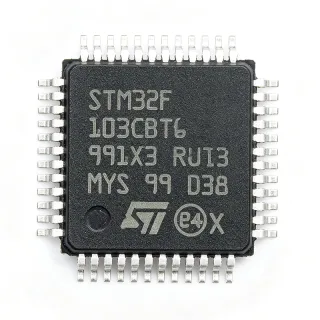
PIC16C67-10I/PT - 8-Bit 10MHz 14KB OTP MCU, 44-TQFP | Microchip
MPN: PIC16C67-10I/PT ✗ End of Life| Qty | Unit Price | Extended |
|---|---|---|
| 1 | $8.5 | $8.50 |
| 10 | $7.65 | $76.50 |
| 100 | $6.8 | $680.00 |
| 500 | $5.95 | $2,975.00 |
| 1,000 | $5.1 | $5,100.00 |
PIC16C67-10I/PT Overview
An 8-bit microcontroller (MCU) is a small single-chip computer that integrates a CPU, non-volatile program memory, working RAM, peripheral set (timers, USART, ADC, I/O), and an interrupt controller on a single die. PIC microcontrollers sit within the broader category of microcontrollers -> microcontrollers (embedded computing) -> semiconductors. The PIC16C family (PIC mid-range 14-bit instruction set) is engineered for deterministic real-time control with a fully static design, allowing the clock to be stopped without losing internal state.
Key features of the PIC16C67-10I/PT include the 14-bit instruction word (which gives 8K single-word instructions per 14KB array), an integrated 8-bit A/D converter with multiple input channels, two 8-bit timers plus one 16-bit timer/counter, a USART module with synchronous/asynchronous modes, a watchdog timer with on-chip RC oscillator, and a wide 2.5V to 6.0V operating voltage range. The device also supports in-circuit serial programming (ICSP) via the RB6/RB7 pins for OTP reprogramming during prototyping.
Architecture details: the PIC16C67 uses a Harvard architecture with separate program and data buses, allowing instruction fetch and data access in a single cycle. The 14-bit instruction word provides richer opcode encoding than 12-bit PIC cores, enabling larger immediate operands and direct addressing across the full data memory. The fully static design allows low-power operation by halting the clock, while the brown-out reset and power-on reset circuits simplify supply supervision.
Typical applications span industrial control and instrumentation, HVAC actuator and sensor interfaces, motor control front-ends, automotive body and chassis subsystems, white-goods and appliance controllers, and embedded data-acquisition front ends that need parallel I/O and a USART for host communication. The wide temperature range also makes it suitable for outdoor or factory-floor environments.
Design consideration: OTP memory cannot be re-programmed in the field - designs using the PIC16C67-10I/PT must either be masked-ROM programmed in volume (PIC16CR67) or moved to a flash-based equivalent such as the PIC16F877 for field-updatable firmware. Plan programming flow accordingly.
This page synthesizes distributor pricing, pin-compatible drop-in alternatives, and practical design notes not found in the manufacturer datasheet alone.
Drop-in alternatives for PIC16C67-10I/PT — same package, pin-to-pin compatible. Different-package parts requiring PCB rework are excluded.
Variants in this series
Same-series models that are drop-in compatible with PIC16C67-10I/PT (same form factor and footprint) — differing in Operating Temperature, Maximum Clock Frequency, Program Memory Size, Program Memory Type, Package.
Quick Comparison Tool — Select alternative parts for side-by-side comparison:
PIC16C67-10/PT
✅ Drop-In📋 Reference alternative (not in catalog)
PIC16C67-04I/PT
✅ Drop-In ⚠️ 参数待验证📋 Reference alternative (not in catalog)
PIC16C67-04/PT
✅ Drop-In ⚠️ 参数待验证✓ In Stock
$4.85 / Unit
View Datasheet →PIC16C66-10I/PT
✅ Drop-In📋 Reference alternative (not in catalog)
PIC16F877-10I/PT
✅ Drop-In📋 Reference alternative (not in catalog)
PIC16C67-10I/PT Maximum Ratings & Electrical Characteristics
| Core Architecture | PIC 8-bit (mid-range, 14-bit instruction) |
| Program Memory Type | OTP EPROM |
| Program Memory Size | 14 KB (8K x 14) |
| RAM Size | 368 x 8 bytes |
| EEPROM Data Memory | None (not present on this family) |
| Maximum CPU Speed | 10 MHz |
| Supply Voltage (Vcc) | 4.0 V to 6.0 V |
| Operating Temperature | -40 C to +85 C (Industrial, "I") |
| Number of I/O Pins | 33 |
| Package | 44-TQFP (PT), 10 x 10 mm |
| Mounting Type | Surface Mount |
| Timers | 2 x 8-bit + 1 x 16-bit (TMR0 / TMR1 / TMR2) |
| A/D Converter | 8-bit, 8 channels |
| Communication | 1 x USART (SCI/SPI synchronous+async) |
| Oscillator | External (XT/HS/LP/RC modes selectable) |
| Watchdog Timer | Yes, with on-chip RC oscillator |
| Brown-out Reset / POR | Yes |
| ICSP (In-Circuit Serial Programming) | Yes (RB6/RB7) |
| Packaging | Tube |
| RoHS Status | Compliant (per distributor listing) |
PIC16C67-10I/PT Pin Configuration
| Pin 1 | MCLR/VPP — Master Clear (reset) input / programming voltage |
| Pin 2 | RA0/AN0 — Port A bit 0 / Analog input 0 |
| Pin 3 | RA1/AN1 — Port A bit 1 / Analog input 1 |
| Pin 4 | RA2/AN2 — Port A bit 2 / Analog input 2 |
| Pin 5 | RA3/AN3/VREF — Port A bit 3 / Analog input 3 / VREF+ |
| Pin 6 | RA4/T0CKI — Port A bit 4 / Timer 0 clock input |
| Pin 7 | RA5/AN4/SS — Port A bit 5 / Analog input 4 / SPI slave select |
| Pin 8 | RE0/RD/AN5 — Port E bit 0 / Read control / Analog input 5 |
| Pin 9 | RE1/WR/AN6 — Port E bit 1 / Write control / Analog input 6 |
| Pin 10 | RE2/CS/AN7 — Port E bit 2 / Chip select / Analog input 7 |
| Pin 11 | VDD — Positive supply (4.0V to 6.0V) |
| Pin 12 | VSS — Ground |
| Pin 13 | OSC1/CLKI — Oscillator input / external clock input |
| Pin 14 | OSC2/CLKO — Oscillator output / clock output |
| Pin 15 | RC0/T1OSO/T1CKI — Port C bit 0 / Timer 1 oscillator output / Timer 1 clock |
| Pin 16 | RC1/T1OSI/CCP2 — Port C bit 1 / Timer 1 oscillator input / CCP2 |
| Pin 17 | RC2/CCP1 — Port C bit 2 / CCP1 (PWM/capture/compare) |
| Pin 18 | RC3/SCK/SCL — Port C bit 3 / SPI clock / I2C clock |
| Pin 19 | RD0/PSP0 — Port D bit 0 / Parallel Slave Port bit 0 |
| Pin 20 | RD1/PSP1 — Port D bit 1 / Parallel Slave Port bit 1 |
| Pin 21 | RD2/PSP2 — Port D bit 2 / Parallel Slave Port bit 2 |
| Pin 22 | RD3/PSP3 — Port D bit 3 / Parallel Slave Port bit 3 |
| Pin 23 | RC4/SDI/SDA — Port C bit 4 / SPI data in / I2C data |
| Pin 24 | RC5/SDO — Port C bit 5 / SPI data out |
| Pin 25 | RC6/TX/CK — Port C bit 6 / USART TX / USART clock |
| Pin 26 | RC7/RX/DT — Port C bit 7 / USART RX / USART data |
| Pin 27 | RD4/PSP4 — Port D bit 4 / Parallel Slave Port bit 4 |
| Pin 28 | RD5/PSP5 — Port D bit 5 / Parallel Slave Port bit 5 |
| Pin 29 | RD6/PSP6 — Port D bit 6 / Parallel Slave Port bit 6 |
| Pin 30 | RD7/PSP7 — Port D bit 7 / Parallel Slave Port bit 7 |
| Pin 31 | VSS — Ground |
| Pin 32 | VDD — Positive supply (4.0V to 6.0V) |
| Pin 33 | RB0/INT — Port B bit 0 / External interrupt |
| Pin 34 | RB1 — Port B bit 1 |
| Pin 35 | RB2 — Port B bit 2 |
| Pin 36 | RB3 — Port B bit 3 |
| Pin 37 | RB4 — Port B bit 4 |
| Pin 38 | RB5 — Port B bit 5 |
| Pin 39 | RB6/PGD — Port B bit 6 / ICSP data |
| Pin 40 | RB7/PGC — Port B bit 7 / ICSP clock |
| Pin 41 | NC — Not connected (per datasheet) |
| Pin 42 | NC — Not connected (per datasheet) |
| Pin 43 | NC — Not connected (per datasheet) |
| Pin 44 | NC — Not connected (per datasheet) |
Typical Applications
PIC16C67-10I/PT is suitable for 6 applications: Industrial Process Control Front End, HVAC Actuator and Damper Controller, Automotive Body and Chassis Subsystems, White-Goods and Appliance Controllers, Embedded Data-Acquisition Front End, Educational and Hobbyist Embedded Platform.
Industrial Process Control Front End
The PIC16C67-10I/PT's 33 digital I/O lines, 8-channel 8-bit ADC and USART make it well-suited to industrial process control front ends that aggregate sensor inputs and forward filtered readings to a host PLC over RS-232/RS-485. Operating from 4.0V to 6.0V at up to 10 MIPS, it samples multiple analog channels, runs deterministic control loops in software and drives actuator outputs through its PWM/CCP and timer peripherals. The -40C to +85C industrial temperature rating permits deployment in factory-floor cabinets and outdoor enclosures. Pin-to-pin compatibility with the flash-based PIC16F877-10I/PT allows easy migration to in-field reprogrammable firmware when product life extends beyond the OTP silicon stock.
Recommended
HVAC Actuator and Damper Controller
The PIC16C67-10I/PT is a natural fit for HVAC damper and valve actuators that need multiple PWM channels, ADC inputs for temperature/pressure sensors, and a USART for communicating with the building automation bus. Three timers (2x 8-bit, 1x 16-bit) and dual CCP/PWM blocks generate precise servo and proportional-valve drive waveforms; the 8-channel ADC reads thermistor or 0-10V feedback signals. Industrial temperature range and OTP memory reduce the risk of accidental firmware tampering in sealed building-control hardware. Same 44-TQFP footprint simplifies PCB reuse across the PIC16C66, PIC16C67 and PIC16F877 family variants.
Recommended
Automotive Body and Chassis Subsystems
With 33 I/O and a USART, the PIC16C67-10I/PT is widely used in automotive body controllers for low-speed functions such as seat-position memory, mirror folding, interior lighting dimming and wiper timing. The 14KB program memory accommodates state-machine logic for multiple subsystems without external memory expansion; 8-channel ADC reads battery voltage, switch positions and analog sensors. Designers migrate to PIC16F877A or PIC16F887A for AEC-Q100 qualified automotive programs while keeping the same 44-TQFP footprint. Wide 4.0V to 6.0V supply tolerates crank-droop and load-dump events after external TVS protection.
Recommended
White-Goods and Appliance Controllers
White-goods and small-appliance control boards rely on the PIC16C67-10I/PT's combination of OTP memory, ample I/O and integrated ADC to keep BOM cost low while supporting wash-cycle timers, motor-direction logic, user-interface key scanning and triac phase-angle control. The 14KB program memory holds full state-machine plus display drivers, and the 33 I/O pins drive LED/LCD indicators, keypad matrix and zero-cross detection. Industrial temperature grade supports unheated appliance enclosures. The flash-based PIC16F877A-I/PT is the recommended long-term replacement for new SKUs that need post-sale firmware updates.
Recommended
Embedded Data-Acquisition Front End
The PIC16C67-10I/PT serves as a low-cost data-acquisition front end that aggregates analog and digital channels and forwards packets over its USART to a host PC or embedded gateway. Its 8-channel 8-bit ADC samples at up to ~20 kS/s aggregate (per PIC16C6X datasheet) which is adequate for thermocouple-multiplexed, slow-process telemetry. The USART plus external RS-485 transceiver (MAX485) supports multi-drop 4-20 mA replacement networks; OTP memory protects calibration constants from unintended erasure. Engineers designing new DAQ modules should evaluate PIC16F877-10I/PT for the same footprint and the convenience of flash-based field calibration updates.
Recommended
Educational and Hobbyist Embedded Platform
The PIC16C67-10I/PT and its wider PIC16C6X family are a classic teaching platform for 8-bit embedded programming thanks to their deterministic Harvard architecture, simple MPLAB toolchain and abundant textbook material. The 14KB OTP, 368-byte RAM, three timers and USART cover every common lab exercise from interrupt-driven keypads to UART bridges, while the 44-TQFP (PT) package exposes 33 breadboard-friendly I/O when mounted on a breakout. Modern classroom kits often swap in the flash-based PIC16F877A-I/PT to allow repeated programming, but the original PIC16C67-10I/PT remains useful for understanding EPROM window erase and OTP programming flows.
Recommended
Recommended Products Summary
Engineering reference data for PIC16C67-10I/PT — comparison, design guidance, and compliance information.
Selection Guide
Comparison with Alternatives
| Parameter | This Product | PIC16C67-10/PT | PIC16C67-04I/PT | PIC16C67-04/PT | PIC16C66-10I/PT | PIC16F877-10I/PT |
|---|---|---|---|---|---|---|
| Package | 44-TQFP (PT), 10x10 mm | 44-TQFP (PT) - same | 44-TQFP (PT) - same | 44-TQFP (PT) - same | 44-TQFP (PT) - same | 44-TQFP (PT) - same |
| Brand | Microchip Technology | Microchip Technology | Microchip Technology | Microchip Technology | Microchip Technology | Microchip Technology |
| Program Memory Type | OTP EPROM (14 KB / 8K x 14) | OTP EPROM (14 KB) | OTP EPROM (14 KB) | OTP EPROM (14 KB) | OTP EPROM (8 KB) | Flash (14 KB) |
| Maximum CPU Speed | 10 MHz | 10 MHz | 4 MHz | 4 MHz | 10 MHz | 10 MHz |
| Operating Temperature | -40 C to +85 C (Industrial) | 0 C to +70 C (Commercial) | -40 C to +85 C (Industrial) | 0 C to +70 C (Commercial) | -40 C to +85 C (Industrial) | -40 C to +85 C (Industrial) |
| Number of I/O Pins | 33 | 33 | 33 | 33 | 33 | 33 |
| RAM Size | 368 bytes | 368 bytes | 368 bytes | 368 bytes | 368 bytes | 368 bytes |
| A/D Converter | 8-bit, 8 channels | 8-bit, 8 channels | 8-bit, 8 channels | 8-bit, 8 channels | 8-bit, 8 channels | 10-bit, 8 channels |
| Memory Type | OTP (one-time programmable) | OTP | OTP | OTP | OTP | Flash (field-updatable) |
| Lifecycle Status | Obsolete | Obsolete | Obsolete | Obsolete | Obsolete | Active |
Key Differentiators
- Highest-density OTP option in the PIC16C6X family (vs PIC16C66-10I/PT)
- Direct flash migration path on the same footprint (vs PIC16C67-10I/PT vs PIC16F877-10I/PT)
- Industrial temperature OTP option in 44-TQFP (vs PIC16C67-10/PT)
- Faster 10MHz speed grade versus 4MHz option (vs PIC16C67-04I/PT)
Design Notes
OTP EPROM cannot be re-programmed. A single bad firmware build requires scrapping the part. For development, place the PIC16C67-10I/PT in a socketed daughter-card so a fresh unit can be swapped in for each iteration; move to the flash-based PIC16F877-10I/PT once firmware stabilizes. Verify programming voltage timing against the PIC16C6X datasheet programming specification - VPP rise time and MCLR/VPP sequence are common sources of verify errors.
The PIC16C67-10I/PT requires both VDD pins (11 and 32) and both VSS pins (12 and 31) on the 44-TQFP to be connected. Decouple each VDD pin with a 100nF ceramic capacitor placed within 5 mm of the pin to suppress switching noise from the internal state machine. Add a 10uF bulk capacitor near the package. Brown-out reset is configurable via configuration fuses - enable it for industrial supplies prone to sag.
Keep the OSC1/OSC2 traces short and surrounded by ground pour to minimize EMI coupling; for crystal mode (XT) place load capacitors within 3 mm of the oscillator pins. Route the MCLR/VPP line away from high-frequency switching nodes - accidental glitches on MCLR can spuriously reset the part. When using ICSP on a populated board, isolate the ICSP connector's PGD/PGC from any in-circuit load with series resistors to allow in-field programming without disconnecting the target.
Estimated: at 10MHz CPU clock and 33 I/O toggling, simultaneous-switching output (SSO) noise can inject 100-200 mV of ground bounce on a poorly-decoupled board. Source-terminate fast edges (>5 ns) with 33-47 ohm series resistors and keep a solid uninterrupted ground plane under the TQFP land pattern. ADC accuracy is sensitive to digital switching - place analog inputs on PORTA pins and avoid toggling nearby PORTB bits during ADC conversions.
Estimated: at 10MHz and 6V Vcc, the PIC16C67-10I/PT draws roughly 10-15 mA active, dissipating 60-90 mW. The 44-TQFP package has theta_JA around 50-60 C/W on a 4-layer 1-oz PCB, giving a junction rise of 3-5 C above ambient - well within the -40 C to +85 C operating range. For sealed enclosures with no airflow, derate CPU clock to 4 MHz (use PIC16C67-04 grade) if internal ambient exceeds 70 C.
Compliance Information
RoHS compliance per Heisener and distributor listings. The -I industrial temperature variant is not AEC-Q100 qualified; for automotive applications use the flash-based PIC16F877A-I/PT automotive grade instead. Halogen-free status not explicitly stated in the verified data.