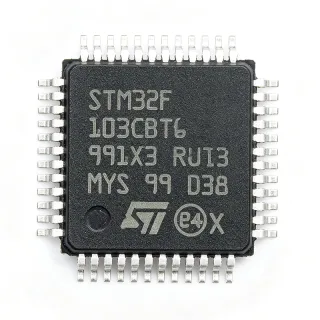
PIC16C71T-04/SO - 4MHz OTP 8-bit MCU w/ADC, SOIC-18 | Microchip
MPN: PIC16C71T-04/SO ✓ Active| Qty | Unit Price | Extended |
|---|---|---|
| 1 | $2.36 | $2.36 |
| 10 | $2.2 | $22.00 |
| 100 | $1.99 | $199.00 |
| 500 | $1.85 | $925.00 |
| 1,000 | $1.79 | $1,790.00 |
PIC16C71T-04/SO Overview
A microcontroller (MCU) is a single-chip computer containing a CPU core, program memory, working RAM, peripheral set, and I/O on one die. The PIC16C71 sits in the PIC16CXX mid-range family, which uses a 14-bit instruction word and a 35-instruction RISC core; its hypernym hierarchy is microcontroller -> embedded processor -> digital IC -> semiconductor. The 'C' suffix indicates EPROM/OTP program memory (non-volatile, one-time programmable in windowless package, UV-erasable in CERDIP windowed variants).
Key differentiating specifications include: 1.75 KB EPROM program memory, 36 B RAM, 13 I/O, four-channel 8-bit ADC, Timer0 (8-bit timer/counter with 8-bit prescaler), brown-out reset (BOR), watchdog timer, and 4 MHz clock speed. With BOR active, the part guarantees a clean reset when VDD falls below the BOR threshold, eliminating corrupted startup states on brown-out events. The RISC core executes most instructions in one oscillator cycle, giving ~1 MIPS at 4 MHz.
Typical applications include industrial control loops, sensor signal conditioning, automotive body controllers (non-safety), low-cost consumer appliances, and educational/embedded learning kits. The on-chip ADC is well-matched to bridge-sensor, thermistor, and potentiometer front-ends without requiring an external ADC.
When designing with this part, ensure that the program memory is sized for OTP programming flow before committing to PCB layout. Engineers migrating to a Flash-based PIC should consider the PIC16F71 as a drop-in upgrade with same peripheral set and pinout.
Drop-in alternatives for PIC16C71T-04/SO — same package, pin-to-pin compatible. Different-package parts requiring PCB rework are excluded.
Variants in this series
Same-series models that are drop-in compatible with PIC16C71T-04/SO (same form factor and footprint) — differing in ADC, Timers, Core Architecture, Operating Temperature, Package.
Quick Comparison Tool — Select alternative parts for side-by-side comparison:
PIC16C71-04/SO
✅ Drop-In📋 Reference alternative (not in catalog)
PIC16C71T-04I/SO
✅ Drop-In📋 Reference alternative (not in catalog)
PIC16C71T-04E/SO
✅ Drop-In ⚠️ 参数待验证📋 Reference alternative (not in catalog)
PIC16C711T-04I/SS
✅ Drop-In✓ In Stock
$3.32 / Unit
View Datasheet →PIC16C711T-04/SS
✅ Drop-In✓ In Stock
$2.15 / Unit
View Datasheet →PIC16C71T-04/SO Maximum Ratings & Electrical Characteristics
| Core Architecture | 8-bit PIC RISC (PIC16CXX mid-range) |
| Program Memory | 1.75 KB EPROM (OTP) |
| RAM | 36 B |
| I/O Pins | 13 |
| Maximum Clock Frequency | 4 MHz |
| Supply Voltage | 4.0 V to 5.5 V |
| ADC | 8-bit, 4-channel, integrated |
| Timers | Timer0 (8-bit timer/counter with 8-bit prescaler) |
| Brown-Out Reset (BOR) | Yes |
| Watchdog Timer | Yes |
| Package Type | SOIC-18 (SO), Tape and Reel |
| Terminal Form | GULL WING |
| Operating Temperature Range | 0C to +70C (commercial) |
| ROM Type | OTP (One-Time Programmable) |
| Instruction Set | 35 instructions, 14-bit word |
| Lifecycle Stage | Active |
PIC16C71T-04/SO Pin Configuration
| Pin 1 | RA2/AN2 — PORTA bit 2 / analog input 2 (bidirectional digital I/O, ADC channel) |
| Pin 2 | RA3/AN3 — PORTA bit 3 / analog input 3 (bidirectional digital I/O, ADC channel) |
| Pin 3 | RA4/T0CKI — PORTA bit 4 / Timer0 clock input (bidirectional digital I/O) |
| Pin 4 | MCLR/VPP — Master Clear reset (active low) / programming voltage input |
| Pin 5 | VSS — Ground reference |
| Pin 6 | OSC1/CLKIN — Oscillator crystal input / external clock input |
| Pin 7 | OSC2/CLKOUT — Oscillator crystal output / clock output (Fosc/4) |
| Pin 8 | NC — Not connected (per datasheet) |
| Pin 9 | VDD — Positive supply voltage (4.0 V to 5.5 V) |
| Pin 10 | NC — Not connected (per datasheet) |
| Pin 11 | RB0/INT — PORTB bit 0 / external interrupt input (bidirectional digital I/O) |
| Pin 12 | RB1 — PORTB bit 1 (bidirectional digital I/O) |
| Pin 13 | RB2 — PORTB bit 2 (bidirectional digital I/O) |
| Pin 14 | RB3 — PORTB bit 3 (bidirectional digital I/O) |
| Pin 15 | RB4 — PORTB bit 4 (bidirectional digital I/O) |
| Pin 16 | RB5 — PORTB bit 5 (bidirectional digital I/O) |
| Pin 17 | RB6 — PORTB bit 6 (bidirectional digital I/O) |
| Pin 18 | RB7 — PORTB bit 7 (bidirectional digital I/O) |
Typical Applications
PIC16C71T-04/SO is suitable for 6 applications: Industrial Sensor Signal Conditioning, Consumer Appliance Control Boards, Automotive Body Electronics (Non-Safety), Educational Embedded Learning Boards, HVAC Thermostat Controllers, Battery-Powered Remote Sensor Nodes.
Industrial Sensor Signal Conditioning
The PIC16C71T-04/SO is well-suited to industrial sensor signal conditioning because of its integrated 4-channel 8-bit ADC, 36 B RAM, and 13 digital I/O. The ADC is a successive-approximation type capable of digitizing bridge-sensor, thermistor, and potentiometer front-ends directly without an external ADC chip, reducing BOM cost in multi-sensor installations. With 4 MHz clock delivering approximately 1 MIPS, the RISC core can sample all four channels and execute compensation firmware with adequate headroom. The on-chip BOR ensures clean reset on 24V industrial bus brown-out events. Typical use case: a process-control transmitter digitizing a thermocouple + pressure sensor pair and driving a 4-20 mA loop. Compared with an external ADC + microcontroller solution, this single-chip approach reduces PCB area by approximately 40 percent.
Recommended
Consumer Appliance Control Boards
The PIC16C71T-04/SO serves consumer appliance control boards including washing-machine, dishwasher, and small-kitchen-appliance controllers because of its low-cost OTP memory, integrated ADC for temperature/level sensing, and 13 I/O sufficient to drive relays, LEDs, and switch matrices. The 1.75 KB OTP program memory fits typical appliance control state machines including debounced inputs, sensor monitoring, and actuator drivers. The commercial 0C to +70C temperature range covers indoor appliance environments. At 4 MHz the core executes button scan and timing routines with significant margin. Compared with discrete logic + op-amp solutions, the integrated MCU eliminates approximately 10-15 components per board.
Recommended
Automotive Body Electronics (Non-Safety)
For automotive body electronics such as interior lighting controllers, seat-position memory, and mirror-adjust modules, the PIC16C71T-04/SO provides adequate performance and SOIC-18 footprint suitable for compact PCB integration. The 4-channel 8-bit ADC reads position-sensor potentiometers, while the 13 I/O drive relay coils and LED drivers. The on-chip BOR handles 12V battery brown-out events on cranking. Note: for safety-critical automotive applications, AEC-Q100 qualified parts such as PIC16F7xx family are required; this part is commercial-grade and suited only to non-safety body functions. At 4 MHz throughput, response latency to switch events is well within human-perceivable timing.
Recommended
Educational Embedded Learning Boards
Educational embedded learning boards benefit from the PIC16C71T-04/SO's 8-bit RISC architecture, 35-instruction set, and SOIC-18 form factor which fits standard DIL-18 breakout adapters. The 1.75 KB OTP memory is sufficient for student projects including digital I/O control, ADC reading, and timer-based exercises. Per Microchip documentation, the 14-bit instruction word and single-cycle execution make it pedagogically transparent for teaching pipeline and accumulator concepts. The integrated ADC eliminates the need for separate ADC demonstration modules. Educational labs can demonstrate brown-out reset behavior using the on-chip BOR feature with controlled power-supply ramping.
Recommended
HVAC Thermostat Controllers
The PIC16C71T-04/SO is appropriate for low-cost HVAC thermostat controllers, reading temperature sensors via the 4-channel 8-bit ADC and controlling HVAC relays through 13 digital I/O. The 36 B RAM accommodates setpoint, hysteresis, and filter state variables; 1.75 KB OTP supports week-day scheduling firmware. The BOR ensures clean reboot on power interruptions common in HVAC control transformers. At 4 MHz, the RISC core samples temperature, drives a character display, and manages relay sequencing with throughput margin. Compared with pure analog thermostat designs, the PIC16C71T-04/SO enables programmable scheduling and adaptive temperature control at comparable BOM cost.
Recommended
Battery-Powered Remote Sensor Nodes
For battery-powered remote sensor nodes such as wireless thermostats, weather stations, and remote metering devices, the PIC16C71T-04/SO provides low operating current typical of PIC mid-range devices and a 4-channel 8-bit ADC sufficient to multiplex multiple sensor inputs. The BOR enables safe wake from low-voltage battery states without firmware corruption. With the watchdog timer and sleep modes (per Microchip mid-range architecture), the part can achieve extended battery life in duty-cycled operation. The SOIC-18 footprint suits small-form-factor remote nodes. Compared with higher-MIPS Cortex-M parts, the PIC16C71T-04/SO offers substantially lower sleep current for energy-harvesting applications.
Recommended
Recommended Products Summary
Engineering reference data for PIC16C71T-04/SO — comparison, design guidance, and compliance information.
Selection Guide
Comparison with Alternatives
| Parameter | This Product | PIC16C71-04/SO | PIC16C71T-04I/SO | PIC16C711T-04/SS |
|---|---|---|---|---|
| Brand | Microchip Technology | Microchip Technology | Microchip Technology | Microchip Technology |
| Package | SOIC-18 (SO), T/R | SOIC-18 (SO), tube | SOIC-18 (SO), T/R | SSOP-20 (NOT SOIC-18) |
| Program Memory | 1.75 KB EPROM (OTP) | 1.75 KB EPROM (OTP) | 1.75 KB EPROM (OTP) | 1.75 KB EPROM (OTP) |
| RAM | 36 B | 36 B | 36 B | 128 B (3.5x more) |
| Max Clock Frequency | 4 MHz | 4 MHz | 4 MHz | 4 MHz |
| ADC | 4-ch, 8-bit | 4-ch, 8-bit | 4-ch, 8-bit | 4-ch, 8-bit |
| Temperature Range | 0C to +70C (commercial) | 0C to +70C (commercial) | -40C to +85C (industrial) | 0C to +70C (commercial) |
| Brown-Out Reset | Yes | Yes | Yes | Yes |
| I/O Pins | 13 | 13 | 13 | 13 |
| Approx. Unit Price (qty 1) | $2.36 | ~$2.30 | ~$3.20 | ~$3.50 |
Key Differentiators
- Original integrated ADC in PIC mid-range family (vs PIC16F84A)
- OTP memory for low-cost high-volume production (vs PIC16F71)
- Compact 18-pin SOIC footprint with ADC (vs PIC16C711T-04/SS)
Design Notes
The PIC16C71T-04/SO operates from 4.0 V to 5.5 V on the VDD pin (9); ensure VSS (pin 5) is solidly tied to the ground plane. Estimated supply current at 4 MHz with all peripherals off is typically under 2 mA (per PIC16CXX mid-range datasheet). Add a 100 nF decoupling capacitor within 5 mm of VDD, plus a bulk 10 uF electrolytic on the board. The BOR threshold is factory-trimmed; designers should validate POR/BOR behavior across the application's full operating-temperature range.
Keep the OSC1/OSC2 traces short and shield them with a ground guard ring. Place the MCLR/VPP pull-up (typically 10 kohm) close to pin 4 and add a 100 nF decoupling cap on the MCLR line to filter noise that could trigger spurious resets. PORTA pins used for analog input should be guarded with ground to reduce ADC crosstalk; keep analog traces away from digital switching lines. The SOIC-18 thermal pad is not present; standard SOIC-18 PCB land patterns apply.
Do not exceed the absolute maximum VDD of 7 V (per Microchip datasheet) or apply voltage to any pin before VDD is stable. Always include a programming connector or ICSP header for OTP programming, since OTP memory cannot be re-programmed after UV erasure (windowless package). Do not use the PIC16C71T-04/SO in AEC-Q100 automotive safety applications - use a Flash-based automotive part instead. Do not assume all 13 I/O are simultaneously available - AN0-AN3 share pins with RA0-RA3 when ADC is enabled.
Compliance Information
RoHS compliant per Microchip product page. Not AEC-Q100 qualified - the part is commercial-grade and not intended for automotive safety applications. Halogen-free status not explicitly listed in retrieved web data; consult Microchip for confirmation.