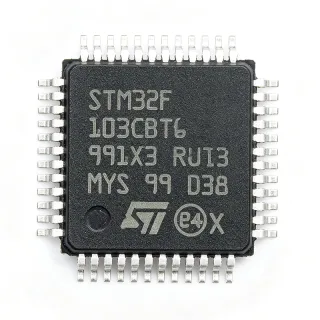
PIC16F1512-I/MV - 8-bit PIC MCU, 3.5KB Flash, 28-UQFN | Microchip
MPN: PIC16F1512-I/MV ✓ Active| Qty | Unit Price | Extended |
|---|---|---|
| 1 | $1.82 | $1.82 |
| 10 | $1.64 | $16.40 |
| 100 | $1.41 | $141.00 |
| 500 | $1.18 | $590.00 |
| 1,000 | $0.99 | $990.00 |
PIC16F1512-I/MV Overview
A microcontroller (MCU) is a single-chip computer that integrates a CPU core, program memory (Flash/ROM), data memory (RAM), and peripherals such as ADC, timers, communication interfaces, and I/O ports on one silicon die. The PIC16F151x family belongs to the hierarchy: microcontroller -> embedded MCU -> 8-bit MCU -> PIC mid-range core -> Microchip PIC16F family -> semiconductor. XLP technology positions this part for battery-powered and energy-harvesting designs where sleep-mode current and wake-up time directly determine battery life.
Key features include 17 I/O pins, one 10-bit ADC with multiple acquisition channels, multiple timers (Timer0, Timer1, Timer2), enhanced Universal Synchronous/Asynchronous Receiver/Transmitter (EUSART), and Master Synchronous Serial Port (MSSP) supporting SPI and I2C. The device includes configurable internal oscillator options, a wide operating voltage range (2.5V to 5.5V), and very low sleep current typical of nanoWatt XLP technology. The 28-UQFN package (4x4 mm) provides a compact footprint suited to space-constrained PCB designs, while the exposed pad (EP) improves thermal dissipation for higher clock-rate operation.
The PIC16F1512 utilizes Microchip's enhanced mid-range 8-bit RISC architecture with a hardware stack and single-cycle instruction execution at the system clock. Internal oscillator calibration, configurable digital I/O, and on-chip debug support via MPLAB tools simplify firmware development. The Flash memory supports self-programming, and the integrated ADC, EUSART, and MSSP peripherals address the most common embedded-sensing and connectivity tasks.
Typical applications include consumer appliances, IoT edge sensor nodes, battery-operated remote controls, low-power sensor interfaces, and automotive AEC-Q100 body and convenience sub-systems. The wide voltage tolerance and industrial temperature range also make it suitable for factory automation sensor endpoints.
When designing with this part, allocate PCB copper to the exposed thermal pad on the UQFN for reliable thermal performance, and place a 0.1uF decoupling capacitor close to VDD. Configure the oscillator mode (HFINTOSC, LFINTOSC, or external crystal) early in firmware to ensure timing accuracy for EUSART baud-rate generation.
This page consolidates datasheet specifications, real distributor pricing tiers, same-family PIC16F15xx drop-in alternatives, and practical PCB/firmware design notes that are not assembled in any single manufacturer document.
Drop-in alternatives for PIC16F1512-I/MV — same package, pin-to-pin compatible. Different-package parts requiring PCB rework are excluded.
Variants in this series
Same-series models that are drop-in compatible with PIC16F1512-I/MV (same form factor and footprint) — differing in ADC, Communication, Mounting Type, Operating Temperature, Package.
Quick Comparison Tool — Select alternative parts for side-by-side comparison:
PIC16F1513-I/MV
✅ Drop-In📋 Reference alternative (not in catalog)
PIC16F1514-I/MV
✅ Drop-In📋 Reference alternative (not in catalog)
PIC16F1516-I/MV
✅ Drop-In✓ In Stock
$1.69 / Unit
View Datasheet →PIC16F1518-I/MV
✅ Drop-In📋 Reference alternative (not in catalog)
PIC16F15214-I/MV
✅ Drop-In📋 Reference alternative (not in catalog)
PIC16F1512-I/MV Maximum Ratings & Electrical Characteristics
| Core | PIC16 8-bit Enhanced Mid-Range RISC |
| Program Memory | 3.5 KB Flash (2K x 14 words) |
| Data RAM | 128 bytes |
| Data EEPROM | 0 bytes |
| Maximum CPU Speed | 20 MHz |
| Operating Voltage Range | 2.5 V to 5.5 V |
| I/O Pins | 17 |
| ADC | 10-bit, multiple channels |
| Timers | Timer0, Timer1, Timer2 |
| Communication | EUSART, MSSP (SPI / I2C) |
| Low-Power Technology | nanoWatt XLP |
| Package | 28-UQFN EP (4x4 mm) |
| Mounting Type | Surface Mount |
| Operating Temperature | -40 C to +85 C (Industrial) |
| Temperature Grade Suffix | I = -40C to +85C |
| AEC-Q100 | Automotive grade family available (separate /VAO suffix variants) |
| RoHS Status | Compliant |
PIC16F1512-I/MV Pin Configuration
| Pin 1 | RA3/AN7/CCP1 — Bidirectional I/O, analog input, capture/compare/PWM |
| Pin 2 | RA4/T0CKI — Bidirectional I/O, Timer0 clock input |
| Pin 3 | RA5/AN4/SS — Bidirectional I/O, analog input, SPI slave select |
| Pin 4 | RA6/OSC2 — Bidirectional I/O, oscillator output |
| Pin 5 | RA7/OSC1 — Bidirectional I/O, oscillator input |
| Pin 6 | VSS — Ground reference |
| Pin 7 | RA0/AN0 — Bidirectional I/O, analog input |
| Pin 8 | RA1/AN1 — Bidirectional I/O, analog input |
| Pin 9 | RA2/AN2 — Bidirectional I/O, analog input |
| Pin 10 | RC0/SOSCO — Bidirectional I/O, secondary oscillator output |
| Pin 11 | RC1/SOSCI — Bidirectional I/O, secondary oscillator input |
| Pin 12 | RC2/AN6 — Bidirectional I/O, analog input |
| Pin 13 | RC3/AN8 — Bidirectional I/O, analog input |
| Pin 14 | RC4 — Bidirectional I/O |
| Pin 15 | RC5 — Bidirectional I/O |
| Pin 16 | RC6/AN9 — Bidirectional I/O, analog input |
| Pin 17 | RC7/AN10 — Bidirectional I/O, analog input |
| Pin 18 | RB0/AN12 — Bidirectional I/O, analog input |
| Pin 19 | RB1/AN10 — Bidirectional I/O, analog input |
| Pin 20 | RB2/AN8 — Bidirectional I/O, analog input |
| Pin 21 | RB3/AN9 — Bidirectional I/O, analog input |
| Pin 22 | RB4/AN11 — Bidirectional I/O, analog input |
| Pin 23 | RB5/AN13 — Bidirectional I/O, analog input |
| Pin 24 | RB6/ICSPCLK — Bidirectional I/O, in-circuit serial programming clock |
| Pin 25 | RB7/ICSPDAT — Bidirectional I/O, in-circuit serial programming data |
| Pin 26 | VDD — Positive supply voltage |
| Pin 27 | RE3/MCLR — Master clear reset input |
| Pin 28 | RA4 — Bidirectional I/O (alternate location) |
Typical Applications
PIC16F1512-I/MV is suitable for 6 applications: Low-Power IoT Sensor Nodes, Consumer Remote Controls, Industrial Sensor Endpoints, Automotive Body Electronics, Battery-Powered Toys and Gadgets, White Goods and Home Appliances.
Low-Power IoT Sensor Nodes
The PIC16F1512-I/MV suits battery-powered IoT sensor endpoints thanks to its nanoWatt XLP technology, nA-range sleep current, and 2.5V to 5.5V supply range covering 2xAA/2xAAA alkaline and CR2032 lithium chemistries. The 10-bit ADC multiplexes thermistor, humidity, or battery-voltage channels, while the EUSART links to a sub-GHz or BLE module for periodic telemetry. The 28-UQFN EP (4x4 mm) drops into compact coin-cell sensor PCBs without forcing a larger MCU footprint.
Recommended
Consumer Remote Controls
IR/RF remote controls benefit from the PIC16F1512's XLP sleep current (nA range) and fast wake from Timer1 interrupt to minimize standby drain across years of shelf life. The EUSART handles the IR or RF transmitter modulation, while 17 I/O pins drive key-scan matrices and LED indicators. Operating from 2.5V to 5.5V lets the same firmware target both 3V CR2032 and 4.5V (3xAAA) battery packs.
Recommended
Industrial Sensor Endpoints
Factory-automation sensor endpoints leverage the PIC16F1512's industrial -40C to +85C rating and 5V tolerance for direct 24V-bus-derived rails. The 10-bit ADC reads 4-20 mA loop interfaces or thermistor/PTC inputs, while MSSP (SPI/I2C) interfaces to EEPROM for calibration data and to digital temperature/humidity sensors. The 28-UQFN EP footprint allows dense multi-channel sensor PCBs inside M12 or M8 industrial housings.
Recommended
Automotive Body Electronics
Automotive body and convenience sub-systems use the AEC-Q100-qualified members of the PIC16F1512 family for seat controllers, ambient lighting drivers, and HVAC blend-door actuators. The industrial -I grade variant PIC16F1512-I/MV covers non-safety cabin modules where AEC-Q100 is not strictly required, while the same firmware migrates to /VAO-suffix AEC-Q100 parts with no source changes. The 10-bit ADC and PWM outputs handle motor-speed sensing and LED current monitoring.
Recommended
Battery-Powered Toys and Gadgets
Cost-sensitive consumer toys and gadgets adopt the PIC16F1512-I/MV because of its sub-$1.00 price at 1000 pieces, compact UQFN footprint, and integrated peripherals (ADC, EUSART, MSSP) that eliminate external driver ICs. Sound playback, motor PWM, LED animation, and IR control all fit within 3.5 KB Flash using optimized MPLAB XC8 PRO code. The wide 2.5V to 5.5V supply supports both alkaline and NiMH battery packs.
Recommended
White Goods and Home Appliances
Washing machines, dishwashers, and small kitchen appliances use the PIC16F1512-I/MV for user-interface board controllers where the 17 I/O pins drive 7-segment or matrix displays, button inputs, and buzzer drivers. The integrated EUSART links to the main appliance MCU, while the MSSP interfaces to EEPROM for storing user settings and error logs. The -40C to +85C industrial range survives appliance under-cabinet thermal conditions.
Recommended
Recommended Products Summary
Engineering reference data for PIC16F1512-I/MV — comparison, design guidance, and compliance information.
Selection Guide
Comparison with Alternatives
| Parameter | This Product | PIC16F1513-I/MV | PIC16F1514-I/MV | PIC16F1516-I/MV | PIC16F1518-I/MV | PIC16F15214-I/MV |
|---|---|---|---|---|---|---|
| Package | 28-UQFN EP (4x4 mm) | 28-UQFN EP (4x4 mm) - same | 28-UQFN EP (4x4 mm) - same | 28-UQFN EP (4x4 mm) - same | 28-UQFN EP (4x4 mm) - same | 28-UQFN EP (4x4 mm) - same |
| Brand | Microchip Technology | Microchip Technology | Microchip Technology | Microchip Technology | Microchip Technology | Microchip Technology |
| Flash Memory | 3.5 KB | 4 KB | 7 KB | 7 KB | 14 KB | 14 KB |
| Data RAM | 128 bytes | 256 bytes | 256 bytes | 512 bytes | 512 bytes | 512 bytes |
| Maximum CPU Speed | 20 MHz | 20 MHz | 20 MHz | 20 MHz | 20 MHz | 32 MHz |
| Operating Voltage | 2.5V to 5.5V | 2.5V to 5.5V | 2.5V to 5.5V | 2.5V to 5.5V | 2.5V to 5.5V | 2.5V to 5.5V |
| ADC Resolution | 10-bit | 10-bit | 10-bit | 10-bit | 10-bit | 10-bit |
| AEC-Q100 Available | Family only (separate /VAO variant) | Family only | Family only | Family only | Family only | Family only |
Key Differentiators
- Lowest-cost entry into the PIC16F151x family in 28-UQFN EP (vs PIC16F1513-I/MV)
- Single-voltage industrial range with nanoWatt XLP (vs PIC16F1514-I/MV)
- Industrial temperature grade with EUSART and MSSP peripherals (vs PIC16F15214-I/MV)
Design Notes
The PIC16F1512-I/MV supports 2.5V to 5.5V supply; place a 0.1uF ceramic decoupling capacitor within 2 mm of the VDD pin and a bulk 1uF to 10uF capacitor on the same node. For battery-powered XLP designs, route the secondary 32 kHz crystal on SOSCO/SOSCI (RC0/RC1) and switch the main CPU to LFINTOSC between Timer1 wake-ups to minimize active current.
Solder the exposed thermal pad (EP) of the 28-UQFN to a copper pour connected to VSS; this is mandatory for mechanical reliability because the EP carries most of the solder-joint strength and improves thermal dissipation. Per IPC-7351 nominal land-pattern dimensions, leave at least 0.2 mm clearance between EP copper and adjacent signal traces.
Do not leave the MCLR pin floating when not used as a reset input; tie it through a 10 kohm pull-up to VDD, or configure the configuration bit MCLRE = OFF and use as a digital I/O only. Floating MCLR is a common source of spurious resets during ESD or brownout events. Always select the LFINTOSC and HFINTOSC tuning bits via the OSCCON register before assuming UART baud-rate accuracy.
Compliance Information
RoHS and REACH compliant per Microchip product page. The -I/MV suffix denotes industrial temperature grade (-40C to +85C); AEC-Q100 automotive-grade parts are separate /VAO variants not covered by this exact MPN.