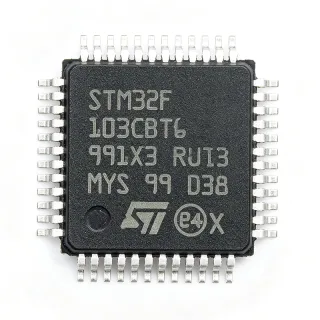
PIC16F15225-I/SL - 14KB Flash 8-bit MCU 32MHz | Microchip
MPN: PIC16F15225-I/SL ✓ Active| Qty | Unit Price | Extended |
|---|---|---|
| 1 | $0.9 | $0.90 |
| 10 | $0.81 | $8.10 |
| 100 | $0.7485 | $74.85 |
| 500 | $0.67 | $335.00 |
| 1,000 | $0.6 | $600.00 |
PIC16F15225-I/SL Overview
An 8-bit microcontroller (MCU) is a single-chip computer that integrates a CPU, non-volatile program memory (typically Flash), volatile data RAM, and a set of on-chip peripherals around an 8-bit data path. PIC microcontrollers use a RISC-style Harvard architecture and are the dominant 8-bit platform for cost-sensitive embedded control, sitting at the bottom of the MCU hierarchy: MCU -> 8-bit MCU -> PIC -> PIC16 family -> PIC16F152xx sub-family. Core Independent Peripherals (CIPs) offload tasks such as waveform generation and signal conditioning from the CPU, enabling deterministic real-time behavior without software intervention.
Key features of the PIC16F15225 include a 10-bit ADC with computation, two PWM modules, two Capture/Compare/PWM (CCP) peripherals, Peripheral Pin Select (PPS) for flexible I/O mapping, hardware EUSART plus SPI and I2C communication, a Windowed Watchdog Timer (WWDT), and eXtreme Low-Power (XLP) Sleep mode. PPS allows designers to remap digital peripherals to most I/O pins, simplifying PCB layout. The XLP Sleep mode supports battery-powered applications with nanoampere quiescent currents.
Typical applications include sensor node interfaces, low-cost motor control, LED lighting controllers, battery-powered IoT endpoints, and home appliances. Industrial-grade -40C to +85C operation allows use in uncontrolled-temperature environments.
When designing with this MCU, ensure that the on-chip debug and programming pins (ICSPCLK/ICSPDAT) are accessible for in-circuit serial programming, and place a 100 nF decoupling capacitor as close as possible to the VDD pin. PPS should be configured early in firmware to avoid peripheral pin mapping conflicts.
Drop-in alternatives for PIC16F15225-I/SL — same package, pin-to-pin compatible. Different-package parts requiring PCB rework are excluded.
Variants in this series
Same-series models that are drop-in compatible with PIC16F15225-I/SL (same form factor and footprint) — differing in ADC, Operating Temperature, Package, Program Memory (Flash), Core.
Quick Comparison Tool — Select alternative parts for side-by-side comparison:
PIC16F15225-E/SL
✅ Drop-In✓ In Stock
$0.79 / Unit
View Datasheet →PIC16F15224-I/SL
✅ Drop-In📋 Reference alternative (not in catalog)
PIC16F15223-I/SL
✅ Drop-In✓ In Stock
$0.53 / Unit
View Datasheet →PIC16F15245-I/SL
✅ Drop-In ⚠️ 参数待验证📋 Reference alternative (not in catalog)
PIC16F15224-E/SL
✅ Drop-In✓ In Stock
$0.52 / Unit
View Datasheet →PIC16F15225-I/SL Maximum Ratings & Electrical Characteristics
| Core | PIC16 8-bit RISC |
| CPU Speed | 32 MHz (max) |
| Program Memory (Flash) | 14 KB (8K x 14 words) |
| Data RAM | 1 KB |
| Operating Voltage (VDD) | 1.8 V to 5.5 V |
| Operating Temperature | -40C to +85C (Industrial, "I") |
| ADC | 10-bit, with computation |
| PWM Modules | 2 |
| CCP Modules | 2 |
| Communication Peripherals | EUSART, SPI, I2C |
| Watchdog Timer | WWDT (Windowed) |
| Peripheral Pin Select (PPS) | Yes |
| Low-Power Mode | XLP Sleep mode |
| Package | 14-pin SOIC (SL), narrow body |
| Mounting Type | Surface Mount |
| RoHS Status | Compliant |
| MSL Level | 1 |
PIC16F15225-I/SL Pin Configuration
| Pin 1 | VDD — Positive supply voltage (1.8 V to 5.5 V) |
| Pin 2 | RA5 — Port A bit 5 (I/O, PPS-mappable) |
| Pin 3 | RA4 — Port A bit 4 (I/O, PPS-mappable) |
| Pin 4 | RA3/MCLR — Port A bit 3 / Master Clear (reset) input |
| Pin 5 | RC5 — Port C bit 5 (I/O, PPS-mappable) |
| Pin 6 | RC4 — Port C bit 4 (I/O, PPS-mappable) |
| Pin 7 | RC3 — Port C bit 3 (I/O, PPS-mappable) |
| Pin 8 | RC2 — Port C bit 2 (I/O, PPS-mappable) |
| Pin 9 | RC1 — Port C bit 1 (I/O, PPS-mappable) |
| Pin 10 | RC0 — Port C bit 0 (I/O, PPS-mappable) |
| Pin 11 | RA2 — Port A bit 2 (I/O, PPS-mappable) |
| Pin 12 | RA1/ICSPCLK — Port A bit 1 / In-Circuit Serial Programming clock |
| Pin 13 | RA0/ICSPDAT — Port A bit 0 / In-Circuit Serial Programming data |
| Pin 14 | VSS — Ground reference |
Typical Applications
PIC16F15225-I/SL is suitable for 6 applications: Battery-Powered IoT Sensor Nodes, LED Lighting Controllers, Low-Cost BLDC/PWM Motor Control, Home Appliance Control Panels, Industrial Sensor Transmitters, Consumer Electronics Remote Controls.
Battery-Powered IoT Sensor Nodes
The PIC16F15225-I/SL's eXtreme Low-Power (XLP) Sleep mode and 1.8 V minimum VDD make it ideal for battery-powered IoT sensor nodes that must run for years on a single coin cell. Its 14 KB Flash fits lightweight protocol stacks (BLE HID, sub-GHz proprietary, LoRaWAN device drivers), and the 10-bit ADC with computation offloads sensor averaging from the CPU. The PPS peripheral pin select allows the I2C sensor bus and SPI radio to be routed to convenient package pins, simplifying PCB layout in space-constrained nodes.
Recommended
LED Lighting Controllers
The PIC16F15225-I/SL drives LED lighting systems through its two PWM modules and two CCP peripherals, supporting multi-channel dimming and color-mixing control. The 32 MHz CPU enables smooth PWM resolution for flicker-free dimming below 1% duty cycle, while the 14 KB Flash accommodates DMX, DALI, or proprietary lighting protocol stacks. PPS allows the PWM outputs to be routed to any available I/O, simplifying PCB layout in strip-light controllers and architectural fixtures.
Recommended
Low-Cost BLDC/PWM Motor Control
The PIC16F15225-I/SL's two PWM channels and two CCP peripherals, combined with the 32 MHz CPU and 10-bit ADC, are well-matched to low-cost BLDC, brushed DC, and stepper motor control applications. Hardware PWM generation offloads switching from the CPU, freeing cycles for speed control loops. The ADC-with-computation feature provides automated current sensing and threshold detection, while XLP Sleep reduces standby drain when the motor is idle.
Recommended
Home Appliance Control Panels
In washing machines, dishwashers, and small kitchen appliances, the PIC16F15225-I/SL provides user-interface control (buttons, encoders, LED indicators, segment LCD drives) and supervisory control of motor and heater subsystems. The EUSART plus SPI and I2C allow connection to sensor modules and display drivers, while the 10-bit ADC reads thermistor inputs for temperature regulation. The -40C to +85C industrial temperature grade handles appliance environments without derating.
Recommended
Industrial Sensor Transmitters
The PIC16F15225-I/SL serves as the controller in 4-20 mA loop-powered or RS-485 industrial sensor transmitters. Its EUSART supports Modbus RTU on RS-485, the 10-bit ADC reads bridge sensors, thermocouples, or 4-20 mA loop inputs, and XLP Sleep minimizes quiescent current in loop-powered designs. The industrial -40C to +85C grade ensures operation in cabinets and field enclosures without additional thermal conditioning.
Recommended
Consumer Electronics Remote Controls
The PIC16F15225-I/SL is well-suited for IR/RF remote controls and other consumer HMI devices. Its low Sleep current extends battery life across months of standby, the 14 KB Flash fits IR protocol libraries (RC5, NEC, SIRC) or BLE HID stacks, and the ADC with computation reads capacitive touch or battery voltage. PPS simplifies PCB routing when board space forces irregular pin placement of the IR LED and buttons.
Recommended
Recommended Products Summary
Engineering reference data for PIC16F15225-I/SL — comparison, design guidance, and compliance information.
Selection Guide
Comparison with Alternatives
| Parameter | This Product | PIC16F15225-E/SL | PIC16F15224-I/SL | PIC16F15223-I/SL | PIC16F15245-I/SL | PIC16F15224-E/SL |
|---|---|---|---|---|---|---|
| Package | 14-pin SOIC (SL) | 14-pin SOIC (SL) - same | 14-pin SOIC (SL) - same | 14-pin SOIC (SL) - same | 14-pin SOIC (SL) - same | 14-pin SOIC (SL) - same |
| Brand | Microchip Technology | Microchip Technology | Microchip Technology | Microchip Technology | Microchip Technology | Microchip Technology |
| Program Memory (Flash) | 14 KB | 14 KB | 7 KB (-50%) | 3.5 KB (-75%) | 28 KB (+100%) | 7 KB (-50%) |
| Data RAM | 1 KB | 1 KB | 512 B (-50%) | 256 B (-75%) | 2 KB (+100%) | 512 B (-50%) |
| CPU Speed | 32 MHz | 32 MHz | 32 MHz | 32 MHz | 32 MHz | 32 MHz |
| Operating Temperature | -40C to +85C (I grade) | -40C to +125C (E grade) | -40C to +85C | -40C to +85C | -40C to +85C | -40C to +125C |
| Operating Voltage | 1.8 V to 5.5 V | 1.8 V to 5.5 V | 1.8 V to 5.5 V | 1.8 V to 5.5 V | 1.8 V to 5.5 V | 1.8 V to 5.5 V |
| PWM Modules | 2 | 2 | 2 | 2 | 2 | 2 |
| CCP Modules | 2 | 2 | 2 | 2 | 2 | 2 |
| ADC Resolution | 10-bit | 10-bit | 10-bit | 10-bit | 10-bit | 10-bit |
Key Differentiators
- Larger memory within the same SOIC-14 footprint (vs PIC16F15224-I/SL)
- Industrial temperature grade suited for industrial and consumer environments (vs PIC16F15225-E/SL)
- 10-bit ADC with computation offloads CPU (vs PIC16F15213-E/P)
Design Notes
Place a 100 nF decoupling capacitor as close as possible to the VDD pin (pin 1) and a bulk capacitor (1-10 uF) at the board power entry. For battery-powered designs, leverage XLP Sleep mode with the on-chip LFINTOSC and disable unused peripherals via PMDx registers to minimize quiescent current into the nanoampere range.
Route the ICSP clock (RA1/ICSPCLK, pin 12) and ICSP data (RA0/ICSPDAT, pin 13) to an in-circuit programming header without intervening series components. Keep traces short and away from high-current switching nodes. Maintain a ground plane under the MCU to reduce EMI susceptibility, and avoid running analog signals (ADC inputs) parallel to switching traces for more than a few millimeters.
Configure Peripheral Pin Select (PPS) early in firmware before enabling peripherals; an unmapped peripheral will not drive any pin. Do not leave the MCLR pin (pin 4) floating - tie it to VDD through a 10 kohm resistor for normal operation, or directly to VDD if unused. Always program configuration bits for oscillator selection and watchdog timer before the first code execution.
Compliance Information
RoHS compliant per Microchip product page. Industrial temperature grade -40C to +85C; not AEC-Q100 qualified - for automotive applications, evaluate the PIC16F15225-E/SL or contact Microchip for automotive-grade variants.